







Question: Consider an incoherent source radiating with spatial intensity distribution (I(xi, eta)). (a) Using the Van Cittert-Zernike theorem, show that the coherence area of the light
Consider an incoherent source radiating with spatial intensity distribution \(I(\xi, \eta)\).
(a) Using the Van Cittert-Zernike theorem, show that the coherence area of the light (mean wavelength \(\bar{\lambda}\) ) at distance \(z\) from the source can be expressed as
\[ A_{c}=(\bar{\lambda} z)^{2} \frac{\iint_{-\infty}^{\infty} I^{2}(\xi, \eta) d \xi d \eta}{\left[\iint_{-\infty}^{\infty} I(\xi, \eta) d \xi d \eta\right]^{2}} \]
(b) Show that if an incoherent source has an intensity distribution describable as
\[ I(\xi, \eta)=I_{0} P(\xi, \eta) \]
where \(P(\xi, \eta)\) is a function with values 1 or 0 , then
\[ A_{c}=\frac{(\bar{\lambda} z)^{2}}{A_{s}} \]
where \(A_{s}\) is the area of the source.
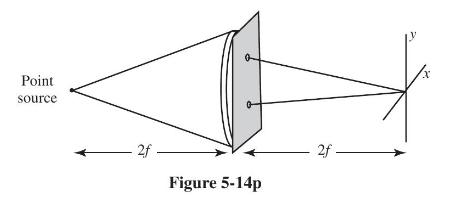
Point source 0 -2f. Figure 5-14p 2f-
Step by Step Solution
3.31 Rating (163 Votes )
There are 3 Steps involved in it
a Coherence Area using Van CittertZernike Theorem Let there be an incoherent light source with inten... View full answer

Get step-by-step solutions from verified subject matter experts
 Study Help