







Question: The data from problem 7-17 are used in this problem to make calculations in part a. All inventory items valued at more than ($700) are
The data from problem 7-17 are used in this problem to make calculations in part a. All inventory items valued at more than \($700\) are considered a part of stratum 1. All those valued at \($700\) or less are considered a part of stratum 2, which includes 640 population items with a recorded value of \($170,000\). Even though only 20 items in total are used to simplify the problem, compute sampling results as indicated.
Required :
a. Calculate each of the following. (Where a blank should not be completed because it is inappropriate to do so, indicate by NA.)
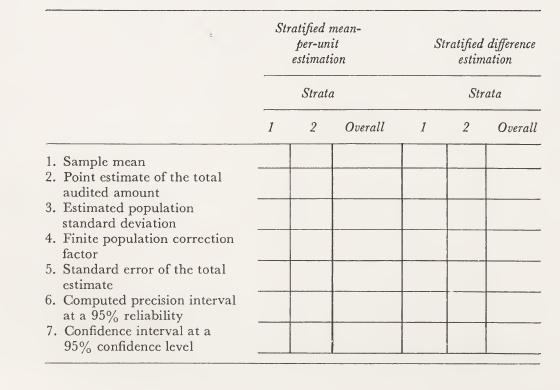
b. Compare the stratified mean-per-unit results to the unstratified mean-per- unit results in problem 7-17. Explain why the overall point estimate is similar in size and the precision interval is so different.
c. Compare the stratified difference results to the unstratified difference results in problem 7-17. Explain why there is so little difference in the point estimate and precision interval.
Problem 7-17:
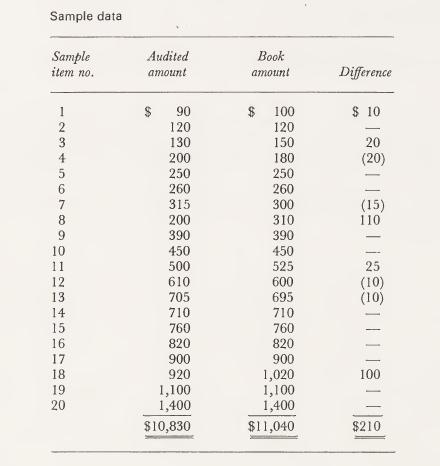
The following is a set of sample and related data taken from a population of 1,000 items that have a recorded book value of \($498,000\). Even though only 20 items are used to simplify the problem, compute the sampling results as indicated.
1. Sample mean 2. Point estimate of the total audited amount 3. Estimated population standard deviation 4. Finite population correction factor 5. Standard error of the total estimate 6. Computed precision interval at a 95% reliability 7. Confidence interval at a 95% confidence level Stratified mean- per-unit estimation Stratified difference estimation Strata Strata 1 2 Overall 1 2 Overall
Step by Step Solution
There are 3 Steps involved in it

Get step-by-step solutions from verified subject matter experts
 Study Help