







Question: 12.16 How does flextime, which allows workers to set their individual work schedules, affect worker job satisfaction? Researchers recently conducted a study to compare a
12.16 How does flextime, which allows workers to set their individual work schedules, affect worker job satisfaction? Researchers recently conducted a study to compare a measure of job satisfaction for workers, using three types of work scheduling:
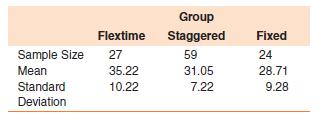
flextime, staggered starting hours, and fixed hours. Workers in each group worked according to their specified work-scheduling system for four months. Although each worker filled out job satisfaction questionnaires both before and after the four-month test period, we will examine only the post–test-period scores. The sample sizes, means, and standard deviations of the scores for the three groups are shown in the table below:
a Assume that the data were collected according to a completely randomized design. Use the information in the table to calculate the treatment totals and SST.
b Use the values of the sample standard deviation to calculate the sum of squares of deviations within each of the three samples.Then calculate SSE, the sum of these quantities.
c Construct an analysis of variance table for the data.
d Do the data provide sufficient evidence to indicate differences in mean job satisfaction scores among the three groups? Test by using = 0.05.
e Find a 90% confidence interval for the difference in mean job satisfaction scores between workers on flextime and workers on fixed schedules.
f Do the data provide sufficient evidence to indicate a difference in mean scores between workers on flextime and workers using staggered starting hours? Test by using = 0.05.
Flextime Group Staggered Fixed Sample Size 27 59 24 Mean 35.22 31.05 28.71 Standard 10.22 7.22 9.28 Deviation
Step by Step Solution
There are 3 Steps involved in it

Get step-by-step solutions from verified subject matter experts
 Study Help