







Question: The skewed normal distribution defines a skewed continuous random variable. Let m,s denote a normal p.d.f. with moments (m, s) and let (z) denote a
The skewed normal distribution defines a skewed continuous random variable. Let ϕm,s denote a normal p.d.f. with moments (m, s) and let Φ(z) denote a standard normal c.d.f. The skewed normal can be defined by its p.d.f.,

For α > 0 (α SN(µ, σ, α) for a skewed normal random variable X. For the following questions use the data set stockreturns.txt9 of (simulated) stock returns. We assume the sampling model
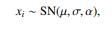
i = 1, . . . , n, i.i.d., and complete the model with a conditionally conjugate prior on µ, σ and a gamma prior on α:

with fixed hyperparameters κ,
c, d, µ0,
a, and σ
2 0 .
a. Let γ = 1/σ2 . For fixed α suggest an importance sampling strategy to estimate posterior means (conditional on α). Let p(µ, γ) denote the importance sampling density, and let w denote the importance sampling weights. Propose a choice for p(·), and find a bound M such that w ≤ M.
b. Claim

where the expectation is with respect to a t-distributed random variable W. Show the claim, and then use the result to find the marginal posterior mode of α over a grid α ∈ {1, 1.1, 1.2, 1.3, 1.4, 1.5}.
f(x),, ) (3) xx(x) (ax). 0
Step by Step Solution
There are 3 Steps involved in it

Get step-by-step solutions from verified subject matter experts
 Study Help