







Question: In the Chapter Preview we described a study showing that students had more academic problems following nights with less than average sleep compared to nights
In the Chapter Preview we described a study showing that students had more academic problems following nights with less than average sleep compared to nights with more than average sleep
(Gillen-O’Neel, Huynh, & Fuligni, 2013). Suppose a researcher is attempting to replicate this study using a sample of n = 8 college freshmen. Each student records the amount of study time and amount of sleep each night and reports the number of academic problems each day. The following data show the results from the study.
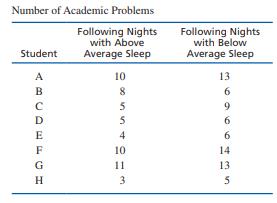
a. Treat the data as if the scores are from an independent-measures study using two separate samples, each with n = 8 participants. Compute the pooled variance, the estimated standard error for the mean difference, and the independent-measures t statistic. Using a two-tailed test with α = .05, is there a significant difference between the two sets of scores?
b. Now assume that the data are from a repeatedmeasures study using the same sample of n = 8 participants in both treatment conditions. Compute the variance for the sample of difference scores, the estimated standard error for the mean difference and the repeated-measures t statistic. Using a two-tailed test with α = .05, is there a significant difference between the two sets of scores? (You should find that the repeated-measures design substantially reduces the variance and increases the likelihood of rejecting H0 .)
Number of Academic Problems Following Nights with Above Following Nights Student Average Sleep 10 8 with Below Average Sleep 13 6 ABCDEFGH 5 9 5 6 4 6 14 13 10 11 3 5
Step by Step Solution
There are 3 Steps involved in it

Get step-by-step solutions from verified subject matter experts
 Study Help