







Question: For our model presented in Example 2, test the hypotheses where (beta_{1}) is the slope coefficient for the explanatory variable age, and (beta_{2}) is the
For our model presented in Example 2, test the hypotheses
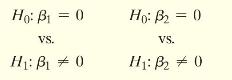
where \(\beta_{1}\) is the slope coefficient for the explanatory variable age, and \(\beta_{2}\) is the slope coefficient for the explanatory variable saturated fat.
Approach We will use Minitab to determine the \(P\)-values for each explanatory variable. If the \(P\)-value is less than the level of significance, we reject the null hypothesis and conclude that the slope coefficient is different from zero.
Data from Example 2
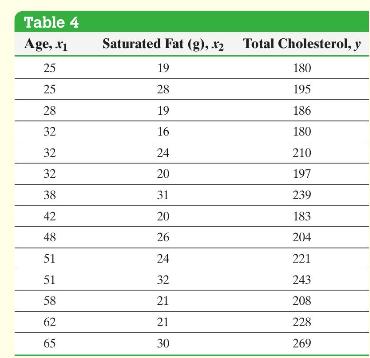
Use the data in Table 4.
Find the least-squares regression equation \(\hat{y}=b_{0}+b_{1} x_{1}+b_{2} x_{2}\), where \(x_{1}\) represents the patient's age, \(x_{2}\) represents the patient's daily consumption of saturated fat, and \(y\) represents the patient's total cholesterol.
Draw residual plots and a boxplot of the residuals to assess the adequacy of the model.
Enter the data into Minitab to obtain the least-squares regression equation and to draw the residual plots and boxplot of the residuals. The steps for determining the multiple regression equation and residual plots using Minitab, Excel, and StatCrunch are given in the Technology Step-by-Step.
Ho: B = 0 VS. H: B0 Ho: B = 0 VS. H: B 0
Step by Step Solution
3.45 Rating (155 Votes )
There are 3 Steps involved in it
Looking again to the output in Figure 15 we see that the test statistic for the explana... View full answer

Get step-by-step solutions from verified subject matter experts
 Study Help