



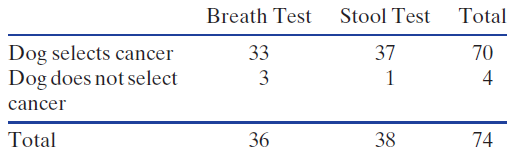
Question: Exercise 2.17 on page 55 describes a study in which scientists train dogs to smell cancer. Researchers collected breath and stool samples from patients with
Table 3.14
Exercise 2.17
Scientists are working to train dogs to smell cancer, including early stage cancer that might not be detected with other means. In previous studies, dogs have been able to distinguish the smell of bladder cancer, lung cancer, and breast cancer. Now, it appears that a dog in Japan has been trained to smell bowel cancer. Researchers collected breath and stool samples from patients with bowel cancer as well as from healthy people. The dog was given five samples in each test, one from a patient with cancer and four from healthy volunteers. The dog correctly selected the cancer sample in 33 out of 36 breath tests and in 37 out of 38 stool tests.
Breath Test Stool Test Total Dog selects cancer Dog does not select 70 33 37 3 4 cancer Total 74 36 38 4.
Step by Step Solution
3.28 Rating (166 Votes )
There are 3 Steps involved in it
The dog got p B 3336 0917 or 917 of the breath samples correct and p S 3738 0974 or 974 of the st... View full answer

Get step-by-step solutions from verified subject matter experts