







Question: Asia contains a complex array of active fault types. As shown in Fig. G-30, for example, there is amajor system of thrust faults in the
Asia contains a complex array of active fault types. As shown in Fig. G-30, for example, there is amajor system of thrust faults in the Himalaya (Himalayan Frontal Thrust), major left-lateral strike-slip faults in China (e.g., Kunlun and Altyn Tagh Faults), major right-lateral strike-slip faults in Central Asia (e.g., Talasso-Fergana Fault) and also in Indochina (e.g., Red River Fault), and normal fault systems in Siberia (Baikal Rift System) and also in China (Shansi Graben System). Obviously, no single stress ellipsoid orientation can account for this tectonic nightmare, yet all of these faults probably owe their existence to the collision and continued compression between India and Asia, which began in the Eocene (Molnar & Tapponnier, 1975).
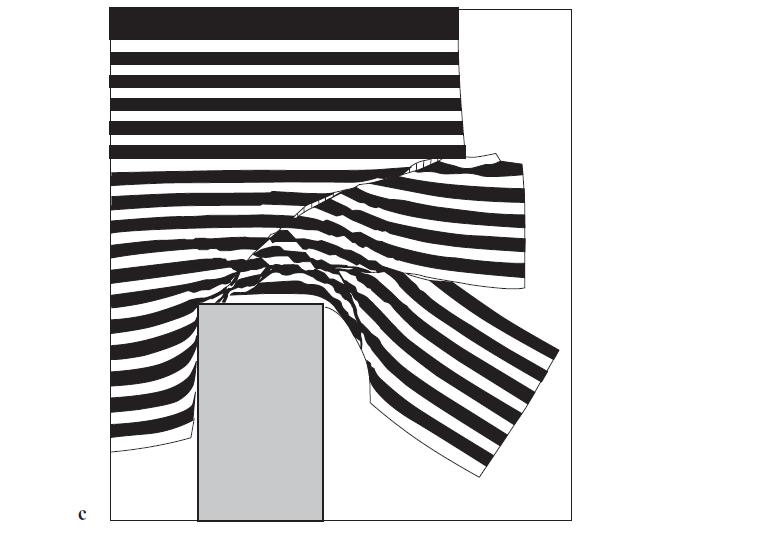
The India–Asia collision has been experimentally reconstructed with plasticene, producing insightful results (Tapponnier et al., 1982). Figure G-31 shows drawings made from photographs taken during one of the plasticene experiments. The upper and lower surfaces of the plasticene were confined between two plates, preventing the development of dip-slip faults, but in spite of this limitation there is a remarkable similarity between the features in Fig. G- 31c and the fault map of Asia (Fig. G-30).
1. On the basis of fault type and orientation, on Fig. G-30 draw the orientations of the two horizontal principal stresses acting on each of the seven faults listed below. (Refer to Fig. 10.4 for help with this.)
(a) Himalayan Frontal Thrust.
(b) Quetta-Chaman Fault.
(c) Talasso-Fergana Fault.
(d) Altyn Tagh Fault.
(e) Baikal Rift System.
(f) Shansi Graben System.
(g) Kang Ting Fault.
2. Place a sheet of tracing paper over the three drawings of Fig. G-31. On Fig. G-31c locate the faults that correspond to the seven faults listed above. Draw these faults on the overlay, and transfer the stress orientations from Fig. G-30.
3. On the overlays of Fig. G-31a and b, draw the major faults and indicate the orientation of the horizontal principal stresses along each of these.
4. In one succinct paragraph describe the evolution of regional stresses during the India–Asia collision. Use the space provided on Fig. G-30.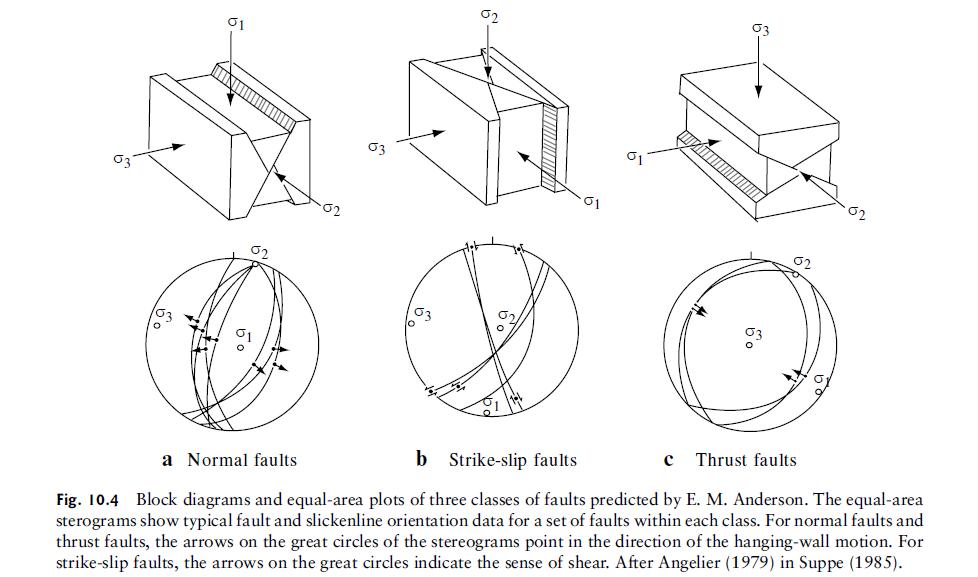 Fig. G-30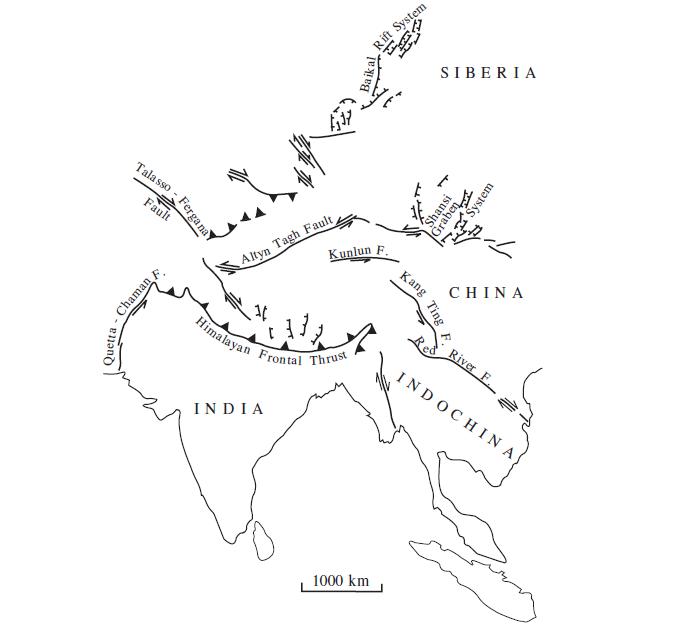
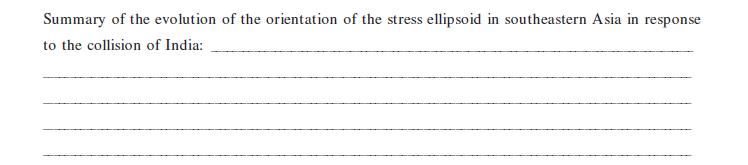
Fig. G-31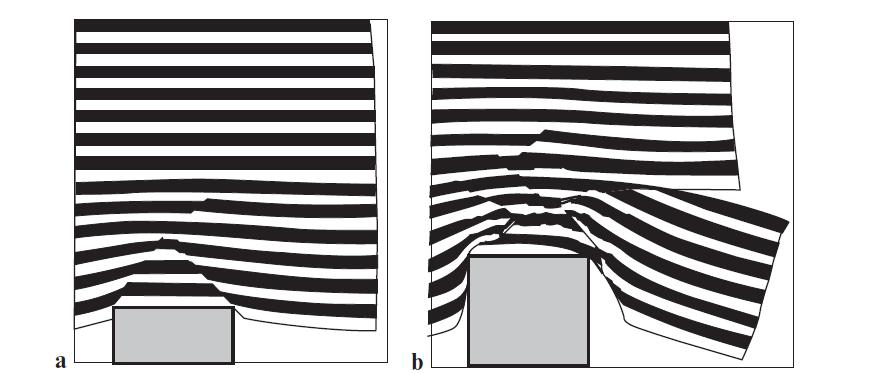
03 01 02 02 a Normal faults b Strike-slip faults Fig. 10.4 Block diagrams and equal-area plots of three classes of faults predicted by E. M. Anderson. The equal-area sterograms show typical fault and slickenline orientation data for a set of faults within each class. For normal faults and thrust faults, the arrows on the great circles of the stereograms point in the direction of the hanging-wall motion. For strike-slip faults, the arrows on the great circles indicate the sense of shear. After Angelier (1979) in Suppe (1985). Thrust faults
Step by Step Solution
3.55 Rating (155 Votes )
There are 3 Steps involved in it

Get step-by-step solutions from verified subject matter experts
 Study Help