







Question: The following table shows data from a dehumidification process using aqueous solution of lithium chloride ( (mathrm{LiCl}) ) in a packed tower. The desiccant leaving
The following table shows data from a dehumidification process using aqueous solution of lithium chloride ( \(\mathrm{LiCl}\) ) in a packed tower. The desiccant leaving the dehumidifier is passed through another packed tower for regeneration. For the regeneration process, it is known that the rate of evaporation of water as a function of the concentration \(X\left(\mathrm{~kg}_{\text {LicL }} / \mathrm{kg}_{\text {sol }}\right)\) and temperature \(T\left({ }^{\circ} \mathrm{C}\right)\) of the desiccant is given by the following equation:
\[ m_{\text {evap }}=\left(a_{0}+a_{1} T+a_{2} T^{2}\right)+\left(b_{0}+b_{1} T+b_{2} T^{2}\right) X+\left(c_{0}+c_{1} T+c_{2} T^{2}\right) X^{2}(\mathrm{~g} / \mathrm{s}) \]
where
\[ \begin{aligned} & a_{0}=285077, \quad b_{0}=-1658652, \quad c_{0}=2412282 \\ & a_{1}=-8992, \quad b_{1}=52326, \quad c_{1}=-76112, \text { and } \\ & a_{2}=70.88, \quad b_{2}=-412, \quad c_{2}=600 \end{aligned} \]
Find the temperature to which a flat-plate collector must raise the temperature of the desiccant for the regeneration process. Assume that the flow rate of liquid desiccant in both processes (dehumidification, regeneration) is the same.
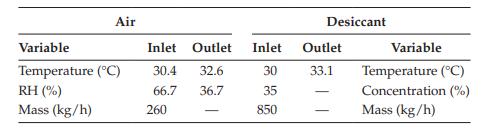
Air Desiccant Variable Inlet Outlet Inlet Outlet Variable Temperature (C) 30.4 32.6 30 33.1 Temperature (C) RH (%) 66.7 36.7 35 Mass (kg/h) 260 850 - Concentration (%) Mass (kg/h)
Step by Step Solution
3.42 Rating (152 Votes )
There are 3 Steps involved in it

Get step-by-step solutions from verified subject matter experts
 Study Help