







Question: a. In Experiment 4A, set the sample frequency to 50 msec and measure the phase margin. b. Compare this with the phase margin with a
a. In Experiment 4A, set the sample frequency to 50 msec and measure the phase margin.
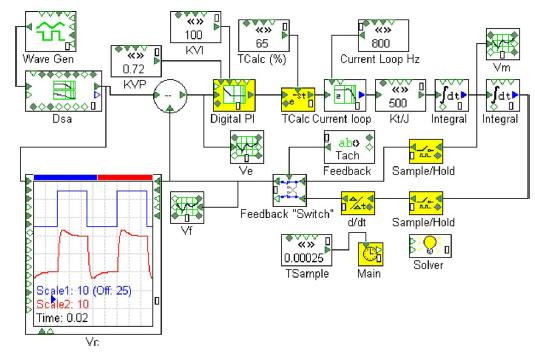
b. Compare this with the phase margin with a 1-msec sample time (same as Question 1c).
(DATA FROM QUETION 1C)
c. Repeat with a sample time of 0.001 sec.
c. Assume that a 50-msec sample time in Experiment 4A is short enough to ignore.
What is the measured phase lag due to digital delay when the sample time is 1 msec?
d. When the sample time is 1 msec, calculate the phase lag due to sample-and-hold.
e. When the sample time is 1 msec, calculate the phase lag due to velocity estimation.
f. When the sample time is 1 msec, calculate the phase lag due to a calculation delay of 65% of one sample time, which is the default setting in Experiment 4A.
g. Compare the total measured phase lag (Question 2c) to the three calculated components of phase lag (Questions 2de2f).
(DATA FROM QUESTION 2CDEF)
c. Assume that a 50-msec sample time in Experiment 4A is short enough to ignore.
What is the measured phase lag due to digital delay when the sample time is 1 msec?
d. When the sample time is 1 msec, calculate the phase lag due to sample-and-hold.
e. When the sample time is 1 msec, calculate the phase lag due to velocity estimation.
f. When the sample time is 1 msec, calculate the phase lag due to a calculation delay of 65% of one sample time, which is the default setting in Experiment 4A.
100 < > 65 KVI Wave Gen TCalc (%) 0.72 KVP Dsa Scale1: 10 (Off: 25) Scale2: 10 Time: 0.02 AA Vc 5 800 Current Loop Hz Vm 100 500 0 Digital Pl TCalc Current loop Kt/J Integral Integral abo Tach AUL Ve Feedback Sample/Hold Ate Feedback "Switch" d/dt Sample/Hold 0.00025 Solver TSample Main
Step by Step Solution
3.37 Rating (141 Votes )
There are 3 Steps involved in it

Get step-by-step solutions from verified subject matter experts
 Study Help