







Question: Solve the same problem as in example 2.1 using (tilde{u}(x)=c_{0}+c_{1} x+c_{2} x^{3}). Data From Example 2.1: Calculate the approximate solution of eq. (2.1) using the
Solve the same problem as in example 2.1 using \(\tilde{u}(x)=c_{0}+c_{1} x+c_{2} x^{3}\).
Data From Example 2.1:
Calculate the approximate solution of eq. (2.1) using the weighted residual method. Use
(a) \(W(x)=1\) and
(b) \(W(x)=x\). Compare these solutions with the exact solution. Assume the approximate solution to be \(\tilde{u}(x)=c_{0}+c_{1} x+c_{2} x^{2}\) and \(p(x)=x\).
Equation 2.1:
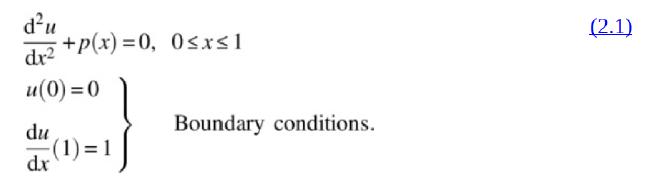
du dr +p(x)=0, 0x1 u(0)=0 du dr (1)=1 Boundary conditions. (2.1)
Step by Step Solution
★★★★★
3.34 Rating (145 Votes )
There are 3 Steps involved in it
1 Expert Approved Answer
Step: 1 Unlock

Question Has Been Solved by an Expert!
Get step-by-step solutions from verified subject matter experts
Step: 2 Unlock
Step: 3 Unlock
 Study Help