



Question: Consider the following algorithm for generating a random permutation of the elements 1, 2, . . . , n. In this algorithm, P(i) can be
Consider the following algorithm for generating a random permutation of the elements 1, 2, . . . , n. In this algorithm, P(i) can be interpreted as the element in position i.
Step 1: Set k = 1.
Step 2: Set P(1) = 1.
Step 3: If k = n, stop. Otherwise, let k = k +1.
Step 4: Generate a random number U, and let![P(k) = P([kU]+1), P([kU]+1)=k. Go to step 3.](https://dsd5zvtm8ll6.cloudfront.net/images/question_images/1725/6/0/5/31966daa5c7590b21725605300443.jpg)
(a) Explain in words what the algorithm is doing.
(b) Show that at iteration k—that is, when the value of P(k) is initially set—
that P(1),P(2), . . . , P (k) is a random permutation of 1, 2, . . . , k.
Hint: Use induction and argue that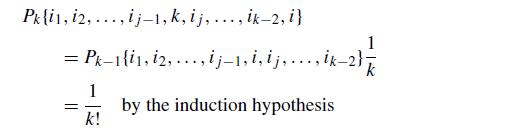
The preceding algorithm can be used even if n is not initially known.
22. Verify that if we use the hazard rate approach to simulate the event times of a nonhomogeneous Poisson process whose intensity function λ(t) is such that λ(t) ≤ λ, then we end up with the approach given in method 1 of Section 11.5.
P(k) = P([kU]+1), P([kU]+1)=k. Go to step 3.
Step by Step Solution
There are 3 Steps involved in it

Get step-by-step solutions from verified subject matter experts