







Question: Given. The impulse response, hp (n), of an ideal low pass filter with is given by hp(n) = ain(uk) *H(W) passband gain 1 and
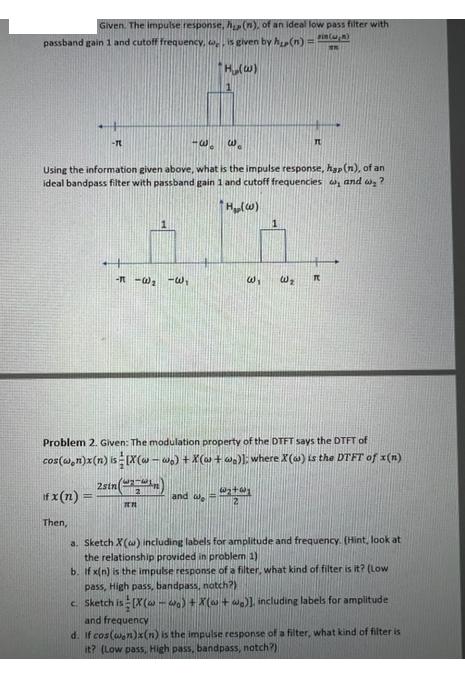
Given. The impulse response, hp (n), of an ideal low pass filter with is given by hp(n) = ain(uk) *H(W) passband gain 1 and cutoff frequency, -@. Using the information given above, what is the impulse response, hap (n), of an ideal bandpass filter with passband gain 1 and cutoff frequencies and ? H(W) -TL -"-W -W W #R Problem 2. Given: The modulation property of the DTFT says the DTFT of cos(won)x(n) is [X(w-wo) + X(w+wa)]; where X (as) is the DTFT of x(n) 761 2sini and we TU W Wz R W+01 2 if x (n) = Then, a. Sketch X(w) including labels for amplitude and frequency. (Hint, look at the relationship provided in problem 1) b. If x(n) is the impulse response of a filter, what kind of filter is it? (Low pass, High pass, bandpass, notch?) c Sketch is [X(-) + X(w+wo)], including labels for amplitude and frequency d. If cos(wen)x(n) is the impulse response of a filter, what kind of filter is it? (Low pass, High pass, bandpass, notch?),
Step by Step Solution
3.45 Rating (161 Votes )
There are 3 Steps involved in it
Lets break down the problems step by step Problem 1 The impulse response of an ideal low pass filter ... View full answer

Get step-by-step solutions from verified subject matter experts
 Study Help