







Question: Temperature rise in a spherical catalyst pellet (Fig. 11B.11) a catalyst pellet has a radius R and a thermal conductivity k (which may be assumed
Temperature rise in a spherical catalyst pellet (Fig. 11B.11) a catalyst pellet has a radius R and a thermal conductivity k (which may be assumed constant). Because of the chemical reaction occurring within the porous pellet, heat is generated at a rate of Sc cal/cm3 ∙ s. Heat is lost at the outer surface of the pellet to a gas stream at constant temperature Tg by convective heat transfer with heat transfer coefficient h. Find the steady-state temperature profile, assuming that Sc is constant throughout.
(a) Set up the differential equation by making a shell energy balance.
(b) Set up the differential equation by simplifying the appropriate form of the energy equation.
(c) Integrate the differential equation to get the temperature profile. Sketch the function T(r).
(d) What is the limiting form of T(r) when h → ∞?
(e) What is the maximum temperature in the system?
(f) Where in the derivation would one modify the procedure to account for variable k and
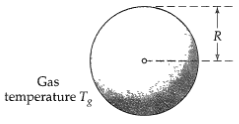
Gas temperature T,
Step by Step Solution
3.45 Rating (164 Votes )
There are 3 Steps involved in it
Temperature rise in a catalyst pellet a We make an energy balance ov... View full answer

Get step-by-step solutions from verified subject matter experts
Document Format (1 attachment)

6-E-C-E-T-P (201).docx
120 KBs Word File
 Study Help