







Question: A long 1.2 m OD pipeline carrying oil is to be installed in Alaska. To prevent the oil from becoming too viscous for pumping, the
A long 1.2 m OD pipeline carrying oil is to be installed in Alaska. To prevent the oil from becoming too viscous for pumping, the pipeline is buried 3 m below ground. The oil is also heated periodically at pumping stations as shown schematically belowThe oil pipe is to be covered with insulation having a thickness t and a thermal conductivity of 0.05 W/(m K). It is specified by the engineer installing the pumping station that the temperature drop of the oil in a distance of 100 km should not exceed 5?C when the soil surface temperature Ts = ?? 40?C. The temperature of the pipe after each heating is to be 120?C and the flow rate is 500 kg/s. The properties of the oil being pumped are given belowDensity (ρoil) = 900 kg/m3Thermal conductivity (koil) = 0.14 W/(m K)Kinematic viscosity (voil) = 8.5 x 10??4 m2/sSpecific heat (coil) = 2000 J/(kg K)The soil under arctic conditions is dry (Table 11, ks = 0.35W/(mK)).Estimate the thickness of insulation necessary to meet the specifications of the pumping engineer. Calculate the required rate of heat transfer to the oil at each heating point. Calculate the pumping power required to move the oil between two adjacent heating stations.GIVENAn insulated underground oil pipelinePipe outside diameter (Dpo) = 1.2 mDepth to centerline (Z) = 3mInsulation thickness = tInsulation thermal conductivity (ki) = 0.05 W/(m K)For L = 100 km = 100,000 m, Maximum ??Tb = 5?C when ground surface temp. (Ts) = ?? 40?COil temperature after heating (Tb,in) = 120?CMass flow rate (m) = 500 kg/sFluid properties listed aboveSoil thermal conductivity (ks) = 0.35 W/(m K)ASSUMPTIONSConstant thermal propertiesUniform ground surface temperatureFlow is fully developedThe thermal resistance of the pipe is negligibleThe thickness of the pipe is negligible compared to thediameter
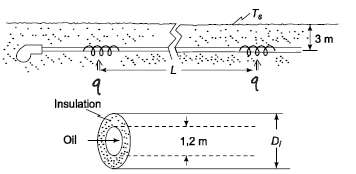
3 m Insulation Oil DI 1,2 m
Step by Step Solution
3.36 Rating (171 Votes )
There are 3 Steps involved in it
The interior heat transfer coefficient can be evaluated from correlations The Rey... View full answer

Get step-by-step solutions from verified subject matter experts
Document Format (1 attachment)

66-E-M-E-H-M-T (1777).docx
120 KBs Word File
 Study Help