







Question: A particle can move along only an x axis, where conservative forces act on it (Figure and the following table). The particle is released at
A particle can move along only an x axis, where conservative forces act on it (Figure and the following table). The particle is released at x = 5.00 m with a kinetic energy of K = 14.0 J and a potential energy of U = 0. If its motion is in the negative direction of the r axis, what are its?
(a) K and?
(b) U at x = 2.00 m and its?
(c) K and?
(d) U at x = 0? If its motion is in the positive direction of the x axis, what are its?
(e) K and?
(f) U at x = 11.0 m, its?
(g) K and?
(h) U at x = 12.0 m, and its
(i) K and?
(j) U at x = 13.0 m??
(k) Plot U(x) versus x for the range x = 0 to x = 13.0m. Next, the particle is released from rest at x are?
(l) Its kinetic energy at x = 5.0 m and?
(m) The positive position xmax it reaches??
(n) What does the after it reaches xmax?
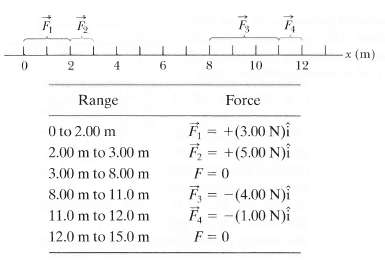
-x (m) 12 10 Range Force F = +(3.00 N)i F = +(5.00 N)i O to 2.00 m 2.00 m to 3.00 m 3.00 m to 8.00 m F = -(4.00 N)i F = -(1.00 N)i 8.00 m to 11.0 m 11.0 m to 12.0 m 12.0 m to 15.0 m
Step by Step Solution
3.50 Rating (177 Votes )
There are 3 Steps involved in it
a The remark in the problem statement that the forces can be associated with potential energies is illustrated as follows the work from x 300 m to x 2... View full answer

Get step-by-step solutions from verified subject matter experts
Document Format (1 attachment)

2-P-M-P-E (301).docx
120 KBs Word File
 Study Help