New Semester
Started
Get
50% OFF
Study Help!
--h --m --s
Claim Now
Question Answers
Textbooks
Find textbooks, questions and answers
Oops, something went wrong!
Change your search query and then try again
S
Books
FREE
Study Help
Expert Questions
Accounting
General Management
Mathematics
Finance
Organizational Behaviour
Law
Physics
Operating System
Management Leadership
Sociology
Programming
Marketing
Database
Computer Network
Economics
Textbooks Solutions
Accounting
Managerial Accounting
Management Leadership
Cost Accounting
Statistics
Business Law
Corporate Finance
Finance
Economics
Auditing
Tutors
Online Tutors
Find a Tutor
Hire a Tutor
Become a Tutor
AI Tutor
AI Study Planner
NEW
Sell Books
Search
Search
Sign In
Register
study help
business
auditing
Principles of Auditing and Other Assurance Services 19th edition Ray Whittington, Kurt Pany - Solutions
What are internal and external file labels? Why are they used?
Distinguish general control activities from application control activities and give examples of the types of controls included in each of these broad categories.
An information systems department usually performs numerous IT processing functions that would be separated in a manual system. Does this imply that separation of duties is not a practical means of achieving internal control in a computerized system? Explain.
Explain the meaning of the term documentation as it pertains to computers and an information systems department. How might a client’s documentation be used by the auditors?
The number of personnel in an information systems department may limit the extent to which segregation of duties is feasible. What is the minimum amount of segregation of duties that will permit satisfactory internal control?
Define and give the purpose of each of the following controls:a. Record countsb. Limit testc. Validity testd. Hash totals
List and define three types of data transmission controls.
Describe briefly the controls that should be established over the operation of a workstation to prevent use by unauthorized personnel.
Explain briefly what is meant by electronic data interchange (EDI). How does EDI affect a company’s audit trail?
Is it probable that the use of IT will eventually eliminate the audit trail, making it impossible to trace individual transactions from their origin to the summary totals in the financial statements? Explain.
A primary requirement of effective internal control is a satisfactory plan of organization. Explain the characteristics of a satisfactory plan of organization for an information systems department, including the relationship between the department and the rest of the organization.
Distinguish between batch processing and online real-time (OLRT) processing. In which of these systems is strong internal control over input most easily attained? Explain.
The use of test data is one method of performing tests of processing controls in an IT-based system. Identify and discuss several other methods by which auditors may test internal processing controls over IT activity.
Discuss how generalized audit software can be used to aid the auditors in examining accounts receivable in a fully IT-based system.
An integrated test facility (ITF) is a method used by both internal and external auditors for testing IT-based system controls. Discuss the advantages and disadvantages of implementing an ITF.
Many companies have part or all of their IT processing done by computer service centers.a. What controls should the company maintain to ensure the accuracy of processing done by a service center?b. How do auditors assess internal control over applications processed for an audit client by a service
Multiple Choice QuestionsSelect the best answer for each of the following questions. Explain the reasons for your selection.a. LAN is the abbreviation for:(1) Large Area Network.(2) Local Area Network.(3) Longitudinal Analogue Network.(4) Low Analytical Nets.b. End user computing is most likely to
For each of the following descriptions, select the computer audit procedure most closely related. Computer audit procedures may be used once, more than once, or not at all.Definitiona. Auditing by manually testing the input and output of a computer system.b. Dummy transactions developed by the
The Ultimate Life Insurance Company has a database system that stores policy and payment information. The company is now planning to provide its branch offices with terminals that have online access to the central IT facility.a. Define a database.b. Give one fundamental advantage of a database.c.
CPAs may audit around or through computers in the audit of the financial statements of clients who use IT to process accounting data.a. Describe the auditing approach referred to as “auditing around the computer.”b. Under what conditions do CPAs decide to audit through the computer instead of
As you are planning the annual audit of Norton Corporation, you note that the company has a number of user operated computers in use in various locations. One of the machines has been installed in the stores department, which has the responsibility for disbursing stock items and for maintaining
You are auditing for the first time the financial statements of Central Savings and Loan Association for the year ending December 31, 20X3. The CPA firm that audited the association’s financial statements for the prior year issued an unqualified audit report.The association uses an online
Lee Wong, CPA, is auditing the financial statements of the Alexandria Corporation, which has a batch-processing IT-based system for shipping and invoicing that it purchased from a software vendor. The following comments have been extracted from Wong€™s notes on IT operations and the
The accompanying flowchart on page 330 summarizes Jenz Corporation€™s processing of sales.Some of the flowchart symbols are labeled to indicate controls and records. For each symbol numbered 1 through 13, select one response from either the list of operations and controls (A through O) or
An IT system uses two types of software: system software and application software. Explain the difference between these two types of software.
Distinguish between end user computing and a distributed data processing network.
Compare the responsibilities and objectives of the data control group in an information systems department to those of the internal auditors with respect to IT processing activities.
Differentiate between a system flowchart and a program flowchart.
Do auditors usually begin their consideration of internal control over IT activities with a review of general or application control activities? Explain.
Describe the audit technique known as tagging and tracing. What is the purpose of the technique?
Auditors encounter the use of user operated computers on almost every audit engagement.a. How do user operated computers differ from large computers?b. When are the auditors concerned with internal control over the use of user operated computers?
Auditors should be familiar with the terminology employed in IT processing. The following statements contain some of the terminology so employed. Indicate whether each statement is true or false.a. A recent improvement in computer hardware is the ability to automatically produce error listings.
For each definition (or partial definition) in the first column below, identify the most closely related term. Each term may be used once or not at all.Definition (or Partial Definition)a. A subject-oriented, integrated collection of data used to support management decision-making processes.b. A
Describe the difference between sampling risk and nonsampling risk.
Explain briefly the term systematic selection as used in auditing and indicate the precautions to be taken if a random sample is to be obtained. Is systematic selection applicable to unnumbered documents? Explain.
Explain the meaning of sampling without replacement and sampling with replacement.
What relationship exists between the expected population deviation rate and sample size?
Describe what is meant by a sequential sampling plan.
In performing a substantive test of the book value of a population, auditors must be concerned with two aspects of sampling risk. What are these two aspects of sampling risk, and which aspect is of greater importance to auditors? Explain.
Using the approach presented in this chapter for mean-per-unit sampling, when is it necessary to calculate an adjusted allowance for sampling risk?
When using nonstatistical sampling, what relationship must exist between the projected misstatement and tolerable misstatement in order for the auditors to conclude that an account balance is acceptable?
CPAs may decide to apply nonstatistical or statistical techniques to audit testing.a. List and explain the advantages of applying statistical sampling techniques to audit testing.b. List and discuss the decisions involving professional judgment that must be made by the CPAs in applying statistical
In performing a test of controls for sales order approvals, the CPAs stipulate a tolerable deviation rate of 8 percent with a risk of assessing control risk too low of 5 percent. They anticipate a deviation rate of 2 percent.a. What type of sampling plan should the auditors use for this test?b.
An auditor has reason to suspect that fraud has occurred through forgery of the treasurer’s signature on company checks. The population under consideration consists of 3,000 checks. Can discovery sampling rule out the possibility that any forged checks exist?
An auditor used a nonstatistical sampling plan to audit the inventory of an auto supply company. The auditor tested the recorded cost of a sample of inventory items by reference to vendors’ invoices. In performing the test, the auditor verified all the items on two pages selected at random from
Cathy Williams is auditing the financial statements of Westerman Industries. In the performance of mean-per-unit estimation of credit sales, Williams has decided to limit the risk of incorrect rejection to 25 percent and the risk of incorrect acceptance to 10 percent. Williams considers the
Ratio estimation and difference estimation are two widely used variables sampling plans.a. Under what conditions are ratio estimation or difference estimation appropriate sampling plans for estimating the total dollar value of a population?b. What relationship determines which of these two plans
Bill Jones wishes to use nonstatistical sampling to select a sample of his client’s 3,000 accounts receivable, which total $330,000. He believes that $30,000 represents a reasonable tolerable misstatement. He also has assessed both the combination of inherent and control risk at the maximum level
During an audit of Potter Company, an auditor needs to estimate the total value of the 5,000 invoices processed during June. The auditor estimates the standard deviation of the population to be $30. Determine the size sample the auditor would select to achieve an allowance for sampling risk
The public accounting firm of Hanson and Brown was expanding very rapidly. Consequently, it hired several staff assistants, including James Small. Subsequently, the partners of the firm became dissatisfied with Small's production and warned him that they would be forced to discharge him unless his
Wanda Young, doing business as Wanda Young Fashions, engaged the CPA partnership of Scott & Green to audit her financial statements. During the audit, Scott & Green discovered certain irregularities that would have indicated to a reasonably prudent auditor that James Smith, the chief accountant,
Susan Harris is a new assistant auditor with the public accounting firm of Sparks, Watts, and Wilcox, CPAs. On her third audit assignment, Harris examined the documentation underlying 60 disbursements as a test of controls over purchasing, receiving, vouchers payable, and cash disbursement
Sawyer and Sawyer, CPAs, audited the financial statements of Rattler Corporation that were included in Rattler’s Form 10-K, which was filed with the SEC. Subsequently, Rattler Corporation went bankrupt and the stockholders of the corporation brought a class-action lawsuit against management,
The international CPA firm of Arthur Andersen faced significant liability in conjunction with its audits of Enron Corporation.Requireda. From a legal liability perspective, describe the unique features of this audit case.b. Describe the important implications of this audit case for a firm of public
Multiple Choice QuestionsSelect the best answer for each of the following questions. Explain the reasons for your selection.a. Which of the following is an element of sampling risk?(1) Choosing an audit procedure that is inconsistent with the audit objective.(2) Concluding that no material
The professional development department of a large CPA firm has prepared the following illustration to familiarize the audit staff with the relationships of sample size to population size and variability and the auditors€™ specifications in regard to the tolerable misstatement and the
The use of statistical sampling techniques in an audit of financial statements does not eliminate judgmental decisions.a. Identify and explain four areas in which judgment may be exercised by CPAs in planninga statistical test of controls.b. Assume that the auditors’ sample shows an unacceptable
As part of your audit of the Abba Company accounts payable function, your audit program includes a test of controls addressing the company policy requiring that all vouchers be properly approved. You estimate the population deviation rate to be 3 percent.a. In addition to an estimate of population
You have been asked to test the effectiveness of Ingo Corporation’s control of manually approving all purchases over $25,000. During the year, Ingo Corporation has made 1,000,000 purchases, of which 3,000 were over $25,000. Jian Zhang, CIA, your supervisor, has asked you to use a tolerable
Scott Duffney, CPA, has randomly selected and audited a sample of 100 of Will-Mart’s accounts receivable. Will-Mart has 3,000 accounts receivable accounts with a total book value of $3,000,000. Duffney has determined that the account’s tolerable misstatement is $250,000.His sample results are
Rachel Robertson wishes to use mean-per-unit sampling to evaluate the reasonableness of the book value of the accounts receivable of Smith, Inc. Smith has 10,000 accounts receivable accounts with a total book value of $1,500,000. Rachel estimates the population’s standard deviation to be equal
You are the auditor of Jexel, an auto air conditioner service and repair company, and you have decided to use the mean-per-unit method to test the existence and gross valuation of recorded accounts receivable. The client’s records include 10,000 accounts with a total book value of $1,250,000. You
In the audit of Potomac Mills, the auditors wish to test the costs assigned to manufactured goods. During the year, the company has produced 2,000 production lots with a total recorded cost of $5.9 million. The auditors select a sample of 200 production lots with an aggregate book value of $600,000
To test the pricing and mathematical accuracy of sales invoices, the auditors selected a sample of 200 sales invoices from a total of 41,600 invoices that were issued during the year under audit. The 200 invoices represented total recorded sales of $22,800. Total sales for the year amounted to $5
The auditors of Landi Corporation wish to use a structured approach to nonstatistical sampling to evaluate the reasonableness of the accounts receivable. Landi has 15,000 receivable accounts with a total book value of $2,500,000. The auditors have assessed the combined level of inherent and control
The auditors wish to test the valuation of accounts receivable in the audit of Kaplan Corporation. The client has $1,000,000 of total recorded receivables, composed of 2,000 accounts.The auditors have decided to use structured nonstatistical sampling and have determined the following:Tolerable
Baker, CPA, was engaged to audit Mill Company’s financial statements for the year ended December 31, 200X. After obtaining an understanding of Mill’s internal control, Baker decided to obtain audit evidence about the effectiveness of both the design and operation of the controls that may
Assume that your firm, Daulton & Weed, CPAs, has been approached by a Tempest, a golf ball manufacturer to attest to the average drive distance that Tempest€™s new GOFAR ball can be driven. Tempest has presented you the following four possible assertions:a. The GOFAR ball goes an average of
Define, and differentiate between, nonstatistical (judgmental) sampling and statistical sampling.
Explain what is meant by the following statement: “When sampling, the auditors should determine that the physical representation of the actual population is complete.”
In selecting items for examination, an auditor considered three alternatives: (a) Random number table selection, (b) Systematic selection, and (c) Random number generator selection. Which, if any, of these methods would lead to a random sample if properly applied?
What are the three major factors that determine the sample size for an attributes sampling plan?
When performing attributes sampling, may auditors include several types of attributes in their definition of a deviation? Explain.
What effects will an auditor’s belief that the population’s actual deviation rate exceeds the tolerable deviation rate have on the test of controls sample size?
What would be the difference between an attributes sampling plan and a variables sampling plan in a test of inventory extensions?
Explain how the auditors may obtain an estimate of a population’s standard deviation to determine an appropriate sample size.
For what purposes is the planned allowance for sampling risk used in mean-per-unit sampling?
What conditions are necessary for the auditors to use either the ratio or difference estimation techniques?
What options are available to an auditor when the client’s book value falls outside the acceptance interval calculated using the estimate of the total value of the population (the adjusted allowance for sampling risk)?
Explain how, in using the mean-per-unit method to evaluate results, the auditors use the differences between the audited values and the book values of the individual items in their sample.
Is it correct to say that when using nonstatistical variables sampling, one is unable to project the misstatements identified to the entire population? Explain why this is or is not the case.
The 10 following statements apply to unrestricted random sampling without replacement.Indicate whether each statement is true or false. Briefly discuss each false statement.a. When sampling from the population of accounts receivable for certain objectives, the auditor might sample only active
For each term in the first column below, identify its definition (or partial definition). Each definition may be used once or not at all.Term a. Allowance for sampling riskb. Deviation ratec. Discovery samplingd. Projected misstatemente. Reliabilityf. Risk of assessing control risk too lowg. Risk
Chris York, CPA, is considering the use of probability-proportional-to-size sampling in examining the sales transactions and accounts receivable of Carter Wholesale Company.a. How does the definition of the items in an accounts receivable population vary between probability-proportional-to-size
The auditors of Dunbar Electronics want to limit the risk of material misstatement in the valuation of inventories to 2 percent. They believe that there exists a 50 percent risk that a material misstatement could have bypassed the client’s internal control and that the inherent risk of the
The auditors wish to test the valuation of accounts receivable in the audit of Desert Enterprises of Bullhead City. The client has $500,000 of total recorded receivables, composed of 850 accounts. The auditors have determined the following:Tolerable misstatement $25,000Risk of incorrect acceptance
Reply as to whether you believe the following statements are correct (C) or incorrect (I) concerning PPS sampling.a. The size of a PPS sample is not based on the estimated variation of audited amounts.b. PPS sampling results in a stratified sample.c. Individually significant items are automatically
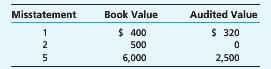
The following is a computer printout generated by audit software using probability-proportional-to-size (PPS)sampling:
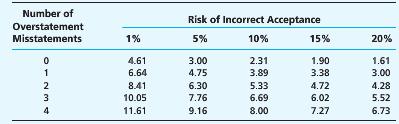
Edwards has decided to use probability-proportional-to-size (PPS) sampling, sometimes called dollar-unit sampling, in the audit of a client’s accounts receivable balance. Few, if any, misstatements of the account balance are expected.Edwards plans to use the following PPS sampling table:.:.a.
Bill Pei, CPA, is about to begin his audit of the accuracy of his client€™s accounts receivable. Based on experience, he expects that approximately 1 percent of the client€™s 40,000 accounts have errors.The total book value of receivables is $5 million. Pei has established
“When using a systematic sample selection technique with PPS sampling, every account larger than the sampling interval will automatically be included in the sample.” Do you agree? Explain.
When using PPS sampling, do auditors select sample items based on individual dollars, audit individual dollars, or both?
A company has an inventory with a book value of $4,583,231, which includes 116 product lines and a total of 326,432 units. How many items compose this population for purposes of applying a probability-proportional-to-size sampling plan? Explain.
“When no misstatements are found in a PPS sample, the upper limit on misstatement is equal to zero.” Is this statement correct? Explain.
A PPS sample with a sampling interval of $2,000 includes an item with an audited value of $90. This value was $30 lower than the account’s book value. Calculate the tainting percent- age for this account.
The reliability factor table provides factors for as many as three computations when planning and evaluating the results of a PPS sample. Describe in general terms each of these computations.
In a probability-proportional-to-size sample with a sampling interval of $20,000, an auditor discovered that a selected account receivable with a recorded amount of $10,000 had an audit amount of $2,000. Calculate the projected misstatement for this one item.
Give two reasons audit work on cash is likely to be more extensive than might appear to be justified by the relative amount of the balance sheet figure for cash.
“If the auditors discover any evidence of employee fraud during their work on cash, they should extend their investigation as far as necessary to develop a complete set of facts, regard- less of whether the amounts involved are or are not material.” Do you agree with the quoted statement?
State one broad general objective of internal control over each of the following: cash receipts, cash disbursements, and cash balances.
Showing 3800 - 3900
of 10291
First
32
33
34
35
36
37
38
39
40
41
42
43
44
45
46
Last
Step by Step Answers

 Get 50% OFF
Claim Now
Get 50% OFF
Claim Now


.png)
.png)
.png)
-1.png)
-2.png)
.png)
.png)


