New Semester
Started
Get
50% OFF
Study Help!
--h --m --s
Claim Now
Question Answers
Textbooks
Find textbooks, questions and answers
Oops, something went wrong!
Change your search query and then try again
S
Books
FREE
Study Help
Expert Questions
Accounting
General Management
Mathematics
Finance
Organizational Behaviour
Law
Physics
Operating System
Management Leadership
Sociology
Programming
Marketing
Database
Computer Network
Economics
Textbooks Solutions
Accounting
Managerial Accounting
Management Leadership
Cost Accounting
Statistics
Business Law
Corporate Finance
Finance
Economics
Auditing
Tutors
Online Tutors
Find a Tutor
Hire a Tutor
Become a Tutor
AI Tutor
AI Study Planner
NEW
Sell Books
Search
Search
Sign In
Register
study help
business
finance
Financial Management Theory And Practice 12th Edition Eugene F. Brigham And Michael C. Ehrhardt - Solutions
Heath Foods’ bonds have 7 years remaining to maturity. The bonds have a face value of $1,000 and a yield to maturity of 8 percent. They pay interest annually and have a 9 percent coupon rate. What is their current yield?
Nungesser Corporation has issued bonds that have a 9 percent coupon rate, payable semiannually. The bonds mature in 8 years, have a face value of $1,000, and a yield to maturity of 8.5 percent. What is the price of the bonds?
The Garraty Company has two bond issues outstanding. Both bonds pay $100 annual interest plus $1,000 at maturity. Bond L has a maturity of 15 years, and Bond S a maturity of 1 year.a. What will be the value of each of these bonds when the going rate of interest is (1) 5 percent, (2) 8 percent, and
The Heymann Company’s bonds have 4 years remaining to maturity. Interest is paid annually; the bonds have a $1,000 par value; and the coupon interest rate is 9 percent.a. What is the yield to maturity at a current market price of (1) $829 or (2) $1,104?b. Would you pay $829 for one of these bonds
Six years ago, The Singleton Company sold a 20-year bond issue with a 14 percent annual coupon rate and a 9 percent call premium. Today, Singleton called the bonds. The bonds originally were sold at their face value of $1,000. Compute the realized rate of return for investors who purchased the
A 10-year, 12 percent semiannual coupon bond, with a par value of $1,000, may be called in 4 years at a call price of $1,060. The bond sells for $1,100. (Assume that the bond has just been issued.)a. What is the bond’s yield to maturity?b. What is the bond’s current yield?c. What is the
You just purchased a bond which matures in 5 years. The bond has a face value of $1,000, and has an 8 percent annual coupon. The bond has a current yield of 8.21 percent. What is the bond’s yield to maturity?
A bond that matures in 7 years sells for $1,020. The bond has a face value of $1,000 and a yield to maturity of 10.5883 percent. The bond pays coupons semiannually. What is the bond’s current yield?
Lloyd Corporation’s 14 percent coupon rate, semiannual payment, $1,000 par value bonds, that mature in 30 years, are callable 5 years from now at a price of $1,050. The bonds sell at a price of $1,353.54, and the yield curve is flat. Assuming that interest rates in the economy are expected to
Suppose Ford Motor Company sold an issue of bonds with a 10-year maturity, a $1,000 par value, a 10 percent coupon rate, and semiannual interest payments.a. Two years after the bonds were issued, the going rate of interest on bonds such as these fell to 6 percent. At what price would the bonds
A bond trader purchased each of the following bonds at a yield to maturity of 8 percent. Immediately after she purchased the bonds, interest rates fell to 7 percent. What is the percentage change in the price of each bond after the decline in interest rates? Fill in the following table:
An investor has two bonds in his portfolio. Each bond matures in 4 years, has a face value of $1,000, and has a yield to maturity equal to 9.6 percent. One bond, Bond C, pays an annual coupon of 10 percent; the other bond, Bond Z, is a zero coupon bond.a. Assuming that the yield to maturity of
Define each of the following terms:a. Proxy; proxy fight; takeover; preemptive right; classified stock; founders’ sharesb. Closely held corporation; publicly owned corporationc. Secondary market; primary market; going public; initial public offering (IPO)d. Intrinsic value (ˆP0); market price
Two investors are evaluating AT&T’s stock for possible purchase. They agree on the expected value of D1 and also on the expected future dividend growth rate. Further, they agree on the riskiness of the stock. However, one investor normally holds stocks for 2 years, while the other normally
A bond that pays interest forever and has no maturity date is a perpetual bond. In what respect is a perpetual bond similar to a no-growth common stock, and to a share of preferred stock?
War Corporation just paid a dividend of $1.50 a share (i.e., D0 = $1.50). The dividend is expected to grow 5 percent a year for the next 3 years, and then 10 percent a year thereafter. What is the expected dividend per share for each of the next 5 years?
Thomas Brothers is expected to pay a $0.50 per share dividend at the end of the year (i.e., D1 = $0.50). The dividend is expected to grow at a constant rate of 7 percent a year. The required rate of return on the stock, rs, is 15 percent. What is the value per share of the company’s stock?
Harrison Clothiers’ stock currently sells for $20 a share. The stock just paid a dividend of $1.00 a share (i.e., D0 = $1.00). The dividend is expected to grow at a constant rate of 10 percent a year. What stock price is expected 1 year from now? What is the required rate of return on the
Fee Founders has preferred stock outstanding which pays a dividend of $5 at the end of each year. The preferred stock sells for $60 a share. What is the preferred stock’s required rate of return?
A company currently pays a dividend of $2 per share, D0 = 2. It is estimated that the company’s dividend will grow at a rate of 20 percent per year for the next 2 years, then the dividend will grow at a constant rate of 7 percent thereafter. The company’s stock has a beta equal to 1.2, the
A stock is trading at $80 per share. The stock is expected to have a year-end dividend of $4 per share (D1 = 4), which is expected to grow at some constant rate g throughout time. The stock’s required rate of return is 14 percent. If you are an analyst who believes in efficient markets, what
You are considering an investment in the common stock of Keller Corp. The stock is expected to pay a dividend of $2 a share at the end of the year (D1 = $2.00). The stock has a beta equal to 0.9. The risk-free rate is 5.6 percent, and the market risk premium is 6 percent. The stock’s dividend is
What will be the nominal rate of return on a preferred stock with a $100 par value, a stated dividend of 8 percent of par, and a current market price of?(a) $60,(b) $80,(c) $100, and(d) $140?
Martell Mining Company’s ore reserves are being depleted, so its sales are falling. Also, its pit is getting deeper each year, so its costs are rising. As a result, the company’s earnings and dividends are declining at the constant rate of 5 percent per year. If D0 = $5 and rs = 15%, what is
Assume that the average firm in your company’s industry is expected to grow at a constant rate of 6 percent and its dividend yield is 7 percent. Your company is about as risky as the average firm in the industry, but it has just successfully completed some R&D work that leads you to expect
Ezzell Corporation issued preferred stock with a stated dividend of 10 percent of par. Preferred stock of this type currently yields 8 percent, and the par value is $100. Assume dividends are paid annually.a. What is the value of Ezzell’s preferred stock?b. Suppose interest rate levels rise to
Your broker offers to sell you some shares of Bahnsen & Co. common stock that paid a dividend of $2 yesterday. You expect the dividend to grow at the rate of 5 percent per year for the next 3 years, and, if you buy the stock, you plan to hold it for 3 years and then sell it.a. Find the expected
Investors require a 15 percent rate of return on Levine Company’s stock (rs =15%).a. What will be Levine’s stock value if the previous dividend was D0 = $2 and if investors expect dividends to grow at a constant compound annual rate of (1) = percent, (2) 0 percent, (3) 5 percent, and (4) 10
Wayne-Martin Electric Inc. (WME) has just developed a solar panel capable of generating 200 percent more electricity than any solar panel currently on the market. As a result, WME is expected to experience a 15 percent annual growth rate for the next 5 years. By the end of 5 years, other firms will
Tausig Technologies Corporation (TTC) has been growing at a rate of 20 percent per year in recent years. This same growth rate is expected to last for another 2 years.a. If D0 = $1.60, rs = 10%, and gn = 6%, what is TTC’s stock worth today? What is its expected dividend yield and capital gains
The risk-free rate of return, rRF, is 11 percent; the required rate of return on the market, rM, 14 percent; and Upton Company’s stock has a beta coefficient of 1.5. a. If the dividend expected during the coming year, D1, is $2.25, and if g = a constant 5%, at what price should Upton’s stock
Define each of the following terms:a. Option; call option; put optionb. Exercise value; strike pricec. Black-Scholes Option Pricing Model
Why do options sell at prices higher than their exercise values?
Describe the effect on a call option’s price caused by an increase in each of the following factors:(1) Stock price,(2) Exercise price,(3) Time to expiration,(4) Risk-free rate, and(5) Variance of stock return.
Assume you have been given the following information on Purcell Industries:Current stock price = $15........................,,,,,..Exercise price of option = $15Time to maturity of option = 6 .....................months Risk-free rate = 6%Variance of stock return = 0.12 .....................d1 =
The exercise price on one of Flanagan Company’s options is $15, its exercise value is $22, and its premium is $5. What are the option’s market value and the price of the stock?
Use the Black-Scholes model to find the price for a call option with the following inputs: (1) current stock price is $30, (2) exercise price is $35, (3) time to expiration is 4 months, (4) annualized risk-free rate is 5%, and (5) variance of stock return is 0.25.
The current price of a stock is $20. In 1 year, the price will be either $26 or $16. The annual risk-free rate is 5 percent. Find the price of a call option on the stock that has an exercise price of $21 and that expires in 1 year. (Hint: Use daily compounding.)
The current price of a stock is $15. In 6 months, the price will be either $18 or $13. The annual risk-free rate is 6 percent. Find the price of a call option on the stock that has an exercise price of $14 and that expires in 6 months.
The current price of a stock is $33, and the annual risk-free rate is 6 percent. A call option with an exercise price of $32 and 1 year until expiration has a current value of $6.56. What is the value of a put option written on the stock with the same exercise price and expiration date as the call
Define each of the following terms:a. Weighted average cost of capital, WACC; after-tax cost of debt, rd (1 = T)b. Cost of preferred stock, rps; cost of common equity or cost of common stock, rsc. Target capital structured. Flotation cost, F; cost of new external common equity, re
In what sense is the WACC an average cost A marginal cost?
How would each of the following affect a firm's cost of debt, rd(1 = T); its cost of equity, rs; and its weighted average cost of capital, WACC? Indicate by a plus (+) a minus (_), or a zero (0) if the factor would raise lower, or have an indeterminate effect on the item in question. Assume other
Distinguish between beta (or market) risk, within-firm (or corporate) risk, and stand-alone risk for a potential project. Of the three measures, which is theoretically the most relevant, and why?
Suppose a firm estimates its cost of capital for the coming year to be 10 percent. What might be reasonable costs of capital for average-risk, high-risk, and low-risk projects?
David Ortiz Motors has a target capital structure of 40 percent debt and 60 percent equity. The yield to maturity on the company’s outstanding bonds is 9 percent, and the company’s tax rate is 40 percent. Ortiz’s CFO has calculated the company’s WACC as 9.96 percent. What is the
Tunney Industries can issue perpetual preferred stock at a price of $50 a share. The issue is expected to pay a constant annual dividend of $3.80 a share. The flotation cost on the issue is estimated to be 5 percent. What is the company’s cost of preferred stock, rps?
Javits & Sons’ common stock is currently trading at $30 a share. The stock is expected to pay a dividend of $3.00 a share at the end of the year (D1 = $3.00), and the dividend is expected to grow at a constant rate of 5 percent a year. What is the cost of common equity?
Calculate the after-tax cost of debt under each of the following conditions:a. Interest rate, 13 percent; tax rate, 0 percent.b. Interest rate, 13 percent; tax rate, 20 percent.c. Interest rate, 13 percent; tax rate, 35 percent.
Trivoli Industries plans to issue some $100 par preferred stock with an 11 percent dividend. The stock is selling on the market for $97.00, and Trivoli must pay flotation costs of 5 percent of the market price. What is the cost of the preferred stock for Trivoli?
A company’s 6 percent coupon rate, semiannual payment, $1,000 par value bond which matures in 30 years sells at a price of $515.16. The company’s federal-plus state tax rate is 40 percent. What is the firm’s component cost of debt for purposes of calculating the WACC?
The earnings, dividends, and stock price of Carpet to Technologies Inc. are expected to grow at 7 percent per year in the future. Carpetto’s common stock sells for $23 per share, its last dividend was $2.00, and the company will pay a dividend of $2.14 at the end of the current year.a. Using the
The Bouchard Company’s current EPS is $6.50. It was $4.42 5 years ago. The company pays out 40 percent of its earnings as dividends, and the stock sells for $36.a. Calculate the past growth rate in earnings. (Hint: This is a 5-year growth period.)b. Calculate the next expected dividend per share,
Sidman Products’ stock is currently selling for $60 a share. The firm is expected to earn $5.40 per share this year and to pay a year-end dividend of $3.60.a. If investors require a 9 percent return, what rate of growth must be expected for Sidman?b. If Sidman reinvests earnings in projects with
On January 1, the total market value of the Tysseland Company was $60 million. During the year, the company plans to raise and invest $30 million in new projects. The firm’s present market value capital structure, shown below, is considered to be optimal. Assume that there is no short-term
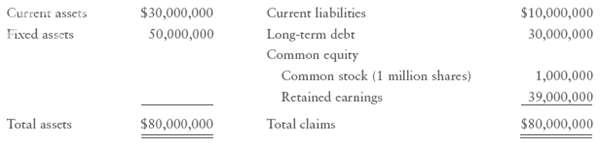
Suppose the School Company has this book value balance sheet: The current liabilities consist entirely of notes payable to banks, and the interest rate on this debt is 10 percent, the same as the rate on new bank loans. The long-term debt consists of 30,000 bonds, each of which has a par vale of
A summary of the balance sheet of Travelers Inn Inc. (TII), a company which was formed by merging a number of regional motel chains and which hopes to rival Holiday Inn on the national scene, is shown in the table: Travelers Inn: December 31, 2004 (Millions of Dollars)These facts are also given
Rework Problem 9-3, assuming that new stock will be issued. The stock will be issued for $30 and the flotation cost is 10 percent of the issue proceeds. The expected dividend and growth remain at $3.00 per share and 5 percent, respectively.
Suppose a company will issue new 20-year debt with a par value of $1,000 and a coupon rate of 9 percent, paid annually. The tax rate is 40 percent. If the flotation cost is 2 percent of the issue proceeds, what is the after-tax cost of debt?
Define each of the following terms:a. Capital budgeting; regular payback period; discounted payback periodb. Independent projects; mutually exclusive projectsc. DCF techniques; net present value (NPV) method; internal rate of return (IRR) methodd. Modified internal rate of return (MIRR)
How is a project classification scheme (for example, replacement, expansion into new markets, and so forth) used in the capital budgeting process?
Explain why the NPV of a relatively long-term project, defined as one for which a high percentage of its cash flows are expected in the distant future, is more sensitive to changes in the cost of capital than is the NPV of a short-term project.
Explain why, if two mutually exclusive projects are being compared, the short-term project might have the higher ranking under the NPV criterion if the cost of capital is high, but the long-term project might be deemed better if the cost of capital is low. Would changes in the cost of capital
In what sense is a reinvestment rate assumption embodied in the NPV, IRR, and MIRR methods? What is the assumed reinvestment rate of each method?
Suppose a firm is considering two mutually exclusive projects. One has a life of 6 years and the other a life of 10 years. Would the failure to employ some type of replacement chain analysis bias an NPV analysis against one of the projects? Explain.
Your division is considering two investment projects, each of which requires an up-front expenditure of $15 million. You estimate that the investments will produce the following net cash flows:What are the two projects' net present values, assuming the cost of capital is 10 percent 5 percent 15
Edelman Engineering is considering including two pieces of equipment, a truck and an overhead pulley system, in this year's capital budget. The projects are independent. The cash outlay for the truck is $17,100, and that for the pulley system is $22,430. The firm's cost of capital is 14 percent.
Davis Industries must choose between a gas-powered and an electric-powered forklift truck for moving materials in its factory. Since both forklifts perform the same function, the firm will choose only one. (They are mutually exclusive investments.) The electric-powered truck will cost more, but it
Project S has a cost of $10,000 and is expected to produce benefits (cash flows) of $3,000 per year for 5 years. Project L costs $25,000 and is expected to produce cash flows of $7,400 per year for 5 years. Calculate the two projects’ NPVs, IRRs, MIRRs, and PIs, assuming a cost of capital of 12
Your company is considering two mutually exclusive projects, X and Y, whose costs and cash flows are shown below:The projects are equally risky, and their cost of capital is 12 percent. You must make a recommendation, and you must base it on the modified IRR (MIRR). What is the MIRR of the better
After discovering a new gold vein in the Colorado Mountains CTC Mining Corporation must decide whether to mine the deposit. The most cost-effective method of mining gold is sulfuric acid extraction, a process that results in environmental damage. To go ahead with the extraction, CTC must spend
Cummings Products Company is considering two mutually exclusive investments. The projects' expected net cash flows are as follows:a. Construct NPV profiles for Projects A and B.b. What is each project's IRR?c. If you were told that each project's cost of capital was 10 percent, which project
The Ewert Exploration Company is considering two mutually exclusive plans for extracting oil on property for which it has mineral rights. Both plans call for the expenditure of $10,000,000 to drill development wells. Under Plan A, all the oil will be extracted in 1 year, producing a cash flow at t
The Pinkerton Publishing Company is considering two mutually exclusive expansion plans. Plan A calls for the expenditure of $50 million on a large-scale, integrated plant which will provide an expected cash flow stream of $8 million per year for 20 years. Plan B calls for the expenditure of $15
The Ulmer Uranium Company is deciding whether or not it should open a strip mine, the net cost of which is $4.4 million. Net cash inflows are expected to be $27.7 million, all coming at the end of Year 1. The land must be returned to its natural state at a cost of $25 million, payable at the end of
The Aubey Coffee Company is evaluating the within-plant distribution system for its new roasting, grinding, and packing plant. The two alternatives are (1) a conveyor system with a high initial cost, but low annual operating costs, and (2) several forklift trucks, which cost less, but have
Your division is considering two investment projects, each of which requires an up-front expenditure of $25 million. You estimate that the cost of capital is 10 percent and that the investments will produce the following after-tax cash flows (in millions of dollars):a. What is the regular payback
Shao Airlines is considering two alternative planes. Plane A has an expected life of 5 years, will cost $100 million, and will produce net cash flows of $30 million per year. Plane B has a life of 10 years, will cost $132 million, and will produce net cash flows of $25 million per year. Shao plans
The Perez Company has the opportunity to invest in one of two mutually exclusive machines that will produce a product it will need for the foreseeable future. Machine A costs $10 million but realizes after-tax inflows of $4 million per year for 4 years. After 4 years, the machine must be replaced.
Filkins Fabric Company is considering the replacement of its old, fully depreciated knitting machine. Two new models are available: Machine 190-3, which has a cost of $190,000, a 3-year expected life, and after-tax cash flows (labor savings and depreciation) of $87,000 per year; and Machine 360-6,
The Scampini Supplies Company recently purchased a new delivery truck. The new truck cost $22,500, and it is expected to generate net after-tax operating cash flows, including depreciation, of $6,250 per year. The truck has a 5-year expected life. The expected salvage values after tax adjustments
Define each of the following terms:a. Cash flow; accounting incomeb. Incremental cash flow; sunk cost; opportunity costc. Net operating working capital changes; salvage valued. Real rate of return, rr, versus nominal rate of return, rne. Sensitivity analysis; scenario analysis; Monte Carlo
Operating cash flows, rather than accounting profits, are listed in Table 11-4.What is the basis for this emphasis on cash flows as opposed to net income?
Why is it true, in general, that a failure to adjust expected cash flows for expected inflation biases the calculated NPV downward?
Explain why sunk costs should not be included in a capital budgeting analysis, but opportunity costs and externalities should be included.
Define (a) simulation analysis, (b) scenario analysis, and (c) sensitivity analysis.
Johnson Industries is considering an expansion project. The necessary equipment could be purchased for $9 million, and the project would also require an initial $3 million investment in net operating working capital. The company’s tax rate is 40 percent. What is the project’s initial investment
Carter Air Lines is now in the terminal year of a project. The equipment originally cost $20 million, of which 80 percent has been depreciated. Carter can sell the used equipment today to another airline for $5 million, and its tax rate is 40 percent. What is the equipment’s after-tax net salvage
The Campbell Company is evaluating the proposed acquisition of a new milling machine. The machine’s base price is $108,000, and it would cost another $12,500 to modify it for special use by your firm. The machine falls into the MACRS 3-year class, and it would be sold after 3 years for $65,000.
You have been asked by the president of your company to evaluate the proposed acquisition of a new spectrometer for the firm’s R&D department. The equipment’s basic price is $70,000, and it would cost another $15,000 to modify it for special use by your firm. The spectrometer, which falls
The Rodriguez Company is considering an average-risk investment in a mineral water spring project that has a cost of $150,000. The project will produce 1,000 cases of mineral water per year indefinitely. The current sales price is $138 per case, and the current cost per case (all variable) is $105.
Shao Industries is considering a proposed project for its capital budget. The company estimates that the project's NPV is $12 million. This estimate assumes that the economy and market conditions will be average over the next few years. The company's CFO, however, forecasts that there is only a 50
BPC has decided to evaluate the riskier project at a 12 percent rate and the less risky project at a 10 percent rate.a. What is the expected value of the annual net cash flows from each project? What is the coefficient of variation (CV)? (Hint: =B = $5,798 and CVB = 0.76.)b. What is the
Singleton Supplies Corporation (SSC) manufactures medical products for hospitals, clinics, and nursing homes. SSC may introduce a new type of X-ray scanner designed to identify certain types of cancers in their early stages. There are a number of uncertainties about the proposed project, but the
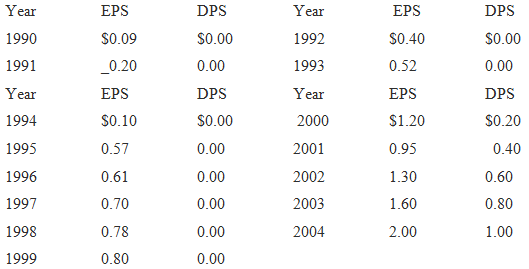
Microtech Corporation is expanding rapidly, and it currently needs to retain all of its earnings, hence it does not pay any dividends. However, investors expect Microtech to begin paying dividends, with the first dividend of $1.00 coming 3 years from today. The dividend should grow rapidly—at a
Explain how net operating working capital is recovered at the end of a project’s life, and why it is included in a capital budgeting analysis.
The Yoran Yacht Company (YYC), a prominent sailboat builder in Newport, may design a new 30-foot sailboat based on the “winged” keels first introduced on the 12-meter yachts that raced for the America’s Cup. First, YYC would have to invest $10,000 at t _ 0 for the design and model tank
Project K has a cost of $52,125, its expected net cash inflows are $12,000 per year for 8 years, and its cost of capital is 12 percent. (Hint: Begin by constructing a time line.)a. What is the project’s payback period (to the closest year)?b. What is the project’s discounted payback
Nixon Communications is trying to estimate the first-year operating cash flow (at t = 1) for a proposed project. The financial staff has collected the following information:Projected sales $10 millionOperating costs (not including depreciation) $7 milliondepreciation $2 millionInterest expense $2
You buy a share of The Ludwig Corporation stock for $21.40. You expect it to pay dividends of $1.07 $1.1449, and $1.2250 in Years 1, 2, and 3, respectively, and you expect to sell it at a price of $26.22 at the end of 3 years.a. Calculate the growth rate in dividends.b. Calculate the expected
Showing 100 - 200
of 20267
1
2
3
4
5
6
7
8
9
10
11
12
13
14
15
Last
Step by Step Answers

 Get 50% OFF
Claim Now
Get 50% OFF
Claim Now


.PNG)
.PNG)
.PNG)
.PNG)
.PNG)
.PNG)
.PNG)
.PNG)
.PNG)
.PNG)
.PNG)
.PNG)
.PNG)
.PNG)


