New Semester
Started
Get
50% OFF
Study Help!
--h --m --s
Claim Now
Question Answers
Textbooks
Find textbooks, questions and answers
Oops, something went wrong!
Change your search query and then try again
S
Books
FREE
Study Help
Expert Questions
Accounting
General Management
Mathematics
Finance
Organizational Behaviour
Law
Physics
Operating System
Management Leadership
Sociology
Programming
Marketing
Database
Computer Network
Economics
Textbooks Solutions
Accounting
Managerial Accounting
Management Leadership
Cost Accounting
Statistics
Business Law
Corporate Finance
Finance
Economics
Auditing
Tutors
Online Tutors
Find a Tutor
Hire a Tutor
Become a Tutor
AI Tutor
AI Study Planner
NEW
Sell Books
Search
Search
Sign In
Register
study help
business
finance
Financial Management Theory And Practice 12th Edition Eugene F. Brigham And Michael C. Ehrhardt - Solutions
What is a corporate beta? How does it differ from a market beta?MINI CASE Sandra McCloud a finance major in her last term of college is currently scheduling her placement interviews through the university's career resource center. Her list of companies is typical of most finance majors:
In general, how is project risk actually measured within not-for-profit businesses? How is project risk incorporated into the decision process?MINI CASE Sandra McCloud a finance major in her last term of college is currently scheduling her placement interviews through the university's career
What are municipal bonds? How do not-for-profit health care businesses access the municipal bond market?MINI CASE Sandra McCloud a finance major in her last term of college is currently scheduling her placement interviews through the university's career resource center. Her list of companies
What is credit enhancement, and what effect does it have on debt costs?MINI CASE Sandra McCloud a finance major in her last term of college is currently scheduling her placement interviews through the university's career resource center. Her list of companies is typical of most finance majors:
What are a not-for-profit business's sources of fund capital?MINI CASE Sandra McCloud a finance major in her last term of college is currently scheduling her placement interviews through the university's career resource center. Her list of companies is typical of most finance majors: several
What impact does the inability to issue common stock have on a not-for-profit business's capital structure and capital budgeting decisions?MINI CASE Sandra McCloud a finance major in her last term of college is currently scheduling her placement interviews through the university's career
What unique problems do not-for-profit businesses encounter in financial analysis and planning? What about short-term financial management?MINI CASE Sandra McCloud a finance major in her last term of college is currently scheduling her placement interviews through the university's career
What are investment returns? What is the return on an investment that costs $1,000 and is sold after one year for $1,100?
Why is the t-bill’s return independent of the state of the economy? Do t-bills promise a completely risk-free return?
Why are Alta Ind.’s returns expected to move with the economy whereas Repo Men’s are expected to move counter to the economy?
Calculate the expected rate of return on each alternative and fill in the blanks on the row for in the table above.
You should recognize that basing a decision solely on expected returns is only appropriate for risk neutral individuals. Since your client, like virtually everyone, is risk averse, the riskiness of each alternative is an important aspect of the decision. One possible measure of risk is the standard
What type of risk is measured by the standard deviation?
Draw a graph which shows roughly the shape of the probability distributions for Alta Inds, Am Foam, and T-bills.
Suppose you suddenly remembered that the coefficient of variation (CV) is generally regarded as being a better measure of stand-alone risk than the standard deviation when the alternatives being considered have widely differing expected returns. Calculate the missing CVs, and fill in the blanks on
Suppose you created a 2-stock portfolio by investing $50,000 in Alta Inds and $50,000 in Repo Men.Calculate the expected return ( p), the standard deviation (σp), and the coefficient of variation (cvp) for this portfolio and fill in the appropriate blanks in the table above.
How does the riskiness of this 2-stock portfolio compare with the riskiness of the individual stocks if they were held in isolation?
Suppose an investor starts with a portfolio consisting of one randomly selected stock. What would happen (1) to the riskiness and (2) to the expected return of the portfolio as more and more randomly selected stocks were added to the portfolio? What is the implication for investors? Draw a graph
Should portfolio effects impact the way investors think about the riskiness of individual stocks?
If you decided to hold a 1-stock portfolio, and consequently were exposed to more risk than diversified investors, could you expect to be compensated for all of your risk; that is, could you earn a risk premium on that part of your risk that you could have eliminated by diversifying?
How is market risk measured for individual securities? How are beta coefficients calculated?
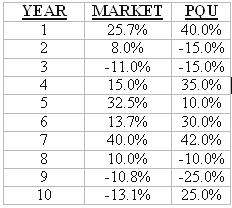
Suppose you have the following historical returns for the stock market and for another company, P.Q. Unlimited. Explain how to calculate beta, and use the historical stock returns to calculate the beta for PQU. Interpret your results.
Do the expected returns appear to be related to each alternative’s market risk? (2) Is it possible to choose among the alternatives on the basis of the information developed thus far?
Write out the security market line (SML) equation, use it to calculate the required rate of return on each alternative, and then graph the relationship between the expected and required rates of return.
How do the expected rates of return compare with the required rates of return?
Does the fact that Repo Men has an expected return which is less than the t-bill rate make any sense?
What would be the market risk and the required return of a 50-50 portfolio of Alta Inds and Repo Men of Alta Inds and Am. Foam?
Suppose investors raised their inflation expectations by 3 percentage points over current estimates as reflected in the 8 percent t-bill rate. What effect would higher inflation have on the SML and on the returns required on high- and low-risk securities?
Suppose instead that investors’ risk aversion increased enough to cause the market risk premium to increase by 3 percentage points. (Inflation remains constant.) What effect would this have on the SML and on returns of high- and low-risk securities?
Financial managers are more concerned with investment decisions relating to real assets such as plant and equipment than with investments in financial assets such as securities. How does the analysis that we have gone through relate to real asset investment decisions, especially corporate capital
Suppose asset A has an expected return of 10 percent and a standard deviation of 20 percent. Asset B has an expected return of 16 percent and a standard deviation of 40 percent. If the correlation between A and B is 0.4, what are the expected return and standard deviation for a portfolio
Plot the attainable portfolios for a correlation of 0.4. Now plot the attainable portfolios for correlations of +1.0 and -1.0.
Suppose a risk-free asset has an expected return of 5 percent. By definition, its standard deviation is zero, and its correlation with any other asset is also zero. Using only asset A and the risk-free asset, plot the attainable portfolios.
Construct a reasonable, but hypothetical, graph which shows risk, as measured by portfolio standard deviation, on the x axis and expected rate of return on the y axis. Now add an illustrative feasible (or attainable) set of portfolios, and show what portion of the feasible set is efficient. What
Now add a set of indifference curves to the graph created for part B. What do these curves represent? What is the optimal portfolio for this investor? Finally, add a second set of indifference curves which leads to the selection of a different optimal portfolio. Why do the two investors choose
What is the capital asset pricing model (CAPM)? What are the assumptions that underlie the model?
Now add the risk-free asset. What impact does this have on the efficient frontier?
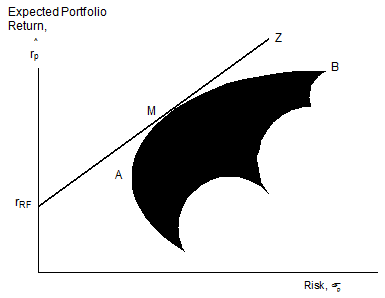
Write out the equation for the capital market line (CML) and draw it on the graph. Interpret the CML. Now add a set of indifference curves, and illustrate how an investor's optimal portfolio is some combination of the risky portfolio and the risk-free asset. What is the composition of the risky
What is a characteristic line? How is this line used to estimate a stock’s beta coefficient? Write out and explain the formula that relates total risk, market risk, and diversifiable risk.
What are two potential tests that can be conducted to verify the CAPM? What are the results of such tests? What is roll’s critique of CAPM tests?
Briefly explain the difference between the CAPM and the arbitrage pricing theory (APT).
Suppose you are given the following information. The beta of company, bi, is 0.9, the risk free rate, rRF, is 6.8%, and the expected market premium, rM-rRF, is 6.3%. Because your company is larger than average and more successful than average (i.e., it has a lower book-to-market ratio), you think
What is capital budgeting?
What is the difference between independent and mutually exclusive projects?
What is the payback period? Find the paybacks for franchises L and S.
What is the rationale for the payback method? According to the payback criterion, which franchise or franchises should be accepted if the firm's maximum acceptable payback is 2 years, and if franchises L and S are independent if they are mutually exclusive?
What is the difference between the regular and discounted payback periods?
What is the main disadvantage of discounted payback? Is the payback method of any real usefulness in capital budgeting decisions?
Define the term net present value (NPV). What is each franchise's NPV?
What is the rationale behind the NPV method? According to NPV, which franchise or franchises should be accepted if they are independent mutually exclusive?
Would the NPVs change if the cost of capital changed?
Define the term Internal Rate of Return (IRR). What is each franchise's IRR?
How is the IRR on a project related to the YTM on a bond?
What is the logic behind the IRR method? According to IRR, which franchises should be accepted if they are independent mutually exclusive?
Would the franchises' IRRs change if the cost of capital changed?
Draw NPV profiles for franchises L and S. At what discount rate do the profiles cross?
Look at your NPV profile graph without referring to the actual NPVs and IRRs. Which franchise or franchises should be accepted if they are independent mutually exclusive? Explain. Are your answers correct at any cost of capital less than 23.6 percent?
What is the underlying cause of ranking conflicts between NPV and IRR?
What is the "reinvestment rate assumption”, and how does it affect the NPV versus IRR conflict?
Which method is the best? Why?
Define the term Modified IRR (MIRR). Find the MIRRs for franchises L and S.
What are the MIRR's advantages and disadvantages vis-à-vis the regular IRR? What are the MIRR's advantages and disadvantages vis-à-vis the NPV?
What are normal and non-normal cash flows?
What is project Ps NPV? What is its IRR Its MIRR?
Draw project P's NPV profile. Does project P have normal or non-normal cash flows? Should this project be accepted?
What is each project's initial npv without replication?
Now apply the replacement chain approach to determine the projects’ extended NPVs. Which project should be chosen?What is each project's initial npv without replication?
Now assume that the cost to replicate project S in 2 years will increase to $105,000 because of inflationary pressures. How should the analysis be handled now, and which project should be chosen?What is each project's initial npv without replication?
You are also considering another project which has a physical life of 3 years; that is, the machinery will be totally worn out after 3 years. However, if the project were terminated prior to the end of 3 years, the machinery would have a positive salvage value. Here are the project's estimated cash
After examining all the potential projects, you discover that there are many more projects this year with positive NPVs than in a normal year. What two problems might this extra large capital budget cause?What is each project's initial npv without replication?
Why are ratios useful? What are the five major categories of ratios?
Calculate the 2005 current and quick ratios based on the projected balance sheet and income statement data. What can you say about the company’s liquidity position in 2003, 2004, and as projected for 2005? We often think of ratios as being useful (1) to managers to help run the business, (2) to
Calculate the 2005 inventory turnover, days sales outstanding (DSO), fixed assets turnover, and total assets turnover. How does Computron’s utilization of assets stack up against other firms in its industry?
Calculate the 2005 debt, times-interest-earned, and EBITDA coverage ratios. How does Computron compare with the industry with respect to financial leverage? What can you conclude from these ratios?
Calculate the 2005 profit margin, basic earning power (BEP), return on assets (ROA), and return on equity (ROE). What can you say about these ratios?
Calculate the 2005 price/earnings ratio, price/cash flow ratios, and market/book ratio. Do these ratios indicate that investors are expected to have a high or low opinion of the company?
Perform a common size analysis and percent change analysis. What do these analyses tell you about Computron?
Use the extended Du Pont equation to provide a summary and overview of Computron’s financial condition as projected for 2005. What are the firm’s major strengths and weaknesses?
What are some potential problems and limitations of financial ratio analysis?
What are some qualitative factors analysts should consider when evaluating a company’s likely future financial performance?
Describe three ways that pro forma statements are used in financial planning.
Explain the steps in financial forecasting.
Assume (1) that SEC was operating at full capacity in 2004 with respect to all assets, (2) that all assets must grow proportionally with sales (3) that accounts payable and accruals will also grow in proportion to sales, and (4) that the 2004 profit margin and dividend payout will be maintained.
How would changes in these items affect the AFN? (1) sales increase, (2) the dividend payout ratio increases, (3) the profit margin increases, (4) the capital intensity ratio increases, and (5) SEC begins paying its suppliers sooner. (Consider each item separately and hold all other things
Briefly explain how to forecast financial statements using the percent of sales approach. Be sure to explain how to forecast interest expenses.
Now estimate the 2005 financial requirements using the percent of sales approach. Assume (1) that each type of asset, as well as payables, accruals, and fixed and variable costs, will be the same percent of sales in 2005 as in 2004; (2) that the payout ratio is held constant at 40 percent; (3) that
Why does the percent of sales approach produce a somewhat different AFN than the equation approach? Which method provides the more accurate forecast?
Calculate SEC's forecasted ratios, and compare them with the company's 2004 ratios and with the industry averages. Calculate SEC’s forecasted free cash flow and return on invested capital (ROIC).
Based on comparisons between SEC's days sales outstanding (DSO) and inventory turnover ratios with the industry average figures, does it appear that SEC is operating efficiently with respect to its inventory and accounts receivable? Suppose SEC was able to bring these ratios into line with the
What level of sales could have existed in 2004 with the available fixed assets?
How would the existence of excess capacity in fixed assets affect the additional funds needed during 2005?
The relationship between sales and the various types of assets is important in financial forecasting. The percent of sales approach, under the assumption that each asset item grows at the same rate as sales, leads to an AFN forecast that is reasonably close to the forecast using the AFN equation.
Now calculate the corporate value, the value of the debt that will be issued, and the resulting market value of equity.
Calculate the resulting price per share, the number of shares repurchased, and the remaining shares.
What is operating leverage, and how does it affect a firm's business risk? Show the operating break even point if a company has fixed costs of $200, a sales price of $15, and variables costs of $10.
Construct partial income statements, which start with EBIT, for the two firms
Now calculate roe for both firms.
What does this example illustrate about the impact of financial leverage on ROE?
Explain the difference between financial risk and business risk.
Now consider the fact that EBIT is not known with certainty, but rather has the following probability distribution:Economic State Probability EBITBad
Showing 700 - 800
of 20267
1
2
3
4
5
6
7
8
9
10
11
12
13
14
15
Last
Step by Step Answers

 Get 50% OFF
Claim Now
Get 50% OFF
Claim Now


.PNG)
.PNG)


