







Question: Consider the representation of a ternary relationship using binary relationships as described in Section 2.4.3 (shown in Figure b) a. Show a simple instance of
Consider the representation of a ternary relationship using binary relationships as described in Section 2.4.3 (shown in Figure b)
a. Show a simple instance of E, A, B, C, RA, RB, and RC that cannot correspond to any instance of A, B, C, and R.
b. Modify the E-R diagram of Figure b to introduce constraints that will guarantee that any instance of E, A, B, C, RA, RB, and RC that satisfies the constraints will correspond to an instance of A, B, C, and R.
c. Modify the translation above to handle total participation constraints on the ternary relationship.
d. The above representation requires that we create a primary key attribute for E. Show how to treat E as a weak entity set so that a primary key attribute is notrequired.
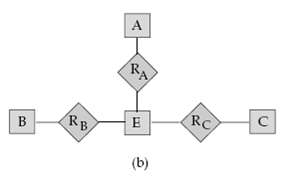
RA RC R B (b)
Step by Step Solution
3.47 Rating (163 Votes )
There are 3 Steps involved in it
a Let E e1 e2 A a1 a2 B b1 C c1 RA e1 a1 e2 a2 RB e1 b1 and ... View full answer

Get step-by-step solutions from verified subject matter experts
Document Format (1 attachment)

16-CS-DB (105).docx
120 KBs Word File
 Study Help