







Question: Icicles Liquid water coats an active (growing) icicle and extends up a short, narrow tube along the central axis (Figure). Because the waterice interface must
(a) Energy conducted upward and
(b) Mass converted from liquid to ice at the top of the central tube?
(c) At what rate does the top of the tube move downward because of water freezing there? The thermal conductivity of ice is 0.400 W/m ˆ™ K, and the density of liquid water is 1000 kg/m3.
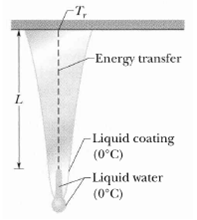
-T, -Energy transfer L. -Liquid coating (0C) -Liquid water (0C)
Step by Step Solution
★★★★★
3.49 Rating (172 Votes )
There are 3 Steps involved in it
1 Expert Approved Answer
Step: 1 Unlock

a Using Eq 1832 we find the rate of energy conducted upward to be 50 ... View full answer
Question Has Been Solved by an Expert!
Get step-by-step solutions from verified subject matter experts
Step: 2 Unlock
Step: 3 Unlock
Document Format (1 attachment)

2-P-T-T (345).docx
120 KBs Word File
 Study Help