Question: Case study Gore-Tex and W.L. Gore & Associates, from the book Trott, P. (2017). Innovation management and new product development (6 th ed). ISBN: 978-1-292-13342-3
Case study Gore-Tex and W.L. Gore & Associates, from the book Trott, P. (2017). Innovation management and new product development(6th ed). ISBN: 978-1-292-13342-3 ;
I need answer for below questions
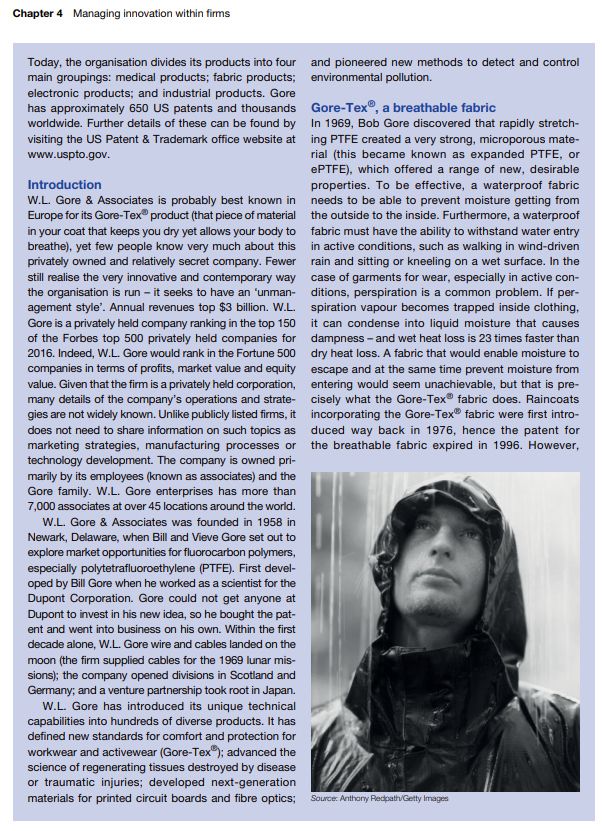
Case study Gore-Tex and W.L. Gore & Associates: an innovative company and a contemporary culture This case study explores the role of organisational creativity. Today, this enigmatic firm employs approx- management and culture within a very innovative imately 7,000 people in more than 45 plants and firm, which is responsible for some very well-known sales locations worldwide. Manufacturing operations products, such as the famous Gore-Tex fabric, and, are clustered in the United States, Germany, yet, few people know very much about this remark- Scotland, Japan and China. Proprietary technologies able organisation. It is operated in a similar way to with the versatile polymer polytetrafluoroethylene that of a cooperative or the John Lewis Partnership in (PTFE) have resulted in numerous products for elec- the United Kingdom, where the employees are also tronic signal transmission; fabric laminates; medical owners. In addition, the organisation seeks to mini- implants; as well as membrane, filtration, sealant and mise management with the emphasis on action and fibre technologies for a range of different industries. Chapter 4 Managing innovation within firms Today, the organisation divides its products into four and pioneered new methods to detect and control main groupings: medical products; fabric products; environmental pollution. electronic products; and industrial products. Gore has approximately 650 US patents and thousands Gore-Tex, a breathable fabric worldwide. Further details of these can be found by In 1969, Bob Gore discovered that rapidly stretch- visiting the US Patent & Trademark office website at ing PTFE created a very strong, microporous mate- www.uspto.gov. rial (this became known as expanded PTFE, or ePTFE), which offered a range of new, desirable Introduction properties. To be effective, a waterproof fabric W.L. Gore & Associates is probably best known in needs to be able to prevent moisture getting from Europe for its Gore-Tex product (that piece of material the outside to the inside. Furthermore, a waterproof in your coat that keeps you dry yet allows your body to fabric must have the ability to withstand water entry breathe), yet few people know very much about this in active conditions, such as walking in wind-driven privately owned and relatively secret company. Fewer rain and sitting or kneeling on a wet surface. In the still realise the very innovative and contemporary way case of garments for wear, especially in active con- the organisation is run - it seeks to have an 'unman- ditions, perspiration is a common problem. If per- agement style'. Annual revenues top $3 billion. W.L. spiration vapour becomes trapped inside clothing, Gore is a privately held company ranking in the top 150 it can condense into liquid moisture that causes of the Forbes top 500 privately held companies for dampness - and wet heat loss is 23 times faster than 2016. Indeed, W.L. Gore would rank in the Fortune 500 dry heat loss. A fabric that would enable moisture to companies in terms of profits, market value and equity escape and at the same time prevent moisture from value. Given that the firm is a privately held corporation, entering would seem unachievable, but that is pre- many details of the company's operations and strate- cisely what the Gore-Tex fabric does. Raincoats gies are not widely known. Unlike publicly listed firms, it incorporating the Gore-Tex fabric were first intro- does not need to share information on such topics as duced way back in 1976, hence the patent for marketing strategies, manufacturing processes or the breathable fabric expired in 1996. However, technology development. The company is owned pri- marily by its employees (known as associates) and the Gore family. W.L. Gore enterprises has more than 7,000 associates at over 45 locations around the world. W.L. Gore & Associates was founded in 1958 in Newark, Delaware, when Bill and Vieve Gore set out to explore market opportunities for fluorocarbon polymers, especially polytetrafluoroethylene (PTFE). First devel- oped by Bill Gore when he worked as a scientist for the Dupont Corporation. Gore could not get anyone at Dupont to invest in his new idea, so he bought the pat- ent and went into business on his own. Within the first decade alone, W.L. Gore wire and cables landed on the moon (the firm supplied cables for the 1969 lunar mis- sions); the company opened divisions in Scotland and Germany, and a venture partnership took root in Japan. W.L. Gore has introduced its unique technical capabilities into hundreds of diverse products. It has defined new standards for comfort and protection for workwear and activewear (Gore-Tex); advanced the science of regenerating tissues destroyed by disease or traumatic injuries; developed next-generation materials for printed circuit boards and fibre optics; Source: Anthony Pedpath/Getty Images Case study new patents are still active on improved methods of making Gore-Tex fabric. There are now many generic versions of breathable fabric on the market. The success of the product has been witnessed largely in the 1990s as outdoor pursuits grew rap- idly in popularity during this period. This led to an explosion in sales of Gore-Tex related products, such as coats, backpacks, shoes and trousers. Indeed, clothing manufacturers who used the Gore- Tex fabric in their garments, such as Berghaus, Karrimor and North Face, became household names, as this once esoteric specialised clothing market became mainstream. Associates are committed to four basic guiding principles articulated by Bill Gore: freedom to encourage, help, and allow other associates to grow in knowledge, skill, and scope of faimess to each other and everyone with whom we come in contact; responsibility; the ability to make one's own commitments and keep them; and consultation with other associ- ates before undertaking actions that could impact the reputation of the company by hitting it below the waterline. (Gore, 2003) Working within W.L. Gore Associates Non-hierarchical corporate culture The very unusual organisational structure and man- The firm's unique structure was born out of Bill Gore's agement sets this firm apart from its competitors. frustration with a large corporate bureaucracy; the Moreover, there is some evidence to support its claim W.L. Gore culture seeks to avoid taxing creativity with to be highly creative and innovative, as Gore-US has conventional hierarchy. The company encourages made all annual lists of the '100 Best Companies to hands-on innovation, involving those closest to a pro- Work for' in Fortune magazine from 1998 to 2016. Its ject in decision making; hence decision making is UK firm was ranked the second best place to work in based on knowledge rather than seniority. Teams the UK in 2016 www.greatplacetowork.co.uk/. Often, organise around opportunities and leaders emerge it is cited as a model for effective management of based on the needs and priorities of a particular busi- innovation and the firm is proud of its heritage and ness unit. The company bases its business philoso- how it works: phy on the belief that, given the right environment, We encourage hands-on innovation, involving there is no limit to what people can accomplish. those closest to a project in decision-making. business, W.L. Gore & Associates has developed The formula seems to have worked. In 40 years of Teams organize around opportunities and leaders emerge. Our founder, Bill Gore created a flat lattice hundreds of unique products that reflect an underly- ing commitment to fluoropolymer technologies. The organization. There are no chains of command nor company is passionate about innovation and has pre-determined channels of communication built a unique work environment to support it based Instead, we communicate directly with each other on a corporate culture that encourages creativity, ini- and are accountable to fellow members of our tiative and discovery. According to Gore: multi-disciplined teams. Associates are hired for general work areas. You won't find the trappings of a traditional corpo With the guidance of their sponsors (not bosses) rate structure here: no rigid hierarchy, no bosses, and a growing understanding of opportunities and and no predictable career ladder. Instead, you'll team objectives, associates commit to projects find direct communication, a team oriented atmos- that match their skills. Everyone can quickly eam phere, and one title - associate - that's shared by the credibility to define and drive projects. everyone. It's an unusual corporate culture that Sponsors help associates chart a course in the contributes directly to the business' success by organization that will offer personal fulfilment while encouraging creativity and opportunity. maximizing their contribution to the enterprise. (Gore, 2003) Leaders may be appointed, but are defined by fol- lowership. More often, leaders emerge naturally The last principle is meant to protect the company by demonstrating special knowledge, skill, or from inappropriate risk. Whilst employees are given experience that advances a business objective. wide latitude to pursue entrepreneurial opportunities, Chapter 4 Managing innovation within firms no one can initiate projects involving significant individual life insurance, family life insurance and corporate financial commitments without thorough health care or dependent care spending accounts. review and participation by qualified associates. An individual starting at W.L. Gore is assigned three Unique characteristics of ownership culture sponsors. A starting sponsor helps get the associate W.L. Gore believes that, given the right environment, acquainted with W.L. Gore. An advocate sponsor there is no limit to what people can accomplish. That is makes sure the associate receives credit and recogni- where the W.L. Gore lattice system comes in to play. It tion for their work and a compensation sponsor makes gives the associates the opportunity to use their own sure the associate is paid fairly. One person can fill all judgement, select their own projects and directly three sponsor roles. Compensation is determined by access the resources they need to be successful. committees and relies heavily on evaluations by other Another unique aspect of the lattice system is the associates as well as the compensation sponsor. company's insistence that no single operating division become larger than 200 people in order to preserve Employee ownership structure the intimacy and ease of communications amongst The goal of Gore's highly flexible and competitive pro- smaller work groups. As divisions grow, they are sepa- gramme is to maximise freedom and fairness for each rated into constituent parts to preserve that culture. associate. The benefit plans consist of core benefits and flexible benefits. Core benefits are basic plans Discussion and services provided by Gore to all eligible associ- This case illustrates some of the organisational char- ates. They include an Associate Stock Ownership acteristics that are necessary for innovation to occur. Plan, holidays, profit sharing, sick pay, basic life insur- The unique organisational model seems to work for ance, travel accident insurance and adoption aid. W.L. Gore. It is certainly contemporary and does The Associate Stock Ownership Plan (ASOP) is seem to help to unleash creativity and to foster team- the most valuable financial benefit. Its purpose is to work in an entrepreneurial environment that seeks to provide equity ownership and, through this owner- provide maximum freedom and support for its ship, to provide financial security for retirement. All employees (associates). Many of the organisational associates have an opportunity to participate in the characteristics are not, however, unique to W.L. Gore growth of the company by acquiring ownership in it and there are many other firms where these charac- Every year, W.L. Gore contributes up to 15 per cent teristics can be found, such as 3M, Hewlett-Packard, of pay to an account that purchases W.L. Gore Coming, Dyson, BP and Shell. It does reinforce the stock for each participating associate. W.L. Gore need for firms wishing to be innovative to adopt these contributes the same percentage of pay for each characteristics (see Table 4.2). associate active in the plan. An associate is eligible There are several key characteristics that help for this benefit after one full year of employment and make the W.L. Gore company successful, both finan- qualifies for full ownership of their accounts after cially and as a place to work. First, the high-quality five years of service, when they are fully vested. technology and heritage of the firm that encourages Valued quarterly, W.L. Gore stock is privately held an emphasis on developing superior products. and is not traded on public markets. The ASOP, Second, the use of small teams encourages direct although it does not own all of the W.L. Gore shares, one-on-one communication; this contributes to the does own a majority of them, with the remainder ability to make timely, informed decisions and get owned by the Gore family. products to market very quickly. Third, the channels Associates also qualify for cash profit-sharing dis- of communications are very open, the lattice struc- tributions when corporate profit goals have been ture allowing all employees the freedom to meet and reached. Profit-sharing distributions typically occur an discuss projects, situations, concerns and share con- average of twice a year. In addition, each pay period gratulations with everyone. Fourth, W.L. Gore associates are provided with pre-tax benefits, called believes that providing equity compensation to its flex dollars, to use for the purchase of 'flexible bene- employees establishes a sense of ownership and fits. These include medical plans, dental plans, long- increased commitment amongst its employees. The term disability insurance, personal days, supplemental ASOP programme at W.L. Gore is the majority owner Chapter summary of the company. Fifth, W.L. Gore provides a compre- wants to become involved in and attempt to win a hensive set of employee benefits and is continually price war in these markets or to try to offer superior looking for ways to improve upon what is currently name-brand products. Alternatively, it could decide available. Sometimes, that just means re-evaluating to rely on its traditional approach of utilising its what the employees want and need. Finally, making R&D to develop new product applications that will sure that the individual work groups do not get too enable it to enter new markets, often as the sole large to be effective is a key element of 'right-sizing' business offering certain product types. Gore may for the company culture. This way, W.L. Gore main- need to reassess its R&D activities to focus on spe- tains a sense of intimacy and ease of communica- cific and marketable new technology if it wishes to tions amongst its work groups. keep its position as the technological leader in Whilst the employee share ownership sounds many of its industries. Rather than allowing indi- attractive, any decrease in performance and fall in vidual associates to organise and conduct their value of the shares can cause enormous resentment own projects, more emphasis could be placed on within the firm as they see the value of their savings strategic R&D programmes where the business decrease. And, unlike publicly listed firms, these sees opportunities for growth to enable it to create shareholders cannot remove the managers. W.L. new ventures. Gore's competitors are varied and diverse: there is no single company that competes with Gore in every Sources: Anfuso, D. (1999) 'Core values shape W.L. Gore's inno- product area. Firms such as Bayer, Hoecht, Coming, vative culture', Workforce magazine (US), March, 48-53; Gore (2003) Extract from the W.L. Gore Associates website; Harrison, Dow and Du-Pont all compete in Gore's product fields: L. (2002) 'We're all the boss', Time, Inside Business edition, 8 medical, fabric, industrial and electronic applications. April; McCall, A. (ed.) (2002) 'The firm that lets staff breathe', The The business strategy pursued by W.L. Gore Sunday Times (London), 24 March, '100 Best Companies to Asssociates has been very successful to date. Work For', special section; Milford, M. (1996) 'A company phi- losophy in bricks and mortar', New York Times, 1 September, However, in some of its markets, competition is Sec. Rp. 5. The Sunday Times (2007) '100 Best Companies to beginning to emerge. Gore must decide whether it Work For' supplement, 11 March Questions 1 Explain what happened to the Gore-Tex brand after the patent expired. What activity can firms use to try to maintain any advantage developed during the patent protection phase? 2 List some of the wide range of products where the Gore-Tex fabric has been applied. 3 It seems that Gore Associates is heavily oriented towards technology, what are some of the dangers of being too heavily focused on technology? 4 Cooperatives and share-ownership schemes provide many attractions and benefits, but there are also limitations; discuss these. 5 What has been the Gore strategy to achieving success in its markets? How is this strategy now being challenged? 6 Using CIM (Figure 1.9) illustrate the innovation processes within W.L. Gore. Note: This case has been written as a basis for class discussion rather than to illustrate effective or ineffective managerial or adminis- trative behaviour. It has been prepared from a variety of published sources, as indicated, and from observations. Chapter summary This chapter has helped to explain how firms can manage innovation. In particular, it explored the organisational environment and the activities performed within it that are necessary for innovation to occur. Emphasis was placed on the issue of uncertainty and how different types of projects require different types of skills. 149









 Study Help