







Question: Make versus buy, activity-based costing opportunity costs. (N. Melumad and S. Reichelstein, adapted) The Ace Company produces bicycles. This years expected production is 10,000 units.
Make versus buy, activity-based costing opportunity costs. (N. Melumad and S. Reichelstein, adapted) The Ace Company produces bicycles. This year’s expected production is 10,000 units. Currently, Ace makes the chains for its bicycles. Ace’s management accountant reports the following costs for making the 10,000 bicycle chains:
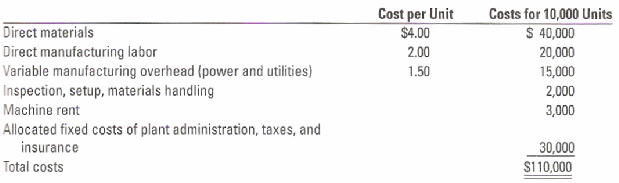
Ace has received an offer from an outside vendor to supply any number of chains Ace requires at $8.20 per chain. The following additional information is available:
a. Inspection, setup, and materials-handling costs vary with the number of batches in which the chains are produced. Ace produces chains in batch sizes of 1,000 units. Ace will produce the 10,000 units in 10 batches.
b. Ace rents the machine used to make the chains. If Ace buys all of its chains from the outside vendor, it does not need to pay rent on this machine.
1. Assume that if Ace purchases the chains from the outside vendor, the facility where the chains are currently made will remain idle. On the basis of financial considerations alone, should Ace accept the outside vendor’s offer at the anticipated production (and sales) volume of 10,000 units? Show your calculations.
2. For this question, assume that if the chains are purchased outside, the facilities where the chains are currently made will be used to upgrade the bicycles by adding mud flaps and reflectors. As a consequence, the selling price of bicycles will be raised by $20. The variable cost per unit of the upgrade would be $18, and additional tooling costs of $16,000 would be incurred. On the basis of financial considerations alone, should Ace make or buy the chains, assuming that 10,000 units are produced (and sold)? Show your calculations.
3. The sales manager at Ace is concerned that the estimate of 10,000 units may be high and believes that only 6,200 units will be sold. Production will be cut back, freeing up work space. This space can be used to add the mud flaps and reflectors whether Ace buys the chains or makes them in-house. At this lower output Ace will produce the chains in 8 batches of 775 units each. On the basis of financial considerations alone, should Ace purchase the chains from the outside vendor? Show your calculations.
Cost per Unit Costs for 10,000 Units Direct materials Direct manufacturing labor Variable manufacturing overhead (power and utilities) Inspection, setup, materials handling Machine rent Allocated fixed costs of plant administration, taxes, and insurance Total costs $4.00 2.00 1.50 S 40,000 20,000 15,000 2,000 3,000 30,000 S110,000
Step by Step Solution
3.39 Rating (155 Votes )
There are 3 Steps involved in it
Make versus buy activitybased costing opportunity costs 1 Relevant costs under buy alternative Purchases 10000 d7 820 82000 Relevant costs under make ... View full answer

Get step-by-step solutions from verified subject matter experts
Document Format (1 attachment)

24-B-C-A-D-M (36).docx
120 KBs Word File
 Study Help