New Semester
Started
Get
50% OFF
Study Help!
--h --m --s
Claim Now
Question Answers
Textbooks
Find textbooks, questions and answers
Oops, something went wrong!
Change your search query and then try again
S
Books
FREE
Study Help
Expert Questions
Accounting
General Management
Mathematics
Finance
Organizational Behaviour
Law
Physics
Operating System
Management Leadership
Sociology
Programming
Marketing
Database
Computer Network
Economics
Textbooks Solutions
Accounting
Managerial Accounting
Management Leadership
Cost Accounting
Statistics
Business Law
Corporate Finance
Finance
Economics
Auditing
Tutors
Online Tutors
Find a Tutor
Hire a Tutor
Become a Tutor
AI Tutor
AI Study Planner
NEW
Sell Books
Search
Search
Sign In
Register
study help
mathematics
statistics
Introduction To Probability 1st Edition Mark Daniel Ward, Ellen Gundlach - Solutions
Let X, Y have joint density fX,Y (x,y) = 6/7(x+y)2 For 0 ≤ x,y ≤ 1 And fX,Y (x,y) = 0 otherwise Find P(X ≤ 1/2, Y ≤ 1/2).
Consider a pair of random variables X, Y with joint density fX,Y(x, y) = 8e-2x-4y, for 0 < x,0, < y, And fX,Y (x, y) = 0 otherwise. Find P(X ≤ 4,Y ≤ 8).
Let X,Y have constant density on the square where 0 ≤ X ≤ 4, 0 ≤ Y≤ 4. Find P(X+Y< 4).
If X and Y have joint density fX,Y(x, y) = 9/32 x2y2, for |x| ≤ 1 and |y| ≤ 2, and fX,Y (x,y) = 0 otherwise, find the probability that X and Y are both positive.
Consider X, Y with joint density fX,Y (x,y) = 10e-2x-5y, for 0 < x, 0 < y, And fX,Y (x,y) = 0 otherwise. Find P(X < 2, Y < 1).
Consider the random variables X and Y defined in Example 25.5, i.e., X is Maxine's waiting time, and Y is Daniella's waiting time. Let W = max(X, Y), i.e., W is either Maxine's or Daniella's waiting time, whichever is larger! Find FW(w) = P(W ≤ w), the cumulative distribution function of W. This
Freddy and Jane have entered a game in which they each win between 0 and 2 dollars. If X is the amount Freddy wins, and Y is the amount that Jane wins, they believe that the joint density of their winnings will be fX,Y(x,y) = 1/4xy for 0 ≤ x ≤ 2 and 0 ≤ y ≤ 2, And fX,Y (x,y) = 0 otherwise.
If X and Y have joint distribution fX,Y (x,y) = sinx cosy, for 0 ≤ x,y ≤ π/2, And fX,Y (x,y) = 0 otherwise, then find the probability that X and Y are both smaller than π/6.
Consider a pair of random variables X, Y with constant joint density on the quadrilateral with vertices (0, 0), (2, 0), (2, 6), (0, 12). Find P (Y ≥ 3X).
If X and Y have joint distribution fX,Y (x,y) = 1/4cosx siny +1/4 for -1 ≤ x, y ≤ 1, And fX,Y (x,y) = 0 otherwise, then find the probability that 0 ≤ X ≤ 1/2 and Y≤2X.
Suppose that X, Y are jointly distributed with fX,Y (x,y) = 1/10, for (x, y) in the triangle with vertices at the origin, (2,0), and (0,10), and fX,Y (x,y) = 0 otherwise. Find the probability that Y ≤ 2.
Consider X, Y with joint density fX,Y (x,y) = sech2x/(y+1)2 for x ≥ 0 and y ≥ 0, and fX,Y (x,y) = 0 otherwise. Find P(X ≤ 2,Y ≤ 2). (The function "sech" is the hyperbolic secant, which should be familiar to many readers who recently completed a course in calculus. Other readers may choose
Consider X, Y with joint densityfX,Y (x,y) = 1/4πfor x2 + y2 ≤ 4,and fX,Y (x,y) = 0 otherwise. Find the probability that (X, Y) is at most 1 unit from the origin and is located in the first quadrant, i.e., that X ≥ 0 and Y ≥ 0 and X2 + Y2 ≤ 1.
Suppose that the joint PDF of X and Y is f(x,y) = 2e-x-y for 0 < y < x < ∞, and f(x, y) = 0 otherwise. a. Find fx(X), the density of X. b. Find fy(Y), the density of Y.
Let X, Y have joint densityFind P(X > Y)
Suppose X, Y have joint densityFind P (|X-Y|
Suppose X, Y have joint densityFind P{Y > X).
Consider random variables X and Y with joint density fX, Y (x, y) = 1/8 (1 - x2) (3 - y) for -1 ≤ x ≤ 1 and -1 ≤ y ≤ 1, And fx, y (x,y) = 0 otherwise. Find the probability that X and Y are both negative.
Let X, Y have joint density fx, y (x, y) = 3/38750 (x3 + y2), for 0 ≤ x ≤ 10 and 0 ≤ y ≤ 5, And fx. y (x, y) = 0 otherwise. Find P (X ≤ 5, y ≤ 2).
Suppose X, Y are jointly distributed with joint densityfx, y (x, y) = 1/304(x + l)(y2 + 1),for 0 ≤ x, y ≤ 4,And fx, y (x, y) = 0 otherwise.a. Find P (l ≤ X ≤ 2, 3 ≤ Y ≤ 4).b. Find the density of X.c. Find the density of Y.
Consider X, Y with joint densityfX,Y(x,y) = 9/64x2y2,for 0 ≤ x,y ≤ 2, 0 ≤ y ≤ 2,and fX,Y(x,y) = 0 otherwise.a. Find P(X < 1,Y < 1).b. Find P(X > l,y < 1).c. Find P(X > 1, Y > 1).d. Check that the answers from parts a-d sum to 1. Exercise
Suppose X,Y have joint densitya. Are X and Y independent? Why or why not?b. Find the density fX(x) of X.c. Find the density fY(y) of Y.
Suppose that X, Y have constant joint density on the triangle with corners at (4, 0), (0, 4), and the origin.a. Find P(X < 3, Y < 3).b. Are X and Y independent?
Suppose X and Y have joint densityfX,Y (x,y) = 18x2y5for 0 < x < 1, 0 < y < 1and fX,Y (x,y) = 0 otherwise.a. Are X and Y independent?b. Find P(X < 1/2).c. Find P(Y < 1/2).d. Find P(X + Y < 1).
Suppose X and Y have joint density fx,y (x, y) = 1512x2y5, for 0 < x, 0 < y, x + y < 1 and fX,Y(x,y) = 0 otherwise. a. Are X and Y independent? b. Find P(X < 1/2). c. Find P(Y < 1/2). d. Find P(X + Y < 1/2).
Let X and Y have constant joint density on the parallelogram with corners at the origin, (1,1), (1,2), and (0,1). a. Find the joint density fX,Y (x,y). b. Find P(Y < 3/2).
Suppose X and Y have joint densityfX,Y (x,y) = (18 - 2x2)/3x2y3,for 1 ≤ x ≤ 2, 1/2 ≤ y ≤ 1and fX,Y (x,y) = 0 otherwise.a. Are X and Y independent?b. Find P(X < 3/2, Y < 3/4).
Let X, Y, Z have joint densityfX,Y,Z (x,y,z) = 6,for 0 < x < y < z < land fX,Y,Z (x,y,z) = 0 otherwise.a. Are X and Y and Z independent?b. Find the density fX(x) of X.c. Find the density fY(y) of Y.d. Find the density fZ(z) of Z.
Consider two random variables X and Y with joint density fX,Y (x,y) = x/8 + y/8, for 0 < x < 2, 0 < y < 2 and fX,Y (x,y) = 0 otherwise. a. Are X and V independent? b. Find P(X > 1) and P(Y > 1). c. Find P(X + Y < 2).
If X and Y have joint densityfX,Y (x, y) = 75xe-5x-3y,for 0 < x, 0 < yand fX,Y(x,y) = 0 otherwise:a. Are X and Y independent?b. Find P(X < Y).
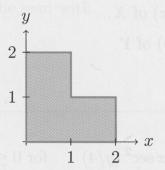
Suppose X and Y have constant density on the region in Figure 26.2.a. Are X and Y independent?b. Find P{X + Y < 2).c. Find P(X + Y < 2.5).
If the pair of random variables X and Y have fX,Y (x,y) = 180x2y2, for 0 < x, 0 < y, and x + y < 1 and fX,Y (x,y) = 0 otherwise, find P(X + Y > 1/2).
Let X, Y have joint densityfX,Y (x,y) = 9/32 √xyfor 0 ≤ x ≤ 1, 0 ≤ y ≤ 4and fX,Y (x,y) = 0 otherwise.a. Are X and Y independent?b. Find P(X < Y).c. Find P(X < 2Y).d. Find P(X < 4Y).
Let X, Y have joint densityfX,Y (x,y) = 3/32 (x - y),for 0 ≤ y ≤ x ≤ 4and fX,Y(x,y) = 0 otherwise.a. Are X and Y independent?b. Find P(X < 2).c. Find P(Y < 2).
Let X, Y have joint densityfX,Y (x,v) = (8-2x)(3-y)/256for -2 ≤ x ≤ 2, -2 ≤ y ≤ 2and fX,Y (x,y) = 0 otherwise.a. Are X and Y independent?b. Find the density fX(x) of X.c. Find the density fY(y) of Y.
LetfX,Y (x,y) = 1/8 sinxsec2 (y/4)for 0 ≤ x ≤ π, 0 ≤ y ≤ πand fX,Y (x,y) = 0 otherwise. Find:a. The density fX{x) of X.b. The density fY(y) of Y.c. P(X < π/2,Y < π/2).
Suppose X and F have joint densityfX,Y(x,y) = 2sech2(l/:r)/y3for 0 < x < y,and fX,Y(x,y) = 0 otherwise.a. Show that fX,Y(x,y) is a joint density, i.e., the integral over all x's and y's is 1.b. Are X and Y independent?
When X and Y have joint density fX,Y(x,y) = 2x2y2/ex+2y for 0 < x, 0 < y and fX,Y(x,y) = 0 otherwise, find P(X < Y).
When X, Y have joint densityfX,Y (x,y) =.x2/yln2for 0 ≤ x ≤ 1, 1/2 ≤ y ≤ 4,and fX,Y(x,y) = 0 otherwise, find:a. The density fX(x) of X.b. The density fY(y) of Y.
Let X, Y have joint densityfX,Y(x, y) = 2x/45,for 0 ≤ x ≤ 3, 0 ≤ y ≤ 5and fX,Y (x,y) = 0 otherwise.a. Are X and Y independent?b. Find the density fX(x) of X.c. Find the density fY(y) of Y.
Let X,Y have joint densityfX,Y (x, y) = 3x,y/1250,for 0 ≤ x, 0 ≤ y, x + y ≤ 10and fX,Y(x,y) = 0 otherwise.a. Are X and Y independent?b. Find the density fx(x) of X.c. Find the density fy(y) of Y.
When an emergency occurs, the response time (in hours) of the first police car is a random variable X with density fx(x) = I2e-12x for x > 0, and fX (x) = 0 otherwise. The response time (in hours) of the first fire engine is a random variable Y with density fY(y) = 10e-10y for y > 0, and fY(y) = 0
Police cars are randomly stationed throughout the town. When an emergency occurs, the distance a police car must travel north or south is a random variable X with density fX(x) = 1/6 for 0 ≤ x ≤ 6, and fX{x) = 0 otherwise. The distance a police car must travel east or west is a random variable
LetfX,Y(x,y) = (9/64√2) (x2)(√y)for 0 < x < 2, 0 < y < 2,and fX,Y (x,y) = 0 otherwise.a. Are X and Y independent? Why?b. Find P(X ≤ 1).c. Find P(Y ≤ 1).d. Find P(X +Y ≤ 1).
Suppose X and Y have joint densityfX,Y(x,y) = e-x-y,for 0 < x and 0 < y,and fX,Y (x,y) = 0 otherwise.a. Are X and Y independent?b. Find P(X < 2, Y < 2).c. Compare with the situation in which X and Y have joint densityfX,Y (x,y) = 2e-x-y,for 0 < z < and fX,Y (x,y) = 0 otherwise.
Find (a) the density (y) of y, (b) the conditional density fX|Y(x | y) of X given Y. Let fX,Y(x,y) = 15/256 x2y, for 0 ≤ x, 0 ≤ y, x + y ≤ 4, and fX,Y(x, y) = 0 otherwise.
Let fX,Y(x, y) = 3/2xy, for 0 ≤ x, 0 ≤ y, x + y ≤ 2, and fX,Y (x,y) = 0 otherwise. find (a) the density fy(y) of y, and (b) the conditional density fx\y(x | y) of X" given Y.
Consider a pair of random variables X, Y with constant joint density on the triangle with vertices at (0, 0), (3, 0), and (0, 3). a. For 0 < y < 3, find the conditional density fX|Y (x | y) of X, given Y = y. b. Find the conditional probability that X ≤ 1, given Y = 1. c. Find the conditional
Consider a pair of random variables X, Y with constant joint density on the quadrilateral with vertices (0, 0), (2, 0), (2, 6), (0, 12).a. For 0 ≤ y ≤ 6, find the conditional density fX|Y (x | y) of X, given Y = y.b. For 6 ≤ y ≤ 12, find the conditional density fX|Y(x | y) of X, given Y =
Let X, Y have joint density fX.Y(x,y) = 14e-2x-7y for x > 0 and y > 0; and fX,Y(x, y) = 0 otherwise.a. For y > 0, find the conditional density fX|Y(x | y) of X given Y = y.b. Find the conditional probability that X ≥ 1, given Y = 3.c. Find the conditional probability that Y ≤ 1/5,
Let X,Y have joint density fXY(x,y) = l8e-2x-7y for 0 < y < x and fX,Y(x,y) = 0 otherwise. a. For y > 0, find the conditional density fX|Y(x | y) of X, given y = y. b. For a: > 0, find the conditional density fY|X(y | x) of Y, given X = x.
Suppose X, y have joint densitya. For 0 ‰¤ y ‰¤ 2, find the conditional density fX|Y{x | y) of X, given Y = y.b. Find the conditional probability that X ‰¤ 2, given y = 3/2.c. Find the conditional probability that Y ‰¥ 1, given X = 5/4.
Every day, a student calls his mother and then (afterwards) calls his girlfriend. Let X be the time (in hours) until he calls his mother, and let Y be the time (in hours) until he calls his girlfriend. Since he always calls his mother first, then X < Y. So let the joint density of the time
Assume that Wyoming is shaded exactly like a rectangle, and that a person's location in Wyoming is 0 ‰¤ X ‰¤ 350 and 0 ‰¤ Y ‰¤ 276. Assume that the joint density of a person's location is constant on this region.Assume that 1-80 runs perfectly
Find(a) The density (y) of y,(b) The conditional density fX|Y(x | y) of X given Y.Let fX,Y(x,y) be constant on the region shown in Figure.
Find (a) The density (y) of y, (b) The conditional density fX|Y(x | y) of X given Y. Let fX,Y(x,y) = 3/80(x2 + y), for 0 ≤ x ≤ 2, 0 ≤ y ≤ 4, and fX,Y(x,y) = 0 otherwise,
Find (a) The density (y) of y, (b) The conditional density fX|Y(x | y) of X given Y. Let fX,Y(x, y) = 3/32 (4 - x)y, for 0 < y < x < 4, and fX,Y(x,y) = 0 otherwise.
Find (a) The density (y) of y, (b) The conditional density fX|Y(x | y) of X given Y. Let fX,Y(x, y) = 5e-x-3y, for 0 < y < x/2, and fX,Y (x,y) = 0 otherwise
Find (a) The density (y) of y, (b) The conditional density fX|Y(x | y) of X given Y. Let fX,Y(x, y) = 9/100 e-x/4-y/5 for 0 < x < y, and fX,Y(x,y) = 0 otherwise.
Find (a) The density (y) of y, (b) The conditional density fX|Y(x | y) of X given Y. Let fX,Y(x,y) = 6/7(x + y)2, for 0 ≤ x ≤ 1, 0 ≤ y ≤ 1, and fX,Y (x,y) = 0 otherwise.
Find (a) The density (y) of y, (b) The conditional density fX|Y(x | y) of X given Y. Let fX,Y(x,y) = 12/5(1 -x2) for 0 ≤ x, 0 ≤ y, x + y ≤ 1, 5 and fX,Y(x,y) = 0 otherwise.
Find (a) The density (y) of y, (b) The conditional density fX|Y(x | y) of X given Y. Let fX,Y (x,y) be constant on the region where x and nonnegative and x + y ≤ 30.
Find the expected value of the random variable.A student models the number of revolutions X on a pencil sharpener that are needed to fully sharpen his pencil, by using densityAnd fx(x) = 0 otherwise.
Consider a pair of random variables X, Y with constant joint density on the quadrilateral with vertices (0, 0), (2, 0), (2, 6), (0, 12).a. Find the expected value E(X).b. Find the expected value E(Y).
Let X, Y have joint density fX,Y(x,y) = I4e-2x-7y for x > 0 and y > 0 and fX,Y (x,y) = 0 otherwise. a. Find the expected value E(X). b. Find the expected value E(V).
Let X,Y have joint density fX,Y(x,y) = 18e-2x-7y for 0 < y < x; and fX,Y(x,y) = 0 otherwise.a. Find the expected value E(X).b. Find the expected value E(Y).
Suppose X, Y have joint densitya. Find the expected value E(X).b. Find the expected value E(Y).
Suppose X, Y have joint densitya. Find the expected value E(X).b. Find the expected value E(Y).
Let X have densityFind E(X).
Let X have densityFind E(X).
Consider the joint density of X and Y from Example 26.2fX,Y (x,y) = 1/8(1 - x2) (3 - y)for -1 ≤ x ≤ 1 and -l ≤ y ≤ 1,and fX,Y (x,y) = 0 otherwise.a. Find E(X).b. Find E(y).
Consider the joint density of X and Y from Example 26.4: fX,Y(x, y) = 3/2xy for 0 ≤ x and 0 ≤ y and x + y ≤ 2, and fX,Y(x,y) = 0 otherwise. Find E(Y).
As in Example 27.2, a bird lands in a grassy region described as follows: 0 ≤ x, and 0 ≤ y, and x + y ≤ 10. Let X and Y be the coordinates of the bird's landing. Assume that X and Y have the joint density fX,Y(x, y) = 1/50 for 0 ≤ x and 0 ≤ y and x + y ≤ 10, and fX,Y(x,y) = 0 otherwise.
Find the expected value of the random variable. The time (in minutes) it takes until Julie's boyfriend calls is a random variable X with density Fx(x) = 1/10 e-x/10 For 0 < x and fx(x) = 0 otherwise.
Consider two points that are independently placed on a line of length 10, at locations X and Y. Thus the joint density of X and Y isfX,Y(x,y) = 1/100for 0 ≤ x ≤ 10 and 0 ≤ y ≤ 10,and fX,Y(x,y) = 0 otherwise.a. First, try to show that, if Z denotes the distance between X and Y (so 0 < Z
Let X and Y have joint density fX,Y(x,y) = 3/80 (x2 + y), for 0 ≤ x ≤ 2 and 0 ≤ y ≤ 4, and fX,Y(x,y) = 0 otherwise. Find E(X).
Find the expected value of the random variable. Let X have density Fx(x) = 1/3e-x/3 For 0 < x, and fx(x) = 0 otherwise.
Find the expected value of the random variable. Bruno goes fishing every day in the summer for 5 hours a day. Let X be the amount of time (in hours) that goes by until he notices that he catches his first fish (there is always a fish on his line by the end of the day, because he fishes in a very
Consider a pair of random variables X, Y with constant joint density on the triangle with vertices at (0, 0), (3, 0), and (0, 3). Find the expected value E(X). (by symmetry, E(Y) is just the same!)
Find the variance of the given random variable. A child has lost her ring somewhere along a 20-foot line in a narrow strip of grass. Let X denote the location (lengthwise) along the grass where it was dropped, so fX(x) = 1/20 for 0 ≤ x ≤ 20, and fX(x) = 0 otherwise.
Consider a pair of random variables X, Y with constant joint density on the quadrilateral with vertices (0, 0), (2, 0), (2, 6), (0, 12).a. Find the variance of X, i.e., find Var X.b. Find the variance of Y, i.e., find Var y.
Let X, Y have joint density fX,Y(x, y) = 14e-2x-7y for x > 0 and y > 0; and fX,Y(x,y) = 0 otherwise. Find the variance of the sum of X and y, i.e., find Var (X + Y).
Let X,Y have joint density fX,Y(x,y) = I8e-2x-7y for 0 < y < x; and fX,Y(x,y) = 0 otherwise. Find the variance of Y.
Suppose X, Y have joint densityFind the expected value of X2 + y3, i.e find E(X2 + Y3).
Let X have densityfx(x) = 1/5for 2 ≤ x ≤ 7and fx(x) = 0 otherwise.a. Find the expected value of X2, i.e., E(X2).b. Find the expected value of 1/X2, i.e., E(l/X2).c. Find the variance Vav(X).d. Find the standard deviation σx.
Two convicts are running away from prison. One man, John, runs east X miles, and another man, Jeff, runs north Y miles. John cannot run more than 4 miles, and Jeff cannot run more than 6 miles. At a random point in time, their locations are spotted by a helicopter. Assume that the joint density of
The distance X, in yards, that a small person can throw a 50-pound weight, has densityfx(x) = - 0.0375x2 + 0.075x + 0.3,for 0 ≤ x ≤ 4,and fx(x) = 0 otherwise. Find the variance of X.
Find E(g(X,Y)).Let X, Y have joint densityfX,Y(x,y) = 1/36,for 0 ≤ x ≤ 6, 0 ≤ y ≤ 6,and fX,Y(x, y) = 0 otherwise. Let g(x, y) = 2x + y.
Find E(g(X,Y)).Let X,Y have joint densityfX,Y(x,y) = 1,for 0 ≤ x ≤ 1, 0 ≤ y ≤ 1,and fX,Y(x,y) = 0 otherwise. Let g(x,y) = x2 + y2
Find E(g(X,Y)). Let X,Y have joint density fX,Y(x,y) = 1/36 for 0 ≤ x ≤ 4, 0 ≤ y ≤ 9, and fX,Y(x,y) = 0 otherwise. Let g(x,y) = xy.
Find the variance of the given random variable. Let X have density fx(x) = 2/25x, for 0 ≤ x ≤ 5, and fx(x) = 0 otherwise.
Find E(g(X,Y)). Let X,Y have joint density fX,Y(x,y) = 1, for 0 ≤ x ≤ 1, 0 ≤ y ≤ 1, and fX,Y(x, y) = 0 otherwise. Let g(x, y) = x + y
Find E(g(X,Y)).Let X, Y have joint densityfX,Y(x,y) = 1/6for 8 ≤ x ≤ 10, and 0 ≤ y ≤ 3,and fX,Y (x,y) = 0 otherwise. Let g(x,y) = x2y3.
Find E(g(X,Y)).Let X,Y have joint densityfX,Y(x,y) = xy2/72for 0 ≤ x ≤ 4, 0 ≤ y ≤ 3,and fX,Y(x,y) = 0 otherwise. Let g(x,y) = (x-y)/2.
Geoffrey does not like to be low on gas, so he randomly stops to fill up his tank. He has a 14-gallon tank, and the current price of gas is $3.75 per gallon. Whenever he stops to buy gas, he always buys a candy bar for $1.30. If X is the amount of gas (in gallons) in his tank when he stops for a
Let X have density fx(x) = 1/3 e-x/3 for 0 < x and fx(x) = 0 otherwise. a. Find the expected value of X2, i.e., E(X2). b. Find the variance Var(X). c. Find the standard deviation ox-
Let X and Y correspond to the horizontal and vertical coordinates in the triangle with corners at (2, 0), (0, 2), and the origin. Let fX,Y(x,y) = 15/28(xy2 + y) for (x,y) inside the triangle, and fX,Y(x,y) = 0 otherwise. Find E(XY).
Let X and Y correspond to the horizontal and vertical coordinates in the rectangle with corners at (15, 0), (15, 10), (0, 10), and the origin. Let fX,Y(x,y) = 1/50 for (x,y) inside the rectangle, and fX,Y(x,y) = 0 otherwise. Find E(XY2).
Let X have density fx(x) = 2/75 for x in the quadrilateral with vertices at (0,0), (10,0), (5,5), (0,5), and fx(x) = 0 otherwise. a. Find E(X). b. Find Var(X).
Let X have densityfx(x) = 25xe-5xfor 0 < xand fx(x) = 0 otherwise. Find Var(X).
Showing 58500 - 58600
of 88243
First
579
580
581
582
583
584
585
586
587
588
589
590
591
592
593
Last
Step by Step Answers

 Get 50% OFF
Claim Now
Get 50% OFF
Claim Now


.png)
.png)
.png)
.png)
.png)
.png)
.png)
.png)
.png)
.png)
.png)
.png)
.png)


