New Semester
Started
Get
50% OFF
Study Help!
--h --m --s
Claim Now
Question Answers
Textbooks
Find textbooks, questions and answers
Oops, something went wrong!
Change your search query and then try again
S
Books
FREE
Study Help
Expert Questions
Accounting
General Management
Mathematics
Finance
Organizational Behaviour
Law
Physics
Operating System
Management Leadership
Sociology
Programming
Marketing
Database
Computer Network
Economics
Textbooks Solutions
Accounting
Managerial Accounting
Management Leadership
Cost Accounting
Statistics
Business Law
Corporate Finance
Finance
Economics
Auditing
Tutors
Online Tutors
Find a Tutor
Hire a Tutor
Become a Tutor
AI Tutor
AI Study Planner
NEW
Sell Books
Search
Search
Sign In
Register
study help
mathematics
statistics
Operations Research An Introduction 9th Edition Hamdy A. Taha - Solutions
Determine the optimum solution for each of the following LPs by enumerating all the basic solutions.(a) Maximize z = 2x1 - 4x2 + 5x3 - 6x4Subject tox1 + 4x2 - 2x3 + 8x4 ≤ 2- x1 + 2x2 + 3x3 + 4x4 ≤ 1x1, x2, x3, x4 ≥ 0(b) Minimize z = x1 + 2x2 - 3x3 - 2x4Subject toX1 + 2x2 - 3x3 + x4 = 4X1 +
Show algebraically that all the basic solutions of the following LP are infeasible. Maximize z = x1 + x2 Subject to X1 + 2x2 ≤ 6 2x1 + x2 ≤ 16 X1, x2 ≥ 0
Consider the following LP: Maximize z = 2x1 + 3x2 + 5x3 Subject to - 6x1 + 7x2 - 9x3 ≥ 4 X1 + x2 + 4x3 = 10 X1, x3 ≥ 0 X2 unrestricted
Consider the following LP:Maximize z = x1 + 3x2Subject toX1 + x2 ≤ 2- x1 + x2 ≤ 4X1 unrestrictedX2 ≥ 0(a) Determine all the basic feasible solutions of the problem.(b) Use direct substitution in the objective function to determine the best basic solution.(c) Solve the problem graphically, and
In Figure 3.3, suppose that the objective function is changed to Maximize z = 8x1 + 4x2 Identify the path of the simplex method and the basic and non-basic variables that define this path.
Consider the graphical solution of the Reddy Mikks model given in Figure 2.2. Identify the path of the simplex method and the basic and non-basic variables that define this path.
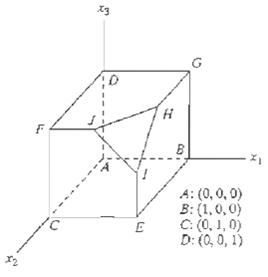
Consider the three-dimensional LP solution space in Figure 3.4, whose feasible extreme points are A, B, ... , and 1. (a) Which of the following pairs of corner points cannot represent successive simplex iterations: (A, B), (B, D), (E, H), and (A, I)? Explain the reason. (b) Suppose that the simplex
For the solution space in Figure 3.4, all the constraints are of the type ≤ and all the variables X1, X2, and X3 are nonnegative. Suppose that S1, S2, 3, and S4 (≥ 0) are the slacks associated with constraints represented by the planes CEIJF, BEIHG, DFJHG, and IJH, respectively. Identify the
This problem is designed to reinforce your understanding of the simplex feasibility condition. In the first tableau in Example 3.3-1, we used the minimum (nonnegative) ratio test to determine the leaving variable. Such a condition guarantees that none of the new values of the basic variables will
The Gutchi Company manufactures purses, shaving bags, and backpacks. The construction includes leather and synthetics, leather being the scarce raw material. The production process requires two types of skilled labor: sewing and finishing. The following table gives the availability of the
Consider the following LP:Maximize z = x1 + x2 + 3x3 + 2x4Subject toX1 + 2x2 - 3x3 + 5x4 ≤ 45x1 - 2x2 + 6x4 ≤ 82x1 + 3x2 - 2x3 + 3x4 ≤ 3- x1 + x3 + 2x4 ≤ 0X1, x2, x3, x4 ≥ 0(a) Use TORA’s iterations option to determine the optimum tableau.(b) Select any non basic variable to “enter”
In Problem 12, use TORA to find the next-best optimal solution.
Consider the following set of constraints: X1 + 2x2 + 2x3 + 4x4 ≤ 40 2x1 - x2 + x3 + 2x4 ≤ 8 4x1 + 2x2 + x3 - x4 ≤ 10 X1, x2, x3, x4 ≥ 0 Solve the problem for each of the following objective functions. (a) Maximize z = 2x1 + x2 + 3x3 + 5x4. (b) Maximize z = 8x1 + 6x2 + 3x3 - 2x4. (c)
Consider the following system of equations:Let x5, x6,..., and X8 be a given initial basic feasible solution. Suppose that Xl becomes basic. Which of the given basic variables must become non basic at zero level to guarantee that all the variables remain nonnegative, and what is the value of Xl in
Consider the following LP:Maximize z = x3Subject to(a) Solve the problem by inspection (do not use the Gauss-Jordan row operations), and justify the answer in terms of the basic solutions of the simplex method.(b) Repeat (a) assuming that the objective function calls for minimizing z = Xl.
Solve the following problem by inspection, and justify the method of solution in terms of the basic solution of the simplex method. Maximize z = 5x1 - 6x2 + 3x3 - 5x4 + 12x5 Subject to X1 + 3x2 + 5x3 + 6x4 + 3x5 ≤ 90 X1, x2, x3, x4, x5 ≥ 0 (Hint: A basic solution consists of one variable only.)
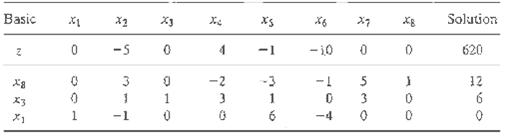
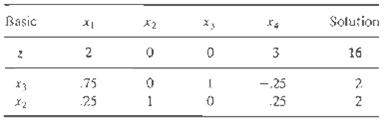
The following tableau represents a specific simplex iteration. All variables are nonnegative.The tableau is not optimal for either a maximization or a minimization problem. Thus, when a non basic variable enters the solution it can either increase or decrease z or leave it unchanged, depending on
Consider the two-dimensional solution space in Figure 3.6.(a) Suppose that the objective function is given asMaximize z = 3x1 + 6x2If the simplex iteration start at point A, identify the path to the optimum point E.(b) Determine the entering variable, the corresponding ratios of the feasibility
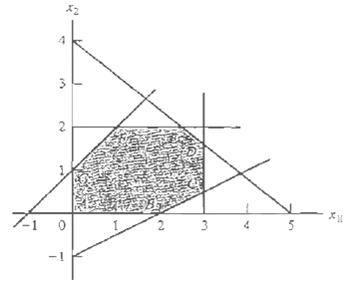
Consider the following LP: Maximize z = 16x1 + 15x2 Subject to 40x1 + 31x2 ≤ 124 - x1 + x2 ≤ 1 X1 ≤ 3 X1, x2 ≥ 0 (a) Solve the problem by the simplex method, where the entering variable is the non basic variable with the most negative z-row coefficient. (b) Resolve the problem by the
In Example 3.3-1, show how the second best optima) value of z can be determined from the optimal tableau.
Use hand computations to complete the simplex iteration of Example 3.4-1 and obtain the optimum solution.
TORA experiment. Generate the simplex iterations of Example 3.4-1 using TORA's .iterations => M-method module (file toraEx3.4-l.txt). Compare the effect of using M = 1, M == 10, and M = 1000 on the solution. What conclusion can be drawn from this experiment?
In Example 3.4-1, identify the starting tableau for each of the following (independent) cases, and develop the associated z-row after substituting out all the artificial variables: (a) The third constraint is X1 + 2X2 ≥ 4. (b) The second constraint is 4X1 + 3X2 ≤ 6. (c) The second constraint is
Consider the following set of constraints: - 2X1 + 3X2 = 3 (1) 4X1 + 5X2 ≥ 10 (2) X1 + 2X2 ≤ 5 (3) 6X1+7x2 ≤ 3 (4) 4X1 + 8X2 ≥ 5 (5) X1, x2 ≥ 0 For each of the following problem, develop the Z - row after substituting out the artificial variables: (a) Maximize z = 5x1 + 6X2 subject to
Consider the following set of constraints: X1 + X2 + x3 = 7 2x1 - 5x2 + x3 ≥ 10 X1, x2, x3 ≥ 0 Solve the problem for each of the following objective functions: (a) Maximize z = 2X1 + 3X2 - 5X3. (b) Minimize z = 2X1 + 3X2 - 5x3. (c) Maximize z = X1 + 2X2 + X3. (d) Minimize z = 4X1 - 8X2 + 3x3.
Consider the problem Maximize z = 2x1 + 4x2 + 4x3 - 3x4 Subject to X1 + x2 + x3 = 4 X1 + 4x2 + x4 = 8 X1, x2, x3, x4 ≥ 0 The problem shows that x3 and x4 can play the role of slacks for the two equations. They differ from slacks in that they have nonzero
Solve the following problem using x3 and x4 as starting basic feasible variables. As in problem 6, do not use any artificial variables. Minimize z = 3x1 + 2x2 + 3x3 Subject to X1 + 4x2 + x3 ≥ 7 2x1 + x2 + x4 ≥ 10 X1, x2, x3, x4 ≥ 0
Consider the problem Maximize z = x1 + 5x2 + 3x3 Subject to X1 + 2x2 + x3 = 3 2x1 - x2 = 4 X1, x2, x3 ≥ 0
Show how the M-method will indicate that the following problem has no feasible solution. Maximize z = 2x1 + 5X2 Subject to 3x1 + 2x2 ≥ 6 2x1 + x2 ≤ 2 X1, x2 ≥ 0
In phase I, if the LP is of the maximization type, explain why we do not maximize the sum of the artificial variables in Phase I.
For each case in Problem 4, set 3.4a, write the corresponding Phase I objective function.
Solve Problem 5, Set 3.4a, by the two-phase method.
Write Phase I for the following problem, and then solve (with TORA for convenience) to show that the problem has no feasible solution. Maximize z = 2x1 + 5x2 Subject to 3x1 + 2x2 ≥ 6 2x1 + x2 ≤ 2 X1, x2 ≥ 0
Consider the following problem: Maximize z = 2x1 + 2x2 + 4x3 Subject to 2x1 + x2 + x3 ≤ 2 3x1 + 4x2 + 2x3 ≥ 8 X1, x2, x3 ≥ 0 (a) Show that Phase I will terminate with an artificial basic variable at zero level (you may use TORA for convenience). (b) Remove the zero artificial variable prior
Consider the following problem: Maximize z = 3x1 + 2x2 + 3x3 Subject to 2x1 + x2 + x3 = 2 X1 + 3x2 + x3 = 6 3x1+ 4x2 + 2x3 = 8 X1, x2, x3 ≥ 0
Consider the following LP:Maximize z = 3x1 + 2x2 + 3x3Subject to2x2 + x2 + x3 ‰¤ 23x1 + 4x2 + 2x3 ‰¥ 81X1, x2, x3 ‰¥ 0The optimal simplex tableau at the end of Phase I is given asExplain why the non-basic variables X1 > X3, X4, and X5 can never assume positive values at the
Consider the LP model Minimize z = 2x1 - 4x2 + 3x3 Subject to 5x1 - 6x2 + 2x3 ≥ 5 - x1 + 3x2 + 5x3 ≥ 8 2x1 + 5x2 - 4x3 ≤ 4 X1, x2, x3 ≥ 0 Show how the inequalities can be modified to a set of equations that requires the use of a single artificial variable only (instead of two).
Consider the graphical solution space in Figure 3.8. Suppose that the simplex iterations start at A and that the optimum solution occurs at D. Further, assume that the objective function is defined such that at A, x1 enters the solution first. (a) Identify (on the graph) the corner points that
Consider the following LP: Maximize z = 3x1 + 2x2 Subject to 4x1 - x2 ≤ 8 4x1 + 3x2 ≤ 12 4x1 + x2 ≤ 8 X1, x2 ≥ 0 (a) Show that the associated simplex iterations are temporarily degenerate (you may use TORA for convenience). (b) Verify the result by solving the problem graphically (TORA's
TORA experiment. Consider the LP in Problem 2. (a) Use TORA to generate the simplex iterations. How many iterations are needed to reach the optimum? (b) Interchange constraints (1) and (3) and re-solve the problem with TORA. How many iterations are needed to solve the problem? (c) Explain why the
For the following LP, identify three alternative optimal basic solutions, and then write a general expression for all the non-basic alternative optima comprising these three basic solutions. Maximize z = x1 + 2x2 + 3x3 Subject to X1 + 2x2 + 3x3 ≤ 10 X1 + x2 ≤ 5 X1 ≤ 0 X1, x2, x3 ≥ 0 From
Solve the following LP: Maximize z = 2x1 - x2 + 3x3 Subject to X1 - x2 + 5x3 ≤ 10 2x1 - x2 + 3x3 ≤ 40 X1, x2, x3 ≥ 0 From the optimal tableau, show that all the alternative optima are not corner points
For the following LP, show that the optimal solution is degenerate and that none of the alternative solutions are corner points (you may use TORA for convenience). Maximize z = 3x1 + x2 Subject to X1 + 2x2 ≤ 5 X1 + x2 - x3 ≤ 2 7x1 + 3x2 - 5x3 ≤ 20 X1, x2, x3 ≥ 0
TORA Experiment. Solve Example 3.5-3 using TORA's Iterations option and show that even though the solution starts with X1 as the entering variable (per the optimality condition), the simplex algorithm will point eventually to an unbounded solution.
Consider the LP:Maximize z = 20x1 + 10x2 + x3Subject to3x1 - 3x2 + 5x3 ‰¤ 50X1 + x3 ‰¤ 10X1 - x2 + 4x3 ‰¤ 20X1, x2, x3 ‰¥ 0FIGURE 3.10LP unbounded solution in Example 3.5-3(a) By inspecting the constraints, determine the direction (X1. X2, or X3) in which the solution space is
In some ill-constructed LP models, the solution space may be unbounded even though the problem may have a bounded objective value. Such an occurrence can point only to irregularities in the construction of the model. In large problems, it may be difficult to detect unboundedness by inspection.
Toolco produces three types of tools, T1, T2, and T3.The tools use two raw materials, M1 and M2, according to the data in the following table:The available daily quantities of raw materials M1 and M2 are 1000units and 1200 units, respectively. The marketing department informed the production
Consider the LP model Maximize z = 3x1 + 2x1 + 3x3 Subject to 2x1 + x2 + x3 ≤ 2 3x1 + 4x2 + 2x3 ≥ 8 X1, x2, x3 ≥ 0
A company produces two products, A and B. The unit revenues are $2 and $3, respectively. Two raw materials, M1 and M2, used in the manufacture of the two products have respective daily availabilities of 8 and 18 units. One unit of A uses 2 units of Ml and 2 units of M2, and 1 unit of Buses 3 units
Wild West produces two types of cowboy hats. A Type 1 hat requires twice as much labor time as a Type 2. If all the available labor time is dedicated to Type 2 alone, the company can produce a total of 400 Type 2 hats a day. The respective market limits for the two types are 150 and 200 hats per
Consider Problem 1, Set 3.6a.(a) Determine the optimality condition for CA/CB that will keep the optimum unchanged.(b) Determine the optimality ranges for CA and CB, assuming that the other coefficient is kept constant at its present value.(c) If the unit revenues CA and CB are changed
In the Reddy Mikks model of Example 2.2-1;(a) Determine the range for the ratio of the unit revenue of exterior paint to the unit revenue of interior paint.(b) If the revenue per ton of exterior paint remains constant at $5000 per ton, determine the maximum unit revenue of interior paint that will
In the TOYCO model, suppose that the changes D1, D2, and D3 are made simultaneously in the three operations.(a) If the availabilities of operations 1,2, and 3 are changed to 438,500, and 410 minutes, respectively, use the simultaneous conditions to show that the current basic
The Gutchi Company manufactures purses, shaving bags, and backpacks. The construction of the three products requires leather and synthetics, with leather being the limiting raw material. The production process uses two types of skilled labor: sewing and finishing.The following table gives the
HiDec produces two models of electronic gadgets that use resistors, capacitors, and chips.The following table summarizes the data of the situation:Let x1 and x2 be the amounts produced of models 1 and 2, respectively. Following are the LP model and its associated optimal simplex tableau.Maximize z
A simplified rule based on the individual changes D1, D2,..., and Dm in the right - hand side of the constraints can be used to test whether or not simultaneous changes will maintain the feasibility of the current solution. Assume that the right-hand side bi of constraint i is changed to bi + Di
Consider the problemMaximize z = x1 + x2Subject to2x1 + x2 ≤ 6X1 + 2x2 ≤ 6X1 + x2 ≥ 0(a) Show that the optimal basic solution includes both x1 and x2 and that the feasibility ranges for the two constraints, considered one at a time, are – 3 ≤ D1 ≤ 6 and – 3 ≤ D2 ≤ 6.(b) Suppose
Consider the TOYCO model.(a) Suppose that any additional time for operation 1 beyond its current capacity of 430 minutes per day must be done on an overtime basis at $50 an hour. The hourly cost includes both labor and the operation of the machine. Is it economically advantageous to use overtime
A company produces three products, A, B, and C. The sales volume for A is at least50% of the total sales of all three products. However, the company cannot sell more than 75 units of A per day. The three products use one raw material, of which the maximum daily availability is 240
A company that operates 10 hours a day manufactures three products on three sequential processes. The following table summarizes the data of the problem:(a) Determine the optimal product mix.(b) Use the dual prices to prioritize the three processes for possible expansion.(c) If additional
The Continuing Education Division at the Ozark Community College offers a total of 30 courses each semester. The courses offered are usually of two types: practical, such as woodworking, word processing, and car maintenance; and humanistic, such as history, music, and fine arts. To satisfy the
Show & Sell can advertise its products on local radio and television (TV), or in newspapers.The advertising budget is limited to $10,000 a month. Each minute of advertising on radio costs $15 and each minute on TV costs $300. A newspaper ad costs $50. Show &Sell likes to advertise on radio
The Burroughs Garment Company manufactures men's shirts and women's blouses for Walmark Discount Stores. Walmark will accept all the production supplied by Burroughs.The production process includes cutting, sewing, and packaging. Burroughs employs 25 workers in the cutting department, 35 in the
ChemLabs uses raw materials I and II to produce two domestic cleaning solutions, A andB. The daily availabilities of raw materials I and II are 150 and 145 units, respectively.One unit of solution A consumes .5 unit of raw material 1 and .6 unit of raw material 11, and one unit of solution Buses .5
An assembly line consisting of three consecutive workstations produces two radio models:DiGi-l and DiGi-2. The following table provides the assembly times for the three workstations.The daily maintenance for workstations 1,2, and 3 consumes 10%,14%, and 12%, respectively, of the maximum 480 minutes
In the TOYCO model, determine if the current solution will change in each of the following cases: (i) z = 2x1 + x2 + 4x3 (ii) z = 3x1 + 6x2 + x3 (iii) z = 8x1 + 3x2 + 9x3
B&K grocery store sells three types of soft drinks: the brand names Al Cola and A2 Cola and the cheaper store brand BK Cola. The price per can for Al, A2, and BK are 80, 70, and 60 cents, respectively. On the average, the store sells no more than 500 cans of all colas a day. Although Al is a
Baba Furniture Company employs four carpenters for 10 days to assemble tables and chairs. It takes 2 person-hours to assemble a table and .5 person-hour to assemble a chair.Customers usually buy one table and four to six chairs. The prices are $135 per table and$50 per chair. The company operates
The Bank of Elkins is allocating a maximum of $200,000 for personal and car loans during the next month. The bank charges 14% for personal loans and 12% for car loans.Both types of loans are repaid at the end of a I-year period. Experience shows that about3% of personal loans and 2% of car loans
Electra produces four types of electric motors, each on a separate assembly line. The respective capacities of the lines are 500, 500, 800, and 750 motors per day. Type 1 motor uses 8 units of a certain electronic component, type 2 motor uses 5 units, type 3 motor uses 4 units, and type 4 motor
Popeye Canning is contracted to receive daily 60,000 lb of ripe tomatoes at 7 cents per pound from which it produces canned tomato juice, tomato sauce, and tomato paste. The canned products are packaged in 24-can cases. A can of juice uses lib of fresh tomatoes, a can of sauce uses 1/2 lb, and a
Dean's Furniture Company assembles regular and deluxe kitchen cabinets from precut lumber. The regular cabinets are painted white, and the deluxe are varnished. Both painting and varnishing are carried out in one department. The daily capacity of the assembly department is 200 regular cabinets and
The 100% optimality Rule. A rule similar to the 100% feasibility rule outlined in problem 12, set 3.6c, can also be developed for testing the effect of simultaneously changing all cj to cj + dj , j = 1, 2,..., n, on the optimality of the current solution. Suppose that uj ≤ dj ≤ vj is the
Consider Problem 1, Set 2.3c (Chapter 2). Use the dual price to decide if it is worthwhile to increase the funding for year 4.
Consider Problem 10, Set 2.3e (Chapter 2).(a) Which of the specification constraints impacts the optimum solution adversely?(b) What is the most the company should pay per ton of each ore?
Consider Problem 2, Set 2.3c (Chapter 2).(a) Use the dual prices to determine the overall return on investment.(b) If you wish to spend $1000 on pleasure at the end of year 1, how would this affect the accumulated amount at the start of year 5?
Consider Problem 3, Set 2.3c (Chapter 2).(a) Give an economic interpretation of the dual prices of the model.(b) Show how the dual price associated with the upper bound on borrowed money at the beginning of the third quarter can be derived from the dual prices associated with the balance equations
Consider Problem 4, Set 2.3c (Chapter 2). Use the dual prices to determine the rate of return associated with each year.
Consider Problem 5, Set 2.3c (Chapter 2). Use the dual price to determine if it is worthwhile for the executive to invest more money in the plans.
Consider Problem 6, Set 2.3c (Chapter 2). Use the dual price to decide if it is advisable for the gambler to bet additional money.
Consider Problem 1, Set 2.3d (Chapter 2). Relate the dual prices to the unit production costs of the model.
Consider Problem 2, Set 2.3d (Chapter 2). Suppose that any additional capacity of machines 1 and 2 can be acquired only by using overtime. What is the maximum cost per hour the company should be willing to incur for either machine?
Consider Problem 3, Set 2.3d (Chapter 2). (a) Suppose that the manufacturer can purchase additional units of raw material A at $12 per unit. Would it be advisable to do so? (b) Would you recommend that the manufacturer purchase additional units of raw material B at $5 per unit?
In Example 4.1-1, derive the associated dual problem if the sense of optimization in the primal problem is changed to minimization.
In Example 4.1-2, derive the associated dual problem given that the primal problem is augmented with a third constraint, 3x1 + x2 = 4.
In Example 4.1-3, show that even if the sense of optimization in the primal is changed to minimization, an unrestricted primal variable always corresponds to an equality dual constraint.
Write the dual for each of the following primal problems: (a) Maximize z = - 5x1 + 2x2 Subject to - x1 + x2 ≤ - 2 2x1 + 3x2 ≤ 5 X1, x2 ≥ 0 (b) Minimize z = 6x1 + 3x2 Subject to 6x1 - 3x2 + x3 ≥ 2 3x1 + 4x2 + x3 ≥ 5 X1, x2, x3 ≥ 0 (c) Maximize z = x1 + x2 Subject to 2x1 + x2 = 5 3x1 -
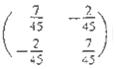
Consider the following matrices:V1 = (11, 22), V2 = (- 1, - 2, - 3) In each of the following cases, indicate whether the given matrix operation is legitimate, and, if so, calculate the result. (a) AV1 (b) AP1 (c) AP2 (d) V1A (e) V2A (f) P1P2 (g) V1P1
Consider the optimal tableau of Example 3.3-1.(a) Identify the optimal inverse matrix.(b) Show that the right-hand side equals the inverse multiplied by the original right hand side vector of the original constraints.
Find the optimal value of the objective function for the following problem by inspecting only its dual. (Do not solve the dual by the simplex method.) Minimize z = 10x1 + 4x2 + 5x3 Subject to 5x1 - 7x2 + 3x3 ≥ 50 X1, x2, x3 ≥ 0
Solve the dual of the following problem, then find its optimal solution from the solution of the dual. Does the solution of the dual offer computational advantages over solving the primal directly? Minimize z = 5x1 + 6x2 + 3x3 Subject to 5x1 + 5x2 + 3x3 ≥ 50 X1 + x2 - x3 ≥ 20 7x1 + 6x2 - 9x3
Consider the following LP:Maximize z = 5x1 + 2x2 + 3x3Subject toX1 + 5x2 + 2x3 = 30X1 - 5x2 - 6x3 ‰¤ 40X1, x2, x3 ‰¥ 0Given that the artificial variable x4 and the slack variable x5 from the starting basic variables and that M was set equal to 100 when solving the problem, the optimal tableau
Consider the following LP:Maximize z = 4x1 + x2Subject to3x1 + x2 = 34x1 + 3x2 ≥ 6X1 + 2x2 ≤ 4X1, x2 ≥ 0The starting solution consists of artificial x4 and x5 for the first and second constrains and slack x6 for the third constraint. Using M = 100 for the artificial variables, the optimal
Consider the following LP:Maximize z = 2x1 + 4x2 + 4x3 - 3x4Subject toX1 + x2 + x3 = 4X1 + 4x2 + x4 = 8X1, x2, x3, x4 ‰¥ 0Using x3 and x4 as starting variables, the optimal tableau is given as
Consider the following LP: Maximize z = x1 + 5x2 + 3x3 Subject to X1 + 2x2 + x3 = 3 2x1 - x2 = 4 X1, x2, x3 ≥ 0
Consider the following set of inequalities: 2x1 + 3x2 ≤ 12 - 3x1 + 2x2 ≤ - 4 3x1 - 5x2 ≤ 2 X1 unrestricted X2 ≥ 0
Estimate a range for the optimal objective value for the following LPs:(a) Minimize z = 5x1 + 2x2Subject toX1 - x2 ≥ 32x1 + 3x2 ≥ 5X1, x2 ≥ 0(b) Maximize z = x1 + 5x2 + 3x3Subject toX1 + 2x2 + x3 = 32x1 - x2 = 4X1, x2, x3 ≥ 0(c) Maximize z 2x1 + x2Subject toX1 - x2 ≤ 102x1 ≤ 40X1, x2
In Problem 7(a), let y1 and y2 be the dual variables. Determine the following pairs of primal-dual solution are optimal: (a) (x1 = 3, x2 = 1; y1 = 4, y2 = 1) (b) (x1 = 4, x2 = 1; y1 = 1, y2 = 0) (c) (x1 = 3, x2 = 0; y1 = 5, y2 = 0)
Generate the first simplex iteration of Example 4.2-1 (you may use TORA's Iterations⇒ M-method for convenience), then use Formulas 1 and 2 to verify all the elements of the resulting tableau.
Consider the following LP model:Maximize z = 4x1 + 14x2Subject to2x1 + 7x2 + x3 = 217x1 + 2x2 + x4 = 21X1, x2, x3, x4 ≥ 0Check the optimality and feasibility of each of the following basic solutions.(a) Basic variables = (x2, x4), Inverse =(b) Basic variables = (x2, x3), Inverse =(c) Basic
Showing 58900 - 59000
of 88243
First
583
584
585
586
587
588
589
590
591
592
593
594
595
596
597
Last
Step by Step Answers

 Get 50% OFF
Claim Now
Get 50% OFF
Claim Now


.png)
.png)
.png)
.png)
-1.png)
.png)
.png)
-1.png)
-2.png)
.png)
.png)
.png)
-1.png)
.png)
.png)