







Question: A stationary process X (t) is applied to a linear time-invariant filter of impulse response b (t), producing an output Y (t). (a) Show that
A stationary process X (t) is applied to a linear time-invariant filter of impulse response b (t), producing an output Y (t).
(a) Show that the cross-correlation function RYX (?) of the output Y (t) and the input X (t) is equal to the impulse response b (?) convolved with the autocorrelation function RX (?) of the input, as shown by, show that the second cross-correlation function RXY (?) equals
(b) Find the cross-spectral densities SYX (f) and SXY (f).
(c) Assuming that X (t) is a white noise process with zero mean and power spectral density N0/2, shows that. Comment on the practical significance of this result.
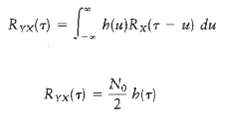
hlu)Rx(T - u) du Ryx(7) No Ryx(T) 2 bir)
Step by Step Solution
3.47 Rating (160 Votes )
There are 3 Steps involved in it
a The crosscorrelation function Ryx T is Ryx T EYtT Xt The Yt and Xt are relat... View full answer

Get step-by-step solutions from verified subject matter experts
Document Format (1 attachment)

19-E-T-E-C-S (11).docx
120 KBs Word File
 Study Help