







Question: Let V be a finite-dimensional real inner product space and let V be its dual. Using Theorem 7.10, prove that the map J: V
Let V be a finite-dimensional real inner product space and let V∗ be its dual. Using Theorem 7.10, prove that the map J: V∗ → V that takes the linear function ℓ ∈ V∗ to the vector J[ℓ] = a ∈ V satisfying ℓ[v] = (a , v) defines a linear isomorphism between the inner product space and its dual: V∗ ≃ V.
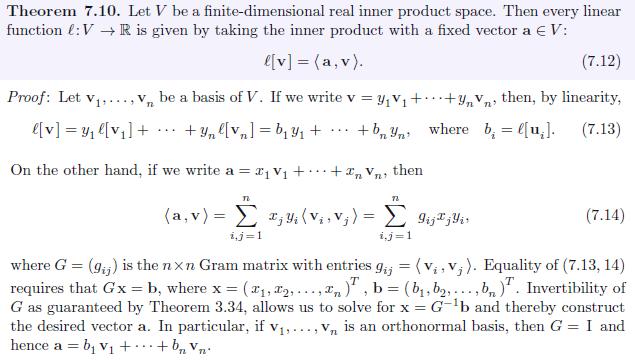
Theorem 7.10. Let V be a finite-dimensional real inner product space. Then every linear function : V R is given by taking the inner product with a fixed vector a V: l[v] = (a, v). (7.12) Proof: Let V, Vn be a basis of V. If we write v = yV++ynVn then, by linearity, l[v] = y l[v] + +yn [vn] =by + +by where b = [u]. (7.13) On the other hand, if we write a = (a,v) = n i,j=1 V + *** +In Vn, then 'nn' 72 (V, Vj) = gijjis ij=1 (7.14) where G = (95) is the nxn Gram matrix with entries gij = (v, v.). Equality of (7.13, 14) requires that Gx = b, where x = (, 2,...,xn), b = (b,b,..., b). Invertibility of G as guaranteed by Theorem 3.34, allows us to solve for x = G-b and thereby construct the desired vector a. In particular, if v,..., V, is an orthonormal basis, then G = I and hence a = b V + + b Vn
Step by Step Solution
3.35 Rating (161 Votes )
There are 3 Steps involved in it
Theorem 710 states that for any finitedimensional real inner product space V the map T V V defined b... View full answer

Get step-by-step solutions from verified subject matter experts
 Study Help