







Question: Select a different input pattern than that we used in Section 11.5.2. Use the unsupervised Hebbian learning algorithm to recognize that pattern. Data from section
Select a different input pattern than that we used in Section 11.5.2. Use the unsupervised Hebbian learning algorithm to recognize that pattern.
Data from section 11.5.2
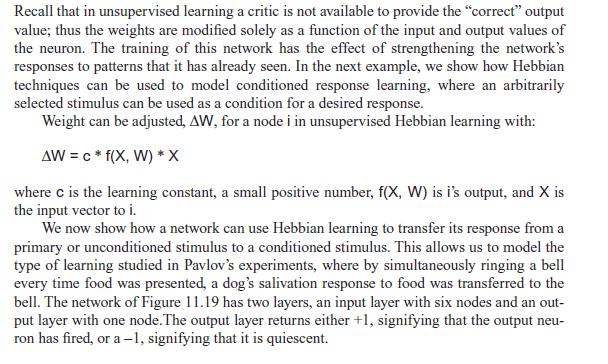
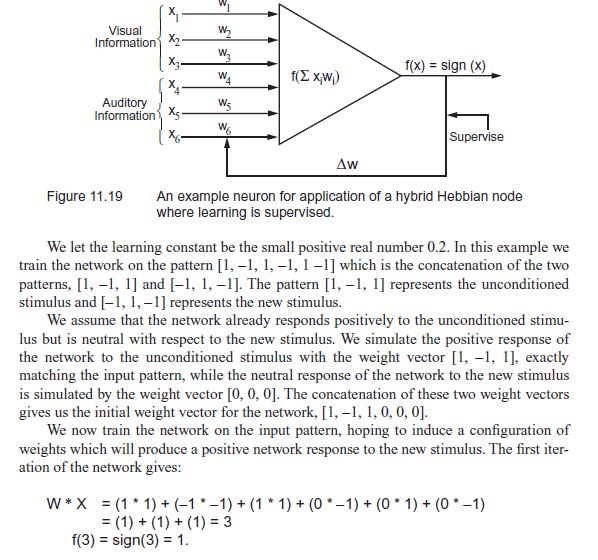
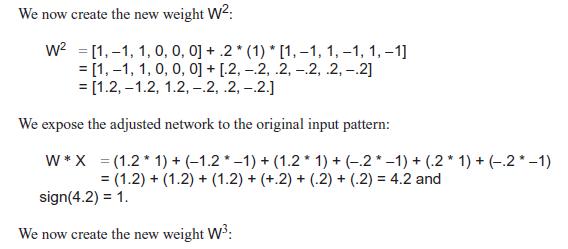
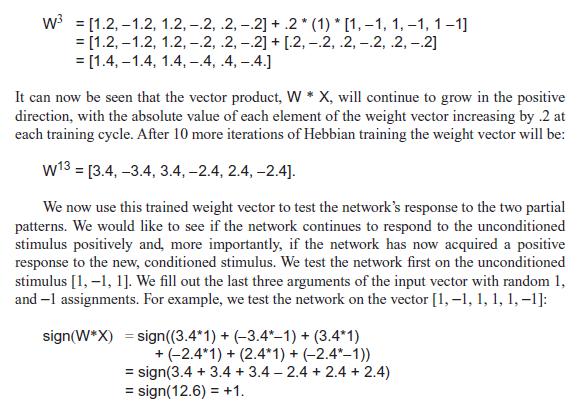
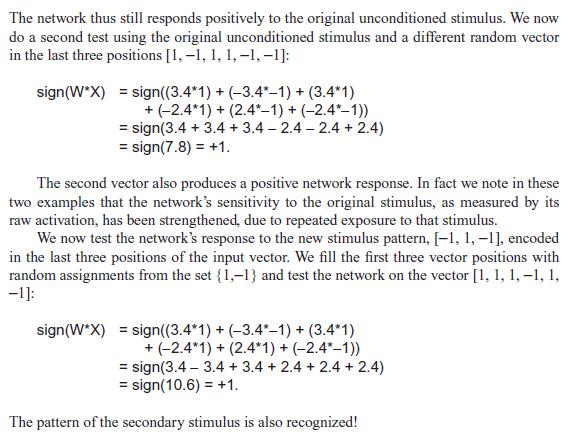
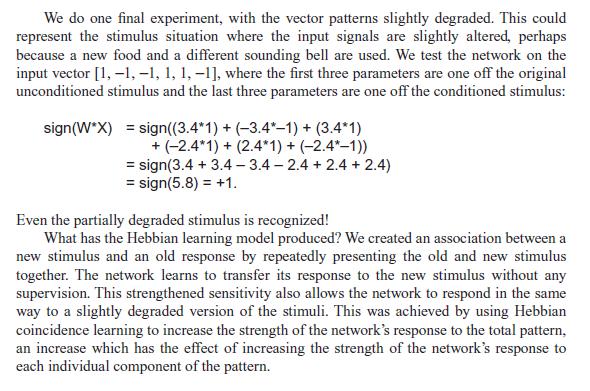
Recall that in unsupervised learning a critic is not available to provide the "correct" output value; thus the weights are modified solely as a function of the input and output values of the neuron. The training of this network has the effect of strengthening the network's responses to patterns that it has already seen. In the next example, we show how Hebbian techniques can be used to model conditioned response learning, where an arbitrarily selected stimulus can be used as a condition for a desired response. Weight can be adjusted, AW, for a node i in unsupervised Hebbian learning with: AW = c * f(X, W) * X where c is the learning constant, a small positive number, f(X, W) is i's output, and X is the input vector to i. We now show how a network can use Hebbian learning to transfer its response from a primary or unconditioned stimulus to a conditioned stimulus. This allows us to model the type of learning studied in Pavlov's experiments, where by simultaneously ringing a bell every time food was presented, a dog's salivation response to food was transferred to the bell. The network of Figure 11.19 has two layers, an input layer with six nodes and an out- put layer with one node. The output layer returns either +1, signifying that the output neu- ron has fired, or a -1, signifying that it is quiescent.
Step by Step Solution
3.39 Rating (155 Votes )
There are 3 Steps involved in it
The images youve provided explain the unsupervised Hebbian learning algorithm and its application on a simple artificial neural network The explanatio... View full answer

Get step-by-step solutions from verified subject matter experts
 Study Help