New Semester
Started
Get
50% OFF
Study Help!
--h --m --s
Claim Now
Question Answers
Textbooks
Find textbooks, questions and answers
Oops, something went wrong!
Change your search query and then try again
S
Books
FREE
Study Help
Expert Questions
Accounting
General Management
Mathematics
Finance
Organizational Behaviour
Law
Physics
Operating System
Management Leadership
Sociology
Programming
Marketing
Database
Computer Network
Economics
Textbooks Solutions
Accounting
Managerial Accounting
Management Leadership
Cost Accounting
Statistics
Business Law
Corporate Finance
Finance
Economics
Auditing
Tutors
Online Tutors
Find a Tutor
Hire a Tutor
Become a Tutor
AI Tutor
AI Study Planner
NEW
Sell Books
Search
Search
Sign In
Register
study help
business
economics an introduction to traditional
Economics An Introduction To Traditional And Progressive Views 7th Edition Howard J. Sherman, E. K. Hunt, Reynold F. Nesiba, Phillip A. O'Hara, Barbara A. Wiens-Tuers - Solutions
What do progressive political economists claim is a key factor for individuals making decisions? Give an example.
Neoclassical economists talk about how individuals are free to spend their dollars in the market. What does this mean? What problems do progressive political economists see with this “freedom”?
What role should the government play according to neoclassical economists? According to progressive political economists?
Should the government do much spending in the economy according to neoclassical economists? Why or why not?
What types of spending does each group think the government should do in the economy?
What do the neoclassical economists have to say about taxes? How do taxes interfere with the individual?
Briefly describe the Robinson Crusoe metaphor underpinning the traditional economics perspective.
What happens if transactions are not voluntary? Can you give an example of a transaction that might not be voluntary?
What shortcomings do critical economists see in the neoclassical use of the Robinson Crusoe metaphor?
How does relative power enter into transactions between employers and employees?
What is meant by consumers “voting with their dollars”? Does everyone have an equal vote? Why or why not?
What is the difference between income and wealth?
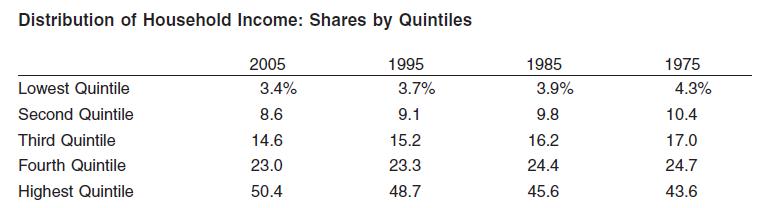
Use Table 18.2 to describe how the distribution of income has changed in the United States over the last three decades. Has inequality increased or decreased? How do you know?Table 18.2 Distribution of Household Income: Shares by Quintiles Lowest Quintile Second Quintile Third Quintile Fourth
Which sources of income are generated from work and which from the ownership of assets?
Personal income can be broken down into five sources or categories. What are these categories and what percentage of personal income coming from each of these sources?
How does the distribution of income in the United State compare with other countries?
What is a Gini coefficient? What would it mean if the Gini coefficient were equal to zero? What if it were equal to one?
Which countries in the world have a more equal distribution of income than the United States? Which countries have a more unequal distribution of income?
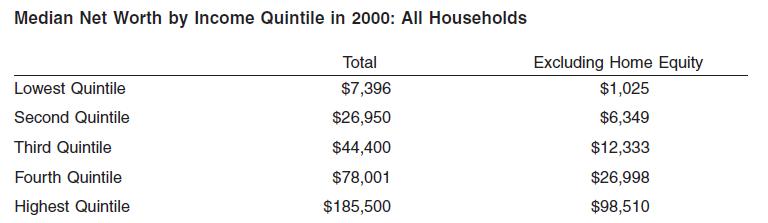
Use Table 18.5 to compute the ratio of net worth for the highest income quintile with that of the lowest income quintile. Given the other evidence in this chapter, do you suspect that this ratio has increased or decreased over the last 30 years?Table 18.5 Median Net Worth by Income Quintile in
What is the poverty threshold for a family of three in the United States in 2005? What percentage of the population have income below this level?
One percent of households own what share of total stock market value?
What has caused the increases in income and wealth inequality over the last three decades?
Which is more important in determining class: the level of income a person earns, or their relationship to the ownership of capital?
What is surplus labor? Give an example.
How is surplus labor different from necessary labor?
Explain how surplus labor relates to profits for the employer.
What is exploitation as discussed in this chapter? Does an employee need to be making low wages to be exploited?
Does exploitation depend on the absolute value of your wage or salary? Why or why not?
Why does exploitation necessarily occur in a capitalist economy? What happens to the employer if there is no surplus labor? To the employee?
Was there exploitation in the prehistoric communal society? Why or why not?
What put a limit on the rate of exploitation in a slave economy?
Assume an employee works five hours producing an amount of product equal in value to her wage and then spends another three hours producing an amount of product over and above the value of her salary. What are the number of hours of necessary labor? Surplus labor? What is the rate of exploitation?
What does a rate of exploitation mean?
If you were an employer, would you want a high or low rate of exploitation? Explain.
Explain why employers and employees bargain or struggle over necessary and surplus labor. What are the three main sources of conflict?
If an employee’s compensation rises, what happens to necessary labor? Profits for the employer?
Even if employee compensation rises and the number of hours of work remains unchanged, why might an employer still make the same amount of profit or even increase profits?
Why can’t an employee be paid below a wage floor? Why wouldn’t an employer pay above a wage ceiling?
What factors would give employees power as they bargain with employers over compensation, hours, and effort? Explain.
When was union membership at its highest level? Why?
What has happened to union membership since the 1950s? Why?
What is meant by the term relative value? What does it measure?
What is the transformation problem?
Explain how the number of chickens could be the “price” of a pig in the simple economy.
Explain why the rate of profit and the rate of exploitation are considered to be inconsistent by some economists. As part of your explanation, define the rate of profit and the rate of exploitation.
How does the example in this chapter use the amount of labor used to produce a product to determine the relative value of one product in terms of another product, such as the value of pigs in terms of chickens? What types of labor go into producing the product?
What is an alternative theory, besides the labor theory of value and the neoclassical model, used in attempting to explain exploitation?
State the key factors that make the analysis of the labor theory of value more complex in a capitalist market economy. Explain.
How do prices in an advanced economy help measure the relative value of two different commodities? How are the prices of various goods measured in an advanced market economy?
Explain how money helps facilitate trade and enables economies to grow.
How is labor input into a product measured in a capitalist market economy? Explain using an example.
What does the labor theory of value assume about other inputs such as, in the example of the pigs, feed or machinery? In other words, how is the labor measured for inputs other than employees?
What is necessary labor?
What is the surplus created in the production of a product? Explain how this surplus is created.
How does surplus translate into profits for business owners in a capitalist market economy?
Assume the price of a quart of yogurt is $5 in the market. A firm employs one worker, and she earns $6 an hour for an eight-hour day. Other inputs to produce a quart of yogurt come to $2 per quart. Each day, the firm produces and sells 20 quarts of yogurt. Calculate the surplus value and rate of
Use the concept of labor power to explain how working for an employer in a capitalist market economy is not the same as slavery.
How can labor power be treated as just another commodity, such as cheese, in the market?
What are some criticisms of this idea of labor power as a commodity? How is labor power not like other commodities?
Why do employers try to keep wages and other employee compensation low? Explain the impact on business owners if the cost of labor rises.
Why do workers struggle to raise wages and other employee compensation? According to the labor theory of value, what are they bargaining over?
The “third wave” of mergers consisted primarily of conglomerate mergers. Explain how conglomerate mergers are different from horizontal or vertical mergers.
What are some of the ways that the conflict between employers and employees over surplus product is manifested?
What are the concerns about the concentration and size of businesses in the global market?
Policymakers often worry less about conglomerates and market power and more about firms whose business is concentrated in a single industry. Why? What concerns are there about large conglomerates?
Does a global corporation have a perfect monopoly with no competition? Explain.
What are economies of scale? Give an example of how the cost per unit of production could be cheaper when many units rather than just a few are produced.
How can a firm attempting to capture all possible economies of scale end up having market power in that industry?
What does it mean when economists say that a firm has market power? How does the position of a firm with market power differ from that of a firm in a perfectly competitive market?
Why might large firms with little competition in their market become less efficient?
What are the debates about the impact of advertising on businesses? on consumers? on the larger economy?
What are some of the debates about regulating monopolies? What is the logic behind the arguments of the different points of view?
What are some key pieces of legislation aimed at controlling the impact of monopolies?
Why do members of dominant social groups have greater opportunities? Give two specific examples of this phenomenon.
How does a dominant group protect its status?
Give a contemporary example of one group using another group as a scapegoat for a social problem.
Define and explain what is meant by stereotype, prejudice, and discrimination.
What are “–isms”? What do they share in common?
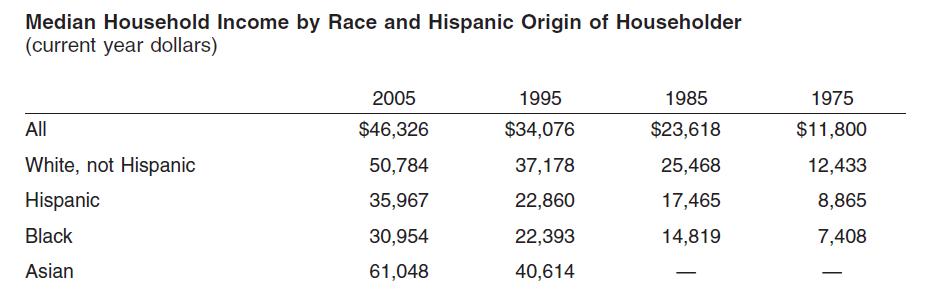
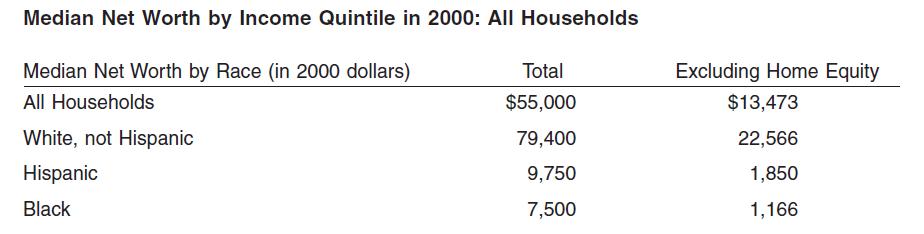
Briefly recount the differences in median incomes among whites, blacks, Hispanics, and Asians. Briefly describe the differences in median wealth for these same groups. Draw on Tables 22.1 and 22.2 as necessary.Table 22.1Table 22.2 Median Household Income by Race and Hispanic Origin of
What are the different ideas that reinforce the discrimination of African Americans?
List two stereotypes each about African Americans, women, and the poor. What is a shared shortcoming of all of these stereotypes?
How has globalization both positively and negatively impacted the degree of discrimination that exists?
Who benefits from racism and sexism?
According to progressives, what are the ways in which capitalists benefit from racist discrimination? How does this view differ from the conservative economics perspective?
Give an example of how racism is used to create a disposable labor force.
According to progressives, how do capitalists gain through sexism? What would a conservative economist say in response?
How can the glorification of housework be profitable for capitalists?
What are examples of some racist myths or prejudice?
Why is the ideology of racial superiority so useful to the ruling class? Give examples to support your reasoning.
How was natural selection important in the development of early humanoids?
What is the definition of a prehistoric society and why is it so difficult to learn about these early communities?
What are some characteristics of early human society?
What evidence is used to substantiate claims about early humans and early society?
List and describe the four basic features of society used as a framework for analysis in this text. Using this framework, what are the basic features of prehistoric society?
What is an economy?
What is technology? What are examples of technology in early communal societies?
What are economic institutions? What is the key economic institution in prehistoric society?
Explain the importance of the communal group and the role of its members for ensuring the survival of all its members.
Can there be more than one way a society could organize to produce and allocate what it needs to survive and grow?
What are social institutions?
Showing 1100 - 1200
of 1373
1
2
3
4
5
6
7
8
9
10
11
12
13
14
Step by Step Answers

 Get 50% OFF
Claim Now
Get 50% OFF
Claim Now