New Semester
Started
Get
50% OFF
Study Help!
--h --m --s
Claim Now
Question Answers
Textbooks
Find textbooks, questions and answers
Oops, something went wrong!
Change your search query and then try again
S
Books
FREE
Study Help
Expert Questions
Accounting
General Management
Mathematics
Finance
Organizational Behaviour
Law
Physics
Operating System
Management Leadership
Sociology
Programming
Marketing
Database
Computer Network
Economics
Textbooks Solutions
Accounting
Managerial Accounting
Management Leadership
Cost Accounting
Statistics
Business Law
Corporate Finance
Finance
Economics
Auditing
Tutors
Online Tutors
Find a Tutor
Hire a Tutor
Become a Tutor
AI Tutor
AI Study Planner
NEW
Sell Books
Search
Search
Sign In
Register
study help
business
financial institutions management
Financial Institutions Management A Risk Management 4th Edition Helen Lange, Anthony Saunders, Marcia Millon Cornett - Solutions
1.The duration of a 20-year, 8 per cent coupon T-bond selling at par is 10.292 years. The bond’s interest is paid semi-annually, and the bond qualifies for delivery against the T-bond futures contract.What is the modified duration of this bond?What is the impact on the T-bond price if market
1.In each of the following cases, indicate whether it would be appropriate for an FI to buy or sell a forward contract to hedge the appropriate risk.A commercial bank plans to issue CDs in three months.An insurance company plans to buy bonds in two months.A savings bank is going to sell Treasury
1.Suppose an FI purchases a T-bond futures contract at 95.What is the FI’s obligation at the time the futures contract is purchased?If an FI purchases this contract, in what kind of hedge is it engaged?Assume that the T-bond futures price falls to 94. What is the loss or gain?Assume that the
1.Contrast the position of being short with that of being long in futures contracts. LO 7.2
1.An FI holds a 15-year, $10 million par value bond that is priced at 104 with a yield to maturity of 7 per cent. The bond has a duration of eight years and the FI plans to sell it after two months. The FI’s market analyst predicts that interest rates will be 8 per cent at the time of the desired
1.What is a naive hedge? How does a naive hedge protect an FI from risk? LO 7.2
1.What are some of the major differences between futures and forward contracts? How do these contracts differ from spot contracts? LO 7.2
1.What are derivative contracts? What is the value of derivative contracts to the managers of FIs? Which type of over-the-counter derivative contracts had the highest notional value outstanding globally as of December 2010? LO 7.1
1.In Example 7.8 , what is the notional size of the swap contract if D fixed = 5 and swap contracts require payment every six months?
1.In Example 7.6 , which of the two FIs has its liability costs fully hedged and which is only partially hedged? Explain your answer.
1.In the example above, what number of put options should you purchase if δ = 0.25 and D = 6? (Np = 1718.213.)
1.If interest rates fall, are you better off purchasing call or put options on T-bonds? Why?
1.In the above example, calculate the value of the option if the exercise price (X ) = $88. (P = $0.064)
1.What are two common models used to calculate the fair value of a bond option? Which is preferable, and why?
1.What are some of the economic reasons for an FI not to write options?
1.How do interest rate increases affect the payoff from buying a put option on a bond? How do they affect the profit from writing a put option on a bond?
1.How do interest rate increases affect the payoff from buying a call option on a bond? How do they affect the profit from writing a call option on a bond?
1.In Example 7.3 , how many futures should have been sold using the 10-year bond and three-month bank accepted bill contracts if the basis risk is br = 0.8?
1.What is the difference between macrohedging and microhedging?That is, the duration of its assets was shorter (DA = 3) than the duration of its liabilities (DL = 5). (This might be the case for a bank that borrows with long-term notes or term deposits to finance floating-rate loans.) What should
1.Why does the FI have to sell more bank accepted bill futures, given that the size of each bank bill futures contract is five times the size of each Tbond futures contract?
1.Describe in general the gains and losses on the bond portfolio and the forward contracts if interest rates rise and how this provides immunisation for the portfolio.
1.Under a naive hedge using forward contracts, what nominal value of forward contracts would be used to hedge a bond portfolio with a face value of$2 million?
1.What are the differences between a futures contract and a forward contract?
1.What are the major differences between a spot contract and a futures contract?
1.A 10-year, 10 per cent annual coupon, $1000 bond trades at a yield to maturity of 8 per cent. The bond has a duration of 6.994 years. What is the modified duration of this bond? What is the practical value of calculating modified duration? Does modified duration change the result of using the
1.Estimate the convexity for each of the following three bonds, all of which trade at yield to maturity of 8 per cent and have face values of $1000:A 7-year, zero-coupon bond.A 7-year, 10 per cent annual coupon bond.A 10-year, 10 per cent annual coupon bond that has a duration value of 6.994 years
1.MLK Bank has an asset portfolio that consists of $100 million of 30-year, 8 per cent coupon, $1000 bonds that sell at par.What will be the bonds’ new prices if market yields change immediately by ±0.10 per cent? What will be the new prices if market yields change immediately by ±2.00 per
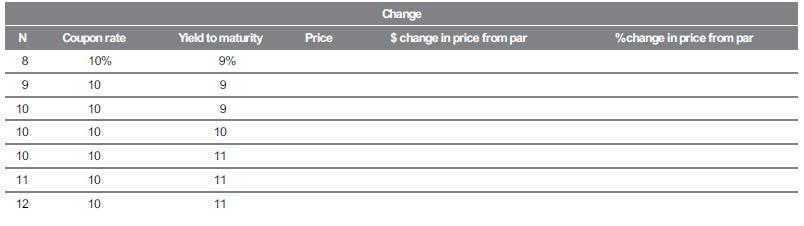
1.Consider a $1000 bond with a fixed-rate 10 per cent annual coupon rate and a maturity (N ) of 10 years. The bond currently is trading at a yield to maturity (YTM ) of 10 per cent.Complete the table:Use this information to verify the principles of interest rate–price relationships for fixed-rate
1.Consider a five-year, 15 per cent annual coupon bond with a face value of $1000. The bond is trading at a yield to maturity of 12 per cent.What is the price of the bond?If the yield to maturity increases 1 per cent, what will be the bond’s new price?Using your answers to parts (a) and (b), what
1.Consider a 12-year, 12 per cent annual coupon bond with a required return of 10 per cent. The bond has a face value of $1000.What is the price of the bond?If interest rates rise to 11 per cent, what is the price of the bond?What has been the percentage change in price?Repeat parts (a), (b) and
1.A financial institution has an investment horizon of two years 9.33 months (or 2.777 years). The institution has converted all assets into a portfolio of 8 per cent, $1000 three-year bonds that are trading at a yield to maturity of 10 per cent. The bonds pay interest annually.The portfolio
1.In general, what changes have occurred in the financial markets that would allow financial institutions to restructure their balance sheets more rapidly and efficiently to meet desired goals? Why is it critical for an investment manager who has a portfolio immunised to match a desired investment
1.Identify and discuss three criticisms of using the duration model to immunise the portfolio of a financial institution. LO 6.6
1.Assume that a goal of the regulatory agencies of financial institutions is to immunise the ratio of equity to total assets, that is, Δ(E /A ) = 0. Explain how this goal changes the desired duration gap for the institution. Why does this differ from the duration gap necessary to immunise the
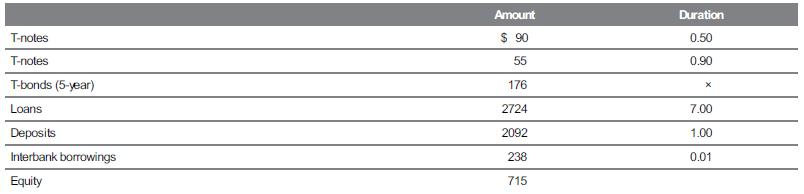
1.The following balance sheet information is available (amounts in thousands of dollars and duration in years) for a financial institution:Note that Treasury Bonds are five-year maturities paying 6 per cent semi-annually and selling at par.What is the duration of the T-bond portfolio?What is the
1.Hands Insurance Company issued a $90 million, one-year, zero-coupon note at 8 per cent add-on annual interest (paying one coupon at the end of the year) or with an 8 per cent yield. The proceeds were used to fund a $100 million, two-year commercial loan with a 10 per cent coupon rate and a 10 per
1.The balance sheet for Gotbucks Bank Inc. (GBI) is presented below ($ million):Notes to the balance sheet: The interbank cash rate is 8.5 per cent, the floating loan rate is (BBR + 4 per cent), and currently BBR is 11 per cent. Fixed-rate loans have five-year maturities, are priced at par, and pay
1.Financial Institution XY has assets of $1 million invested in a 30-year, 10 per cent semi-annual coupon Treasury Bond selling at par. The duration of this bond has been estimated at 9.94 years. The assets are financed with equity and a $900 000, two-year, 7.25 per cent semi-annual coupon capital
1.If you use only duration to immunise your portfolio, what three factors affect changes in the net worth of a financial institution when interest rates change? LO 6.4, 6.5
1.Two banks are being examined by regulators to determine the interest rate sensitivity of their balance sheets. Bank A has assets composed solely of a 10-year $1 million loan with a coupon rate and yield of 12 per cent. The loan is financed with a 10-year $1 million CD with a coupon rate and yield
1.Consider the case in which an investor holds a bond for a period of time longer than the duration of the bond, that is, longer than the original investment horizon.If interest rates rise, will the return that is earned exceed or fall short of the original required rate of return? Explain.What
1.Suppose you purchase a five-year, 15 per cent coupon bond (paid annually) that is priced to yield 9 per cent. The face value of the bond is $1000.Show that the duration of this bond is equal to four years.Show that if interest rates rise to 10 per cent within the next year and your investment
1.Suppose you purchase a six-year, 8 per cent coupon bond (paid annually) that is priced to yield 9 per cent. The face value of the bond is $1000.Show that the duration of this bond is equal to five years.Show that if interest rates rise to 10 per cent within the next year and your investment
1.The duration of an 11-year, $1000 Treasury Bond paying a 10 per cent semi-annual coupon and selling at par has been estimated at 6.763 years.What is the modified duration of the bond? What is the dollar duration of the bond?What will be the estimated price change on the bond if interest rates
1.Calculate the duration of a two-year, $1000 bond that pays an annual coupon of 10 per cent and trades at a yield of 14 per cent. What is the expected change in the price of the bond if interest rates decline by 0.50 per cent (50 basis points)? LO 6.1, 6.4
1.What is dollar duration? How is dollar duration different from duration? LO 6.1, 6.3
1.You have discovered that the price of a bond rose from $975 to $995 when the yield to maturity fell from 9.75 per cent to 9.25 per cent. What is the duration of the bond? LO 6.1
1.How is duration related to the interest elasticity of a fixed-income security? What is the relationship between duration and the price of the fixed-income security? LO 6.3
1.You can obtain a loan of $100 000 at a rate of 10 per cent for two years. You have a choice of (i) paying the interest (10 per cent) each year and the total principal at the end of the second year or (ii) amortising the loan, that is, paying interest (10 per cent) and principal in equal payments
1.An insurance company is analysing three bonds and is using duration as the measure of interest rate risk. All three bonds trade at a yield to maturity of 10 per cent, have $10 000 par values, and have five years to maturity. The bonds differ only in the amount of annual coupon interest that they
1.Maximum Superannuation Fund is attempting to balance one of the bond portfolios under its management. The fund has identified three bonds which have five-year maturities and which trade at a yield to maturity of 9 per cent. The bonds differ only in that the coupons are 7 per cent, 9 per cent and
1.What is a consol bond? What is the duration of a consol bond that sells at a yield to maturity of 8 per cent? 10 per cent? 12 per cent? Would a consol trading at a yield to maturity of 10 per cent have a greater duration than a 20-year zero-coupon bond trading at the same yield to maturity? Why?
1.A six-year, $10 000 CD pays 6 per cent interest annually and has a 6 per cent yield to maturity. What is the duration of the CD? What would be the duration if interest were paid semi-annually? What is the relationship of duration to the relative frequency of interest payments? LO 6.1, 6.2
1.Consider three Treasury Bonds, each of which has a 10 per cent semi-annual coupon and trades at par.Calculate the duration for a bond that has a maturity of four years, three years and two years.What conclusions can you reach about the relationship of duration and the time to maturity? Plot the
1.What is the duration of a five-year, $1000 Treasury Bond with a 10 per cent semi-annual coupon selling at par? Selling with a yield to maturity of 12 per cent? 14 per cent? What can you conclude about the relationship between duration and yield to maturity? Plot the relationship. Why does this
1.Two bonds are available for purchase in the financial markets. The first bond is a two-year, $1000 bond that pays an annual coupon of 10 per cent. The second bond is a two-year, $1000, zero-coupon bond.What is the duration of the coupon bond if the current yield to maturity (R ) is 8 per cent? 10
1.A one-year, $100 000 loan carries a coupon rate and a market interest rate of 12 per cent. The loan requires payment of accrued interest and one-half of the principal at the end of six months. The remaining principal and accrued interest are due at the end of the year.What will be the cash flows
1.What are the two different general interpretations of the concept of duration and what is the technical definition of this term? How does duration differ from maturity? LO 6.1
1.What is the difference between book value accounting and market value accounting? How do interest rate changes affect the value of bank assets and liabilities under the two methods? What is marking to market? LO 6.1
1.Why is the target required in Question 1 different from the duration target required by an FI trying to immunise its equity value only?
1.What duration targets should an FI attempt to meet if it is trying to immunise the net worth ratio (i.e. E /A )?
1.Suppose DA = 3 years, DL = 6 years, k = 0.8, and A = $100 million. What is the effect on owners’ net worth if ΔR /(1-R ) equals 1 per cent? (ΔE =$1.8)
1.How can a manager use information of an FI’s duration gap to restructure, and thereby immunise, the balance sheet against interest rate risk?
1.How is the overall duration gap for an FI calculated?
1.Refer to the example of the insurer in Examples 6.6 to 6.8. Suppose that rates fell to 6 per cent, would the FI still have been immunised?
1.How would the formula in Equation 6 have to be modified to take into account quarterly coupon payments and monthly coupon payments?
1.What is the relationship between the duration of a bond and the interest elasticity of a bond?
1.Do high coupon bonds have high or low durations?
1.What is the relationship between duration and yield to maturity on a financial security?
1.Which has the longest duration, a 30-year, 8 per cent zero-coupon or discount bond, or an 8 per cent infinite maturity consol bond?
1.What is the unique feature of a consol bond compared to other bonds?
1.What is the duration of a zero-coupon bond?
1.Calculate the duration of a one-year, 8 per cent coupon, 10 per cent yield bond that pays coupons quarterly.
1.What does the numerator of the duration equation measure?
1.What does the denominator of the duration equation measure?
1.When is the duration of an asset equal to its maturity?
1.Why is duration considered a more complete measure of an asset or liability’s interest rate sensitivity than maturity or repricing?
1.Go to Westpac’s website and find the latest Westpac New Zealand Disclosure Statement.Examine the document and discuss the sensitivities of Westpac NZ’s assets and liabilities to interest rate movements over the period covered by the report and the impact that interest rate volatility had on
1.Go to the Reserve Bank of Australia’s website and to the Bulletin Statistics. Update Figure 5.1 , and describe the movement in short-term and 10-year interest rates since 2011. LO 5.6
1.If a bank manager were certain that interest rates would increase within the next six months, how should the bank manager adjust the bank’s maturity gap to take advantage of this anticipated increase? What if the manager believes rates will fall? Would your suggested adjustments be difficult or
1.County Bank has the following market value balance sheet (in millions, all interest at annual rates). All securities are selling at par equal to book value.What is the maturity gap for County Bank?What will be the maturity gap if the interest rates on all assets and liabilities increase by 1 per
Nearby Bank has the following balance sheet:What is the maturity gap for Nearby Bank? Is Nearby Bank more exposed to an increase or decrease in interest rates? Explain why. LO 5.6 Assets Sm Liabilities and equity $m Cash 60 Demand deposits 140 5-year Treasury Notes 60 1-year certificates of deposit
What is a maturity gap? How can the maturity model be used to immunise an FI’s portfolio? What is the critical requirement that allows maturity matching to have some success in immunising the balance sheet of an FI? LO 5.6
What are some of the weakness of the repricing model? How have large banks solved the problem of choosing the optimal time period for repricing?What is runoff cash flow and how does this amount affect the repricing model’s analysis? LO 5.5 The following questions and problems are based on
1.A bank has the following balance sheet:Suppose interest rates rise such that the average yield on rate-sensitive assets increases by 45 basis points and the average yield on rate-sensitive liabilities increases by 35 basis points.Calculate the bank’s repricing GAP.Assuming the bank does not
1.A bank has the following balance sheet:Suppose interest rates rise such that the average yield on rate-sensitive assets increases by 45 basis points and the average yield on rate-sensitive liabilities increases by 35 basis points.Calculate the bank’s repricing GAP and gap ratio.Assuming the
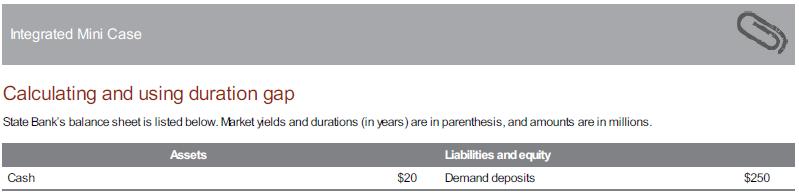
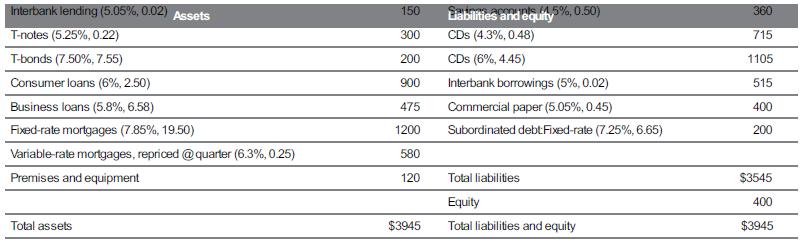
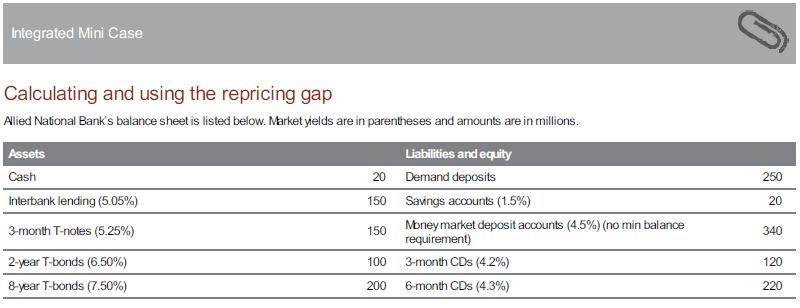
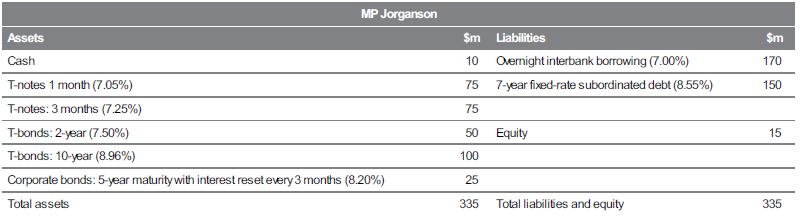
1.Use the following information about a hypothetical government security dealer named MP Jorganson to answer parts (a) to (e). (Market yields are in parentheses.)What is the repricing or funding gap if the planning period is 30 days? 91 days? Two years? (Recall that cash is a non-interest-earning
1.Use the following data to answer parts (a) to (c).What is Givebucks Bank’s current net interest income?What will the net interest income be if interest rates increase by 2 per cent?What is Givebucks’ repricing or funding gap? Use it to check your answer to part (b). LO 5.3, 5.4 Givebucks
1.Consider the following balance sheet for WatchoverU Bank:What is WatchoverU’s expected net interest income at year-end?What will net interest income be at year-end if interest rates rise by 2 per cent?Using the cumulative repricing gap model, what is the expected net interest income for a 2 per
1.A bank manager is quite certain that interest rates are going to fall within the next six months. How should the bank manager adjust the bank’s sixmonth repricing gap and spread to take advantage of this anticipated rise? What if the manger believes rates will rise in the next six months? LO 5.3
1.What is the spread effect? LO 5.3
1.Which of the following assets or liabilities fit the one-year rate or repricing sensitivity test?91-day Treasury Notes One-year Treasury Bonds 20-year Treasury Bonds 20-year floating-rate corporate bonds with annual repricing 30-year floating-rate mortgages with annual repricing 30-year
1.What is the gap ratio? What is the value of this ratio to interest rate risk managers and regulators? LO 5.3, 5.4
1.What are the reasons for not including savings account demand deposits as rate-sensitive liabilities in the repricing analysis for a commercial bank?What is the subtle but potentially strong reason for including savings account demand deposits in the total of rate-sensitive liabilities? Can the
1.Consider the following balance sheet positions for a financial institution:Rate-sensitive assets = $200 million. Rate-sensitive liabilities = $100 million Rate-sensitive assets = $100 million. Rate-sensitive liabilities = $150 million Rate-sensitive assets = $150 million. Rate-sensitive
1.If a bank manager were quite certain that interest rates were going to rise within the next six months, how should the bank manager adjust the bank’s six-month repricing gap to take advantage of this anticipated rise? What if the manger believed rates would fall in the next six months? LO 5.3,
1.Which of the following is an appropriate change to make on a bank’s balance sheet when CGAP is negative, spread is expected to remain unchanged and interest rates are expected to rise?replace fixed-rate loans with rate-sensitive loans replace marketable securities with fixed-rate loans replace
1.What is the CGAP effect? According to the CGAP effect, what is the relation between changes in interest rates and changes in net interest income when CGAP is positive? When CGAP is negative? LO 5.3, 5.4
1.Calculate the repricing gap and impact on net interest income of a 1 per cent increase in interest rates for the following positions:Rate-sensitive assets = $100 million. Rate-sensitive liabilities = $50 million.Rate-sensitive assets = $50 million. Rate-sensitive liabilities = $150
1.a The repricing model requires specification of repricing buckets. Why must a bucket time period be specified? How does the choice of the repricing buckets impact on the delineation between rate-sensitive and fixed-rate assets and liabilities? LO 5.3 What determines the optimal length of the
Showing 2200 - 2300
of 4618
First
16
17
18
19
20
21
22
23
24
25
26
27
28
29
30
Last
Step by Step Answers

 Get 50% OFF
Claim Now
Get 50% OFF
Claim Now