New Semester
Started
Get
50% OFF
Study Help!
--h --m --s
Claim Now
Question Answers
Textbooks
Find textbooks, questions and answers
Oops, something went wrong!
Change your search query and then try again
S
Books
FREE
Study Help
Expert Questions
Accounting
General Management
Mathematics
Finance
Organizational Behaviour
Law
Physics
Operating System
Management Leadership
Sociology
Programming
Marketing
Database
Computer Network
Economics
Textbooks Solutions
Accounting
Managerial Accounting
Management Leadership
Cost Accounting
Statistics
Business Law
Corporate Finance
Finance
Economics
Auditing
Tutors
Online Tutors
Find a Tutor
Hire a Tutor
Become a Tutor
AI Tutor
AI Study Planner
NEW
Sell Books
Search
Search
Sign In
Register
study help
business
fundamentals engineering economics
Fundamentals of Engineering Economics 3rd edition Chan S. Park - Solutions
You obtained a loan of $20,000 to finance your home improvement project. Based on monthly compounding over 24 months, the end‐of‐the‐month equalpayment was figured to be $922.90. What is the APR used for this loan?
Bank A charges 11.5% compounded monthly on its business loan. Bank B charges 11.2% compounded daily. If you want to borrow money, which bankwould you choose?
Bank A charges 11.5% compounded monthly on its business loan. Bank B charges 11.2% compounded daily. If you want to borrow money, which bank would you choose?(a) Monthly(b) Quarterly(c) Semiannually(d) Annually
What is the effective interest rate per quarter if the interest rate is 9% compounded monthly?
What is the effective interest rate per month if the interest rate is 12% compounded continuously?
What is the effective interest rate per quarter if the interest rate is 6% compounded continuously?
James Hogan is purchasing a $25,000 automobile, which is to be paid for in 48 monthly installments of $563.44. What is the effective interest rate per month for this financing arrangement?
Find the APY in each of the following cases:(a) 11% compounded annually(b) 8% compounded semiannually(c) 9.5% compounded quarterly(d) 7.5% compounded daily
What will be the amount accumulated by each of the given present investments?(a) $5,500 in 10 years at 9% compounded semiannually.(b) $12,500 in 15 years at 8% compounded quarterly.(c) $13,600 in seven years at 6% compounded monthly.
What is the future worth of each of the given series of payments?(a) $10,000 at the end of each six‐month period for 10 years at 8% compounded semiannually.(b) $9,000 at the end of each quarter for six years at 8% compounded quarterly.(c) $5,000 at the end of each month for 14 years at 9%
What equal series of payments must be paid into a sinking fund in order to accumulate each given amount?(a) $11,000 in 10 years at 8% compounded semiannually when payments are semiannual.(b) $3,000 in 15 years at 6% compounded quarterly when payments are quarterly.(c) $35,000 in five years at 7.35%
What is the present worth of each of the given series of payments?(a) $1,700 at the end of each six‐month period for 10 years at 9% compounded semiannually.(b) $9,000 at the end of each quarter for five years at 8% compounded quarterly.(c) $4,000 at the end of each month for eight years at 9%
Suppose you deposit $1,000 at the end of each quarter for five years at an interest rate of 9% compounded monthly. Which of the following formulas will determine the equal annual end‐of‐year deposit amount that would accumulate the same balance over five years under the same interest
Suppose a newlywed couple is planning to buy a home two years from now. To save the down payment required at the time of purchasing a home worth $350,000 (let’s assume this required down payment is 20% of the sales price, or $70,000), the couple has decided to set aside some money from their
Georgi Rostov deposits $3,000 in a savings account that pays 6% interest compounded monthly. Three years later, he deposits $4,000. Two years after the $4,000 deposit, he makes another deposit in the amount of $6,000. Four years after the $6,000 deposit, half of the accumulated money is transferred
A man is planning to retire in 30 years. He wishes to deposit a regular amount every three months until he retires so that, beginning one year following his retirement, he will receive annual payments of $60,000 for the next 10 years. How much must he deposit if the interest rate is 8% compounded
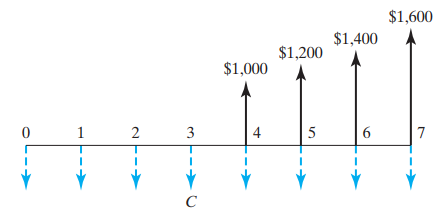
Consider the following cash flow series. Determine the required annual deposits (end of year) that will generate the cash flows from years 4 to 7. Assume the interest rate is 6%, compounded monthly. $1,600 $1,400 $1,200 $1,000 1 2 4 5 6 7 C 3.
You are in financial trouble and are delinquent on your mortgage payment. Your bank has agreed to a repayment schedule of $1,600 per month, and it will charge 0.5% per month interest on the outstanding balance. If the current outstanding balance is $250,000, how long will it take for you to pay off
A building is priced at $255,000. If a buyer makes a down payment of $55,000 and a payment of $2,000 every month thereafter, how many months will it take for the buyer to completely pay for the building? Interest is charged at a rate of 9% compounded monthly.
By reading any business publication give examples that illustrate one of the four fundamental principles of engineering economics.
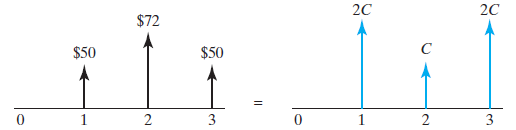
What value of C makes the two cash flows equal? Assume i = 10%. 20 20 $72 $50 $50 C 1 2 3 1 2 3
You are planning to save $1 million for retirement over the next 30 years.(a) If you are earning interest at the rate of 6% and you live 20 years after retirement, what annual level of living expenses will those savings support?(b) Suppose your retirement living expenses will increase at an annual
What is the amount of 10 equal annual deposits that can provide five annual withdrawals, when a first withdrawal of $3,000 is made at the end of year 11 and subsequent withdrawals increase at the rate of 6% per year over the previous year’s rate if(a) The interest rate is 8% compounded
Suppose that an oil well is expected to produce 100,000 barrels of oil during its first production year. However, its subsequent production (yield) is expected to decrease by 10% over the previous year’s production. The oil well has a proven reserve of 1,000,000 barrels.(a) Suppose that the price
Matt Christopher is a 25‐year‐old mechanical engineer, and his salary next year will be $60,000. Matt expects that his salary will increase at a steady rate of 5% per year until his retirement at age 65. If he saves 10% of his salary each year and invest these savings at an interest rate of 9%,
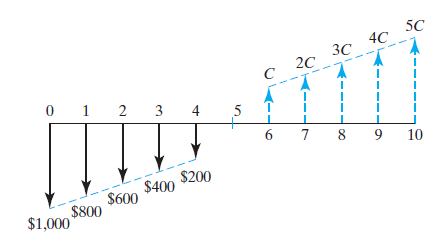
Consider the cash flow series given in the accompanying table. What value of C makes the deposit series equivalent to the withdrawal series at an interest rate of 9% compounded annually? 5C 4C 3C 20 C 0 1 2 3 4 5 6 7 8 9 10 $200 $400 $600 $800 $1,000
The maintenance expense on a machine is expected to be $3,000 during the first year and to increase $600 each year for the following eight years. What present sum of money should be set aside now to pay for the required maintenance expenses over the eight‐year period? (Assume 12% compound
What is the equal‐payment series for 10 years that is equivalent to a payment series starting with $30,000 at the end of the first year and decreasing by $3,000 each year over 10 years? Interest is 8% compounded annually.
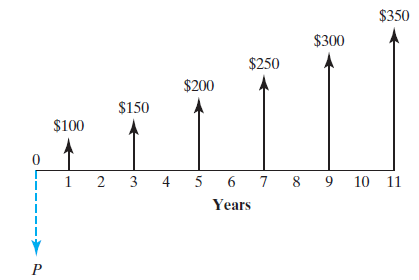
Compute the value of P for the accompanying cash flow diagram. Assume i = 8% per year. $350 $300 $250 $200 $150 $100 1 2 3 4 5 6 7 8 9 9 10 11 Years
Five annual deposits in the amounts of $5,000, $4,500, $4,000, $3,500, and $3,000 are made into a fund that pays interest at a rate of 10% compounded annually. Determine the amount in the fund immediately after the fifth deposit.
Kim deposits her annual bonus into a savings account that pays 8% interest compounded annually. The size of her bonus increases by $2,000 each year, and the initial bonus amount is $5,000. Determine how much will be in the account immediately after the fifth deposit.
At an interest rate of 10%, what is the present value of an asset that produces $1,000 a year in perpetuity?
An investment costs $3,460 and pays $250 in perpetuity. What is the interest earned on this investment?
A company is considering replacing an old piece of industrial equipment to reduce operating and maintenance cost. A new equipment is quoted at $195,000. After 10 years, the machine would have no value, but it would save as much as $30,000 in operating and maintenance cost. If the firm’s interest
If you borrow $5,000 and agree to repay the loan in five equal annual payments at an interest rate of 11%, what will the annual payment be? What if you make the first payment on the loan at the end of second year?
If $500 is deposited in a savings account at the beginning of each year for 15 years and the account earns 7% interest compounded annually, what will be the balance on the account the end of the 15 years (F)?
From the interest tables in Appendix B, determine the value of the following factors by interpolation, and compare the results with those obtained from evaluating the A/P and P/A interest formulas:(a) The capital‐recovery factor for 36 periods at 6.25% compound interest.(b) The
What is the present worth of each of the following given series of payments?(a) $9,000 at the end of each year for eight years at 6% compounded annually.(b) $1,500 at the end of each year for 10 years at 9% compounded annually.(c) $7,500 at the end of each year for six years at 7.25% compounded
You have borrowed $20,000 at an interest rate of 10% compounded annually. Equal payments will be made over a three‐year period with each payment made at the end of the corresponding year. What is the amount of the annual payment? What is the interest payment for the second year?
What equal‐annual‐payment series is required in order to repay each of the following given present amounts?(a) $18,000 in five years at 8% interest compounded annually.(b) $4,200 in four years at 9.5% interest compounded annually.(c) $7,700 in three years at 11% interest compounded annually.(d)
You open a bank account, making a deposit of $500 now and deposits of $1,000 every other year. What is the total balance at the end of 10 years from now if your deposits earn 4% interest compounded annually?
A no‐load (commission‐free) mutual fund has grown at a rate of 9% compounded annually since its beginning. If it is anticipated that it will continue to grow at this rate, how much must be invested every year so that $10,000 will be accumulated at the end of five years?
Part of the income that a machine generates is put into a sinking fund to pay for its replacement when it wears out. If $3,000 is deposited every year at 6% interest compounded annually, how many years must the machine be kept before a new machine costing $35,000 can be purchased?
You want to save the down payment required to purchase a vacation home at the end of five years. If the required down payment is $25,000 and you can earn 5% a year on your savings account, how much do you need to set aside at the end of each of the next five years?
Your company wants to set aside a fixed amount every year to a sinking fund to replace a piece of industrial equipment costing $250,000 at the end of five years from now. The sinking fund is expected to earn 5% interest. How much must your company deposit each year to meet this goal?
What equal annual series of payments must be paid into a sinking fund in order to accumulate each of the following given amounts?(a) $18,000 in 13 years at 5% compounded annually.(b) $11,000 in eight years at 6% compounded annually.(c) $8,000 in 25 years at 8% compounded annually.(d) $12,000 in
What is the future worth of each given series of payments?(a) $6,000 at the end of each year for six years at 6% compounded annually.(b) $8,000 at the end of each year for nine years at 7.25% compounded annually.(c) $15,000 at the end of each year for 25 years at 8% compounded annually.(d) $3,000
What is the future worth of a series of equal yearly deposits of $5,000 for 7 years in a savings account that earns 5% annual compound interest if(a) All deposits are made at the end of each year?(b) All deposits are made at the beginning of each year?
You are planning to contribute $5,000 a year to a mutual fund that earns an average of 6% per year. If you continue to contribute for the next 10 years, how much would you have in your account?
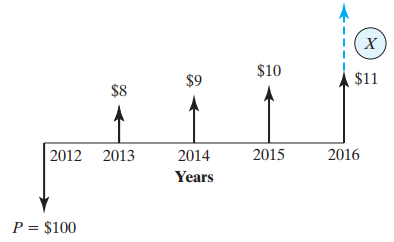
The accompanying diagram shows the anticipated cash dividends for Delta Electronics over the next four years. John is interested in buying some shares of this stock for a total of $100 and will hold them for four years. If John??s interest rate is known to be 8% compounded annually, what would be
You are preparing to buy a vacation home five years from now. The home will cost $80,000 at that time. You plan on saving three deposits at an interest rate of 8%:Deposit 1: Deposit $10,000 today.Deposit 2: Deposit $12,000 two years from now.Deposit 3: Deposit $X three years from now.How much
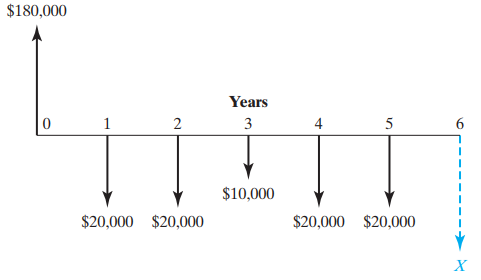
A company borrowed $180,000 at an interest rate of 9% compounded annually over six years. The loan will be repaid in installments at the end of each year according to the accompanying repayment schedule. What will be the size of the last payment (X) that will pay off the loan? $180,000 Years 2 3 4
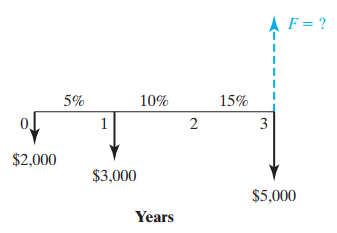
You deposit $2,000 today, $3,000 one year from now, and $5,000 three years from now. How much money will you have at the end of year 3 if there are different annual compound??interest rates per period, according to the accompanying diagram? F = ? 5% 10% 15% 1 2 $2,000 $3,000 $5,000 Years 3.
How much invested now at an interest rate of 9% compounded annually would be just sufficient to provide three payments as follows: the first payment in the amount of $3,000 occurring two years from now, the second payment in the amount of $4,000 five years thereafter, and the third payment in the
If $2,000 is invested now, $3,000 two years from now, and $4,000 four years from now at an interest rate of 8% compounded annually, what will be the total amount in 10 years?
In 1626 the Indians sold Manhattan Island to Peter Minuit of the Dutch West Company for $24. If they saved just $1 from the proceeds in a bank account that paid an 8% annual interest, how much would their descendents have in 2015?
You bought 100 shares of GE stock at $2,330 on December 31, 2011. Your intention is to keep the stock until it doubles in value. If you expect 8% annual growth for GE stock, how many years do you expect to hold onto the stock? Compare your answer with the solution obtained by the Rule of 72.
Which of the following alternatives would you choose, assuming an interest rate of 10% compounded annually?Alternative 1: Receive $100 today.Alternative 2: Receive $120 two years from now.Alternative 3: Receive $170 five years from now.
If you desire to withdraw the given amounts over the next five years from a savings account that earns 5% interest compounded annually, how much do you need to deposit now?N
A project is expected to generate a cash flow of $2,000 in year 1, $800 in year 2, and $1,000 in year 3. At an interest rate of 10%, what is the maximum amount that you could invest in the project at year 0?
John and Susan just opened savings accounts at two different banks. Each deposited $1,000. John’s bank pays simple interest at an annual rate of 10%, whereas Susan’s bank pays compound interest at an annual rate of 9.5%. No principal or interest will be taken out of the accounts for a period
You are interested in buying a piece of real estate property that could be worth $450,000 in five years. If your earning interest rate is 5%, how much would you be willing to pay for this property now?
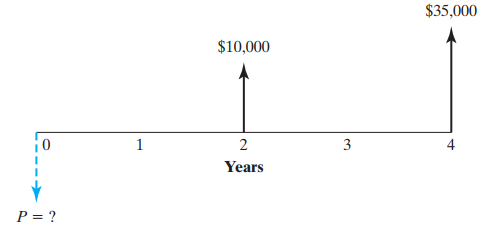
If you want to withdraw $10,000 at the end of two years and $35,000 at the end of four years, how much should you deposit now into an account that pays 9% interest compounded annually? See the accompanying cash flow diagram. $35,000 $10,000 1 2 3 Years P = ?
How many years will it take to double your investment of $2,000 if it has an interest rate of 6% compounded annually?
How many years will it take an investment to triple if the interest rate is 7% compounded annually?
Assuming an interest rate of 8% compounded annually, answer the following questions:(a) How much money can be loaned now if $8,000 is to be repaid at the end of five years?(b) How much money will be required in four years in order to repay a $10,000 loan borrowed now?
State the present worth of the following future payments:(a) $5,500 six years from now at 10% compounded annually.(b) $7,000 three years from now at 9% compounded annually.(c) $22,000 five years from now at 8% compounded annually.(d) $13,000 eight years from now at 7% compounded annually.
You are considering investing $1,000 at an interest rate of 6.5% compounded annually for five years or investing the $1,000 at 6.8% per year simple interest for five years. Which option is better?
Bank A pays 6% simple interest on its savings account balances. Bank B pays 5.5% interest compounded annually. If you made a $10,000 deposit in each bank, which bank provides you more money at the end of 15 years?
Compare the interest earned on $15,000 for 25 years at 7% simple interest with the amount of interest earned if interest were compounded annually.
You deposit $3,000 in a savings account that earns 8% simple interest per year. How many years will it take to double your balance? If, instead, you deposit the $3,000 in another savings account that earns 7% interest compounded yearly, how many years will it take to double your balance?
Read the Wall Street Journal over a one‐week period and identify the business investment news using one of the categories—(1) new products or product expansion, (2) equipment and process selection, (3) cost reduction, (4) equipment replacement, or (5) service or quality improvement.
State the amount accumulated by each of the following present investments:(a) $6,000 in 8 years at 6% compounded annually.(b) $1,550 in 12 years at 5% compounded annually.(c) $8,000 in 32 years at 9% compounded annually.(d) $12,000 in 9 years at 8% compounded annually.
If the interest rate is 10.5%, what is the two‐year discount rate?
If the interest rate is 9%, what is the present value of $500 paid in year 5?
Today you deposited $1,000 in a savings account paying 5% annual interest. How much should you have at the end of three years?
Suppose that, to cover some of your college expenses, you are obtaining a personal loan from your uncle in the amount of $25,000 (now) to be repaid in two years. If your uncle could earn 8% interest (compounded annually) on his money invested in various sources, what minimum lump‐sum payment two
Suppose you have the alternative of receiving either $5,000 at the end of five years or P dollars today. Currently, you have no need for the money, so you could deposit the P dollars into a bank account that pays 7% interest compounded annually. What value of P would make you indifferent in your
You are about to borrow $10,000 from a bank at an interest rate of 9% compounded annually. You are required to make five equal annual repayments in the amount of $2,570.92 per year, with the first repayment occurring at the end of year 1. For each year, show the interest payment and principal
What is the amount of interest earned on $2,000 for five years at 6% simple interest per year?
You are considering purchasing a machine that is expected to produce the following cash flows: $60,000 in year 1, $77,000 in year 2, $65,000 in year 3, $57,000 in year 4, and $45,000 in year 5. If your interest rate is 14%, what would be your maximum offer (purchase price) on this machine?
Showing 4400 - 4500
of 4481
First
31
32
33
34
35
36
37
38
39
40
41
42
43
44
45
Step by Step Answers

 Get 50% OFF
Claim Now
Get 50% OFF
Claim Now