New Semester
Started
Get
50% OFF
Study Help!
--h --m --s
Claim Now
Question Answers
Textbooks
Find textbooks, questions and answers
Oops, something went wrong!
Change your search query and then try again
S
Books
FREE
Study Help
Expert Questions
Accounting
General Management
Mathematics
Finance
Organizational Behaviour
Law
Physics
Operating System
Management Leadership
Sociology
Programming
Marketing
Database
Computer Network
Economics
Textbooks Solutions
Accounting
Managerial Accounting
Management Leadership
Cost Accounting
Statistics
Business Law
Corporate Finance
Finance
Economics
Auditing
Tutors
Online Tutors
Find a Tutor
Hire a Tutor
Become a Tutor
AI Tutor
AI Study Planner
NEW
Sell Books
Search
Search
Sign In
Register
study help
business
introduction to materials management
Introduction To Materials Management 8th Global Edition J. R. Tony Arnold, Chapman, Stephen N., Lloyd M. Clive - Solutions
12. Why is process flexibility desirable? What two conditions are required?
13. Name and describe five advantages of short setup time.
14. What are the two reasons why quality is important?
15. What is quality for manufacturing? How is it obtained?
16. Why is preventive maintenance important?
17. Describe the differences between preventive maintenance and total productive maintenance.
18. What are the four conditions needed for uninterrupted flow? Describe each.
19. What is the difference between leveling based on capacity and leveling based on material flow?
20. Why would a lean production manufacturer schedule 7 hours of work in an 8-hour shift?
21. Why are supplier relations particularly important in a lean production environment?
22. Why is employee involvement important in a lean production environment?
23. What are the differences in a master production schedule in a lean production environment?
24. What effect does a lean production environment have on MRP?
25. Describe the backflushing or post-deduct system of inventory recordkeeping.
26. Why is there sometimes difficulty with the MRP system?
27. What is the major difference between the MRP push system and the pull system?
28. What is the kanban system? How does it work?
29. What is the difference between production cards and move cards?
30. Where does an MRP system work best?
31. Where does a kanban system work best?
32. Where does a drum-buffer-rope system work best?
33. Can MRP and kanban be used at the same time and if so, how?
34. Provide an example of value stream mapping.
35. How does takt time work?
36. Give an example of a visual management system.
37. What are the 5Ss of housekeeping? What is the sixth?
15.2 In problem 15.1, if the annual carrying cost is 18% per unit, what will be the annual savings in carrying cost?
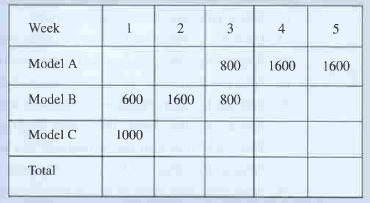
15.5 The following MPS summary schedule is leveled for capacity. Using the following table, level the schedule for material as well. Week 2 3 4 5 Model A 800 1600 1600 Model B 600 1600 800 Model C 1000 Total
1. What is the definition of quality?
3. Name and describe the eight dimensions to quality.
5. What are the six basic concepts of TQM?
6. What does customer focus mean? Who is the customer?
7. What is empowerment, and why is it important in TQM?
8. What are the three key factors in employee involvement?
9. What is the purpose of performance measurement?
10. Quality costs fall under two categories. Name each category and think of an example to illustrate the category.
11. What is chance variation? What are its causes? How can it be altered?
12. What is assignable variation?
13. What is a normal distribution? Why is it important in quality control?
14. What is the arithmetic mean or average?
15. What is meant by process spread? What are the two measures of it?
16. What percentage of the observations will fall within 1, 2, and 3 standard deviations of the mean?
17. In which two ways can a process create defects?
18. What is tolerance, and how does it relate to the USL and LSL?
19. What is the purpose of the process capability index Cp and the Cpk? How do they differ?
20. What is the purpose of process control? What kind of variation does it try to detect?
21. What is a run chart?
22. What is an and R chart?
23. What are upper and lower control limits?
24. What is the difference between variables and attributes?
25. When is it appropriate to use 100% inspection?
26. What is acceptance sampling? When is it appropriate to use?
27. What are the consumer’s risk and the producer’s risk?
28. What is benchmarking, and how is it different from continuous improvement?
29. What is the first step in quality function deployment? What is the output from QFD?
30. List three similarities and three differences between lean production and TQM.
31. What does the acronym VOC stand for?
32. What technique is used to organize the VOC?
16.2 In problem 16.1, if the tolerance changes to ±0.0004 inch, approximately what percentage of the shafts will be within tolerance?
16.3 The specification for the thickness of a piece of steel is 0.5 inch ±0.05 inch. The standard deviation of the band saw is 0.015. Using Cp, calculate whether the process is capable or not.
16.4 The specification for the weight of a chemical in a compound is ±0.06. If the standard deviation of the weighing scales is 0.02, is the process considered capable?
16.5 The specification for the diameter of a hole is 0.80 inch ±0.020 inch. The standard deviation of the drill press is 0.007 inch. Using Cp, calculate whether the process is capable or not.
16.6 If, in problem 16.5, the process is improved so the standard deviation is 0.0035, is the process capable now?
16.7 In problem 16.6, what is the Cpk whena. The process is centered on 0.75? Is the process capable?b. The process is centered on 0.74? Is the process capable?
16.10 A pallet manufacturer has measured the output of a board cutting operation. The boards have a specification of 24 inches ±0.5 inch. A sample of the boards is shown below. Calculate the capability of the board cutting operation. What suggestions would you give to the
1. Analyze the customer complaints using Pareto analysis to identify the largest cause of complaints.Accent Oak Furniture Company has been in business for more than 30 years, serving customers in Chicago and the surrounding area. The business consists of three different divisions: a custom
2. Construct histograms of the spindle and hole data to see if there is an assignable cause to the problem.Accent Oak Furniture Company has been in business for more than 30 years, serving customers in Chicago and the surrounding area. The business consists of three different divisions: a custom
3. Complete the following three office memos to show how the Hank Strong could implement your recommendations.INTEROFFICE MEMO TO: Lead Hand—Handrail FROM: Hank StrongSUBJECT: Customer Complaints—BanistersDATE: August 17INTEROFFICE MEMOTO: Lead Hand—Spindle DepartmentFROM: Hank StrongSUBJECT:
1. What are inventories? Why are they important to manufacturing companies?
2. What are the responsibilities of inventory management?
4. What are decision rules? Why are they necessary?
10. What are the five costs associated with inventories?
11. Name and describe the categories of inventory-carrying costs.
12. Name and describe the categories of ordering costs found in a factory.
13. What are stockout costs and capacity-associated costs? What is their relationship to inventories?
14. What are the balance sheet equation and the income statement equation?
15. What is the purpose of cash flow analysis?
16. What do inventory turns and days of supply measure?
17. What is the basic premise of ABC analysis? What are the three steps in making an ABC inventory analysis?
18. What are the five steps in the procedure for classifying inventory by annual dollar usage?
20. What is the difference between FIFO and LIFO?
21. During times of inflation why does the value of inventory change between FIFO and LIFO evaluations?
9.1. If the transit time for an item is 12 days and the annual demand is 12,000 units, what is the average annual inventory in transit?
9.2. A company is using a carrier to deliver goods to a major customer. The annual demand is $4,000,000, and the average transit time is 12 days. Another carrier promises to deliver in 8 days. What is the reduction in transit inventory?
9.3. A company carries an average annual inventory of $300,000. If the estimated capital costs are 12%, storage costs are 8%, and risk costs are 7%, what does it cost per year to carry this inventory?
9.4. A florist carries an average inventory of $15,000 in cut flowers. The flowers require special storage and are highly perishable. The florist estimates capital costs at 15%, storage costs at 22%, and risk costs at 40%. What is the annual carrying cost?
9.5. Annual purchasing salaries are $90,000, operating expenses for the purchasing department are $22,000, and inspecting and receiving costs are $15 per order. If the purchasing department places 8000 orders a year, what is the average cost of ordering? What is the annual cost of ordering?
9.6. A company incurs the following annual costs to carry on its operations. Production control salaries are $80,000, supplies and operating expenses for the production control department are $25,000, and the cost of setting up work centers for an order are $130. If 1500 orders are placed each
9.10. If the assets are $4,000,000 and liabilities are $2,600,000, what is the owners’ equity?
9.1 1. If the liabilities are $3,000,000 and the owners’ equity is $1,100,000, what is the worth of the assets?
9.13. In question 9.12, how much would profit increase if the materials costs are reduced by $200,000?
9.14. The Autotek Engineering Company manufactures automobile parts. Last year, the cost of goods sold was $450,000,000. The company had the total average aggregate value of inventory as $31,213,000. The company wants to know the following:a. The number of inventory turnsb. Weeks of supply being
9.15. If the annual cost of goods sold is $40,000,000 and the average inventory is $8,000,000, answer the following questions:a. What is the inventory turns ratio?b. What would be the reduction in average inventory if, through better materials management, inventory turns were increased to 10 times
9.16. A company has 8000 units on hand and the annual usage is 50,000 units. There are 250 working days in the year. What are the days of supply?
9.18. Analyze the following data to produce an ABC classification based on annual dollar usage. Part Number Annual Unit Usage Unit Cost $ Annual $ Usage 1 200 10 2 17,000 4 3 60,000 6. 15,000 15 5 1500 10 6 120 50 F 25,000 2 8 700 3 9 25,000 10 7500
9.19.a. The Ajex Company has several of items they store in inventory. The table below shows the annual demand, and the item cost. Develop a logical classification for the inventory based on ABC:ITEM ITEM COST ANNUAL USAGE (# units)C34$12 4000 B99$23 8000 V94$19 5500 H64$41 1200 P77$72 400 Y12$62
1. Use the information above to evaluate the current situation.Randy Smith was very proud of his new position as inventory control manager for the Johnson Trinket Company. His primary responsibility had been fairly clearly defined: Maintain an inventory level in the warehouse that ensures that
2. Given your evaluation, try to develop an integrated inventory control policy that Randy should consider.Randy Smith was very proud of his new position as inventory control manager for the Johnson Trinket Company. His primary responsibility had been fairly clearly defined: Maintain an inventory
3. Is there other information that you would like to see that might help you to make a more effective policy? If so, what would that information be and how would you use it to help you?Randy Smith was very proud of his new position as inventory control manager for the Johnson Trinket Company. His
2. What are decision rules? What is their purpose?
Showing 200 - 300
of 1588
1
2
3
4
5
6
7
8
9
10
11
12
13
14
15
Last
Step by Step Answers

 Get 50% OFF
Claim Now
Get 50% OFF
Claim Now