New Semester
Started
Get
50% OFF
Study Help!
--h --m --s
Claim Now
Question Answers
Textbooks
Find textbooks, questions and answers
Oops, something went wrong!
Change your search query and then try again
S
Books
FREE
Study Help
Expert Questions
Accounting
General Management
Mathematics
Finance
Organizational Behaviour
Law
Physics
Operating System
Management Leadership
Sociology
Programming
Marketing
Database
Computer Network
Economics
Textbooks Solutions
Accounting
Managerial Accounting
Management Leadership
Cost Accounting
Statistics
Business Law
Corporate Finance
Finance
Economics
Auditing
Tutors
Online Tutors
Find a Tutor
Hire a Tutor
Become a Tutor
AI Tutor
AI Study Planner
NEW
Sell Books
Search
Search
Sign In
Register
study help
business
introduction to materials management
Introduction To Materials Management 8th Global Edition J. R. Tony Arnold, Chapman, Stephen N., Lloyd M. Clive - Solutions
3. What is an SKU?
11. What is the period order quantity? How is it established? When can it be used?
10.2. If the order quantity is increased to 1000 units, recalculate problems 10.1a to 10.le and compare the results.
10.4. Items are purchased from a vendor at a cost of $20 each, and the forecast for the next year’s demand is 1000 units. It costs $5 every time an order is placed for more units and the carrying cost is $4 per unit per year.a. What quantity should be ordered each time?b. What is the total
10.5. An SKU has an annual demand of 5000 units, each costing $4. The ordering costs are $120 per order, and the cost of carrying inventory is 20%. Calculate the EOQ in units and then convert it to dollars.
10.6. A city bar has an annual demand of 9000 boxes, which it purchases at a price of $60 per box. The annual carrying cost is $8 and the cost per order is $160. The distributor has offered the bar a reduced price of $56 per box if it orders a quantity of 300.Should the bar take the
10.7. Refer to problem 10.3. The supplier offers a 2% discount on orders of 5000 units.Calculate the purchase cost, the cost of ordering, the cost of carrying, and the total cost if orders of 5000 are placed. Compare the results and calculate the savings if the discount is taken.
10.8. The Carpet Store has an annual demand of 10,000 yards of carpet. The annual carrying cost for a yard of this carpet is $1.5 and the ordering cost is $300. The carpet manufacturer normally charges the store $8 per yard for the carpet. However, the manufacturer has offered a discount price of
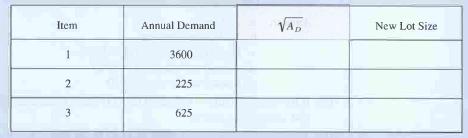
10.9. Calculate the new lot size for the following if K = 4. Item Annual Demand AD New Lot Size 1 3600 2 225 3 625
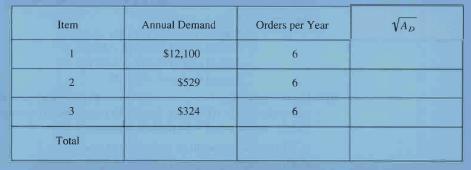
10.10. Calculate K for the following data: Item Annual Demand Orders per Year AD 1 $12,100 6 2 $529 6 3 $324 6 Total
10.13. The EOQ for an item is 138 units, and the annual usage is 2400 units. What is the period order quantity?
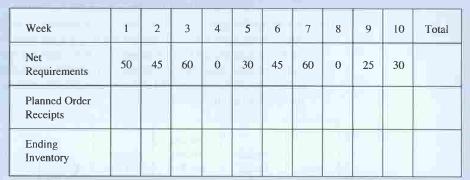
10.14. Given the following net requirements, calculate the planned order receipts based on the period order quantity. The EOQ is 200 units, and the annual demand is 4200 units. T 2 3 4 5 6 7 Week Net Requirements. Planned Order Receipts - $45 60 65 65 30 30 00 8 35 35 65 60 30
10.15. Given the following MRP record and an EOQ of 150 units, calculate the planned order receipts using the economic order quantity. Next, calculate the period order quantities and the planned order receipts. In both cases, calculate the ending inventory and the total inventory carried over the
10.16. An item has a setup cost for production of $300 per order, and the inventory carrying cost for the item is $ 15 per year. The demand for the item is constant at 20 units per day. The production rate is 50 units per day while the item is being produced.What is the non-instantaneous economic
3. What are four characteristics of the order point system?
7. What is service level?
11. Describe the two-bin system.
12. What kinds of information are shown on a perpetual inventory record?
14. Define the target level used in the periodic review system.
15. Describe how changes in demand will affect the order quantity when using the period review system.
16. What are the objectives of distribution inventory management?
18. Describe and compare the pull and push systems of inventory management.
19. Describe distribution requirements planning.
21. Describe the advantages and disadvantages of a decentralized distribution system.
22. Describe how the pattern of continuous demand changes from a distribution center to central supply.
11.1. For a particular SKU, the lead time is 6 weeks, the average demand is 100 units per week, and safety stock is 150 units. What is the average inventory if 1200 units are ordered at one time? What is the order point?
11.2. If the demand for a product is 300 units a week, lead time is 4 weeks, and safety stock is 400 units, calculate the order point. What is the average inventory if 10 weeks’ supply is ordered at one time?
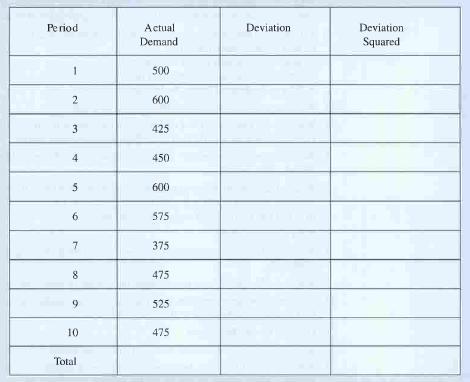
11.3. Given the following data, calculate the average x of the distribution and the standard deviation (a). Period Actual Demand Deviation Deviation Squared 1 500 2 600 3 425 4 450 5 600 6 575 7 375 00 8 475 9 525 10 475 Total
11.4. Given the following data, calculate the average demand and the standard deviation. Period Actual Demand 1700 2 2100 3 1900 4 2200 5 2000 6 1800 7 2100 8 2300 9 2100 10 1800 Total Deviation Deviation Squared
11.5. If sigma is 130 units, and the demand during the lead time is 250 units, calculate the safety stock and order point for:a. A 50% service level.b. An 85% service level.
11.6. Autotek Limited needs a certain casting from its supplier for which the standard deviation is calculated as 150 units.a. What safety stock should be carried to provide a service level of 90%? If the expected demand during the lead time is 1500 units, what is the order point?b. Calculate the
11.7. For an SKU, the standard deviation of demand during the lead time is 200 units, the annual demand is 16,000 units, and the order quantity is 800 units. Management says it will tolerate only one stockout per year. What safety stock should be carried? What is the average inventory? If the lead
11.8. A company stocks an SKU with a weekly demand of 600 units and a lead time of 3 weeks. Management will tolerate one stockout per year. If standard deviation of demand during the lead time is 275 and the order quantity is 1400 units, what are the safety stock, the average inventory, and the
11.10. If the standard deviation is calculated from weekly demand data at 100 units, what is the equivalent sigma for a 3-week lead time?Answer. 173 units
11.11. If the safety stock for an item is 200 units and the lead time is 3 weeks, what should the safety stock become if the lead time is extended to 6 weeks?Answer. 283 units
11.12. If the weekly standard deviation is 140 units, what is it if the lead time is 3 weeks?
11.13. The safety stock on an SKU is set at 220 units. The supplier says it can reduce the lead time from 8 to 6 weeks. What should be the new safety stock?Answer. 191 units
11.14. The safety stock on an SKU is set at 500 units. The supplier says it has to increase the lead time from 4 to 5 weeks. What should be the new safety stock?
11.16. If in problem 11.15, management said that it is considering increasing the service level to one stockout every 2 years, what would the new safety stock be? If the cost of carrying inventory on this item is $10 per unit per year, what is the cost of increasing the inventory from one stockout
11.17. The annual demand for an item is 10,000 units, the order quantity is 250, and the service level is 90%. Calculate the probable number of stockouts per year.
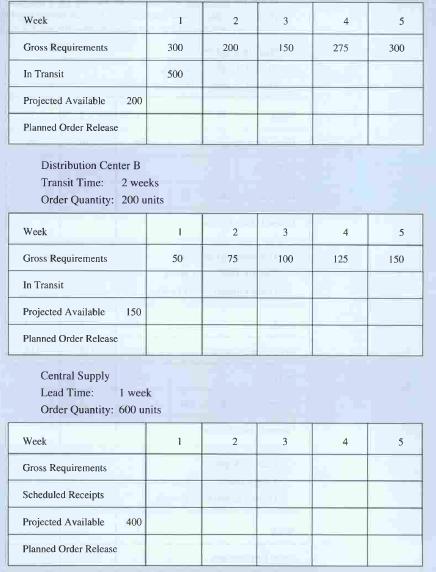
11.18. A company that manufactures stoves has one plant and two distribution centers (DCs). Given the following information for the two DCs, calculate the gross requirements, projected available, and planned order releases for the two DCs and the gross requirements, projected available, and planned
11.19. A company that manufactures snow shovels has one plant and two distribution centers (DCs). Given the following information for the two DCs, calculate the gross requirements, projected available, and planned order releases for the two DCs and the gross requirements, projected available, and
11.20. A firm orders a number of items from a regional warehouse every 2 weeks. Delivery takes 1 week. Average demand is 200 units per week, and safety stock is held at 2 weeks’ supply.a. Calculate the target level.b. If 600 units are on hand, how many should be ordered?Answer. Target level =
11.22. A small hardware store uses a periodic review system to control inventory and calculate order quantities. Inventory is reviewed every 2 weeks and there is a 1-week lead time for delivery. Safety stock is set at I week’s supply. The following table shows the products and the current on-hand
11.23. Using the data from problem 11.22, calculate the order quantities that would result if the store switched to a weekly review of inventory. What effect does more frequent ordering have on order quantities?
1. Using the data on the two part numbers given, provide a comprehensive evaluation of the ordering policies. Compare the present annual average cost with the cost of using a system such as EOQ, and discuss any other order policies as appropriate.There was no question about Carl’s genius. Seven
2. Should Carl’s pursue the price break? Why or why not?There was no question about Carl’s genius. Seven years ago he decided to enter the competitive nightmare that the personal computer business had become. Although on the surface that appeared to be a rather non-genius-like move, the genius
3. What do you think the sources of the other problems are? Be specific and analyze as completely as possible.There was no question about Carl’s genius. Seven years ago he decided to enter the competitive nightmare that the personal computer business had become. Although on the surface that
4. Develop a comprehensive plan to help Rosa get the inventory back under control.There was no question about Carl’s genius. Seven years ago he decided to enter the competitive nightmare that the personal computer business had become. Although on the surface that appeared to be a rather
1. What are the responsibilities of capacity management?
2. What is capacity planning?
3. Describe the three steps of capacity planning.
7. Describe each of the following and the information they contain.a. Open order.b. Routing.c. Work center.
8. What is a shop calendar? Why is it needed?
10. Define capacity available. What are the four factors that affect it?
11. Why is standard time usually used to measure capacity?
12. What are theoretical capacity, rated capacity, utilization, and efficiency? How are they related?
13. What is measured or demonstrated capacity? How is it different from rated capacity?
14. What is load?
15. What is a work center load report? What information does it contain?
16. What is a schedule?
17. Describe the process of backward scheduling.
18. What are the two ways of balancing capacity available and load? Which is preferred? Why?
19. What are some of the ways capacity available can be altered in the short run?
20. Why is feedback necessary in a control system?
21. What might be some of the problems in scheduling rated capacity too closely to the load?
22. How is safety capacity used?
7. What information is used for controlling production?
10. Describe forward and backward scheduling. Why is backward scheduling preferred?
11. Describe infinite and finite loading.
12. What is operation overlapping? What is its purpose?
13. What is operation splitting? What is its purpose?
14. What information does a load report contain? Why is it useful to production activity control?
15. What is a bottleneck operation?
16. What is the definition o f throughput?
17. W hat are the seven bottleneck principles discussed in the text?
18. W hat are the five things discussed in the text that are important in managing bottlenecks?
19. W hat is a shop order? W hat kind o f information does it usually contain?
20. W hat two things must be done to control queue and meet delivery commitments?
21. What is an input/output control system designed to do? How is input controlled? How is output controlled?
22. W hat is dispatching? W hat is a dispatch list?
25. Would critical ratio be better utilized as a static ratio or a dynamic ratio, and why?
26. W hat is the purpose o f production reporting? Why is it needed?
29. W hat is lot traceability? W hy is it important to safety related products?
31. Provide an explanation of Drum-Buffer-Rope and give an example of how it would be used.
2. What are the major functions of planning, implementation, and control?3. What are the major characteristics of flow, intermittent, and project manufacturing?4. Why is production activity control more complex in intermittent manufacturing?5. To plan the flow of materials through manufacturing,
5.1 A work center consists of 3 machines each working a 16-hour day for 5 days a week. What is the weekly available time?
5.2. The work center in problem 5.1 is utilized 75% of the time. What are the hours per week actually worked?
5.3. If the efficiency of the work center in problem 5.1 is 120%, what is the rated capacity of the work center? 5.1. A work center consists of 4 machines each working a 16-hour day for 5 days a week. What is the weekly available time?
5.4. A work center consisting of 5 machines is operated 14 hours a day for a 5-day week. Utilization is 85%, and efficiency is 120%. What is the rated weekly capacity in standard hours?
5.5. In Mac’s workshop, the standard time needed to process a job is 35 hours. How much actual time will be needed to run the order if the work center has an efficiency of 120% and a utilization of 85%?
5.6. Over a period of 4 weeks, a work center produced 40, 44, 38, and 42 standard hours of work. What is the demonstrated capacity of the work center?
5.7. A work center has 4 machines that are operated 8 hours a day for a 5-day week. What is the available time?
5.8. Over a 5-week period, a work center produced 500 standard hours of work. The scheduled hours were 540 hours, and 460 hours are actually worked. Calculate the utilization and the efficiency of the work center.
5.9. In one week, a work center consists of 3 machines that together produce 70 standard hours of work. The hours scheduled are 75, and 68 hours are actually worked. Calculate the utilization and efficiency of the work center. What is the weekly capacity of the work center?
5.10. ABC Machining has 2 major machines managed by 2 operators working in 2 shifts. Each operator works 8 hours a day, 5 days a week. They do not take breaks during the day, but they do allow themselves 30 minutes for lunch or dinner. In addition, they service the machines for about 30 minutes at
5.1 I. A work center got an order to process 130 units of casting. The setup time is 2.5 hours, and the run time is 0.3 hours per piece. What is the standard time needed to run the order?
5.12. How many standard hours are needed to run an order of 300 pieces if the setup time is 3.0 hours and the run time is 0.2 hours per piece? How many actual hours are needed at the work center if the efficiency is 120% and the utilization is 90%?
5.13. A work center has the following open and planned orders for week 4. Calculate the total standard time required (load).Order Quantity Setup Time (hours)Run Time (hours/piece)Total Time (hours)Released Orders 110 250 2.00 0.20 220 200 2.50 0.15 Planned Orders 330 400 2.00 0.10 440 450 3.00 0.15
5.14. Calculate the capacity and load percentage per work center (casting and machining)for the jobs B 110 and B220. Assume 50 hours is available per week for each work center.Work Centers Casting Machining Efficiency 0.95 0.90 Utilization 0.90 0.92 Production/week Week 1 Week 2 B 110 (time
Showing 300 - 400
of 1588
1
2
3
4
5
6
7
8
9
10
11
12
13
14
15
Last
Step by Step Answers

 Get 50% OFF
Claim Now
Get 50% OFF
Claim Now