New Semester
Started
Get
50% OFF
Study Help!
--h --m --s
Claim Now
Question Answers
Textbooks
Find textbooks, questions and answers
Oops, something went wrong!
Change your search query and then try again
S
Books
FREE
Study Help
Expert Questions
Accounting
General Management
Mathematics
Finance
Organizational Behaviour
Law
Physics
Operating System
Management Leadership
Sociology
Programming
Marketing
Database
Computer Network
Economics
Textbooks Solutions
Accounting
Managerial Accounting
Management Leadership
Cost Accounting
Statistics
Business Law
Corporate Finance
Finance
Economics
Auditing
Tutors
Online Tutors
Find a Tutor
Hire a Tutor
Become a Tutor
AI Tutor
AI Study Planner
NEW
Sell Books
Search
Search
Sign In
Register
study help
business
leading and collaborating
Management Leading And Collaborating In A Competitive World 11th Edition Thomas Bateman, Scott Snell, Robert Konopaske - Solutions
6. Select two organizations that you are interested in. Research information about the firms or talk with an employee, if possible. What types of cultures do they have? Write a paragraph that describes each culture.
5. We outlined several proactive responses that organizations can make to the environment. What examples have you seen recently of an organization’s responding effectively to its environment? Did the effectiveness of the response depend on whether the organization was facing a threat or an
4. What kinds of changes do companies make in response to environmental uncertainty?
3. What are the main differences between the macroenvironment and the competitive environment?
2. What are the most important forces in the macroenvironment facing companies today?
1. This chapter’s opening quote by Peter Drucker said, “The essence of a business is outside itself.” What do you think this means? Do you agree?
2. Answer the questions on the Grading System Analysis Worksheet individually, or in small groups, as directed by your instructor.
1. Assume that your university has decided to institute a pass–fail system of grading instead of the letter-grade system it presently has. Apply the systems perspective learned from this chapter to understanding this decision.
3. Which of the subsystems will be affected by the change; that is, what changes are likely to occur throughout the system as a result of the policy change?
2. Identify the following in this system: inputs, outputs, transformations.
1. What subsystems compose the system (the university)? Diagram the system.
8. For each of the management approaches discussed in the appendix, give examples you have seen. How effective or ineffective were they?
7. Why did the contingency perspective become such an important approach to management? Generate a list of contingencies that might affect the decisions you make in your life or as a manager.
6. Choose any organization and describe its system of inputs and outputs.
5. In what situations are quantitative management concepts and tools applicable?
4. What are the advantages and disadvantages of a bureaucratic organization?
3. Table A.1 lists Fayol’s 14 principles of management, first published in 1916. Are they as useful today as they were then?Why or why not? When are they most, and least, useful?
2. What is scientific management? How might today’s organizations use it?
1. How does today’s business world compare with the one of 40 years ago? What is different about today, and what is not so different?
3. Which management skills does Charlie have? In what areas do you think he has the greatest need to develop skills?How can he actively manage his development as a manager?As Charlie Greer drove to work, he smiled, recalling the meeting at the end of the previous day. Inez Rodriguez, the owner of
2. Which of the basic functions of management has Charlie considered? How well is he preparing to carry out these functions?As Charlie Greer drove to work, he smiled, recalling the meeting at the end of the previous day. Inez Rodriguez, the owner of the company where he worked, USA Hospital Supply,
1. How will Charlie’s approach to quality and service affect his company’s performance?As Charlie Greer drove to work, he smiled, recalling the meeting at the end of the previous day. Inez Rodriguez, the owner of the company where he worked, USA Hospital Supply, had summoned him to her office,
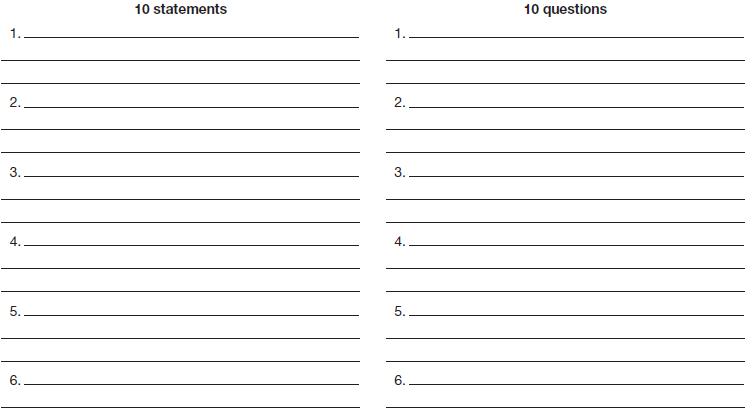
2. Identify 10 statements you can make today about your current career planning. Identify 10 questions you need answered for career planning. 1.. 2. 3. 10 statements 1. 2. 4. 4. 5.. 5. 6. 6. 10 questions
1. Describe your ideal occupation in terms of responsibilities, skills, and how you would know whether you were successful.
2. Bring your rankings to class. Be prepared to justify your results and rationale. If you can add any behaviors to this list that might lead to success or greater management effectiveness, write them in.
1. Following is a partial list of behaviors in which managers may engage. Rank these items in terms of their importance for effective performance as a manager. Put a 1 next to the item that you think is most important, 2 for the next most important, down to 10 for the least important.
5. What did you learn about yourself and others from this exercise?
4. What are some suggestions for approaching secondary contacts, and how is contacting secondary sources different from contacting primary contacts?
3. What are some suggestions for approaching primary contacts?
2. What were some of the best sources for secondary contacts identified by your group?
1. What were some of the best primary sources identified by your group?
13. Who are Bloomberg Businessweek ’s most recent “best and worst managers,” and why were they selected?
12. Consider the managers and companies discussed in the chapter. Have they been in the news lately, and what is the latest? If their image, performance, or fortunes have gone up or down, what has changed to affect how they have fared?
11. Devise a plan for developing yourself and making yourself attractive to potential employers. How would you go about improving your managerial skills?
10. What are your strengths and weaknesses as you contemplate your career? How do they correlate with the skills and behaviors identified in the chapter?
9. Discuss the importance of technical, conceptual, and interpersonal skills at school and in jobs you have held.
8. Describe your use of the four management functions in the management of your daily life.
7. Give examples you have seen of firms that are outstanding and weak on each of the six pillars of competitive advantage.Why do you choose the firms you do?
6. Name an ineffective organization. What can management do to improve it?
5. Name a great organization. How do you think management contributes to making it great?
4. Identify some examples of how different organizations collaborate across boundaries.
3. Describe in as much detail as possible how the Internet and globalization affect your daily life.
2. Have you ever seen or worked for an ineffective manager?Describe the causes and the consequences of the ineffectiveness.
1. Identify and describe a great manager. What makes him or her stand out from the crowd?
Describe strategies for creating a successful future. p. 617
Describe how to manage and lead change effectively. p. 606
Discuss what it takes to be world class. p. 602
List characteristics of successful development projects. p. 585
Describe the elements of an innovative organization. p. 582
Define key roles in managing technology. p. 580
Identify alternative methods of pursuing technological innovation. p. 572
Summarize how to assess technology needs. p. 570
Discuss ways to manage technology for competitive advantage. p. 566
Describe how technologies proceed through a life cycle. p. 564
List the types of processes that spur development of new technologies. p. 562
Describe the boundaryless organization and its advantages. p. 517
Summarize how to work with the company grapevine. p. 516
Explain how to improve downward, upward, and horizontal communication. p. 512
Summarize ways to become a better sender and receiver of information. p. 506
Describe when and how to use the various communication channels. p. 501
Identify communication problems to avoid. p. 499
Discuss important advantages of two-way communication. p. 498
Discuss the use of clan control in an empowered organization. p. 553
Identify ways in which organizations use market control mechanisms. p. 551
List procedures for implementing effective control systems. p. 546
Define basic types of financial statements and financial ratios used as controls. p. 541
Describe the purposes for using budgets as a control device. p. 538
Summarize how to design a basic bureaucratic control system. p. 529
Explain why companies develop control systems for employees. p. 528
Identify causes and consequences of a satisfied workforce. p. 460
Summarize how people assess fairness and how to achieve fairness. p. 457
Define ways to create jobs that motivate. p. 453
Discuss ways in which people’s individual needs affect their behavior. p. 449
Describe the key beliefs that affect people’s motivation. p. 447
Summarize how to reward good performance effectively. p. 443
List principles for setting goals that motivate employees. p. 441
Identify the kinds of behaviors managers need to motivate in people. p. 440
Identify ways to manage conflict. p. 486
List methods for managing a team’s relationships with other teams. p. 485
Describe how to build an effective team. p. 478
Explain why groups sometimes fail. p. 477
Summarize how groups become teams. p. 476
Describe different types of teams. p. 472
Discuss how teams can contribute to an organization’s effectiveness. p. 472
Discuss how to further your own leadership development. p. 429
Describe types of opportunities to be a leader in an organization. p. 428
Distinguish between charismatic and transformational leaders. p. 424
Describe behaviors that will make you a better leader, and identify when the situation calls for them. p. 413
List personal traits and skills of effective leaders. p. 412
Identify sources of power in organizations. p. 410
Explain how a good vision helps you be a better leader. p. 407
Summarize what people want and organizations need from their leaders. p. 406
Discuss what it means to be a leader. p. 406
Summarize how unions and labor laws influence human resources management. p. 358
Describe the fundamental aspects of a reward system. p. 351
Explain alternatives for who appraises an employee’s performance. p. 347
Evaluate the importance of spending on training and development. p. 344
Identify various methods for selecting new employees. p. 334
Give reasons companies recruit both internally and externally for new hires. p. 333
Discuss how companies use human resources management to gain competitive advantage. p. 328
Showing 300 - 400
of 592
1
2
3
4
5
6
Step by Step Answers

 Get 50% OFF
Claim Now
Get 50% OFF
Claim Now