New Semester
Started
Get
50% OFF
Study Help!
--h --m --s
Claim Now
Question Answers
Textbooks
Find textbooks, questions and answers
Oops, something went wrong!
Change your search query and then try again
S
Books
FREE
Study Help
Expert Questions
Accounting
General Management
Mathematics
Finance
Organizational Behaviour
Law
Physics
Operating System
Management Leadership
Sociology
Programming
Marketing
Database
Computer Network
Economics
Textbooks Solutions
Accounting
Managerial Accounting
Management Leadership
Cost Accounting
Statistics
Business Law
Corporate Finance
Finance
Economics
Auditing
Tutors
Online Tutors
Find a Tutor
Hire a Tutor
Become a Tutor
AI Tutor
AI Study Planner
NEW
Sell Books
Search
Search
Sign In
Register
study help
business
macroeconomic theory
Microeconomics For Today 6th Edition Irvin B. Tucker - Solutions
E1.1 (LO 2) (Usefulness, Objective of Financial Reporting) Indicate whether the following statements about the Conceptual Framework are true or false. If false, provide a brief explanation supporting your position.
44. What are some of the major challenges facing the accounting profession?
43. What is the “expectations gap”? What is the profession doing to try to close this gap?
42. The treasurer of Landowska Co. has heard that conservatism is a doctrine that is followed in accounting and, therefore, proposes that several policies be followed that are conservative in nature. State your opinion with respect to each of the policies listed.a. The company gives a 2-year
41. What are some of the costs of providing accounting information?What are some of the benefits of accounting information? Describe the cost-benefit factors that should be considered when new accounting standards are being proposed.
40. Describe the major constraint inherent in the presentation of accounting information.
39. In January 2026, Janeway AG doubled the amount of its outstanding shares by selling an additional 10,000 shares to finance an expansion of the business. You propose that this information be shown by a footnote to the statement of financial position as of December 31, 2025. The president
38. Briefly describe the types of information concerning financial position, income, and cash flows that might be provided (a) within the main body of the financial statements, (b) in the notes to the financial statements, or (c) as supplementary information.
37. Under what conditions should an item be recognized in the financial statements?
36. Three expense recognition methods (associating cause and effect, systematic and rational allocation, and immediate recognition) were discussed in the chapter under the expense recognition principle.Indicate the basic nature of each of these expense recognition methods and give two examples of
35. Mogilny Company paid $135,000 for a machine. The Accumulated Depreciation account has a balance of $46,500 at the present time. The company could sell the machine today for $150,000. The company president believes that the company has a “right to this gain.” What does the president mean by
34. Selane Eatery operates a catering service specializing in business luncheons for large companies. Selane requires customers to place their orders 2 weeks in advance of the scheduled events. Selane bills its customers on the 10th day of the month following the date of service and requires that
33. What are the five steps used to determine the proper time to recognize revenue?
32. What is a performance obligation, and how is it used to determine when revenue should be recognized?
31. Explain the revenue recognition principle.
30. Briefly describe the fair value hierarchy.
29. What is the fair value option? Explain how use of the fair value option reflects application of the fair value principle.
28. What is the definition of fair value?
27. Briefly describe the three bases for measuring current value.
26. The chairman of the board of directors of the company for which you are the chief accountant has told you that he has little use for accounting figures based on historical cost. He believes that fair values are of far more significance to the board of directors than“out-of-date costs.”
25. What is the basic accounting problem created by the monetary unit assumption when there is significant inflation? What appears to be the IASB position on a stable monetary unit?
24. The life of a business is divided into specific time periods, usually a year, to measure results of operations for each such time period and to portray financial conditions at the end of each period.a. This practice is based on the accounting assumption that the life of the business consists of
23. What are the five basic assumptions that underlie the financial accounting structure?
22. What are the basic elements of the Conceptual Framework?Briefly describe the relationship between the “moment in time” and“period of time” elements.
21. Why is it necessary to develop a definitional framework for the basic elements of accounting?
20. What is the distinction between comparability and consistency?
19. According to the Conceptual Framework, the objective of financial reporting for business enterprises is based on the needs of the users of financial statements. Explain the level of sophistication that the IASB assumes about the users of financial statements.
18. What are the enhancing qualities of the qualitative characteristics?What is the role of enhancing qualities in the Conceptual Framework?
17. Your friend (not an accounting major) thinks that prudence in the Conceptual Framework means being conservative. Do you agree?Explain.
16. How are materiality (and immateriality) related to the proper presentation of financial statements? What factors and measures should be considered in assessing the materiality of a misstatement in the presentation of a financial statement?
15. Briefly describe the two fundamental qualities of useful accounting information.
14. What is meant by the term “qualitative characteristics of accounting information”?
13. Does management stewardship have a role in the objective of financial reporting? Explain.
12. What is the primary objective of financial reporting?
11. What is a conceptual framework? Why is a conceptual framework necessary in financial accounting?
10. How are IASB preliminary views and IASB exposure drafts related to IASB standards?
9. What is the purpose of the Monitoring Board?
8. What is the mission of the IASB?
7. What is IOSCO?
6. What are the two key organizations in the development of international accounting standards? Explain their role.
5. What is the benefit of a single set of high-quality accounting standards?
4. How does accounting help in the capital allocation process?
3. What are the major financial statements, and what is the difference between financial statements and financial reporting?
#!# 2. Differentiate broadly between financial accounting and managerial accounting.
1. What is happening to world markets, and what are the implications for financial reporting?
1. At the completion of Teo NV’s audit, the president, Judy Teo, asks about the meaning of the phrase “in conformity with IFRS” that appears in your audit report on the management’s financial statements. Judy observes that the meaning of the phrase must include something more and different
4. Identify the major challenges in the financial reporting environment.
3. Discuss the basic assumptions and principles of accounting.
2. Describe the components and usefulness of the conceptual framework, and identify the qualitative characteristics of accounting information and the basic elements of financial statements.
1. Describe the global financial markets, major standard-setting bodies, and the meaning of International Financial Reporting Standards(IFRS).
for oligopolists to avoid a low-price outcome?a. Tit-for-tatb. Price leadershipc. Carteld. All of the above
20. Which of the following is a game theory strategy
19. Which of the following is a game theory strategy for oligopolists to avoid a low-price outcome?a. Tit-for-tatb. Win-winc. Last-in first-outd. Second best
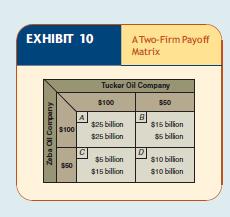
18. Suppose costs are identical for the two firms in Exhibit 10. Each firm assumes without formal agreement that if it sets the high price, its rival will not charge a lower price. Under these“tit-for-tat” conditions, equilibrium will be established bya. Zeba Oil charging $100 and Tucker Oil
17. Suppose costs are identical for the two firms in Exhibit 10. If both firms assume the other willcompete and charge a lower price, equilibrium will be established bya. Zeba Oil charging $100 and Tucker Oil charging $100.b. Zeba Oil charging $100 and Tucker Oil charging $50.c. Zeba Oil charging
16. Assume costs are identical for the two firms in Exhibit 10. If both firms were allowed to form a cartel and agree on their prices, equilibrium would be established bya. Zeba Oil charging $100 and Tucker Oil charging $100.b. Zeba Oil charging $100 and Tucker Oil charging $50.c. Zeba Oil charging
15. Which of the following is evidence that OPEC is a cartel?a. Agreement on price and output quotas by oil ministriesb. Ability to raise prices regardless of demandc. Mutual interdependence in pricing and output decisionsd. Ability to completely control entry
14. According to the kinked demand curve theory, when one firm raises its price, other firms willa. also raise their prices.b. refuse to follow.c. increase their advertising expenditures.d. exit the industry.
13. The kinked demand curve theory attempts to explain why an oligopolistic firma. has relatively large advertising expenditures.b. fails to invest in research and development(R&D).c. infrequently changes its price.d. engages in excessive brand proliferation.
12. A characteristic of an oligopoly isa. mutual interdependence in pricing decisions.b. easy market entry.c. both (a) and (b).d. neither (a) nor (b).
11. The cigarette industry in the United States is described asa. a monopoly.b. perfect competition.c. monopolistic competition.d. an oligopoly.
10. The “Big Three” U.S. automobile industry is described asa. a monopoly.b. perfect competition.c. monopolistic competition.d. an oligopoly.
9. Monopolistic competition is an inefficient market structure becausea. firms earn zero profit in the long run.b. marginal cost is less than price in the long run.c. a wider variety of products is available compared to perfect competition.d. all of the above.
8. One possible effect of advertising on a firm’s long-run average cost curve is toa. raise the curve.b. lower the curve.c. shift the curve rightward.d. shift the curve leftward.
7. A monopolistically competitive firm in the long run earns the same economic profit as aa. perfectly competitive firm.b. monopolist.c. cartel.d. none of the above.
6. A monopolistically competitive firm is inefficient because the firma. earns positive economic profit in the long run.b. is producing at an output where marginal cost equals price.c. is not maximizing its profit.d. produces an output where average total cost is not minimum.
5. The theory of monopolistic competition predicts that in long-run equilibrium a monopolistically competitive firm willa. produce the output level at which price equals long-run marginal cost.b. operate at minimum long-run average cost.c. overutilize its insufficient capacity.d. produce the output
4. A monopolistically competitive firm willa. maximize profits by producing where MR ¼ MC.b. not earn an economic profit in the long run.c. shut down if price is less than average variable cost.d. do all of the above.
3. Which of the following is not a characteristic of monopolistic competition?a. A large number of small firmsb. A differentiated productc. Easy market entryd. A homogeneous product
2. Which of the following industries is the best example of monopolistic competition?a. Wheatb. Restaurantc. Automobiled. Water service
1. An industry with many small sellers, a differentiated product, and easy entry would best be described as which of the following?a. Oligopolyb. Monopolistic competitionc. Perfect competitiond. Monopoly
13. Assume the payoff matrix in Exhibit 7 applies to spending for advertising rather than airline fares.Substitute “Don’t advertise” for “High fare” and“Advertise” for “Low fare.” Assume the same profit and loss figures in each cell, but substitute“Marlboro” for
12. Evaluate the following statement: “A cartel will put an end to price war, which is a barbaric form of competition that benefits no one.”
11. Suppose IBM raised the price of its printers, but Hewlett-Packard (the largest seller) refused to follow. Two years later IBM cut its price, and Hewlett-Packard retaliated with an even deeper price cut, which IBM was forced to match. For the next 5 years, Hewlett-Packard raised its prices five
10. What might be a general distinction between oligopolists that advertise and those that do not?
9. Suppose the jeans industry is an oligopoly in which each firm sells its own distinctive brand of jeans.Each firm believes its rivals will not follow its price increases, but will follow its price cuts. Explain the demand curve facing each firm. Does this demand curve mean that firms in the jeans
8. Why is mutual interdependence important under oligopoly, but not so important under perfect competition, monopoly, or monopolistic competition?
7. List four goods or services that you have purchased that were produced by an oligopolist.Why are these industries oligopolistic, rather than monopolistically competitive?
6. Draw a graph that shows how advertising affects a firm’s ATC curve. Explain how advertising can lead to lower prices in a monopolistically competitive industry.
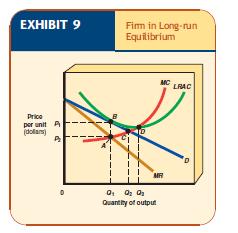
5. Assuming identical long-run cost curves, draw two graphs, and indicate the price and output that result in the long run under monopolisticcompetition and perfect competition. Evaluate the differences between these two market structures. EXHIBIT 9 Firm in Long-run Equilibrium Price per unit P
4. Consider this statement: “Because price equals long-run average cost and profits are zero, a monopolistically competitive firm is efficient.”Do you agree or disagree? Explain.
3. Exhibit 9 represents a monopolistically competitive firm in long-run equilibrium.a. Which price represents the long-run equilibrium price?b. Which quantity represents the long-run equilibrium output?c. At which quantity is the LRAC curve at its minimum?d. Is the long-run equilibrium price
2. Suppose the minimum point on the LRAC curve of a soft-drink firm’s cola is $1 per liter. Under conditions of monopolistic competition, will the price of a liter bottle of cola in the long run be above $1, equal to $1, less than $1, or impossible to determine?
1. Compare the monopolistically competitive firm’s demand curve to those of a perfect competitor and a monopolist.
15. The monopolist, unlike the perfectly competitive firm, can continue to earn an economic profit in the long run because ofa. collusive agreements with competitors.b. price leadership.c. cartels.d. a dominant firm.e. extremely high barriers to entry.
14. In contrast to a perfectly competitive firm, a monopolist operates in the long run at a quantity of output at whicha. P ¼ MC.b. MR ¼ MC.c. P ¼ ATC.d. P > MR.
13. Suppose a monopolist charges a price corresponding to the intersection of the marginal cost and marginal revenue curves. If this price is between its average variable cost and average total cost curves, the firm willa. earn an economic profit.b. stay in operation in the short run, but shut down
12. At any point where a monopolist’s marginal revenue is positive, the downward-sloping straight-line demand curve isa. perfectly elastic.b. elastic, but not perfectly elastic.c. unit elastic.d. inelastic.
11. Under both perfect competition and monopoly, a firma. is a price taker.b. is a price maker.c. will shut down in the short run if price falls short of average total cost.d. always earns a pure economic profit.e. sets marginal cost equal to marginal revenue.
10. What is the act of buying a commodity at a lower price and selling it at a higher price?a. Buying shortb. Discountingc. Tariffingd. Arbitrage
9. For a monopolist to practice effective price discrimination, one necessary condition isa. identical demand curves among groups of buyers.b. differences in the price elasticity of demand among groups of buyers.c. a homogeneous product.d. none of the above.
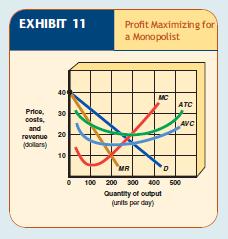
8. If the monopolist in Exhibit 11 operates at the profit-maximizing output, it will earn total revenue to pay about what portion of its total fixed cost?a. Noneb. One-halfc. Two-thirdsd. All total fixed costs
7. To maximize profit or minimize loss, the monopolist in Exhibit 11 should set its price ata. $30 per unit.b. $25 per unit.c. $20 per unit.d. $10 per unit.e. $40 per unit. EXHIBIT 11 Profit Maximizing for a Monopolist 40 Price, 30 costs, and revenue 20 (dollars) 10 MC ATC AVC MR 0 100 200 300 400
5. As shown in Exhibit 11, the profit-maximizing or loss-minimizing output for this monopolist isa. 100 units per day.b. 200 units per day.c. 300 units per day.d. 400 units per day.6. As shown in Exhibit 11, this monopolista. should shut down in the short run.b. should shut down in the long run.c.
4. Which of the following is true for the monopolist?a. Economic profit is possible in the long run.b. Marginal revenue is less than the price charged.c. Profit maximizing or loss minimizing occurs when marginal revenue equals marginal cost.d. All of the above are true.
3. A monopolist setsa. the highest possible price.b. a price corresponding to minimum average total cost.c. a price equal to marginal revenue.d. a price determined by the point on the demand curve corresponding to the level of output at which marginal revenue equals marginal cost.e. none of the
2. A monopolist sets thea. price at which marginal revenue equals zero.b. price that maximizes total revenue.c. highest possible price on its demand curve.d. price at which marginal revenue equals marginal cost.
1. A monopolist always faces a demand curve that isa. perfectly inelastic.b. perfectly elastic.c. unit elastic.d. the same as the market demand curve.
12. Suppose the candy bar industry approximates a perfectly competitive industry. Suppose also that a single firm buys all the assets of the candy bar firms and establishes a monopoly. Contrast these two market structures with respect to price, output, and allocation of resources. Draw a graph of
11. Which of the following constitute price discrimination?a. A department store has a 25 percent off sale.b. A publisher sells economics textbooks at a lower price in North Carolina than in New York.c. The Japanese sell cars at higher prices in the United States than in Japan.d. The phone company
Showing 300 - 400
of 4718
1
2
3
4
5
6
7
8
9
10
11
12
13
14
15
Last
Step by Step Answers

 Get 50% OFF
Claim Now
Get 50% OFF
Claim Now