New Semester
Started
Get
50% OFF
Study Help!
--h --m --s
Claim Now
Question Answers
Textbooks
Find textbooks, questions and answers
Oops, something went wrong!
Change your search query and then try again
S
Books
FREE
Study Help
Expert Questions
Accounting
General Management
Mathematics
Finance
Organizational Behaviour
Law
Physics
Operating System
Management Leadership
Sociology
Programming
Marketing
Database
Computer Network
Economics
Textbooks Solutions
Accounting
Managerial Accounting
Management Leadership
Cost Accounting
Statistics
Business Law
Corporate Finance
Finance
Economics
Auditing
Tutors
Online Tutors
Find a Tutor
Hire a Tutor
Become a Tutor
AI Tutor
AI Study Planner
NEW
Sell Books
Search
Search
Sign In
Register
study help
business
macroeconomics
Exploring Macroeconomics 5th Edition Robert L. Sexton - Solutions
How would the adverse selection problem arise in the insurance market? How is it like the “lemon” used-car problem?
In order to get a license to practice in the United States, foreign-trained veterinarians must take an exam given by the American Veterinary Association. Only 48 people per year are allowed to take the exam, which is administered at only two universities. The fee for the exam, which must be booked
How does a TV broadcast have characteristics of a public good? What about cable services such as HBO?
What kind of problems does the government face when trying to perform a cost-benefit analysis of whether or how much of a public project to produce?
Why do you think buffaloes became almost completely extinct on the Great Plains but cattle did not? Why is it possible that you can buy a buffalo burger in a store or diner today?
Is a lighthouse a public good if it benefits many ship owners? What if it primarily benefits ships going to a port nearby?
For each of the following goods, indicate whether they are nonrival and/or nonexclusive. Indicate whether they are private or public goods.a. hot dogsb. cable TVc. broadcast TVd. automobilese. national defensef. pollution control g. parking in a parking structure h. a sunset i. admission to a theme
Draw a standard supply and demand diagram for televisions, and indicate the equilibrium price and output.a. Assuming that the production of televisions generates external costs, illustrate the effect of the producers being forced to pay a tax equal to the external costs generated, and indicate the
Indicate which of the following activities create a positive externality, a negative externality, or no externality at all:a. During a live theater performance, an audience member’s cell phone loudly rings.b. You are given a flu shot.c. You purchase and drink a soda during a break from class.d. A
In the analysis of the winner’s cursea. a bidder who realizes he might be in a winner’s curse situation may bid less as a result.b. it can be better to lose an auction than to win it.c. a good bought for its value to the bidder is less likely to be subject to the winner’s curse than a good
The winner’s cursea. is more likely the fewer the bidders.b. is more likely the more frequently a good is purchased.c. is more likely when a good is being purchased because of its expected future market value.d. is a myth.
In the market for insurance, the moral hazard problem leadsa. those most likely to collect on insurance to buy it.b. those who buy insurance to take fewer precautions to avoid the insured risk.c. those with more prior insurance claims to be charged a higher premium.d. to none of the above.
If, after you buy a car with air bags, you start to drive recklessly, it would be an illustration ofa. the moral hazard problem.b. the free-rider problem.c. the adverse selection problem.d. the “lemon” problem.
If a company offers a medical and dental care plan that offers benefits to all of the members of each employee’s family for a given monthly premium, an employee who is a mother of five children and who has bad teeth who elects that plan would be an illustration ofa. the moral hazard problem.b.
Which of the following is not true of adverse selection?a. It can result when both parties to a transaction have little information about the quality of the goods involved.b. It can cause the quality of goods traded to fall, if quality detection costs are high.c. It can be a difficult problem to
Adverse selection refers toa. the phenomenon that occurs when one party in an exchange takes advantage of knowing more than another party.b. the tendency for individuals to alter their behavior once they are insured against loss.c. the tendency for individuals to engage in insurance fraud.d. both b
Public goods, like national defense, are usually funded through government becausea. no one cares about them, because they are public.b. it is prohibitively difficult to withhold national defense from someone unwilling to pay for it.c. they cost too much for private firms to produce them.d. they
The market system fails to provide the efficient output of public goods becausea. people place no value on public goods.b. private firms cannot restrict the benefits from those goods to consumers who are willing to pay for them.c. public enterprises can produce those goods at lower cost than
In the case of externalities, appropriate government corrective policy would bea. taxes in the case of external benefits and subsidies in the case of external costs.b. subsidies in the case of external benefits and taxes in the case of external costs.c. taxes in both the case of external benefits
Socially inefficient outcomes may occur in markets that havea. free riders.b. negative externalities.c. asymmetric information problems.d. positive externalities.e. any of the above.
Assume that production of a good generates external benefits of consumption. The market equilibrium price of the good will be _____________ and the equilibrium quantity _____________ for efficient resource allocation.a. too high; too highb. too high; too lowc. too low; too highd. too low; too low
Assume that production of a good imposes external costs on others. The market equilibrium price will be _____________ and the equilibrium quantity _____________ for efficient resource allocation.a. too high; too highb. too high; too lowc. too low; too highd. too low; too low
Which of the following will most likely generate positive externalities of consumption?a. a hot dog vendorb. public educationc. an automobiled. a city buse. a polluting factory
If firms were required to pay the full social costs of the production of goods, including both private and external costs, other things being equal, there would probably bea. an increase in production.b. a decrease in production.c. a greater misallocation of resources.d. a decrease in the market
In the case of a good whose production generates negative externalities,a. those not directly involved in the market transactions are harmed.b. internalizing the externality would tend to result in a greater output of the good.c. too little of the good tends to be produced.d. a subsidy would be the
A tax equal to the external cost on firms that emit pollutants woulda. provide firms with the incentive to increase the level of activity creating the pollution.b. provide firms with the incentive to decrease the level of activity creating the pollution.c. provide firms with little incentive to
The presence of negative externalities leads to a misallocation of societal resources becausea. whenever external costs are imposed on outside parties, the good should not be produced at all.b. less of the good than is ideal for society is produced.c. some costs are associated with production that
Repeat purchasers are less likely to suffer from the winner’s curse than one-time purchasers. True or False.
The winner’s curse is more likely when a large number of bidders is involved. True or False.
In the market for insurance, moral hazard can lead those who buy insurance to take fewer precautions to avoid the insured risk. True or False.
In the market for insurance, the adverse selection problem leads those most likely to collect on insurance to buy it. True or False.
Warranty agreements that limit the responsibility of the insurer in certain situations can be one method of controlling moral hazard problems. True or False.
In adverse selection situations, it is rational for a seller with more information about a product to provide a truthful and complete disclosure and make that fact known to a potential buyer. True or False.
Asymmetric information exists when the available information is initially distributed in favor of one party to a transaction relative to another. True or False.
If quality detection costs are high, high-quality products will tend to be withdrawn from the market, and the average quality will rise. True or False.
In the case of public goods, when people act as free riders, some goods having benefits greater than costs will not be produced.
In the case of goods where all those affected benefit simultaneously and it is prohibitively costly to exclude anyone from consuming them, market failures tend to arise. True or False.
Externality problems always require the intervention of government. True or False.
In the case of external benefits, a tax equal to external benefits would result in an efficient level of output. True or False.
In the case of external benefits, if we could add the benefits that are derived by nonpaying consumers, the demand curve would shift to the right, increasing output. True or False.
Because the decision makers involved ignore some of the real social benefits, the private market does not provide enough of goods that generate external benefits. True or False.
Alternatives to pollution taxes include the government prohibiting certain types of activities that cause pollution and forcing firms to clean up their emissions. True or False.
The tax revenues raised by a pollution tax could be used to compensate those who have suffered damages from the pollution. True or False.
If government could impose a pollution tax equal to the exact size of the external costs imposed by a firm, then the firm would produce at the socially desired level of output. True or False.
In the case of external costs, firms tend to produce too little from society’s standpoint, causing an efficiency loss due to an underallocation of scarce resources to the production of the good. True or False.
A positive externality is when the action of one party benefits another party. True or False.
A negative externality is when the action of one party imposes a cost on another party. True or False.
The winner’s curse is less likely for items that are purchased _____________/infrequently and where there is a larger/_____________ number of bidders.
The _____________ occurs when the winner of an auction overpays.
_____________ arises from the cost involved for the insurer to monitor the behaviors of the insured party.
Good warranties are an example of _____________ behavior that takes place because the _____________ may know the actual quality of durable goods better than the _____________.
A college education can provide a _____________ about a person’s intelligence and perseverance.
When one party enters into an exchange with another party that has more information, we call it _____________ selection.
The existence of _____________ may give rise to signaling behavior.
When the available information is initially distributed in favor of one party relative to another, _____________ is said to exist.
The failure of private incentives to provide adequate maintenance of public resources is known to economists as the _____________.
Fish in the vast ocean are a good example of a _____________ resource.
A common resource is a _____________ good that is _____________.
Goods that are owned by everyone and therefore not owned by anyone are called _____________ resources.
The government may be able to overcome the freerider problem by _____________ the public good and imposing taxes to pay for it.
When individuals derive the benefits of a good without paying for it, it is called a(n) _____________.
If everyone can consume a good simultaneously, it is _____________.
If once a good is produced it is prohibitively costly to exclude anyone from consuming the good, consumption of that good is called _____________.
Unlike the consumption of private goods, the consumption of public goods is both _____________ and _____________.
In the case of either external benefits or external costs, buyers and sellers are receiving the wrong signals: The apparent benefits or costs of some actions differ from the _____________ benefits or costs.
Because producers are unable to collect payments from all who are benefiting from the good or service, the market has a tendency to _____________ goods with external benefits.
If suppliers are unaware of or not responsible for the external costs created by their production, the result is a(n) _____________ of scarce resources to the production of the good.
The benefits of a product or service that spill over to an outside party not involved in producing or consuming the good are called _____________.
If the government taxed a manufacturer by the amount of those external costs it imposes on others, it would force the manufacturer to _____________ the costs.
If a firm can avoid paying the external costs it imposes on others, it _____________ its own costs of production but not the _____________ cost to society.
Whenever an activity has physical impacts on individuals not directly involved in the activity, if the impact on the outside party is negative, it is called a _____________; if the impact is positive, it is called a _____________.
Sometimes the market system fails to produce efficient outcomes because of side effects economists call _____________.
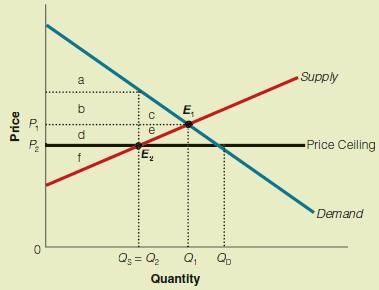
The 2000–2001 California energy crisis produced brownouts, utility company bankruptcies, and worries about high prices. The California electric power regulatory program imposed price ceilings on electricity sold to consumers. The following exhibit describes the California situation with PS as the
Use the diagram to answer the following questions (a–c).a. At the competitive output, Q1, what area represents the consumer surplus? What area represents the producer surplus?b. At the larger output, Q2, what area represents the consumer surplus? What area represents the producer surplus?c. What
Use the diagram to answer the following questions (a–c).a. At the initial equilibrium price, what area represents consumer surplus? What area represents producer surplus?b. After the price ceiling is imposed, what area represents consumer surplus? What area represents producer surplus?c. What
Use consumer and producer surplus to show the deadweight loss from a subsidy (producing more than the equilibrium output). (Hint: Remember that taxpayers will have to pay for the subsidy.)
Use the diagram to answer the following questions (a–d).a. At the equilibrium price before the tax is imposed, what area represents consumer surplus? What area represents producer surplus?b. Say that a tax of $T per unit is imposed in the industry. What area now represents consumer surplus? What
Elasticity of demand in the market for one-bedroom apartments is 2.0, elasticity of supply is 0.5, the current market price is $1,000, and the equilibrium number of one-bedroom apartments is 10,000. If the government imposes a price ceiling of$800 on this market, predict the size of the resulting
Which of the following do you think are good markets for the government to tax if the goal is to boost tax revenue?Which will lead to the least amount of deadweight loss? Why?a. luxury yachtsb. alcoholc. motor homesd. cigarettese. gasolinef. pizza
If the government’s goal is to raise tax revenue, which of the following are good markets to tax?a. luxury yachtsb. alcoholc. moviesd. gasolinee. grapefruit juice
How is total surplus (the sum of consumer and producer surpluses) related to the efficient level of output? Using a supply and demand curve, demonstrate that producing less than the equilibrium output will lead to an inefficient allocation of resources—a deadweight loss.
If demand for apples increased as a result of a news story that highlighted the health benefits of two apples a day, what would happen to producer surplus?
If a freeze ruined this year’s lettuce crop, show what would happen to consumer surplus.
Steve loves potato chips. His weekly demand curve is shown in the following exhibit.a. How much is Steve willing to pay for one bag of potato chips?b. How much is Steve willing to pay for a second bag of potato chips?c. If the actual market price of potato chips is $2.50, and Steve buys five bags
Refer to the following exhibit.a. If the price of each karate lesson is P0, the consumer surplus is equal to what area?b. If the price falls from P0 to P1, the change in consumer surplus is equal to what area? Price of Karate Lessons (per lesson) Po P A B D E F % Q Quantity of Karate Lessons
With a deficiency payment program,a. the government sets the target price at the equilibrium price.b. producer and consumer surplus falls.c. there is a deadweight loss because the program increases the output beyond the efficient level of output.d. all of the above are true.
The longer a price ceiling is left below the equilibrium price in a market, the _____________ is the reduction in the quantity exchanged and the _____________ is the resulting deadweight loss.a. greater; greaterb. greater; smallerc. smaller; greaterd. smaller; smaller
In the case of a price floor, if the government buys up the surplus,a. consumer surplus decreases.b. producer surplus increases.c. a greater deadweight loss occurs than with a deficiency payment system.d. all of the above are true.
A permanent increase in price would tend to decrease the consumer surplus by _____________ or increase the producer surplus by _____________ in the long run than in the short run.a. more; moreb. more; lessc. less; mored. less; less
The longer the time people have to adjust to a tax, the _____________ revenue it will raise and the _____________ quantity traded will fall.a. more; moreb. more; lessc. less; mored. less; less
With a subsidy,a. the price producers receive is the price consumers pay plus the subsidy.b. the subsidy leads to the production of more than the efficient level of output.c. there is a deadweight loss.d. all of the above are true.
An increase in a subsidy will increasea. consumer surplus.b. producer surplus.c. the deadweight loss.d. all of the above.
Other things being equal, for a given tax, if the demand curve is less elastic,a. the greater the tax revenue raised and the greater the deadweight cost of the tax.b. the greater the tax revenue raised and the smaller the deadweight cost of the tax.c. the less the tax revenue raised and the greater
After the imposition of a tax,a. consumers pay a higher price, including the tax.b. consumers lose consumer surplus.c. producers receive a lower price after taxes.d. producers lose producer surplus.e. all of the above occur.
Taxes on goods with ______________ demand curves will tend to raise more tax revenue for the government than taxes on goods with ______________ demand curves.a. elastic; unit elasticb. elastic; inelasticc. inelastic; elasticd. unit elastic; inelastic
In a supply and demand graph, the triangular area between the demand curve and the supply curve lost because of the imposition of a tax, price ceiling, or price floor isa. the consumer surplus.b. the producer surplus.c. the marginal cost.d. the deadweight loss.e. the net gain to society from
In a supply and demand graph, the triangular area under the demand curve but above the supply curve isa. the consumer surplus.b. the producer surplus.c. the marginal cost.d. the deadweight loss.e. the net gain to society from trading that good.
At the market equilibrium price and quantity, the total welfare gains from trade are measured bya. the total consumer surplus captured by consumers.b. the total producer surplus captured by producers.c. the sum of consumer surplus and producer surplus.d. the consumer surplus minus the producer
Which of the following is not true about producer surplus?a. Producer surplus is the difference between what sellers are paid and their cost of producing those units.b. Producer surplus is shown graphically as the area under the market price but above the supply curve.c. An increase in the market
Which of the following is not true about consumer surplus?a. Consumer surplus is the difference between what consumers are willing to pay and what they actually pay.b. Consumer surplus is shown graphically as the area under the demand curve but above the market price.c. An increase in the market
Showing 3700 - 3800
of 7318
First
31
32
33
34
35
36
37
38
39
40
41
42
43
44
45
Last
Step by Step Answers

 Get 50% OFF
Claim Now
Get 50% OFF
Claim Now