New Semester
Started
Get
50% OFF
Study Help!
--h --m --s
Claim Now
Question Answers
Textbooks
Find textbooks, questions and answers
Oops, something went wrong!
Change your search query and then try again
S
Books
FREE
Study Help
Expert Questions
Accounting
General Management
Mathematics
Finance
Organizational Behaviour
Law
Physics
Operating System
Management Leadership
Sociology
Programming
Marketing
Database
Computer Network
Economics
Textbooks Solutions
Accounting
Managerial Accounting
Management Leadership
Cost Accounting
Statistics
Business Law
Corporate Finance
Finance
Economics
Auditing
Tutors
Online Tutors
Find a Tutor
Hire a Tutor
Become a Tutor
AI Tutor
AI Study Planner
NEW
Sell Books
Search
Search
Sign In
Register
study help
business
macroeconomics principles
Macroeconomics 9th Edition Stephen Slavin - Solutions
Which one of the following has not slowed our productivity growth? ( LO3 , 4 )a) High military spendingb) High health care costsc) Immigrationd) Low savingse) Technological change
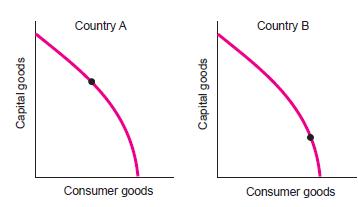
All other things remaining equal, which country in the fi gure below would you expect to have a higher growth rate? ( LO4 )a) Country Ab) Country Bc) They would have the same growth rate.d) There is no way of telling which would have the higher growth rate. Capital goods Country A Capital goods
The events of 9/11 had . ( LO2 )a) the long-term effect of raising our rate of productivity growthb) the long-term effect of lowering our rate of productivity growthc) virtually no effect on our rate of productivity growth
Which is the most accurate statement? ( LO5 )a) Americans work fewer hours per year than the citizens of virtually every other developed country.b) Americans work about the same number of hours as French and German workers.c) Americans work more hours than the citizens of virtually every other
Which statement is true? ( LO5 )a) Immigration has long been a tremendous drain on our economy and has slowed our rate of economic growth.b) Hundreds of thousands of immigrants come here every year on work visas.c) Our immigration policies in the 19th century favored Chinese immigrants.d) Very few
Which is the most accurate statement? ( LO3 , 4 )a) We are spending more on defense (as a percentage of our GDP) than at any previous time in our history.b) We are spending less on defense (as a percentage of GDP) than at any previous time in our history.c) Defense spending (as a percentage of GDP)
Sustained economic growth did not begin anywhere in the world until around . ( LO1 )a) 1450b) 1600c) 1750d) 1900
Which one of the following factors contributed most to our economic growth between 1995 and today? ( LO4 )a) Our high rate of savingsb) Our educational systemc) Technological changed) Our high rate of investment
The Malthusian theory appears to be coming true in. ( LO7 )a) sub-Saharan Africab) the United Statesc) Chinad) the entire world
Almost half of the people in the world live in. ( LO6 )a) LDCsb) NICsc) industrialized countries
Edward Denison attributes about percent of our economic growth to increases in productivity. ( LO2 )a) 10b) 30c) 50d) 70e) 90
Rising productivity could be each of these except. ( LO2 )a) more units of output from more units of inputb) more output per unit of inputc) the same output from fewer units of input
The key to productivity growth is . ( LO2 )a) an increasing labor forceb) technological changec) expansion of land under cultivationd) the use of deteriorating and obsolete capital
Each of the following except slowed our rate of economic growth in the 1970s. ( LO4 )a) research and development spendingb) pollution regulations and requiring pollution reductionc) health and safety regulationsd) rising energy costs
Which one of the following statements is true? ( LO5 )a) America’s immigration policies are much less restrictive today than they were 100 years ago.b) The fewer immigrants we let into the United States, the better off we’ll be.c) The colleges in the United States graduate fewer engineers than
Our rate of productivity increase in the 1980s was the rate of productivity increase in the 1960s. ( LO2 )a) faster thanb) aboutc) slower than
Practical Application: If you were hired as an effi ciency consultant by a large corporation, list the measures you might take to raise the productivity of the workers.
If we could let in an extra hundred thousand immigrants every year, should we favor certain immigrants over others? Why?
Should we remove all barriers to immigration into the United States? What would be the consequences?
Why did our rate of productivity growth speed up in the late 1990s? Is this higher growth rate just temporary, or will it be sustained over the next 10 or 15 years?
Why did our rate of productivity growth slow from the mid-1970s through the mid-1990s?
What changes took place during the Industrial Revolution that made possible sustained economic growth?
How does the American savings rate compare to that of other leading industrial nations? What accounts for the difference?
Explain the Malthusian theory of population. Is it relevant today anywhere in the world? Explain where and why.
How has our educational system affected the quality of our labor force?
If P were 7 and Q were 800, how much would MV be? ( LO1 )
Initially M 5 600, V 5 8, P 5 16, and Q 5 300.According to the crude quantity theory of money, if M rose to 720, how much would P be? ( LO1 )
If M were 800, P were 20, and Q were 400, how much would V be? ( LO1 )
According to the crude quantity theory of money, if M were to increase by 10 percent, what would happen to V, P, and Q? ( LO2 )
If M were 600 and V were 10, how much would PQ be? ( LO1 )
In recent years macropolicy has . ( LO8 )a) become more powerfulb) become less powerfulc) remained about as powerful as it was 15 years ago
Which statement is true? ( LO8 )a) In recent years infl ation and recession have become separate problems.b) In recent years infl ation and recession have become related problems.c) Infl ation and recession have never been related problems.d) Infl ation and recession have always been related
During infl ations, we want . ( LO8 )a) budget defi cits and faster monetary growthb) budget defi cits and slower monetary growthc) budget surpluses and faster monetary growthd) budget surpluses and slower monetary growth
During recessions, we want . ( LO8 )a) budget defi cits and faster monetary growthb) budget defi cits and slower monetary growthc) budget surpluses and faster monetary growthd) budget surpluses and slower monetary growth
One problem or dilemma we might face in fi ghting a recession is that . ( LO8 )a) we might end up with budget surplusesb) output might rise too quicklyc) interest rates might falld) interest rates might rise
The conventional monetary policy to fi ght infl ation would be to . ( LO8 )a) increase the rate of monetary growthb) decrease the rate of monetary growthc) run budget defi citsd) run budget surpluses
The conventional fi scal policy to fi ght a recession would be to . ( LO8 )a) increase the rate of monetary growthb) decrease the rate of monetary growthc) run budget defi citsd) run budget surpluses
Which is the most accurate statement about President George W. Bush’s economic policies? ( LO3 , 4 , 5 , 6 )a) They are pure supply-side.b) They are pure Keynesian.c) They are pure monetarist.d) They are pure classical.e) They have some elements of supply-side and some elements of Keynesian
The behaviorial economists believe that economic behavior is guided . ( LO7 )a) entirely by rational, unemotional self-interestb) entirely by emotionsc) by both rational self-interest and emotionsd) by neither rational self-interest nor emotions
The rational expectationists believe that fi scal and monetary policy are . ( LO7 )a) most effective fi ghting recessionsb) most effective fi ghting infl ationc) more effective in infl uencing aggregate supply than aggregate demandd) not effective
Each of the following explains why wages are not downwardly fl exible except . ( LO4 )a) the effi ciency wage theoryb) the law of diminishing returnsc) the insider-outsider theoryd) labor contractse) the minimum wage
As we approach full employment, what will probably happen? ( LO1 , 2 )a) V will falld) P will riseb) Q will falle) P will fallc) Q will rise
The modern monetarists believe . ( LO5 )a) V is very unstableb) V never changesc) any changes in V are either very small or predictabled) if M rises, V will fall by the same percentage
The crude quantity theory of money states that if M rises by 20 percent, P will . ( LO2 )a) fall by 20 percentd) riseb) falle) rise by 20 percentc) stay the same
MV 5 PQ . ( LO1 )a) all the timec) some of the timeb) most of the timed) never 26. If MV rises, PQ . ( LO1 )a) must risec) must stay the sameb) may rised) must fall
Which school would consider cutting tax rates as the cure for all our economic ills? ( LO6 )a) Classicald) Supply-sideb) Keynesiane) Rational expectationsc) Monetarist
Which school would advocate government spending to end a recession? ( LO4 )a) Classicald) Supply-sideb) Keynesiane) Rational expectationsc) Monetarist
The advice the rational expectations theorists give the federal government is to . ( LO7 )a) change macropolicy oftenb) fi gure out the right policies to follow and stick to themc) fi gure out what the public is expecting and then do the opposite
The effects of most macroeconomic policy changes, say the rational expectations theorists, are. ( LO7 )a) very hard to predictb) very easy to predictc) slow—that is, they take place over a period of many yearsd) irrational
According to the rational expectations theorists, everyone learns that when the Fed sharply increases monetary growth . ( LO7 )a) infl ation will result and people must move to protect themselvesb) a recession will result and people must move to protect themselvesc) people will continue to make the
The rational expectations theorists said antiinfl ationary policy will . ( LO7 )a) generally workb) defi nitely do more harm than goodc) either do no good or do harm
According to the Laffer curve, when very high marginal tax rates are lowered, tax revenue will. ( LO6 )a) decline considerablyc) stay the sameb) decline slightlyd) increase
According to the supply-siders, each of the following resulted from high marginal tax rates except. ( LO6 )a) the work effectb) the savings-investment effectc) the elimination of productive market exchangesd) lagging demand for imported goods and services
Supply-siders felt . ( LO6 )a) the federal government played too large an economic roleb) the federal government played too small an economic rolec) tax rates were too lowd) the federal government was not spending enough to meet the needs of the poor
The monetarists criticized . ( LO5 )a) the stop-and-go policies of the Federal Reserveb) the ineffectiveness of monetary policy at fi ghting infl ationc) the importance given to money by the Keynesiansd) the Fed for keeping a heavy foot on the monetary brake and allowing the money supply to rise by
The monetary rule states that . ( LO5 )a) the federal budget must be balanced every yearb) the money supply must increase at the same rate as the price levelc) the money supply must remain a constant from year to yeard) the money supply must be increased at a constant rate
Which of the following is a basic proposition of monetarism? ( LO5 )a) The key to stable economic growth is a constant rate of increase in the money supply.b) Expansionary monetary policy will permanently depress the interest rates.c) Expansionary monetary policy will permanently reduce the
During a recession, if the money supply were increased . ( LO4 , 5 )a) the Keynesians and the monetarists agree that people would probably just hold on to these fundsb) the Keynesians and the monetarists agree that people would spend this money on assets of one kind or anotherc) the Keynesians
To the monetarists, the most important thing was. ( LO5 )a) the rate of growth of the money supplyb) balancing the federal budgetc) raising the federal government’s tax based) giving the Federal Reserve free reign
Big government was ushered in during the. ( LO4 )a) 1920sc) 1960sb) 1930sd) 1980s
Classical economics lost most of its popularity in. ( LO3 )a) the 1920sc) the 1960sb) the 1930sd) the 1980s
The key to investment spending, said Keynes, was. ( LO4 )a) the interest rateb) the expected profi t ratec) foreign spendingd) government spending
Keynes believed budget defi cits were. ( LO4 )a) to be avoided at all costsb) bad during recessionsc) good during recessionsd) good all the time
According to Keynes, was necessary to get us out of a depression. ( LO4 )a) investment spendingb) consumer spendingc) foreign spendingd) any kind of spending
The problem during recessions, said John Maynard Keynes, was . ( LO4 )a) inadequate aggregate supplyb) inadequate aggregate demandc) too much infl ationd) too much government intervention
The classicals believed recessions were. ( LO3 )a) impossibleb) potential depressionsc) temporaryd) hard to end without government intervention
The classical economists believed . ( LO3 )a) both wages and prices were downwardly fl exibleb) neither wages nor prices were downwardly fl exiblec) wages, but not prices, were downwardly fl exibled) prices, but not wages, were downwardly fl exible
According to the classical economists, if the quantity of money that people wanted to save was greater than the amount that people wanted to invest,. ( LO3 )a) there would be a recessionb) there would be infl ationc) the interest rate would falld) the interest rate would rise
Say’s law states that . ( LO3 )a) supply creates its own demandb) demand creates its own supplyc) demand will always exceed supplyd) supply will always exceed demand
Practical Application: Outline the conventional monetary and fi scal policies for fi ghting an infl ation. Then outline the conventional monetary and fi scal policies for fi ghting a recession. Why would an infl ationary recession pose a dilemma for those who would attempt to apply conventional
When a recession begins, if the federal government spent tens of billions of dollars on a highway building program and consequently ran a large defi cit, how would this fi scal policy measure be judged by each of the fi ve main schools of 20th century economic thought?
How does the crude quantity theory of money differ from the modern, sophisticated version?
Is there any consensus among at least some of the different schools of economic thought with respect to the effectiveness of monetary and fi scal policy?
What are the three basic assumptions of the rational expectations theorists? Are they valid?
What is the Laffer curve? How do supply-siders use it with respect to tax rates?
What is the monetary rule and why is it favored by the monetarists?
According to John Maynard Keynes, what was the basic problem during recessions, and what was his solution?
According to the classical economists, how did Say’s law, the interest rate mechanism, and downwardly fl exible wages and prices ensure that recessions would cure themselves?
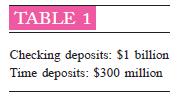
Use the information in Table 1 to fi nd this bank’s required reserves. ( LO2 ) TABLE 1 Checking deposits: $1 billion Time deposits: $300 million
How much reserves would a bank have to hold on:(a) $1 billion of time deposits that will mature in less than 18 months? (b) $1 billion of time deposits that will mature in more than 18 months? (Hint: see Table 1 on page 333.) ( LO2 )
If a bank has reserves of $100 million and checking deposits of $700 million, how much are the bank’s:(a) required reserves? (b) excess reserves? ( LO2 )
Approximately how much in reserves does a bank with$5 billion in demand deposits have to hold? ( LO2)
If a bank has reserves of $21 million and demand deposits of $200 million, how much are the bank’s:(a) required reserves? (b) excess reserves? ( LO2 )
How much is the effective, or market, interest rate on a bond that has a face value of $1,000 and a selling price of $1,200 and that pays $120 interest? ( LO5 )
Using your answer from the previous problem, if the Federal Reserve increased bank reserves by$100 million, by how much would the money supply rise? ( LO2 )
If the reserve requi.rement were 15 percent, how much would the deposit multiplier be? ( LO2 )
If you ran a bank with checking deposits of$400 million, you would need to hold reserves of a little less than how much (assuming you don’t remember the cutoff point)? ( LO2 )
If you ran a bank with checking deposits of$20 million, you would need to hold reserves of how much? (Use Table 1 on page 333.) ( LO2 )
Which is the most accurate statement? . ( LO9 )a) The Fed’s actions in dealing with the 2008 fi nancial crisis may encourage future risky fi nancial behavior, since a future crisis will be met with another bailout.b) Although the Fed managed to avert a fi nancial meltdown in 2008, it will not
The main players in the shadow banking system are. ( LO9 )a) the large commercial banks.b) the smaller banks.c) investment banks, hedge funds, and brokerage houses.d) foreign investors.!~!~!~!~!~!39 To deal with the fi nancial crisis of 2008 the Fed resorted primarily to . ( LO9 )a) traditional
The primary objective of the Fed in early 2008 was to. ( LO9)a) avert a fi nancial meltdown.b) enable millions of subprime borrowers to keep their homes.c) tamp down infl ation.d) prevent a recession.
Bank deposit creation is limited by . ( LO4)a) reserve requirementsb) the interest ratec) whether a bank is nationally or state charteredd) whether a bank is in a large city or a rural area
Money is created when someone . ( LO4 )a) takes out a bank loanb) pays back a bank loanc) spends moneyd) saves money
A decrease in the rate of growth in the money supply will tend to interest rates and the level of investment. ( LO4 )a) raise, raiseb) lower, lowerc) lower, raised) raise, lower
The subprime lending mess was caused by ( LO9 )a) the lowered lending standards of mortgage brokers.b) the Federal Reserve’s lowering of interest rates.c) both the lowered lending standards of mortgages brokers and the Federal Reserve’s lowering of interest rates.d) neither the lowered lending
Which would be the most accurate statement? ( LO1 )a) The Federal Reserve Board of Governors has more power than the monetary authorities of any other country.b) The Deutsche Bundesbank has more power than the Federal Reserve.c) The Bank of England and La Banca d’Italia are two of the most
Faster monetary growth tends to . ( LO4 )a) lower interest rates, leading to lower investmentb) lower interest rates, leading to higher investmentc) raise interest rates, leading to lower investmentd) raise interest rates, leading to higher investment
If the equilibrium rate of interest is 7 percent and market price of a U.S. government bond is $1,000, what is the most likely interest rate and bond price if the Fed increases the money supply by a substantial amount? ( LO5 )a) 8 percent; $1,100b) 8 percent; $1,000c) 8 percent; $900d) 6 percent;
The repeal of Glass-Steagall in 1999. ( LO7 )a) had the objective of allowing banks, securities fi rms, and insurance companies to merge and to sell each others’ productsb) will result in a huge expansion in the number of fi nancial institutions doing business in the United Statesc) will result
Which of the following is the most accurate statement? ( LO5 )a) We will have a checkless economy before 2012.b) Your bank must return the checks you wrote with your monthly statement.c) The Fed uses open-market operations to hit its target Federal funds rate.d) When the Fed pushes up the money
Showing 300 - 400
of 6280
1
2
3
4
5
6
7
8
9
10
11
12
13
14
15
Last
Step by Step Answers

 Get 50% OFF
Claim Now
Get 50% OFF
Claim Now