New Semester
Started
Get
50% OFF
Study Help!
--h --m --s
Claim Now
Question Answers
Textbooks
Find textbooks, questions and answers
Oops, something went wrong!
Change your search query and then try again
S
Books
FREE
Study Help
Expert Questions
Accounting
General Management
Mathematics
Finance
Organizational Behaviour
Law
Physics
Operating System
Management Leadership
Sociology
Programming
Marketing
Database
Computer Network
Economics
Textbooks Solutions
Accounting
Managerial Accounting
Management Leadership
Cost Accounting
Statistics
Business Law
Corporate Finance
Finance
Economics
Auditing
Tutors
Online Tutors
Find a Tutor
Hire a Tutor
Become a Tutor
AI Tutor
AI Study Planner
NEW
Sell Books
Search
Search
Sign In
Register
study help
business
microeconomics
Microeconomics 7th Edition Robert S. Pindyck, Daniel L. Rubinfeld - Solutions
1.1. Why can feedback effects make a general equilibrium analysis substantially different from a partial equilibrium analysis?
1.12. A consumer faces the following decision: She can buy a computer for $1000 and $10 per month for Internet access for three years, or she can receive a $400 rebate on the computer (so that its cost is $600) but agree to pay $25 per month for three years for Internet access. For simplification,
1.11. Suppose you can buy a new Toyota Corolla for $20,000 and sell it for $12,000 after six years. Alternatively, you can lease the car for $300 per month for three years and return it at the end of the three years. For simplification, assume that lease payments are made yearly instead of
1.10. Reexamine the capital investment decision in the disposable diaper industry (Example 15.3) from the point of view of an incumbent firm. If P&G or Kimberly-Clark were to expand capacity by building three new plants, they would not need to spend $60 million on R&D before start-up. How does this
1.9. You are planning to invest in fine wine. Each case costs $100, and you know from experience that the value of a case of wine held for t years is 100t1/2. One hundred cases of wine are available for sale, and the interest rate is 10 percent.a. How many cases should you buy, how long should you
1.8. Suppose your uncle gave you an oil well like the one described in Section 15.8. (Marginal production cost is constant at $10.) The price of oil is currently $20 but is controlled by a cartel that accounts for a large fraction of total production. Should you produce and sell all your oil now or
1.7. Ralph is trying to decide whether to go to graduate school. If he spends two years in graduate school, paying $15,000 tuition each year, he will get a job that will pay $60,000 per year for the rest of his working life. If he does not go to school, he will go into the workforce immediately. He
1.6. The market interest rate is 5 percent and is expected to stay at that level. Consumers can borrow and lend all they want at this rate. Explain your choice in each of the following situations:a. Would you prefer a $500 gift today or a $540 gift next year?b. Would you prefer a $100 gift now or a
1.5. Equation (15.5) (page 563) shows the net present value of an investment in an electric motor factory. Half of the $10 million cost is paid initially and the other half after a year. The factory is expected to lose money during its first two years of operation. If the discount rate is 4
1.4. A bond has two years to mature. It makes a coupon payment of $100 after one year and both a coupon payment of $100 and a principal repayment of $1000 after two years. The bond is selling for $966. What is its effective yield?
1.3. Suppose the interest rate is 10 percent. What is the value of a coupon bond that pays $80 per year for each of the next five years and then makes a principal repayment of $1000 in the sixth year? Repeat for an interest rate of 15 percent.
1.2. You are offered the choice of two payment streams: (a) $150 paid one year from now and $150 paid two years from now; (b) $130 paid one year from now and $160 paid two years from now. Which payment stream would you prefer if the interest rate is 5 percent? If it is 15 percent?
1.1. Suppose the interest rate is 10 percent. If $100 is invested at this rate today, how much will it be worth after one year? After two years? After five years? What is the value today of $100 paid one year from now? Paid two years from now? Paid five years from now?
1.13. What determines the supply of loanable funds? The demand for loanable funds? What might cause the supply or demand for loanable funds to shift? How would such a shift affect interest rates?
1.12. What is meant by the “user cost” of producing an exhaustible resource? Why does price minus extraction cost rise at the rate of interest in a competitive market for an exhaustible resource?
1.11. How does a consumer trade off current and future costs when selecting an air conditioner or other major appliance? How could this selection be aided by an NPV calculation?
1.10. Suppose you are deciding whether to invest $100 million in a steel mill. You know the expected cash flows for the project, but they are risky—steel prices could rise or fall in the future. How would the CAPM help you select a discount rate for an NPV calculation?
1.9. What is meant by the “market return” in the Capital Asset Pricing Model (CAPM)? Why is the market return greater than the risk-free interest rate? What does an asset’s “beta” measure in the CAPM? Why should high-beta assets have a higher expected return than low-beta assets?
1.8. How is risk premium used to account for risk in NPV calculations? What is the difference between diversifiable and nondiversifiable risk?Why should only nondiversifiable risk enter into the risk premium?
1.7. What is the difference between a real discount rate and a nominal discount rate? When should a real discount rate be used in an NPV calculation and when should a nominal rate be used?
1.6. You have noticed that bond prices have been rising over the past few months. All else equal, what does this suggest has been happening to interest rates? Explain.
1.5. You are retiring from your job and are given two options: You can accept a lump sum payment from the company, or you can accept a smaller annual payment that will continue for as long as you live. How would you decide which option is best? What information do you need?
1.4. What is the net present value (NPV) criterion for investment decisions? How does one calculate the NPV of an investment project? If all the cash flows for a project are certain, what discount rate should be used to calculate NPV?
1.3. What is the effective yield on a bond? How does one calculate it? Why do some corporate bonds have higher effective yields than others?
1.2. How do investors calculate the net present value of a bond? If the interest rate is 5 percent, what is the present value of a perpetuity that pays$1000 per year forever?
1.1. A firm uses cloth and labor to produce shirts in a factory that it bought for $10 million. Which of its factor inputs are measured as flows and which as stocks? How would your answer change if the firm had leased a factory instead of buying one? Is its output measured as a flow or a stock?
1.10. A firm uses a single input, labor, to produce output q according to the production function . The commodity sells for $150 per unit and the wage rate is $75 per hour.a. Find the profit-maximizing quantity of L.b. Find the profit-maximizing quantity of q.c. What is the maximum profit?d.
1.9. Using the same information as in Exercise 8, suppose now that the only labor available is controlled by a monopolistic labor union that wishes to maximize the rent earned by union members. What will be the quantity of labor employed and the wage rate? How does your answer compare with your
1.8. The demand for labor by an industry is given by the curve L = 1200 − 10w, where L is the labor demanded per day and w is the wage rate. The supply curve is given by L = 20w. What is the equilibrium wage rate and quantity of labor hired? What is the economic rent earned by workers?
1.7. The only legal employer of military soldiers in the United States is the federal government. If the government uses its knowledge of its monopsonistic position, what criteria will it employ when determining how many soldiers to recruit? What happens if a mandatory draft is implemented?
1.6. Suppose that a firm’s production function is given by Q = 12L − L2, for L = 0 to 6, where L is labor input per day and Q is output per day. Derive and draw the firm’s demand for labor curve if the firm’s output sells for $10 in a competitive market. How many workers will the firm hire
1.5. Suppose there are two groups of workers, unionized and nonunionized. Congress passes a law that requires all workers to join the union. What do you expect to happen to the wage rates of formerly nonunionized workers? Of those workers who were originally unionized? What have you assumed about
1.4. The demands for the factors of production listed below have increased. What can you conclude about changes in the demands for the related consumer goods? If demands for the consumer goods remain unchanged, what other explanation is there for an increase in derived demands for these items?a.
1.3. Using your knowledge of marginal revenue product, explain the following:a. A famous tennis star is paid $200,000 for appearing in a 30-second television commercial. The actor who plays his doubles partner is paid$500.b. The president of an ailing savings and loan is paid not to stay in his job
1.2. Assume that workers whose incomes are less than $10,000 currently pay no federal income taxes. Suppose a new government program guarantees each worker $5000, whether or not he or she earns any income. For all earned income up to $10,000, the worker must pay a 50-percent tax. Draw the budget
1.1. Suppose that the wage rate is $16 per hour and the price of the product is $2. Values for output and labor are in units per hour.a. Find the profit-maximizing quantity of labor.b. Suppose that the price of the product remains at $2 but that the wage rate increases to $21. Find the new
1.11. A firm uses both labor and machines in production. Explain why an increase in the average wage rate causes both a movement along the labor demand curve and a shift of the curve.
1.10. A small specialty cookie company, whose only variable input is labor, finds that the average worker can produce 50 cookies per day, the cost of the average worker is $64 per day, and the price of a cookie is $1. Is the company maximizing its profit? Explain.
1.9. The government wants to encourage individuals on welfare to become employed. It is considering two possible incentive programs:a. Give firms $2 per hour for every individual on welfare who is hired.b. Give each firm that hires one or more welfare workers a payment of $1000 per year,
1.8. Currently the National Football League has a system for drafting college players by which each player is picked by only one team. The player must sign with that team or not play in the league. What would happen to the wages of both newly drafted and more experienced football players if the
1.7. For a monopsonist, what is the relationship between the supply of an input and the marginal expenditure on it?
1.6. What happens to the demand for one input when the use of a complementary input increases?
1.5. Rock musicians sometimes earn several million dollars per year. Can you explain such large incomes in terms of economic rent?
1.4. Compare the hiring choices of a monopsonistic and a competitive employer of workers. Which will hire more workers, and which will pay the higher wage? Explain.
1.3. How is a computer company’s demand for computer programmers a derived demand?
1.2. Why might a labor supply curve be backward bending?
1.1. Why is a firm’s demand for labor curve more inelastic when the firm has monopoly power in the output market than when the firm is producing competitively?
1.13. You are in the market for a new house and have decided to bid for a house at auction. You believe that the value of the house is between$125,000 and $150,000, but you are uncertain as to where in the range it might be. You do know, however, that the seller has reserved the right to withdraw
1.12. An antique dealer regularly buys objects at hometown auctions whose bidders are limited to other dealers. Most of her successful bids turn out to be financially worthwhile because she is able to resell the antiques for a profit. On occasion, however, she travels to a nearby town to bid in an
1.11. Three contestants, A, B, and C, each have a balloon and a pistol. From fixed positions, they fire at each other’s balloons. When a balloon is hit, its owner is out. When only one balloon remains, its owner gets a $1000 prize. At the outset, the players decide by lot the order in which they
1.10. Defendo has decided to introduce a revolutionary video game. As the first firm in the market, it will have a monopoly position for at least some time. In deciding what type of manufacturing plant to build, it has the choice of two technologies. Technology A is publicly available and will
1.9. You play the following bargaining game. Player A moves first and makes Player B an offer for the division of $100. (For example, Player A could suggest that she take $60 and Player B take $40.) Player B can accept or reject the offer. If he rejects it, the amount of money available drops
1.8. You are a duopolist producer of a homogeneous good. Both you and your competitor have zero marginal costs. The market demand curve is P = 30 – Q where Q = Q1 + Q2. Q1 is your output and Q2 your competitor’s output. Your competitor has also read this book.a. Suppose you will play this game
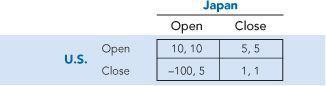
1.7. We can think of U.S. and Japanese trade policies as a prisoners’ dilemma. The two countries are considering policies to open or close their import markets. The payoff matrix is shown below.a. Assume that each country knows the payoff matrix and believes that the other country will act in its
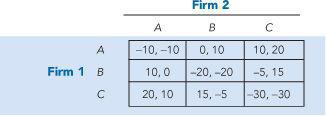
1.6. Two competing firms are each planning to introduce a new product. Each will decide whether to produce Product A, Product B, or Product C.They will make their choices at the same time. The resulting payoffs are shown below.a. Are there any Nash equilibria in pure strategies? If so, what are
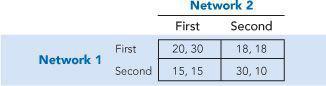
1.5. Two major networks are competing for viewer ratings in the 8:00–9:00 P.M. and 9:00–10:00 P.M. slots on a given weeknight. Each has two shows to fill these time periods and is juggling its lineup. Each can choose to put its “bigger” show first or to place it second in the 9:00–10:00
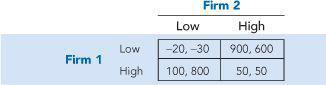
1.4. Two firms are in the chocolate market. Each can choose to go for the high end of the market (high quality) or the low end (low quality). Resulting profits are given by the following payoff matrix:a. What outcomes, if any, are Nash equilibria?b. If the managers of both firms are conservative
1.3. Two computer firms, A and B, are planning to market network systems for office information management. Each firm can develop either a fast, high-quality system (High), or a slower, low-quality system (Low). Market research indicates that the resulting profits to each firm for the alternative
1.2. Many industries are often plagued by overcapacity: Firms simultaneously invest in capacity expansion, so that total capacity far exceeds demand. This happens not only in industries in which demand is highly volatile and unpredictable, but also in industries in which demand is fairly stable.
1.1. In many oligopolistic industries, the same firms compete over a long period of time, setting prices and observing each other’s behavior repeatedly. Given the large number of repetitions, why don’t collusive outcomes typically result?
1.12. Why is the winner’s curse potentially a problem for a bidder in a common-value auction but not in a private-value auction?
1.11. A strategic move limits one’s flexibility and yet gives one an advantage. Why? How might a strategic move give one an advantage in bargaining?
1.10. Can the threat of a price war deter entry by potential competitors? What actions might a firm take to make this threat credible?
1.9. What is a “strategic move”? How can the development of a certain kind of reputation be a strategic move?
1.8. What is meant by “first-mover advantage”? Give an example of a gaming situation with a first-mover advantage.
1.7. Suppose you and your competitor are playing the pricing game shown in Table 13.8 (page 490). Both of you must announce your prices at the same time. Can you improve your outcome by promising your competitor that you will announce a high price?
1.6. Consider a game in which the prisoners’ dilemma is repeated 10 times and both players are rational and fully informed. Is a tit-for-tat strategy optimal in this case? Under what conditions would such a strategy be optimal?
1.5. What is a “tit-for-tat” strategy? Why is it a rational strategy for the infinitely repeated prisoners’ dilemma?
1.4. How does a Nash equilibrium differ from a game’s maximin solution? When is a maximin solution a more likely outcome than a Nash equilibrium?
1.3. Explain the meaning of a Nash equilibrium. How does it differ from an equilibrium in dominant strategies?
1.2. What is a dominant strategy? Why is an equilibrium stable in dominant strategies?
1.1. What is the difference between a cooperative and a noncooperative game? Give an example of each.
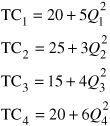
1.14. A lemon-growing cartel consists of four orchards. Their total cost functions areTC is in hundreds of dollars, and Q is in cartons per month picked and shipped.a. Tabulate total, average, and marginal costs for each firm for output levels between 1 and 5 cartons per month (i.e., for 1, 2, 3,
1.13. Suppose the market for tennis shoes has one dominant firm and five fringe firms. The market demand is Q = 400 – 2P. The dominant firm has a constant marginal cost of 20. The fringe firms each have a marginal cost of MC = 20 + 5q.a. Verify that the total supply curve for the five fringe
1.12. The dominant firm model can help us understand the behavior of some cartels. Let’s apply this model to the OPEC oil cartel. We will use isoelastic curves to describe world demand W and noncartel (competitive) supply S. Reasonable numbers for the price elasticities of world demand and
1.11. Two firms compete by choosing price. Their demand functions are Q1 = 20 – P1 + P2 and Q2 = 20 + P1 – P2 where P1 and P2 are the prices charged by each firm, respectively, and Q1 and Q2 are the resulting demands. Note that the demand for each good depends only on the difference in prices;
1.10. Two firms produce luxury sheepskin auto seat covers: Western Where (WW) and B.B.B. Sheep (BBBS). Each firm has a cost function given by C(q) = 30q + 1.5q2 The market demand for these seat covers is represented by the inverse demand equation P = 300 – 3Q where Q = q1 + q2, total output.a. If
1.9. Demand for light bulbs can be characterized by Q = 100 – P, where Q is in millions of boxes of lights sold and P is the price per box. There are two producers of lights, Everglow and Dimlit. They have identical cost functions:a. Unable to recognize the potential for collusion, the two firms
1.8. Suppose the airline industry consisted of only two firms: American and Texas Air Corp. Let the two firms have identical cost functions, C(q) =40q. Assume that the demand curve for the industry is given by P = 100 – Q and that each firm expects the other to behave as a Cournot competitor.a.
1.7. Suppose that two competing firms, A and B, produce a homogeneous good. Both firms have a marginal cost of MC = $50. Describe what would happen to output and price in each of the following situations if the firms are at (i) Cournot equilibrium, (ii) collusive equilibrium, and (iii) Bertrand
1.6. Suppose that two identical firms produce widgets and that they are the only firms in the market. Their costs are given by C1 = 60Q1 and C2 =60Q2, where Q1 is the output of Firm 1 and Q2 the output of Firm 2. Price is determined by the following demand curve:P = 300 – Q where Q = Q1 + Q2.a.
1.5. Two firms compete in selling identical widgets. They choose their output levels Q1 and Q2 simultaneously and face the demand curve P = 30 – Q where Q = Q1 + Q2. Until recently, both firms had zero marginal costs. Recent environmental regulations have increased Firm 2’s marginal cost to
1.4. This exercise is a continuation of Exercise 3. We return to two firms with the same constant average and marginal cost, AC = MC = 5, facing the market demand curve Q1 + Q2 = 53 – P. Now we will use the Stackelberg model to analyze what will happen if one of the firms makes its output
1.3. A monopolist can produce at a constant average (and marginal) cost of AC = MC = $5. It faces a market demand curve given by Q = 53 – P.a. Calculate the profit-maximizing price and quantity for this monopolist. Also calculate its profits.b. Suppose a second firm enters the market. Let Q1 be
1.2. Consider two firms facing the demand curve P = 50 – 5Q, where Q = Q1 + Q2. The firms’ cost functions are C1(Q1) = 20 + 10Q1 and C2(Q2) = 10+ 12Q2.a. Suppose both firms have entered the industry. What is the joint profit-maximizing level of output? How much will each firm produce? How would
1.1. Suppose all firms in a monopolistically competitive industry were merged into one large firm. Would that new firm produce as many different brands? Would it produce only a single brand? Explain.
1.10. Why has the OPEC oil cartel succeeded in raising prices substantially while the CIPEC copper cartel has not? What conditions are necessary for successful cartelization? What organizational problems must a cartel overcome?
1.9. Why does price leadership sometimes evolve in oligopolistic markets? Explain how the price leader determines a profit-maximizing price.
1.8. The kinked demand curve describes price rigidity. Explain how the model works. What are its limitations? Why does price rigidity occur in oligopolistic markets?
1.7. Explain the meaning of a Nash equilibrium when firms are competing with respect to price. Why is the equilibrium stable? Why don’t the firms raise prices to the level that maximizes joint profits?
1.6. What do the Cournot and Bertrand models have in common? What is different about the two models?
1.5. In the Stackelberg model, the firm that sets output first has an advantage. Explain why.
1.4. Why is the Cournot equilibrium stable? (i.e., Why don’t firms have any incentive to change their output levels once in equilibrium?) Even if they can’t collude, why don’t firms set their outputs at the joint profit-maximizing levels (i.e., the levels they would have chosen had they
1.3. Some experts have argued that too many brands of breakfast cereal are on the market. Give an argument to support this view. Give an argument against it.
1.2. Why is the firm’s demand curve flatter than the total market demand curve in monopolistic competition? Suppose a monopolistically competitive firm is making a profit in the short run. What will happen to its demand curve in the long run?
1.1. What are the characteristics of a monopolistically competitive market? What happens to the equilibrium price and quantity in such a market if one firm introduces a new, improved product?
1.4. The House Products Division of Acme Corporation manufactures and sells digital clock radios. A major component is supplied by the electronics division of Acme. The cost functions for the radio and the electronic component divisions are, respectively,Note that TCr does not include the cost of
1.3. Reebok produces and sells running shoes. It faces a market demand schedule P = 11 − 1.5Qs, where Qs is the number of pairs of shoes sold and P is the price in dollars per pair of shoes. Production of each pair of shoes requires 1 square yard of leather. The leather is shaped and cut by the
1.2. Ajax Computer makes a computer for climate control in office buildings. The company uses a microprocessor produced by its upstream division, along with other parts bought in outside competitive markets. The microprocessor is produced at a constant marginal cost of $500, and the marginal cost
1.1. Review the numerical example about Race Car Motors. Calculate the profit earned by the upstream division, the downstream division, and the firm as a whole in each of the three cases examined: (a) there is no outside market for engines; (b) there is a competitive market for engines in which the
Showing 1000 - 1100
of 7548
First
4
5
6
7
8
9
10
11
12
13
14
15
16
17
18
Last
Step by Step Answers

 Get 50% OFF
Claim Now
Get 50% OFF
Claim Now