New Semester
Started
Get
50% OFF
Study Help!
--h --m --s
Claim Now
Question Answers
Textbooks
Find textbooks, questions and answers
Oops, something went wrong!
Change your search query and then try again
S
Books
FREE
Study Help
Expert Questions
Accounting
General Management
Mathematics
Finance
Organizational Behaviour
Law
Physics
Operating System
Management Leadership
Sociology
Programming
Marketing
Database
Computer Network
Economics
Textbooks Solutions
Accounting
Managerial Accounting
Management Leadership
Cost Accounting
Statistics
Business Law
Corporate Finance
Finance
Economics
Auditing
Tutors
Online Tutors
Find a Tutor
Hire a Tutor
Become a Tutor
AI Tutor
AI Study Planner
NEW
Sell Books
Search
Search
Sign In
Register
study help
business
microeconomics
Microeconomics 7th Edition Robert S. Pindyck, Daniel L. Rubinfeld - Solutions
1.17. Consider a firm with monopoly power that faces the demand curve P = 100 − 3Q + 4A1/2 and has the total cost function C = 4Q2 + 10Q + A where A is the level of advertising expenditures, and P and Q are price and output.a. Find the values of A, Q, and P that maximize the firm’s profit.b.
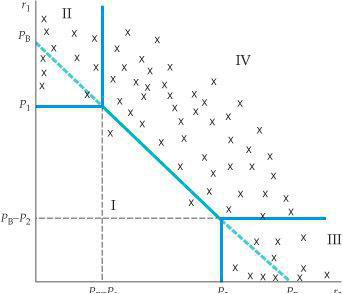
1.16. A cable TV company offers, in addition to its basic service, two products: a Sports Channel (Product 1) and a Movie Channel (Product 2).Subscribers to the basic service can subscribe to these additional services individually at the monthly prices P1 and P2, respectively, or they can buy the
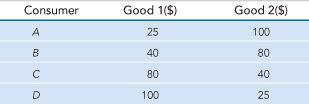
1.15. Your firm produces two products, the demands for which are independent. Both products are produced at zero marginal cost. You face four consumers (or groups of consumers) with the following reservation prices:a. Consider three alternative pricing strategies: (i) selling the goods separately;
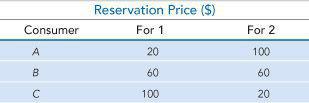
1.14. You are selling two goods, 1 and 2, to a market consisting of three consumers with reservation prices as follows:The unit cost of each product is $30.a. Compute the optimal prices and profits for (i) selling the goods separately, (ii) pure bundling, and (iii) mixed bundling.b. Which strategy
1.13. Some years ago, an article appeared in the New York Times about IBM’s pricing policy. The previous day, IBM had announced major price cuts on most of its small and medium-sized computers. The article said:IBM probably has no choice but to cut prices periodically to get its customers to
1.12. Look again at Figure 11.17 (p. 418). Suppose that the marginal costs c1 and c2 were zero. Show that in this case, pure bundling, not mixed bundling, is the most profitable pricing strategy. What price should be charged for the bundle? What will the firm’s profit be?
1.11. Look again at Figure 11.12 (p. 415), which shows the reservation prices of three consumers for two goods. Assuming that marginal production cost is zero for both goods, can the producer make the most money by selling the goods separately, by using pure bundling, or by using mixed bundling?
1.10. As the owner of the only tennis club in an isolated wealthy community, you must decide on membership dues and fees for court time. There are two types of tennis players. “Serious” players have demand Q1 = 10 − P where Q1 is court hours per week and P is the fee per hour for each
1.9. You are an executive for Super Computer, Inc. (SC), which rents out super computers. SC receives a fixed rental payment per time period in exchange for the right to unlimited computing at a rate of P cents per second. SC has two types of potential customers of equal number—10 businesses and
1.8. Sal’s satellite company broadcasts TV to subscribers in Los Angeles and New York. The demand functions for each of these two groups arewhere Q is in thousands of subscriptions per year and P is the subscription price per year. The cost of providing Q units of service is given by C = 1000 +
1.7. Many retail video stores offer two alternative plans for renting films:• A two-part tariff: Pay an annual membership fee (e.g., $40) and then pay a small fee for the daily rental of each film (e.g., $2 per film per day).• A straight rental fee: Pay no membership fee, but pay a higher daily
1.6. Elizabeth Airlines (EA) flies only one route: Chicago–Honolulu. The demand for each flight is Q = 500 − P. EA’s cost of running each flight is$30,000 plus $100 per passenger.a. What is the profit-maximizing price that EA will charge? How many people will be on each flight? What is EA’s
1.5. A monopolist is deciding how to allocate output between two geographically separated markets (East Coast and Midwest). Demand and marginal revenue for the two markets areThe monopolist’s total cost is C = 5 + 3(Q1 +Q2). What are price, output, profits, marginal revenues, and deadweight loss
1.4. Suppose that BMW can produce any quantity of cars at a constant marginal cost equal to $20,000 and a fixed cost of $10 billion. You are asked to advise the CEO as to what prices and quantities BMW should set for sales in Europe and in the United States. The demand for BMWs in each market is
1.3. In Example 11.1 (page 400), we saw how producers of processed foods and related consumer goods use coupons as a means of price discrimination. Although coupons are widely used in the United States, that is not the case in other countries. In Germany, coupons are illegal.a. Does prohibiting the
1.2. If the demand for drive-in movies is more elastic for couples than for single individuals, it will be optimal for theaters to charge one admission fee for the driver of the car and an extra fee for passengers. True or false? Explain.
1.1. Price discrimination requires the ability to sort customers and the ability to prevent arbitrage. Explain how the following can function as price discrimination schemes and discuss both sorting and arbitrage:a. Requiring airline travelers to spend at least one Saturday night away from home to
1.15. How can a firm check that its advertising-to-sales ratio is not too high or too low? What information does it need?
1.14. Why is it incorrect to advertise up to the point that the last dollar of advertising expenditures generates another dollar of sales? What is the correct rule for the marginal advertising dollar?
1.13. How does tying differ from bundling? Why might a firm want to practice tying?
1.12. How does mixed bundling differ from pure bundling? Under what conditions is mixed bundling preferable to pure bundling? Why do many restaurants practice mixed bundling (by offering a complete dinner as well as an à la carte menu) instead of pure bundling?
1.11. Why did MGM bundle Gone with the Wind and Getting Gertie’s Garter? What characteristic of demands is needed for bundling to increase profits?
1.10. In the town of Woodland, California, there are many dentists but only one eye doctor. Are senior citizens more likely to be offered discount prices for dental exams or for eye exams? Why?
1.9. Why is the pricing of a Gillette safety razor a form of two-part tariff? Must Gillette be a monopoly producer of its blades as well as its razors?Suppose you were advising Gillette on how to determine the two parts of the tariff. What procedure would you suggest?
1.8. How can a firm determine an optimal two-part tariff if it has two customers with different demand curves? (Assume that it knows the demand curves.)
1.7. How is peak-load pricing a form of price discrimination? Can it make consumers better off? Give an example.
1.6. When pricing automobiles, American car companies typically charge a much higher percentage markup over cost for “luxury option” items(such as leather trim, etc.) than for the car itself or for more “basic” options such as power steering and automatic transmission. Explain why.
1.5. Show why optimal, third-degree price discrimination requires that marginal revenue for each group of consumers equals marginal cost. Use this condition to explain how a firm should change its prices and total output if the demand curve for one group of consumers shifts outward, causing
1.4. Give some examples of third-degree price discrimination. Can third-degree price discrimination be effective if the different groups of consumers have different levels of demand but the same price elasticities?
1.3. Electric utilities often practice second-degree price discrimination. Why might this improve consumer welfare?
1.2. How does a car salesperson practice price discrimination? How does the ability to discriminate correctly affect his or her earnings?
1.1. Suppose a firm can practice perfect, first-degree price discrimination. What is the lowest price it will charge, and what will its total output be?
1.18. A monopolist faces the following demand curve:Q = 144/P2 where Q is the quantity demanded and P is price. Its average variable cost is AVC = Q1/2 and its fixed cost is 5.a. What are its profit-maximizing price and quantity? What is the resulting profit?b. Suppose the government regulates the
1.17. A certain town in the Midwest obtains all of its electricity from one company, Northstar Electric. Although the company is a monopoly, it is owned by the citizens of the town, all of whom split the profits equally at the end of each year. The CEO of the company claims that because all of the
1.16. There are 10 households in Lake Wobegon, Minnesota, each with a demand for electricity of Q = 50 − P. Lake Wobegon Electric’s (LWE)cost of producing electricity is TC = 500 + Q.a. If the regulators of LWE want to make sure that there is no deadweight loss in this market, what price will
1.15. Dayna’s Doorstops, Inc. (DD) is a monopolist in the doorstop industry. Its cost is C = 100 − 5Q + Q2, and demand is P = 55 − 2Q.a. What price should DD set to maximize profit? What output does the firm produce? How much profit and consumer surplus does DD generate?b. What would output
1.14. The employment of teaching assistants (TAs) by major universities can be characterized as a monopsony. Suppose the demand for TAs is W =30,000 − 125n, where W is the wage (as an annual salary) and n is the number of TAs hired. The supply of TAs is given by W = 1000 + 75n.a. If the
1.13. You produce widgets for sale in a perfectly competitive market at a market price of $10 per widget. Your widgets are manufactured in two plants, one in Massachusetts and the other in Connecticut. Because of labor problems in Connecticut, you are forced to raise wages there, so that marginal
1.12. Michelle’s Monopoly Mutant Turtles (MMMT) has the exclusive right to sell Mutant Turtle t-shirts in the United States. The demand for these tshirts is Q = 10,000/P2. The firm’s short-run cost is SRTC = 2000 + 5Q, and its long-run cost is LRTC = 6Q.a. What price should MMMT charge to
1.11. A monopolist faces the demand curve P = 11 − Q, where P is measured in dollars per unit and Q in thousands of units. The monopolist has a constant average cost of $6 per unit.a. Draw the average and marginal revenue curves and the average and marginal cost curves. What are the
1.10. One of the more important antitrust cases of the 20th century involved the Aluminum Company of America (Alcoa) in 1945. At that time, Alcoa controlled about 90 percent of primary aluminum production in the United States, and the company had been accused of monopolizing the aluminum market. In
1.9. A drug company has a monopoly on a new patented medicine. The product can be made in either of two plants. The costs of production for the two plants are MC1 = 20 + 2Q1 and MC>2 = 10 + 5Q2. The firm’s estimate of demand for the product is P = 20 − 3(Q1 + Q2). How much should the firm plan
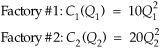
1.8. A firm has two factories, for which costs are given by:The firm faces the following demand curve:p = 700 − 5Q where Q is total output—i.e., Q = Q1 + Q2.a. On a diagram, draw the marginal cost curves for the two factories, the average and marginal revenue curves, and the total marginal cost
1.7. Suppose a profit-maximizing monopolist is producing 800 units of output and is charging a price of $40 per unit.a. If the elasticity of demand for the product is -2, find the marginal cost of the last unit produced.b. What is the firm’s percentage markup of price over marginal cost?c.
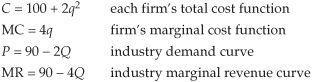
1.6. Suppose that an industry is characterized as follows:a. If there is only one firm in the industry, find the monopoly price, quantity, and level of profit.b. Find the price, quantity, and level of profit if the industry is competitive.c. Graphically illustrate the demand curve, marginal revenue
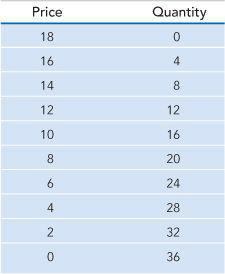
1.5. The following table shows the demand curve facing a monopolist who produces at a constant marginal cost of $10:a. Calculate the firm’s marginal revenue curve.b. What are the firm’s profit-maximizing output and price? What is its profit?c. What would the equilibrium price and quantity be in
1.4. A firm faces the following average revenue (demand) curve:P = 120 − 0.02Q where Q is weekly production and P is price, measured in cents per unit. The firm’s cost function is given by C = 60Q + 25,000. Assume that the firm maximizes profits.a. What is the level of production, price, and
1.3. A monopolist firm faces a demand with constant elasticity of -2.0. It has a constant marginal cost of $20 per unit and sets a price to maximize profit. If marginal cost should increase by 25 percent, would the price charged also rise by 25 percent?
1.2. Caterpillar Tractor, one of the largest producers of farm machinery in the world, has hired you to advise it on pricing policy. One of the things the company would like to know is how much a 5-percent increase in price is likely to reduce sales. What would you need to know to help the company
1.1. Will an increase in the demand for a monopolist’s product always result in a higher price? Explain. Will an increase in the supply facing a monopsonist buyer always result in a lower price? Explain.
1.14. Explain briefly how the U.S. antitrust laws are actually enforced.
1.13. How do the antitrust laws limit market power in the United States? Give examples of major provisions of these laws.
1.12. Why is there a social cost to monopsony power? If the gains to buyers from monopsony power could be redistributed to sellers, would the social cost of monopsony power be eliminated? Explain briefly.
1.11. What are some sources of monopsony power? What determines the amount of monopsony power an individual firm is likely to have?
1.10. What is meant by the term “monopsony power”? Why might a firm have monopsony power even if it is not the only buyer in the market?
1.9. How should a monopsonist decide how much of a product to buy? Will it buy more or less than a competitive buyer? Explain briefly.
1.8. Why will a monopolist’s output increase if the government forces it to lower its price? If the government wants to set a price ceiling that maximizes the monopolist’s output, what price should it set?
1.7. Why is there a social cost to monopoly power? If the gains to producers from monopoly power could be redistributed to consumers, would the social cost of monopoly power be eliminated? Explain briefly.
1.6. What factors determine the amount of monopoly power an individual firm is likely to have? Explain each one briefly.
1.5. What are some of the different types of barriers to entry that give rise to monopoly power? Give an example of each.
1.4. Why might a firm have monopoly power even if it is not the only producer in the market?
1.3. Why is there no market supply curve under conditions of monopoly?
1.2. We write the percentage markup of price over marginal cost as (P − MC)/P. For a profit-maximizing monopolist, how does this markup depend on the elasticity of demand? Why can this markup be viewed as a measure of monopoly power?
1.1. A monopolist is producing at a point at which marginal cost exceeds marginal revenue. How should it adjust its output to increase profit?
1.15. In 2007, Americans smoked 19.2 billion packs of cigarettes. They paid an average retail price of $4.50 per pack.a. Given that the elasticity of supply is 0.5 and the elasticity of demand is -0.4, derive linear demand and supply curves for cigarettes.b. Cigarettes are subject to a federal tax,
1.14. You know that if a tax is imposed on a particular product, the burden of the tax is shared by producers and consumers. You also know that the demand for automobiles is characterized by a stock adjustment process. Suppose a special 20-percent sales tax is suddenly imposed on automobiles. Will
1.13. Currently, the social security payroll tax in the United States is evenly divided between employers and employees. Employers must pay the government a tax of 6.2 percent of the wages they pay, and employees must pay 6.2 percent of the wages they receive. Suppose the tax were changed so that
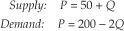
1.12. The domestic supply and demand curves for hula beans are as follows:where P is the price in cents per pound and Q is the quantity in millions of pounds. The U.S. is a small producer in the world hula bean market, where the current price (which will not be affected by anything we do) is 60
1.11. Example 9.5 (page 333) describes the effects of the sugar quota. In 2005, imports were limited to 5.3 billion pounds, which pushed the domestic price to 27 cents per pound. Suppose imports were expanded to 10 billion pounds.a. What would be the new U.S. domestic price?b. How much would
1.10. In Example 9.1 (page 314), we calculated the gains and losses from price controls on natural gas and found that there was a deadweight loss of $5.68 billion. This calculation was based on a price of oil of $50 per barrel.a. If the price of oil were $60 per barrel, what would be the
1.9. Among the tax proposals regularly considered by Congress is an additional tax on distilled liquors. The tax would not apply to beer. The price elasticity of supply of liquor is 4.0, and the price elasticity of demand is -0.2. The cross-elasticity of demand for beer with respect to the price of
1.8. A particular metal is traded in a highly competitive world market at a world price of $9 per ounce. Unlimited quantities are available for import into the United States at this price. The supply of this metal from domestic U.S. mines and mills can be represented by the equation QS = 2/3P,
1.7. The United States currently imports all of its coffee. The annual demand for coffee by U.S. consumers is given by the demand curve Q = 250 −10P, where Q is quantity (in millions of pounds) and P is the market price per pound of coffee. World producers can harvest and ship coffee to
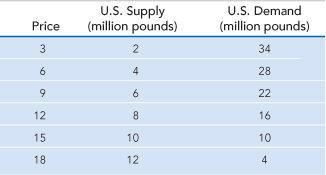
1.6. In Exercise 4 in Chapter 2 (page 62), we examined a vegetable fiber traded in a competitive world market and imported into the United States at a world price of $9 per pound. U.S. domestic supply and demand for various price levels are shown in the following table.Answer the following
1.5. About 100 million pounds of jelly beans are consumed in the United States each year, and the price has been about 50 cents per pound.However, jelly bean producers feel that their incomes are too low and have convinced the government that price supports are in order. The government will
1.4. In 1983, the Reagan administration introduced a new agricultural program called the Payment-in-Kind Program. To see how the program worked, let’s consider the wheat market:a. Suppose the demand function is QD = 28 − 2P and the supply function is QS = 4 + 4P, where P is the price of wheat
1.3. Japanese rice producers have extremely high production costs, due in part to the high opportunity cost of land and to their inability to take advantage of economies of large-scale production. Analyze two policies intended to maintain Japanese rice production: (1) a per-pound subsidy to farmers
1.2. Suppose the market for widgets can be described by the following equations:where P is the price in dollars per unit and Q is the quantity in thousands of units. Then:a. What is the equilibrium price and quantity?b. Suppose the government imposes a tax of $1 per unit to reduce widget
1.1. In 1996, Congress raised the minimum wage from $4.25 per hour to $5.15 per hour, and then raised it again in 2007. (See Example 1.3 [page 13].) Some people suggested that a government subsidy could help employers finance the higher wage. This exercise examines the economics of a minimum wage
1.9. Why does a tax create a deadweight loss? What determines the size of this loss?
1.8. The burden of a tax is shared by producers and consumers. Under what conditions will consumers pay most of the tax? Under what conditions will producers pay most of it? What determines the share of a subsidy that benefits consumers?
1.7. Suppose the government wants to limit imports of a certain good. Is it preferable to use an import quota or a tariff? Why?
1.6. Suppose the government wants to increase farmers’ incomes. Why do price supports or acreage-limitation programs cost society more than simply giving farmers money?
1.5. How are production limits used in practice to raise the prices of the following goods or services: (a) taxi rides, (b) drinks in a restaurant or bar, (c) wheat or corn?
1.4. Suppose the government regulates the price of a good to be no lower than some minimum level. Can such a minimum price make producers as a whole worse off? Explain.
1.3. How can a price ceiling make consumers better off? Under what conditions might it make them worse off?
1.2. Suppose the supply curve for a good is completely inelastic. If the government imposed a price ceiling below the market-clearing level, would a deadweight loss result? Explain.
1.1. What is meant by deadweight loss? Why does a price ceiling usually result in a deadweight loss?
1.15. A sales tax of 10 percent is placed on half the firms (the polluters) in a competitive industry. The revenue is paid to the remaining firms (the nonpolluters) as a 10 percent subsidy on the value of output sold.a. Assuming that all firms have identical constant long-run average costs before
1.14. A sales tax of $1 per unit of output is placed on a particular firm whose product sells for $5 in a competitive industry with many firms.a. How will this tax affect the cost curves for the firm?b. What will happen to the firm’s price, output, and profit?c. Will there be entry or exit in the
1.13. Consider a city that has a number of hot dog stands operating throughout the downtown area. Suppose that each vendor has a marginal cost of $1.50 per hot dog sold and no fixed cost. Suppose the maximum number of hot dogs that any one vendor can sell is 100 per day.a. If the price of a hot dog
1.12. A number of stores offer film developing as a service to their customers. Suppose that each store offering this service has a cost function C(q)= 50 + 0.5q + 0.08q2and a marginal cost MC = 0.5 + 0.16q.a. If the going rate for developing a roll of film is $8.50, is the industry in long-run
1.11. Suppose that a competitive firm has a total cost function C(q) = 450 + 15q + 2q2 and a marginal cost function MC(q) = 15 + 4q. If the market price is P = $115 per unit, find the level of output produced by the firm. Find the level of profit and the level of producer surplus.
1.10. Suppose you are given the following information about a particular industry:Assume that all firms are identical and that the market is characterized by perfect competition.a. Find the equilibrium price, the equilibrium quantity, the output supplied by the firm, and the profit of each firm.b.
1.9.a. Suppose that a firm’s production function is q = 9x1/2 in the short run, where there are fixed costs of $1000, and x is the variable input whose cost is $4000 per unit. What is the total cost of producing a level of output q? In other words, identify the total cost function C(q).b. Write
1.8. A competitive firm has the following short-run cost function: C(q) = q3 − 8q2 + 30q + 5.a. Find MC, AC, and AVC and sketch them on a graph.b. At what range of prices will the firm supply zero output?c. Identify the firm’s supply curve on your graph.d. At what price would the firm supply
1.7. Suppose the same firm’s cost function is C(q) = 4q2 + 16.a. Find variable cost, fixed cost, average cost, average variable cost, and average fixed cost. (Hint: Marginal cost is given by MC = 8q.)b. Show the average cost, marginal cost, and average variable cost curves on a graph.c. Find the
1.6. A firm produces a product in a competitive industry and has a total cost function C = 50 + 4q + 2q2 and a marginal cost function MC = 4 + 4q. At the given market price of $20, the firm is producing 5 units of output. Is the firm maximizing its profit? What quantity of output should the firm
1.5. Suppose that a competitive firm’s marginal cost of producing output q is given by MC(q) = 3 + 2q. Assume that the market price of the firm’s product is $9.a. What level of output will the firm produce?b. What is the firm’s producer surplus?c. Suppose that the average variable cost of the
1.4. Suppose you are the manager of a watchmaking firm operating in a competitive market. Your cost of production is given by C = 200 + 2q2, where q is the level of output and C is total cost. (The marginal cost of production is 4q; the fixed cost is $200.)a. If the price of watches is $100, how
Showing 1100 - 1200
of 7548
First
5
6
7
8
9
10
11
12
13
14
15
16
17
18
19
Last
Step by Step Answers

 Get 50% OFF
Claim Now
Get 50% OFF
Claim Now