New Semester
Started
Get
50% OFF
Study Help!
--h --m --s
Claim Now
Question Answers
Textbooks
Find textbooks, questions and answers
Oops, something went wrong!
Change your search query and then try again
S
Books
FREE
Study Help
Expert Questions
Accounting
General Management
Mathematics
Finance
Organizational Behaviour
Law
Physics
Operating System
Management Leadership
Sociology
Programming
Marketing
Database
Computer Network
Economics
Textbooks Solutions
Accounting
Managerial Accounting
Management Leadership
Cost Accounting
Statistics
Business Law
Corporate Finance
Finance
Economics
Auditing
Tutors
Online Tutors
Find a Tutor
Hire a Tutor
Become a Tutor
AI Tutor
AI Study Planner
NEW
Sell Books
Search
Search
Sign In
Register
study help
business
operations research an introduction
Operations Research An Introduction 8th Edition Hamdy A. Taha - Solutions
(c) Maximize z = 7xI + 6x} + 5x~subject to Xl + 2x2 === 10 Xl - 3X2 === 9 Xl> X2 ~ 0
2. In the n-item knapsack problem of Example 10.3-1, suppose that the weight and volume limitations are Wand V, respectively. Given that Wi, Vj, and rj are the weight, value, and revenue per unit of item i, write the DP backward recursive equation for the problem.
1. In each of the following cases, no shortage is allowed, and the lead time between placing and receiving an order is 30 days. Determine the optimal inventory policy and the associated cost per day.(a) K == $100, h = $.05, D = 30 units per day(b) K == $50, h = $.05, D :: 30 units per day(c) K ==
*2. McBurger orders ground meat at the start of each week to cover the week's demand of 300 lb. The fixed cost per order is $20. It costs about $.03 per lb per day to refrigerate and store the meat.(a) Determine the inventory cost per week of the present ordering policy.
(b) Determine the optimal inventory policy that McBurger should use, assuming zero lead time between the placement and receipt of an order.
3. A company stocks an item that is consumed at the rate of 50 units per day. It costs the company$20 each time an order is placed. An inventory unit held in stock for a week will cost $.35.
3. Consider Problem 2, Set 8.la, which deals with the presentation of band concerts and art shows at the NW Mall. Suppose that the goals set for teens, the young/middle-aged group, and seniors are referred to as GI , Gz, and G3, respectively. Solve the problem for each of the following priority
(a) Determine the optimum inventory policy, assuming a lead time of 1 week.
2. Solve Problem 1, Set 8.la, using the following priority ordering for the goals:
1. In Example 8.2-2, suppose that the budget goal is increased to $110,000. The exposure goal remains unchanged at 45 million persons. Show how the preemptive method will reach a solution.
9. The Maleo Company has compiled the following table from the files of five of its employees to study the impact on income of three factors: age, education (expressed in number of college years completed), and experience (expressed in number of years in the business).Age (yr) Education (yr)
8. In the Vista City Hospital of Problem 8, Set 8.1a, suppose that only the bed limits represent flexible goals and that all the goals have equal weights. Can all the goals be met?
*7. In Problem 7, Set 8.1a, suppose that production strives to meet the quota for the two products, using overtime if necessary. Find a solution to the problem, and specify the amount of overtime, if any, needed to meet the production quota.
6. In Problem 6, Set 8.1a, suppose that the market demand goal is twice as important as that of balancing the two machines, and that no overtime is allowed. Solve the problem, and determine if the goals are met.
5. In Problem 5, Set 8.1a, determine the solution, and specify whether or not the daily production of wheels and seats can be balanced.
*4. In the Circle K model of Problem 4, Set 8.1a, is it possible to satisfy all the nutritional requirements?
(b) Determine the optimum number of orders per year (based on 365 days per year).
3. In the Ozark University admission situation described in Problem 3, Set 8.1a, suppose that the limit on the size of the incoming freshmen class must be met, but the remaining requirements can be treated as flexible goals. Further, assume that the ACT score goal is twice as important as any of
2. In Problem 2, Set 8.1a, suppose that the goal of attracting young/middle-aged people is twice as important as for either of the other two categories (teens and seniors). Find the associated solution, and check if all the goals have been met.
*1. Consider Problem 1, Set 8.1a dealing with the Fairville tax situation. Solve the problem, assuming that aU five goals have the same weight. Does the solution satisfy all the goals?
11. Chebyshev Problem. An alternative goal for the regression model in Problem 10 is to minimize over hi the maximum of the absolute deviations. Formulate the problem as a goal programming model.
10. Regression analysis. In a laboratory experiment, suppose that Yi is the ith observed (independent)yield associated with the dependent observational measurements Xii' i = 1,2, ... , m; j = 1,2, ... , n. It is desired to detennine a linear regression fit into these data points. Let hi' j = 0,1,
9. The Von Trapp family is in the process of moving to a new city where both parents have accepted new jobs. In trying to find an ideal location for their new home, the Von Trapps list the following goals:(a) It should be as close as possible to Mrs. Von Trapp's place of work (within ~ mile).(b) It
7. Two products are manufactured on two sequential machines. The following table gives the machining times in minutes per unit for the two products.Machining time in min Machine 12 Product 1 56 Product 2 32·.;'~~1 ... .~~i' .~, ..,:,;-:~v...; ." .._~~~''',".c_ ....The daily production quotas for
6. Camyo Manufacturing produces four parts that require the use of a lathe and a drill press. The two machines operate 10 hours a day. The following table provides the time in minutes required by each part:Production time in min Part Lathe DrWpress 1 5 3 2 6 2 3 4 6 4 7 4 It is desired to balance
*5. Mantel produces a toy carriage, whose final assembly must include four wheels and two seats. The factory producing the parts operates three shifts a day. The following table provides the amounts produced of each part in the three shifts.Units produced per run Shift Wheels Seats 1 500 300 2 600
4. Circle K farms consumes 3 tons of special feed daily. The feed-a mixture of limestone, corn, and soybean meal-must satisfy the following nutritional requirements:Calcium. At least 0.8% but not more than 1.2%.Protein. At least 22%.Fiber. At most 5%.The following table gives the nutritional
2. The NW Shopping Mall conducts special events to attract potential patrons. Among the events that seem to aUract teenagers, the young/middle-aged group, and senior citizens, the two most popular are band concerts and art shows. Their costs per presentation are$1500 and $3000, respectively. The
*1. Formulate the Fairville tax problem, assuming that the town council is specifying an additional goal, Gs, that requires gasoline tax to equal at least 10% of the total tax bill.
6. A hotel uses an external laundry service to provide clean towels. The hotel generates 600 soiled towels a day.The laundry service picks up the soiled towels and replaces them with clean ones at regular intervals. There is a fixed charge of $81 per pickup and delivery service, in addition to the
8. Consider the inventory situation in which the stock is replenished uniformly (rather than instantaneously) at the ratea. Consumption occurs at the constant rate D. Because consumption also occurs during the replenishment period, it is necessary that a > D. The setup cost is K per order, and the
9. A company can produce an item or buy it from a contractor. If it is produced, it will cost$20 each time the machines are set up. The production rate is 100 units per day. If it is bought from a contractor, it will cost $15 each time an order is placed.The cost of maintaining the item in stock,
1. Consider the hotel laundry service situation in Problem 6, Set 11.3a. The normal charge for washing a soiled towel is $.60, but the laundry service will charge only $.50 if the hotel supplies them in lots of at least 2500 towels. Should the hotel take advantage of the discount?
3. An item sells for $25 a unit, but a 10% discount is offered for lots of 150 units or more. A company uses this item at the rate of 20 units per day. The setup cost for ordering a lot is$50, and the holding cost per unit per day is $.30. The lead time is 12 days. Should the company take advantage
4. Solve Problem 2 assuming that the right-hand side is changed to bet) "" (3 + 3t2, 6 + 2t2,4 - Pl
3. The analysis in this section assumes that the optimal LP solution at t = 0 is obtained by the (primal) simplex method. In some problems, it may be more convenient to obtain the optimal solution by the dual simplex method (Section 4.4.1). Show how the parametric analysis can be carried out in
*4. In Problem 3, determine the range on the price discount percentage that, when offered for lots of size 150 units or more, will not result in any financial advantage to the company.
*1. In Example 7.5-2, find the first critical value, tl , and define the vectors of B1 in each of the following cases:*(a) bet) = (40 + 2t, 60 - 3t,30 + 6t)T(b) bet) = (40 - t,60 + 2t,30 - 5t)T*2. Study the variation in the optimal solution of the following parameterized Lp, given t ~ O.Minimize z
4. The analysis in this section assumes that the optimal solution of the LP at t = 0 is obtained by the (primal) simplex method. In some problems, it may be more convenient to obtain the optimal solution by the dual simplex method (Section 4.4.1). Show how the parametric analysis can be carried out
3. Study the variation in the optimal solution of the following parameterized LP given t 2:: o.Minimize z = (4 - t)Xl + (1 - 3t)X2 + (2 - 2t)X3
2. Solve Example 7.5-1, assuming that the objective function is given as*(a) Maximize z = (3 + 3t)Xl + 2X2 + (5 - 6t)X3(b) Maximize z = (3 - 2t)Xl + (2 + t)X2 + (5 + 2t)X3(c) Maximize z = (3 + t)Xl + (2 + 2t)X2 + (5 - t)X3
*1. In example 7.5-1, suppose that t is unrestricted in sign. Determine the range of t for which X Bo remains optimal.
(b) In each of the following cases, first verify that the given basis B is feasible for the primal.Next, using Y = CBB-I , compute the associated dual values and verify whether or not the primal solution is optimal. .(i) B = (P4' P3) (iii) B = (PI> P2)(ii) B = (P2, p)) (iv) B = (PI> P4 )
3. Consider the following LP:Maximize z = 5Xl + 12x2 + 4X3(a) Write the dual.
2. Consider the following LP:Maximize z = SOXl + 30X2 + lOx3(a) Write the dual.(b) Show by inspection that the primal is infeasible.(c) Show that the dual in (a) is unbounded.(d) From Problems 1 and 2, develop a general conclusion regarding the relationship between infeasibility and unboundedness
1. Verify that the dual problem of the numeric example given at the end of Theorem 7.4-1 is correct. Then verify graphically that both the primal and dual problems have no feasible solution.
8. Bounded Dual Simplex Algorithm. The dual simplex algorithm (Section 4.4.1) can be modified to accommodate the bounded variables as follows. Given the upper bound constraint Xj :5 Uj for allj (if Uj is infinite, replace it with a sufficiently large upper bound M), the LP problem is converted to a
5. In the inventory model discussed in this section, suppose that the holding cost per unit per unit time is hI for quantities below q and h2 otherwise, h) > hz. Show how the economic lot size is determined.
7. Solve part (a) of Problem 3 using the revised simplex (matrix) version for upper-bounded variables.
6. In Example 7.3-1, do the following:(a) In Iteration 1, verify that X B = (X4' xil = U,~)T by using matrix manipulation.(b) In Iteration 2, show how B-1 can be computed from the original data of the problem.Then verify the given values of basic X4 and X2 using matrix manipulation.
(c) Maximize z = 4Xl + 2X2 + 6X3 subject to 4Xl - X2 =5 9-Xl + X2 + 2x3 =5 8
(b) Maximize z = Xl + 2X2 subject to-Xl + 2X2 2: 0 3Xl + 2X2 =5 10
4. In the following problems, some of the variables have positive lower bounds. Use the bounded algorithm to solve these problems.(a) Maximize z = 3Xl + 2X2 - 2X3 subject to 2Xl + X2 + X3 =5 8 Xl + 2X2 - X3 2: 3
3. Solve the following problems by the bounded algorithm:(a) Minimize z = 6Xl - 2X2 - 3X3 subject to 2Xl + 4X2 + 2X3 :5 8 Xl - 2X2 + 3X3 ~ 7 o :5 Xl :5 2,0 :5 X2 :5 2,0 :5 X3 :::;; 1(b) Maximize z = 3Xl + 5x2 +. 2X3 subject to Xl + 2X2 + 2x3 :5 10 2Xl + 4X2 + 3X3 =5 15
*2. Solve the following problem by the bounded algorithm:subject to 8Xl + x2 + 8X3 + 2X4 + 2xs + 4X6 :5 13 o:5 Xj :5 1, j = 1,2, ... , 6
1. Consider the following linear program:Maximize z = 2XI + X2 subject to ble, Xl + X2 :5 3 o:5 Xl :5 2, 0 :5 X2 :5 2(a) Solve the problem graphically, and trace the sequence of extreme points leading to the optimal solution. (You may use TORA.)(b) Solve the problem by the upper-bounding algorithm
2. Solve the model of Example 11.3-3, assuming that we require the sum of the average inventories for all the items to be less than 25 units.
4. Solve the following using the two-phase revised simplex method:(a) Problem 2-c.(b) Problem 2-d.(c) Problem 3 (ignore the given starting XOo)'
3. Solve the following LP by the revised simplex method given the starting basic feasible vector X Oo = (X2, X4, xsl.Minimize z =7x2 + llx3 - lOx4 + 26x6 subject to X2 - X3 + Xs + X6 = 6 X2 - X3 + X4 + 3X6 = 8 Xl + X2 - 3X3 + X4 + Xs = 12
(d) Minimize z = 5Xl - 4X2 + 6X3 + 8X4 subject to Xl + 7X2 + 3X3 + 7X4 ~ 46 3Xl - X2 + X3 + 2X4 ~ 20 2Xl + 3X2 - X3 + X4 ~ 18
(c) Minimize z = 2XI + X2 subject to 3xI + X2 = 3 4x} + 3X2 ;::: 6 XI + 2X2 :5 3
*(b) Maximize z = 2xI + X2 + 2x3 subject to 4Xl + 3X2 + 8X3:5 12 4Xl + X2 + 12 X3 :5 8 4Xl - X2 + 3 X3 :5 8
2. Solve the following LPs by the revised simplex method:(a) Maximize z = 6Xl - 2x2 + 3X3 subject to 2XI - X2 + 2X3 ::;; 2 Xl + 4X3 ::;; 4
13. Consider the LP Maximize z = ex subject to (A, I)X =b, X ;;:::: 0 Define Xn as the current basic vector with B as its associated basis and eB as its vector of objective coefficients. Show that if eB is replaced with the new coefficients DB, the values of Zj - Cj for the basic vector XB will
3. In Problem 2, assume that the only restriction is a limit of $1000 on the amount of capital that can be invested in inventory. The purchase costs per unit of items 1,2, and 3 are $100,$55, and $100, respectively. Determine the optimum solution.
12. Consider the LP Maximize z = ex subject to AX $b, X ;;:::: 0, where b ;;:::: 0 After obtaining the optimum solution, it is suggested that a nonbasic variable Xi can be made basic (profitable) by reducing the (resource) requirements per unit of Xi for the different resources to ~ of their
*11. Consider the Lp, maximize z = ex subject to AX $b, X ~ 0, where b ~ O. Suppose that the entering vector Pj is such that at least one element of B-1Pj is positive.(a) If Pi is replaced with aPi' where a is a positive scalar, and provided Xi remains the entering variable, find the relationship
9. In the implementation of the feasibility condition of the simplex method, what are the conditions for encountering a degenerate solution (at least one basic variable = 0) for the first time? For continuing to obtain a degenerate solution in the next iteration? For removing degeneracy in the next
8. In applying the feasibility condition of the simplex method, suppose that X r = 0 is a basic variable and that Xj is the entering variable with (B-1pj)r -:P O. Prove that the resulting basic solution remains feasible even if (B-1pj)r is negative.
6. Consider an LP in which the variable Xk is unrestricted in sign. Prove that by substituting xk = x; - xt, where x; and xt are nonnegative, it is impossible that the two variables will replace one another in an alternative optimum solution.
4. In an all-slack starting basic solution, show using the matrix form of the tableau that the mechanical procedure used in Section 3.3 in which the objective equation is set as nZ - :2>jXj = 0 j=l automatically computes the proper Zj - Cj for all the variables in the starting tableau.
*1. Consider the following LP:subject to TIle vectors Ph Pz, P3, and P4 are shown in Figure 7.4. Assume that the basis B of the current iteration is comprised of PI and Pz.(a) If the vector P3 enters the basis, which of the current two basic vectors must leave in order for the resulting basic
*4. The following is an optimal LP tableau:Basic Xl X2 X3 X4 Xs Z 0 0 0 3 2 X3 0 0 1 1 -1 X2 0 1 0 1 0 Xl 1 0 0 -1 1 Solution?2 62 The variables X3, X4, and Xs are slacks in the original problem. Use matrix manipulations to reconstruct the original LP, and then compute the optimum value.
3. In the following Lp, compute the entire simplex tableau associated with X B = (Xl> X2, xs)T.Minimize z = 2xI + Xz
*4. The following data describe four inventory items.Item i Ki ($) Dj (units per day) hi ($)1 100 10 .1 2 50 20 .2 3 90 5 .2 4 20 10 .1 The company wishes to determine the economic order quantity for each of the four items such that the total number of orders per 365-day year is at most 150.
2. Consider the following LP:Maximize z = 5XI + 12xz + 4X3 subject to Xl + 2X2 + x3 + X4 = 10. 2XI - 2X2 - x3 = 2 Check if each of the following matrices forms a (feasible or infeasible) basis: (PI> Pz),(Pz, P3), (P3, P4)·
*1. In Example 7.1-3, consider B = (P3, P4 ). Show that the corresponding basic solution is feasible, then generate the corresponding simplex tableau.
Determine if any of the following combinations forms a basis.*(a) (Ph P2, P3)(b) (Ph P2, P4)(c) (P2, P3, P4)*(d) (PI' P2, P3, P4)
3. Determine graphically the extreme points of the following convex set:Q = {Xl> x2 1xl + X2 :s; 2, Xl ::::: 0, X2 ::::: O}Show that the entire feasible solution space can be determined as a convex combination of its extreme points. Hence conclude that any convex (bounded) solution space is totally
*2. Show that the set Q = {Xl> x21xl ;::: lor Xz ::::: 2} is not convex.
1. Show that the set Q = {Xl> x21xj + X2 :S 1, Xl ::::: 0, X2 ;::: O} is convex. Is the nonnegativity condition essential for the proof?
1. In Figure 11.8 determine the combined requirements for subassembly S in each of the following cases:*(a) Lead time for Ml is only one period.(b) Lead time for Ml is three periods.
1. Solve Example 11.4-1, assuming that the unit production and holding costs are as given in the following table.Regular time Overtime unit Unit holding cost ($)Period i unit cost ($) cost ($) to period i + 1 1 5.00 7.50 .10 2 3.00 4.50 .15 3 4.00 6.00 .12 4 1.00 1.50 .20
2. An item is manufactured to meet known demand for four periods according to the following data:Unit production cost ($) for period Production range (units) 1 2 3 4 1-3 1 2 2 3 4-11 1 4 5 4 12-15 2 4 7 5 16-25 5 6 10 7 Unit holding cost to next period ($) .30 .35 .20 .25 Total demand (units) 11 4
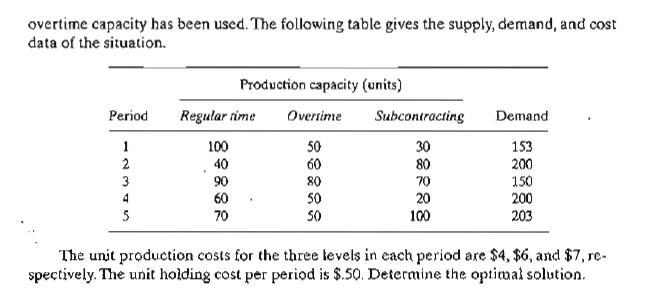
*3. The demand for a product over the next five periods may be filled from regular production, overtime production, or subcontracting. Subcontracting may be used only if the overtime capacity has been used. The following table gives the supply, demand, and cost data of the situation. Production
PROBLEM SET 11.4C*1. Consider Example 11.4-2.(a) Does it make sense to have X4 > O?(b) For each of the following two cases, determine the feasible ranges for ZJ, Z2, Z3, Xl> X2, and X3' (You will find it helpful ,to represent each situation as in Figure 11.10.)(i) Xl = 4 and all the remaining data
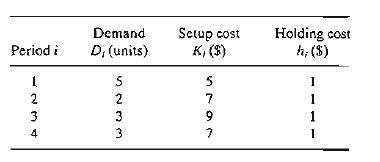
2. *(a) Find the optimal solution for the following four-period inventory model.The unit production cost is $1 each for the first 6 units and $2 each for additional units.(b) Verify the computations using exceIDPlnv.xls. 7 Holding cost h; ($) 1 1 9 1 7 1 Demand Period i D, (units). Setup cost K,
4. Develop the backward recursive equation for the model, and then use it to solve Example 11.4-2.
S. Develop the backward recursive equation for the model, assuming that the inventoryholding cost is based on the average inventory in the period.
*1. Solve Example 11.4-3, assuming that the initial inventory is 80 units. You may use excelWagnerWhitin.xls to check your calculations.
2. Solve the following IO-period deterministic inventory model. Assume an initial inventory of 50 units.Demand Unit production Unit holding Setup cost Period i Dj (units) cost ($) cost ($) ($)1 150 6 1 100 2 100 6 1 100 3 20 4 2 100 4 40 4 1 200 5 70 6 2 200 6 90 8 3 200 7 130 4 1 300 8 180 4 4 300
3. Find the optimal inventory policy for the following five-period model. The unit production cost is $10 for all periods. The unit holding cost is $1 per period.Period i Demand D;(units) Setup cost K; ($)1 50 80 2 70 70 3 100 60 4 30 80 5 60 60
4. Find the optimal inventory policy for the following six-period inventory situation: The unit production cost is $2 for all the periods.Period I D; (units) K; ($) h; ($)1 10 20 1 2 15 17 1 3 7 10 1 4 20 18 3 5 13 5 1 6 25 50 1
*1. The demand for fishing poles is at its minimum during the month of December and reaches its maximum during the month of April. Fishing Hole, Inc., estimates the December demand at 50 poles. It increases by 10 poles a month until it reaches 90 in April. Thereafter, the demand decreases by 5
2. A small publisher reprints a novel to satisfy the demand over the next 12 months. The demand estimates for the successive months are 100,120,50,70,90, 105,115,95,80,85,100, and 110.The setup cost for reprinting the book is $200.00 and the holding cost per book per month is $1.20. Determine the
1. True or False?(a) To balance a transportation model, it may be necessary to add both a dummy source and a dummy destination.
(b) The amounts shipped to a dummy destination represent surplus at the shipping source.
(c) The amounts shipped from a dummy source represent shortages at the receiving destinations.
2. In each of the following cases, determine whether a dummy source or a dummy destination must be added to balance the model.(a) Supply: al = 10, a2 = 5, a3 = 4, a4 = 6 Demand: bi = 10, b2 = 5, b3 = 7, b4 = 9(b) Supply: aJ = 30, Q2 = 44 Demand: bJ = 25, bi = 30, b3 = 10
3. In Table 5.4 of Example 5.1-2, where a dummy plant is added, what does the solution mean when the dummy plant "ships" 150 cars to Denver and 50 cars to Miami?
Showing 4000 - 4100
of 4739
First
34
35
36
37
38
39
40
41
42
43
44
45
46
47
48
Step by Step Answers

 Get 50% OFF
Claim Now
Get 50% OFF
Claim Now