New Semester
Started
Get
50% OFF
Study Help!
--h --m --s
Claim Now
Question Answers
Textbooks
Find textbooks, questions and answers
Oops, something went wrong!
Change your search query and then try again
S
Books
FREE
Study Help
Expert Questions
Accounting
General Management
Mathematics
Finance
Organizational Behaviour
Law
Physics
Operating System
Management Leadership
Sociology
Programming
Marketing
Database
Computer Network
Economics
Textbooks Solutions
Accounting
Managerial Accounting
Management Leadership
Cost Accounting
Statistics
Business Law
Corporate Finance
Finance
Economics
Auditing
Tutors
Online Tutors
Find a Tutor
Hire a Tutor
Become a Tutor
AI Tutor
AI Study Planner
NEW
Sell Books
Search
Search
Sign In
Register
study help
business
organizational change
Organizational Change 6th Edition Barbara Senior, Stephen Swailes, Colin Carnall - Solutions
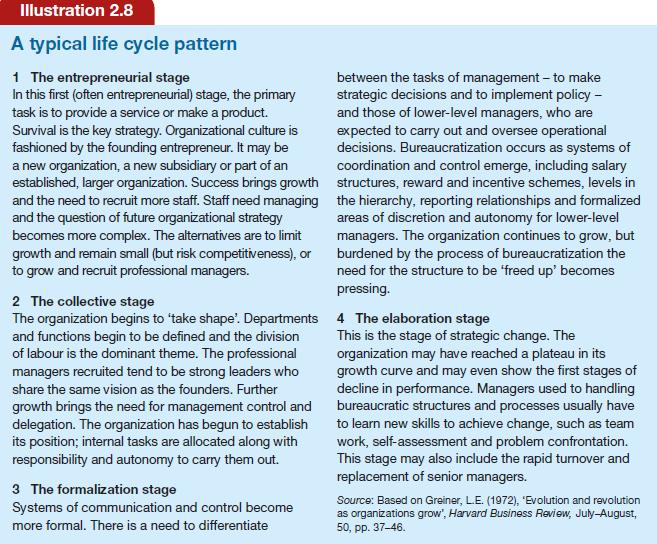
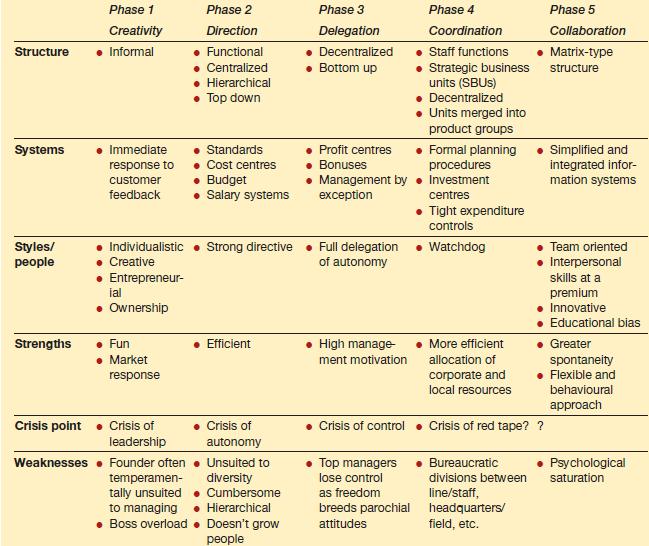
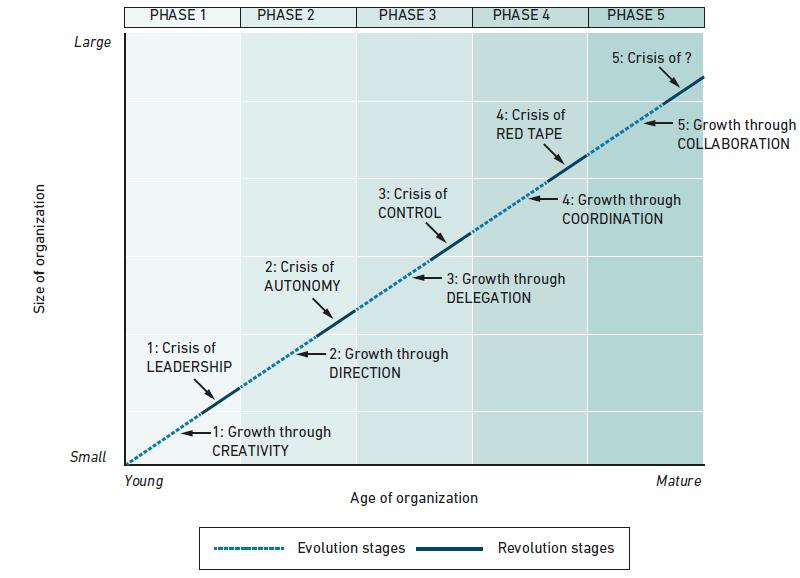
Consider an organization you know well. Using the descriptions in Illustration 2.8 and Table 2.1 , position the organization on the graph in Figure 2.4 .Table 2.1Figure 2.4 Illustration 2.8 A typical life cycle pattern 1 The entrepreneurial stage In this first (often entrepreneurial) stage, the
This activity will help identify the routines, rituals and symbols prevalent in an organization and who uses them. Think of your own organization, or one you are familiar with.1. Which routines and rituals are most emphasized? How are they enforced (think of the people and systems behind them)?2.
The governing body for world football, FIFA, reached a contentious decision in 2010 to hold the World Cup in Qatar in 2022. In the final round of voting, 14 votes went to Qatar and 8 to the USA. Qatar has no tradition of football, little football infrastructure and summer temperatures too severe
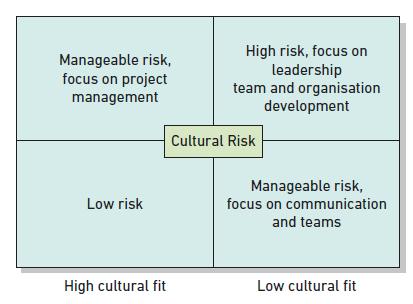
For an organization you know well, use the matrix set out in Figure 4.8 to consider the appropriate organizational strategies for achieving change in the three conditions of high risk in the need for change, high risk in the need for cultural fit and high risk in the need for both. Manageable
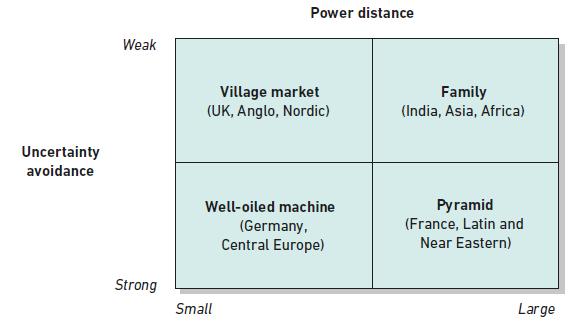
Look again at Figure 4.5 , which positions four models of organization on Hofstede’s power distance and uncertainty avoidance dimensions. Consider Deal and Kennedy’s four culture types described in Illustration 4.6 and consider how far each can be related to one or more of Hofstede’s
Discuss the following statement: ‘If it is managed well, conflict can add substantial value to change processes.’
Some studies have shown that organizations with women in the boardroom outperform men-only boards. The same reports imply that gender diversity is a causal factor in explaining better performance. If this is true, then how would you explain the causal mechanism? Would an all-women board perform
Discuss the proposition: ‘Conflict between individuals and groupDiscuss the following statement: ‘If it is managed well, conflict can add substantial value to change processes.’s in the workplace is inevitable.’
How are power relations expressed and managed, overtly and covertly, where you work?
Think about some occasions at work when you have tried to achieve something that you wanted. To what extent were ‘push’ or ‘pull’ strategies used? Were the strategies successful? If so, why do you think they worked?If any of the strategies were not successful, why was this?
Think of people in your organization and give examples of the sources of power that they enjoy.
1. In relation to French and Raven’s sources of power, identify individuals in your own organization whom you consider ‘fit’ each of the five categories.2. Repeat the activity but this time thinking of people outside your organization. They might be in the media, government or entertainment,
To what extent can an organization culture change while still retaining the majority of its employees?
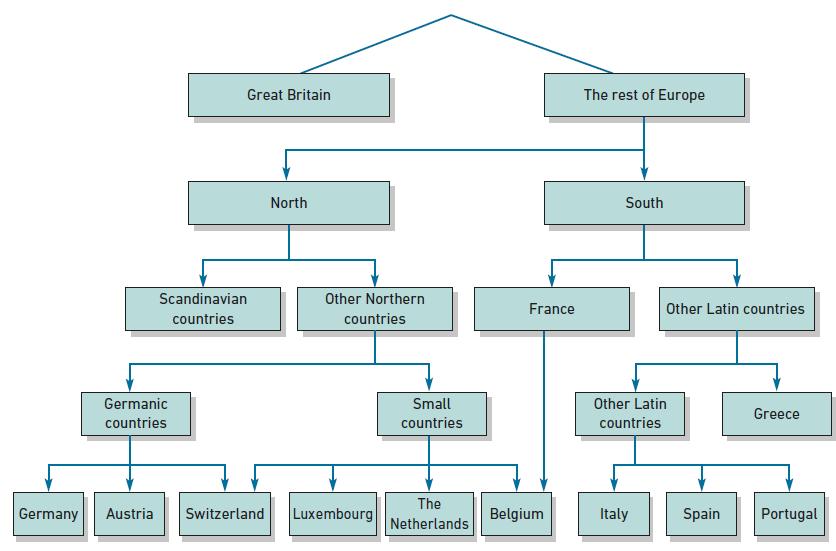
Consider the country groupings and characteristics identified by Calori and De Woot in Figure 4.6 . To what extent do any of these characteristics agree with your own experience? Great Britain Scandinavian countries Germanic countries North Other Northern countries Germany Austria Switzerland
How could organizations that are moving towards a merger or acquisition begin to carry out a cultural audit? In particular, how could they assess the compatibility of their respective cultures to identify possible problem areas that could impede integration?
Drawing on typologies of culture, prepare a presentation to demonstrate how cultural types relate to different types of organizational change.
Consider your own organization in terms of Handy’s four cultural types. Which description best matches the culture as you see it?
Review the evidence for and against the notion that national cultures are converging.
Thirty years have passed since the competing values framework was introduced.Perhaps management has changed since then. To what extent do you think that the four values are in competition? For instance, can organizations focus both on their employees and on the organization? Can they have flexible
To what extent does an organization’s structure influence its culture and its capacity to work with change?
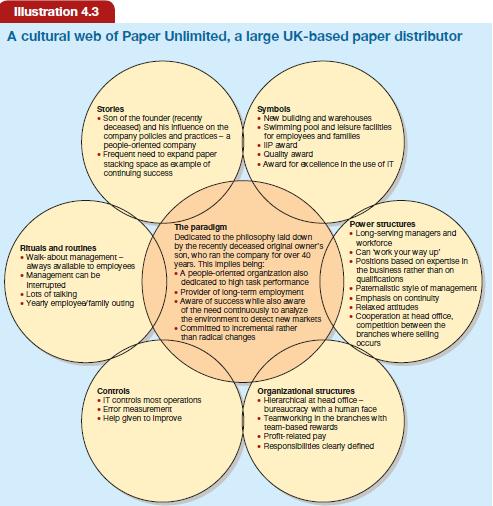
Illustration 4.3 shows the cultural web for an organization involved in paper production.Using this as a guide, construct a cultural web for an organization you know well.If you wanted to initiate strategic change in the company that you have described, which features of the culture present the
Governments come and go, each promising to deliver change and reforms to improve the economy and society.But government policy and strategy are filtered through and buffered by a civil service and it looks as if long-running attempts to reform the British Civil Service have met with little success.
Drawing on your experience, consider how realistic it is for managers to try and change organizational culture.
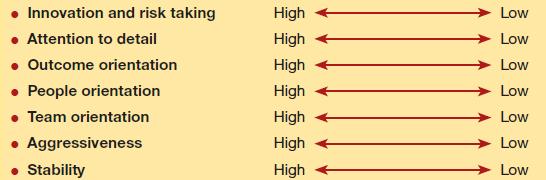
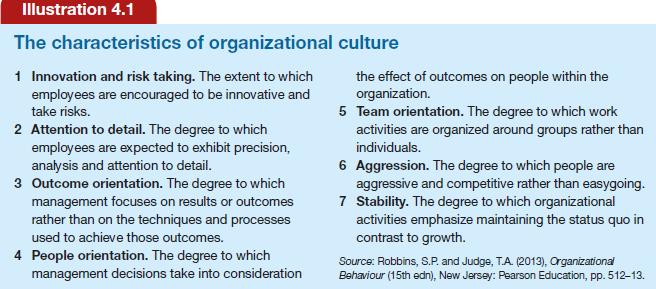
The scales below relate to the organizational culture characteristics listed in Illustration 4.1 . Indicate on each scale how you rate your own organization (or one you know). If possible, ask others who know the organization to do the same. You could find some different views of the culture
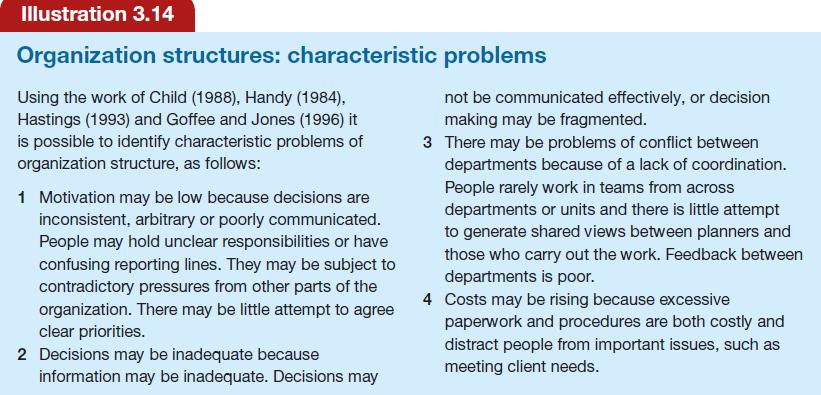
1. Considering an organization that you know well, to what extent do any of the four consequences of structural deficiencies listed in Illustration 3.14 apply to it?2. If you think that some of these deficiencies are present, what does this imply for the way the organization is structured? What
If you work in an organization, consider the institutional field that it operates within. Identify aspects of organizational design and structure that exist because of conformity to that field and not because they add value in themselves.
Think of one small part of an organization that you know well and try to identify where the routine actions of people are creating structure and structural relationships. Then consider why these situations exist – for example, individual management styles, dominating personalities or
In spite of the talk about network and virtual organizations, most organizations conform to more traditional structure types. Why is this?
Matrix-type organizations occur frequently in construction, aerospace, marketing and management consulting firms, in which professionals work together on a project ( Koontz, 2010 ). Using your general knowledge, attempt to design a matrix structure for the way The Beautiful Buildings Company, as a
UK retailer Marks & Spencer has over 1,000 stores in Britain and Europe. Its financial performance is basically sound, but city analysts see it as declining.Recent performance is disappointing despite a series of efforts to revitalize it. Several top management teams have tried but with only
Consider the following statement:Starting from scratch underplays the fact that significant redesign has to be planned and implemented in a real-life context that won’t go away. Hospitals’re-engineering projects run into the problems of physician power. Government projects are often stifled by
● Obtain an official organization chart for an organization that you know well. To what extent would you regard the organization’s structure as indicative of a bureaucratic structure and indicative of how work actually gets done?● To what extent does the organization of work conform to
To what extent do you think the environmental scanning tools are effective in diagnosing the environment for organizations? Are there situations when they might not be effective?
Take each example you thought of in Activity 2.4 and make a judgement as to whether your example is, overall, a hard or soft problem/change situation.Did the activity confirm or refute your judgement of what is a difficulty and what is a mess in terms of your answer to Activity 2.4 ?Activity 2.41
To what extent do organizational messes get treated as if they were difficulties? What are the organizational consequences of this? Does it matter how change situations are classified?
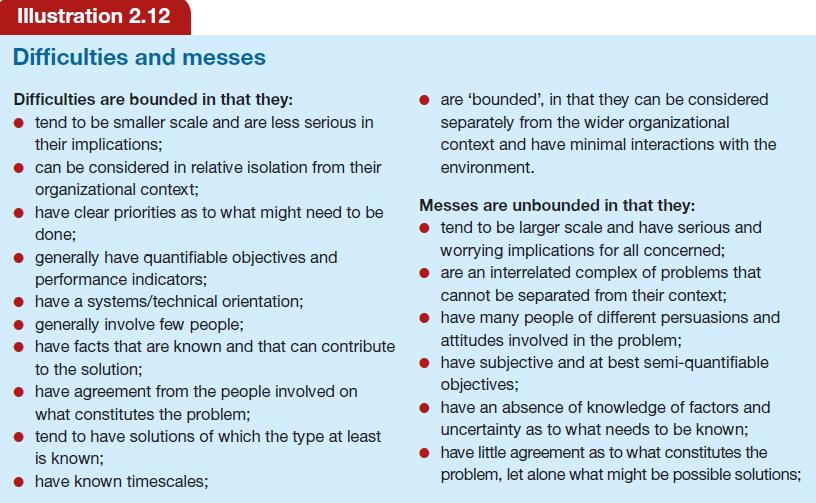
1 Using the descriptions in Illustration 2.12 , identify three ‘difficulties’ you have faced at work or in similar situations elsewhere.2 Identify two or three ‘messes’ you have faced or been involved in.3 Using Illustration 2.12 , list the ways in which the difficulties differ from the
Discuss Quinn’s (1979) contention that change occurs through a process of ‘logical incrementalism’. Give examples to support your argument.
Which (one or more) of the five levels of environmental turbulence do you think fits the situation Equitable Life found itself in?What type(s) of change was Equitable Life pushed into?
To what extent are Dunphy and Stace’s four types of change helpful in working with ‘real-life’ examples of change? Illustrate your answer with examples from organizations you know well.
Professional service firms occur in sectors such as architecture, law and accounting. These sectors are characterized by extensive and long traditions of professional practice, highly regulated professional training and examination, and a professional partnership (PP) style of organization. The PP
Discuss the proposition that: ‘All change can be categorized as either incremental or radical.’ Use examples from your own experience to support your argument.
Think about the future trends identified by the Chartered Management Institute (2014).What sorts of changes will organizations have to confront if they are to respond to them? What managerial attitudes would need to change?
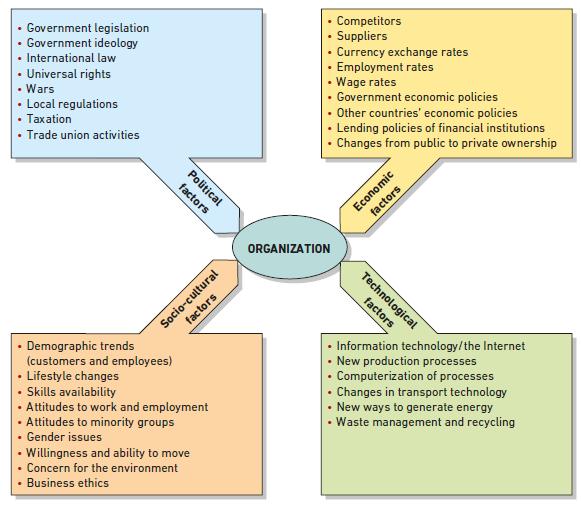
Take the list you made when doing Activity 1.3 and categorize each factor according to whether you consider it to stem from political, economic, technological or socio-cultural forces. Are there any factors that do not easily fit into one of these four categories?Activity 1.3For an organization
What do your conclusions tell you about the interconnections between the various aspects of the PEST environment? Can you make any interconnections between events and decisions made outside your country that will affect organizations in the country where you live and work? . Government
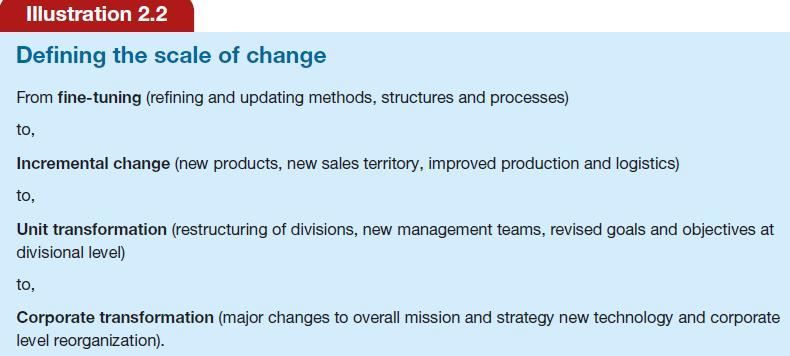
Look again at Dunphy and Stace’s types of change in Illustration 2.2 . Position an organization with which you are familiar on the following scale:How well does the type of change now being experienced by your organization fit the environment in which it is currently operating and that is likely
Think about two or three organizations with which you are familiar. Carry out an environmental assessment for each organization. To help you with this, consider:● the PEST factors and the organizations’ internal environments;● how past historical developments (either in societal or
For an organization that you know well, what are the main reasons why it has attempted to make changes to products, services, systems and/or structure? Who is actually set to benefit most from the changes that are being attempted?
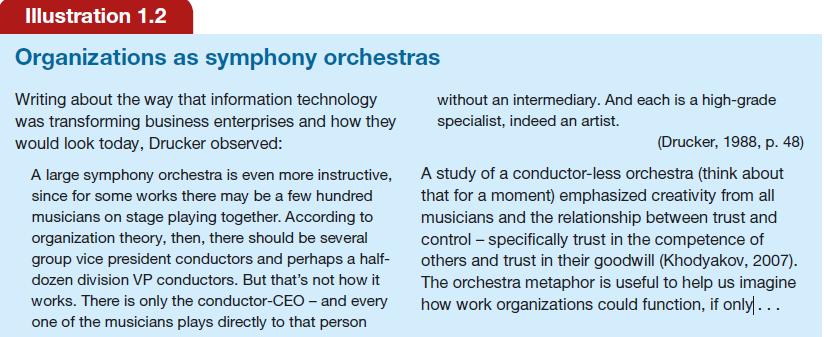
Linking to Illustration 1.2, if you work in an organization, think about the people you work with. What are your impressions of your trust in their goodwill and their competence? What might your colleagues think of you in this regard? What do your impressions of trust mean for the likelihood of
Consider how you would describe an organization that you know well in terms of its wealth-creating capacity. For instance:● Which business sectors does it operate in?● Does the organization operate at a local, regional, national or international level?● In what ways does the organization need
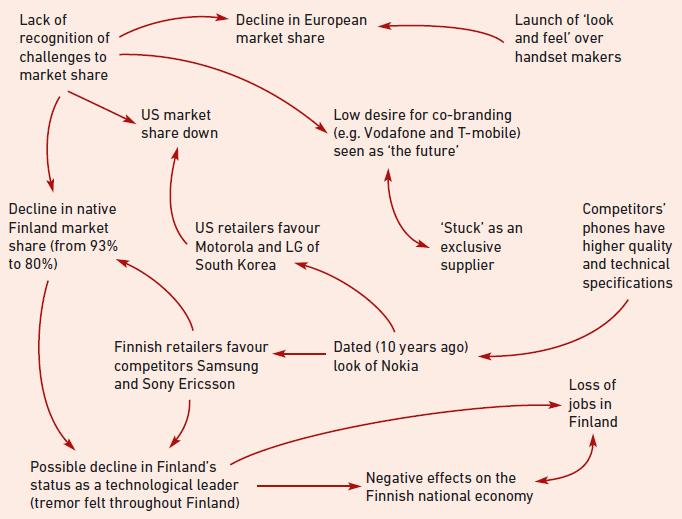
Based in Finland, Nokia transformed from being a diverse conglomerate into a world-leading mobile phone producer in the 1990s. Since then, the company has experienced very tough operating conditions in the face of competition from Samsung and products like the Apple iPhone. Substantial layoffs and
Showing 700 - 800
of 750
1
2
3
4
5
6
7
8
Step by Step Answers

 Get 50% OFF
Claim Now
Get 50% OFF
Claim Now