New Semester
Started
Get
50% OFF
Study Help!
--h --m --s
Claim Now
Question Answers
Textbooks
Find textbooks, questions and answers
Oops, something went wrong!
Change your search query and then try again
S
Books
FREE
Study Help
Expert Questions
Accounting
General Management
Mathematics
Finance
Organizational Behaviour
Law
Physics
Operating System
Management Leadership
Sociology
Programming
Marketing
Database
Computer Network
Economics
Textbooks Solutions
Accounting
Managerial Accounting
Management Leadership
Cost Accounting
Statistics
Business Law
Corporate Finance
Finance
Economics
Auditing
Tutors
Online Tutors
Find a Tutor
Hire a Tutor
Become a Tutor
AI Tutor
AI Study Planner
NEW
Sell Books
Search
Search
Sign In
Register
study help
business
principles corporate finance
Excel Modeling In Corporate Finance 5th Global Edition Craig W. Holden - Solutions
Perform instant experiments on whether changing various inputs causes an increase or decrease in the Bond Price and by how much.(a.) What happens when the annual coupon rate is increased?(b.) What happens when the yield to maturity is increased?(c.) What happens when the number of payments / year
A 4 year Treasury Bond with a face value of $900, and an annual coupon rate of 4.20% has a yield to maturity of 3.03%. This bond makes 2(semiannual) coupon payments per year and thus has 8 periods until maturity. What is the duration, modified duration, and convexity of this bond based on the
A 4 year Treasury Bond with a face value of $900, and an annual coupon rate of 6.30% has a yield to maturity of 4.79%. This bond makes 2(semiannual) coupon payments per year and thus has 8 periods until maturity. What is the price sensitivity of a bond to changes in yield and how does that compare
Given four of the bond variables, determine the fifth bond variable.(a.) Given Number of Periods to Maturity is 10, Face Value is $1,000.00, Discount Rate / Period is 3.27%, and Coupon Payment is $40.00, determine the Bond Price.(b.) Given Number of Periods to Maturity is 8, Face Value is
Currently a stock pays a dividend per share of $6.64. A security analyst projects the future dividend growth rate over the next five years to be 12.0%, 11.0%, 10.0%, 9.0%, 8.0% and then 7.0% each year thereafter to infinity. The levered cost of equity capital for the firm is 12.0% per year. What is
Currently a stock pays a dividend per share of $43.37. A security analyst projects the future dividend growth rate over the next five years to be 21.0%, 18.0%, 15.0%, 13.5%, 11.5% and then 11.0% each year thereafter to infinity. The levered cost of equity capital for the firm is 11.4% per year.What
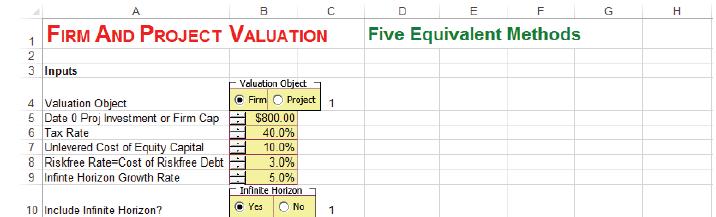
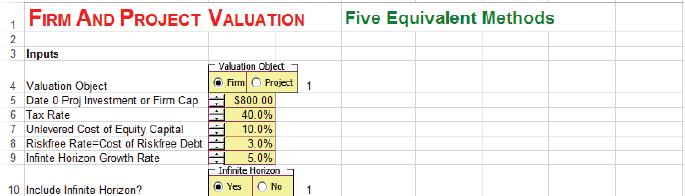
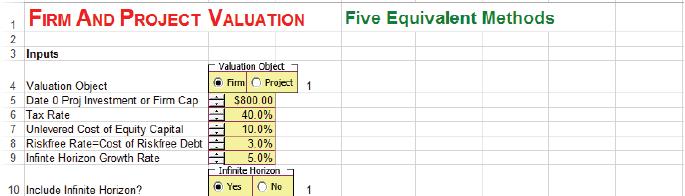
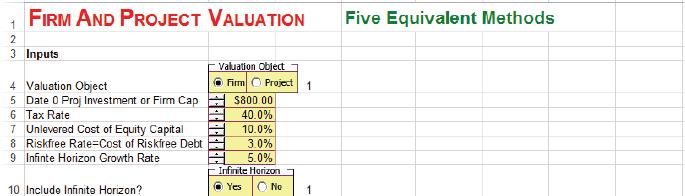
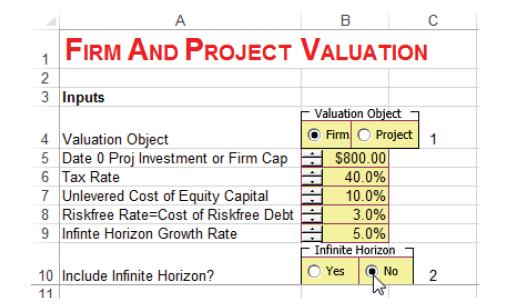
Given the cash flow streams, compute the current value of the firm and the value added by the firm using Adjusted Present Value. 123 A B FIRM AND PROJECT VALUATION 3 Inputs 4 Valuation Object 5 Date 0 Proj Investment or Firm Cap 6 Tax Rate 7 Unlevered Cost of Equity Capital 8 Riskfree Rate Cost of
Given the cash flow streams, compute the current value of the firm and the value added by the firm using Free Cash Flow to Equity. 123 FIRM AND PROJECT VALUATION 3 Inputs 4 Valuation Object 5 Date 0 Proj Investment or Firm Cap 6 Tax Rate 7 Unlevered Cost of Equity Capital 8 Riskfree Rate Cost of
Given the cash flow streams, compute the current value of the firm and the value added by the firm using Free Cash Flow to the Firm. 123 FIRM AND PROJECT VALUATION 3 Inputs 4 Valuation Object 5 Date 0 Proj Investment or Firm Cap 6 Tax Rate 7 Unlevered Cost of Equity Capital 8 Riskfree Rate Cost of
Given the cash flow streams, compute the current value of the firm and the value added by the firm using a Dividend Discount Model. 123 FIRM AND PROJECT VALUATION 3 Inputs 4 Valuation Object 5 Date 0 Proj Investment or Firm Cap 6 Tax Rate 7 Unlevered Cost of Equity Capital 8 Riskfree Rate Cost of
Given the cash flow streams, compute the current value of the firm and the value added by the firm using Residual Income. 123 FIRM AND PROJECT VALUATION 3 Inputs 4 Valuation Object 5 Date 0 Proj Investment or Firm Cap 6 Tax Rate 7 Unlevered Cost of Equity Capital 8 Riskfree Rate Cost of Riskfree
Eliminate the (stage two) infinite horizon cash flows and recompute the value of the firm and the value added by the firm using the same five methods. Then, switch to evaluating a project while maintaining no infinite horizon cash flows. Compute the value of future cash flows and the NPV of the
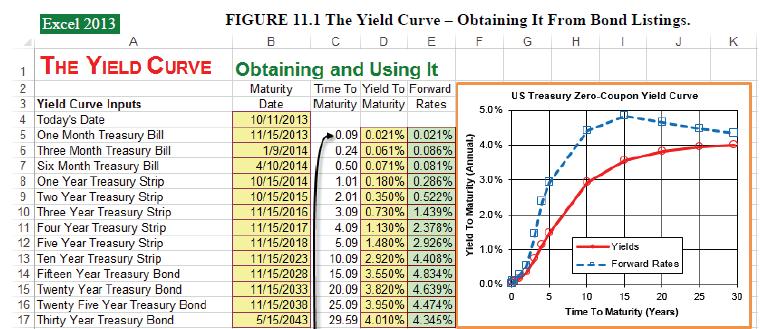
Given bond prices and yields as published by the financial press or other information sources, obtain the U.S. Treasury Yield Curve. 2 Excel 2013 A FIGURE 11.1 The Yield Curve - Obtaining It From Bond Listings. C D E F G H 1 J K B THE YIELD CURVE Obtaining and Using It US Treasury Zero-Coupon Yield
Given the yield curve as published by the financial press, consider a coupon bond has a face value of $1,000, an annual coupon rate of 3.5%, makes 2 (semiannual) coupon payments per year, and 8 periods to maturity (or 4 years to maturity). What is price and yield to maturity of this coupon bond
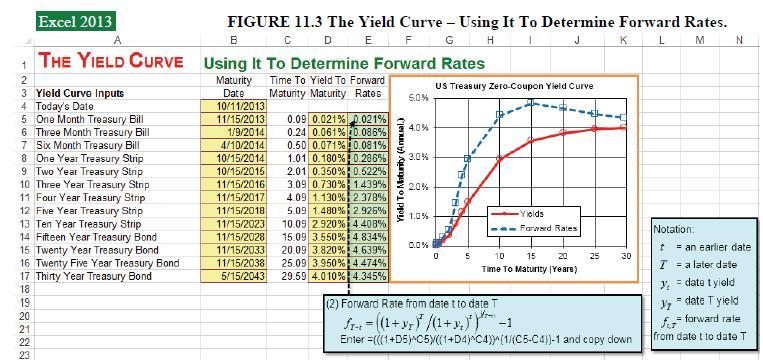
Given the yield curve as published by the financial press, calculate the implied forward rates at all maturities Excel 2013 FIGURE 11.3 The Yield Curve - Using It To Determine Forward Rates. C D E F G H J K L M N - 23 B THE YIELD CURVE Using It To Determine Forward Rates 3 Yield Curve Inputs 4
Given bond prices and yields as published by the financial press or other information sources, obtain the U.S. Treasury Yield Curve. Excel 2013 FIGURE 11.3 The Yield Curve - Using It To Determine Forward Rates. C D E F G KL B THE YIELD CURVE Using It To Determine Forward Rates H J M N 3 Yield Curve
Given the yield curve as published by the financial press, consider a coupon bond has a face value of $1,500, an annual coupon rate of 3.9%, makes 2(semiannual) coupon payments per year, and 8 periods to maturity (or 4 years to maturity). Determine the price and yield to maturity of this coupon
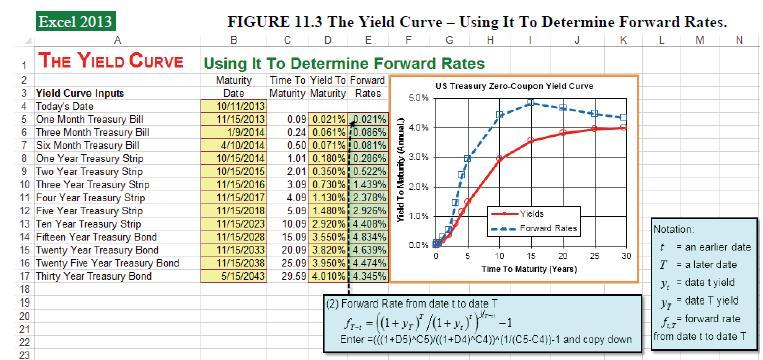
Given the yield curve as published by the financial press, calculate the implied forward rates at all maturities. Excel 2013 FIGURE 11.3 The Yield Curve - Using It To Determine Forward Rates. C D E F G KL B THE YIELD CURVE Using It To Determine Forward Rates H J M N 3 Yield Curve Inputs 4 Today's
How does the US yield curve change over time?
What determines the volatility of changes in the yield curve?
Are there differences in the volatility of short rates, medium rates, long rates, etc.?
How volatile are short rates versus medium rates versus long rates?(a.) Get a visual sense of the answer to this question by clicking on the right arrow of the scroll bar to run through all of the years of US Yield Curve history in the database.(b.) Calculate the variance of the time series of: (i)
Determine the relationship between the volatility of the yield curve and the level of the yield curve. Specifically, for each five year time period (70-74, 75-79, 80-84, etc.) calculate the variance and the average level of the time series of: (i) one-month yields, (ii) five-year yields, (iii)
For a particular firm, the value of its debt is $1,300 and the value of its equity is $1,800. Given the firm’s risk exposure, the unlevered cost of equity capital is 11.00%. The cost of debt is 7.00%. Plot the cost of equity, the weighted average cost of capital (WACC), and the cost of debt
For a particular firm, the value of its debt is $1,300 and the expected free cash flow on all future dates forever is $500. Given the firm’s risk exposure, the unlevered cost of equity capital is 11.00%. The cost of debt is 7.00%. The corporate tax rate is 33.00%. Plot the cost of equity, the
For a particular firm, the value of its debt is $1,300 and the expected free cash flow on all future dates forever is $500. Given the firm’s risk exposure, the unlevered cost of equity capital is 11.00%. The corporate tax rate is 33.00%.Distress cost is modeled as a quadratic function –
For a particular firm, the value of its debt is $3,000 and the value of its equity is $3,500. Given the firm’s risk exposure, the unlevered cost of equity capital is 14.50%. The cost of debt is 7.20%. Plot the cost of equity, the weighted average cost of capital (WACC), and the cost of debt
For a particular firm, the value of its debt is $3,000 and the expected free cash flow on all future dates forever is $1,100. Given the firm’s risk exposure, the unlevered cost of equity capital is 13.80%. The cost of debt is 8.50%. The corporate tax rate is 33.00%. Plot the cost of equity, the
For a particular firm, the value of its debt is $3,000 and the expected free cash flow on all future dates forever is $900. Given the firm’s risk exposure, the unlevered cost of equity capital is 14.90%. The corporate tax rate is 33.00%. Distress cost is modeled as a quadratic function –
Select a company with publicly traded stock. Locate the historical 10K financial statements for that company over the past few years. Forecast your company's financial statements over the next three years. 2010 1 A B D E F CORPORATE FINANCIAL PLANNING Problems 2 Global Impact P2P 3 Financial Plan
Suppose the Euro/Dollar Exchange Rate is €1 = $1.3640, the annual US riskfree rate is 4.47%, the US inflation rate is 2.69%, and the annual Eurozone riskfree rate is 4.27%. What is the one-year Forward Euro/Dollar Exchange Rate, the one-year ahead Expected Spot Euro/Dollar Exchange Rate, and
Suppose the Euro/Dollar Exchange Rate is €1 = $1.3640, the annual US riskfree rate is 4.47%, the US inflation rate is 2.69%, the annual Eurozone riskfree rate is 4.27%, the Eurozone inflation rate is 1.90%, and the one-year Forward Euro/Dollar Exchange Rate is €1 = $1.3739. What will the
Suppose the Euro/Dollar Exchange Rate is €1 = $1.083, the annual US riskfree rate is 4.61%, the US inflation rate is 3.69%, and the annual Eurozone riskfree rate is 6.39%. What is the one-year Forward Euro/Dollar Exchange Rate, the one-year ahead Expected Spot Euro/Dollar Exchange Rate, and
Suppose the Euro/Dollar Exchange Rate is €1 = $1.6371, the annual US riskfree rate is 6.90%, the US inflation rate is 4.72%, the annual Eurozone riskfree rate is 2.15%, the Eurozone inflation rate is 2.85%, and the one-year Forward Euro/Dollar Exchange Rate is €1 = $1.7941. What will the
What is the annual standard deviation of Facebook stock based on continuous returns? A B C D E F G H BINOMIAL OPTION PRICING Estimating Volatility 12345678 9 6 Stock: 7 Symbol: (1) Download three months of daily stock price data Facebook Inc. FB (2) LN[(Price on date t) / (Price on date t-1)] Enter
At the close of trading on October 11, 2013, SPY, an Exchange Traded Fund (ETF) based on the S&P 500 index, traded at 170.30. European call and put options on SPY with the exercise prices shown below traded for the following prices:These call options mature on December 20, 2014, which is in
The S&P 500 index closes at 2000. European call and put options on the S&P 500 index with the exercise prices shown below trade for the following prices::All options mature in 88 days. The S&P 500 portfolio pays a continuous dividend yield of 1.47% per year and the annual yield on a
An annuity pays $132.38 each period for 5 periods. For these cash flows, the appropriate discount rate / period is 3.5%. What is the present value of this annuity?
An annuity pays $63.92 each period for 4 periods. For these cash flows, the appropriate discount rate / period is 9.1%. What is the period 5 future value of this annuity?
Consider a system of four annuity variables.(a) An annuity pays $63.00 each period for 3 periods. For these cash flows, the appropriate discount rate / period is 8.0%. What is the present value of this annuity?(b) An annuity pays each period for 11 periods, the appropriate discount rate / period is
An annuity pays $80.00 each period for 5 periods. For these cash flows, the appropriate discount rate / period is 6.0%. What is the present value of this annuity?
An annuity pays $80.00 each period for 5 periods. For these cash flows, the appropriate discount rate / period is 6.0%. What is the period 5 future value of this annuity?
There is a tight connection between all of the inputs and output to annuity valuation. Indeed, they form a system of four annuity variables: (1)Payment, (2) Discount Rate / Period, (3) Number of Periods, and (4) Present Value. Given any three of these variables, find the fourth variable.
A project requires a current investment of $100.00 and yields future expected cash flows of $21.00, $34.00, $40.00, $33.00, and $17.00 in periods 1 through 5, respectively. All figures are in thousands of dollars. For these expected cash flows, the appropriate nominal discount rate is 8.0%. What is
A project requires a current investment of $100.00 and yields future expected cash flows of $21.00, $34.00, $40.00, $33.00, and $17.00 in periods 1 through 5, respectively. All figures are in thousands of dollars. The inflation rate is 3.0%. For these expected cash flows, the appropriate Real
A project requires a current investment of $179.32 and yields future expected cash flows of $35.19, $63.11, $88.54, $82.83, and $68.21 in periods 1 through 5, respectively. All figures are in thousands of dollars. For these expected cash flows, the appropriate discount rate is 5.3%. What is the net
A project requires a current investment of $107.39 and yields future expected cash flows of $48.31, $58.53, $82.80, $106.31, and $62.18 in periods 1 through 5, respectively. All figures are in thousands of dollars. The inflation rate is 3.7%. For these expected cash flows, the appropriate Real
A project requires a current investment of $100.00 and yields future expected cash flows of $21.00, $34.00, $40.00, $33.00, and $17.00 in periods 1 through 5, respectively. All figures are in thousands of dollars. For these expected cash flows, the appropriate nominal discount rates are 8.0% in
A project requires a current investment of $100.00 and yields future expected cash flows of $21.00, $34.00, $40.00, $33.00, and $17.00 in periods 1 through 5, respectively. All figures are in thousands of dollars. The forecasted inflation rate is 3.0% in period 1, 2.8% in period 2, 2.5% in period
A project requires a current investment of $64.39 and yields future expected cash flows of $29.27, $37.33, $44.94, $51.76, and $42.49 in periods 1 through 5, respectively. All figures are in thousands of dollars. For these expected cash flows, the appropriate nominal discount rates are 7.4% in
A project requires a current investment of $308.47 and yields future expected cash flows of $97.39, $144.97, $163.28, $184.99, and $96.41 in periods 1 through 5, respectively. All figures are in thousands of dollars. The forecasted inflation rate is 4.4% in period 1, 4.6% in period 2, 4.9% in
To purchase a house, you take out a 30 year mortgage. The present value (loan amount) of the mortgage is $300,000. The mortgage charges an interest rate / year of 8.00%. What is the annual payment required by this mortgage? How much of each year's payment goes to paying interest and how much to
Examine the same 30 year mortgage for $300,000 as in the previous section. Consider what would happen if the interest rate / year dropped from 8.00% to 7.00%. How much of each year's payment goes to paying interest vs.how much goes to reducing the principal under the two interest rates?
To purchase a house, you take out a 30 year mortgage. The present value(loan amount) of the mortgage is $237,832. The mortgage charges an interest rate / year of 7.27%. What is the annual payment required by this mortgage?How much of each year's payment goes to paying interest and how much to
In purchasing a house, you need to obtain a mortgage with a present value(loan amount) of $175,000. You have a choice of: (A) a 30 year mortgage at an interest rate / year of 9.74% or (B) a 15 year mortgage at an interest rate /year of 9.46%. What is the annual payment required by the two
Consider a 30 year mortgage for $462,264 as in the previous section. What would happen if the interest rate / year dropped from 10.21% to 7.95%. How much of each year's payment goes to paying interest and how much goes to reducing the principal under the two interest rates?
You are trying to decide whether to lease a car for four years or buy a new car now and sell it four years later. The annual lease payment would be$4,100 with payments made at the beginning of each year. The new car price is$32,000 now. Four years later, it will be worth $21,000. The appropriate
A corporation is trying to decide whether to lease a machine for five years and pay the residual purchase cost to buy the machine in the last year of the lease or buy the machine now. The annual lease payment would be $4,100 with payments made at the beginning of each year. The residual purchase
You are trying to decide whether to lease a car for four years or buy a new car now and sell it four years later. The annual lease payment would be$7,300 with payments made at the beginning of each year. The new car price is $49,000 now. Four years later, it will be worth $33,000. The appropriate
A corporation is trying to decide whether to lease a machine for five years and pay the residual purchase cost to buy the machine in the last year of the lease or buy the machine now. The annual lease payment would be $9,000 with payments made at the beginning of each year. The residual purchase
Given monthly total return data on individual stocks, US portfolios, and country portfolios, estimate the Static CAPM under three market portfolio benchmarks (SPDR “Spider” Exchange Traded Fund, CRSP Value-Weighted Market Return, and Dow Jones World Stock Index) using the standard Fama-MacBeth
Given monthly total return data on individual stocks, US portfolios, and country portfolios, estimate the APT or Intertemporal CAPM (ICAPM)under two sets of factors (Fama-French 3 factors and 3 macro factors) and using the standard Fama-MacBeth methodology. Then use the APT or ICAPM estimates from
Download ten years of monthly total return data for individual stocks, US portfolios, and country portfolios. Then use that data to estimate the Static CAPM under three market portfolio benchmarks (SPDR “Spider” Exchange Traded Fund, CRSP Value-Weighted Market Return, and Dow Jones World Stock
Download ten years of monthly total return data for individual stocks, US portfolios, and country portfolios. Then use that data to estimate the APT or Intertemporal CAPM (ICAPM) under two sets of factors (Fama-French 3 factors and 3 macro factors) and using the standard Fama-MacBeth methodology.
The expected future cash flows for a firm have been forecasted in two stages and correspond to two time periods. Stage one is a finite horizon from years 1 to 5. Stage two is the remaining infinite horizon from year 6 to infinity.Given these forecasted cash flows, compute the current value of the
Starting from their historical financial statements, forecast the expected future cash flows for a real firm in two stages corresponding to two time periods. Stage one is a finite horizon from years 1 to 5. Stage two is the remaining infinite horizon from year 6 to infinity. Given these forecasted
Perform instant experiments on whether changing various inputs causes an increase or decrease in the firm’s value / share and by how much.(a.) What happens when the date 0 firm capital is increased?(b.) What happens when the tax rate is increased?(c.) What happens when the unlevered cost of
Suppose a firm is considering the following project, where all of the dollar figures are in thousands of dollars. In year 0, the project requires an$11,350 investment in plant and equipment, is depreciated using the straight-line method over seven years, and has a salvage value of $1,400 in year 7.
Consider the same project as Project NPV - Basics. Let's examine the details of how you forecast the project cash flows. Suppose that Direct Labor, Materials, Selling Expenses, and Other Variable Costs are forecast to be $3.50,$2.00, $1.20, and $0.70, respectively, in year 1 and then grow with
Consider the same project as above. Suppose we add that the project will require working capital in the amount of $0.87 in year 0 for every unit of next year's forecasted sales and this amount will grow with inflation going forward. What is the project NPV?
Consider the same project as above. Assume that the product life-cycle of seven years is viewed as a safe bet, but that the scale of demand for the product is highly uncertain. Analyze the sensitivity of the project NPV to the unit sales scale factor and to the cost of capital
Suppose a firm is considering the following project, where all of the dollar figures are in thousands of dollars. In year 0, the project requires $37,500 investment in plant and equipment, is depreciated using the straight-line method over seven years, and there is a salvage value of $5,600 in year
Consider the same project as problem 1, but modify it as follows. Suppose that Direct Labor, Materials, Selling Expenses, and Other Variable Costs are forecast to be $4.10, $4.20, $1.10, and $2.20, respectively, in year 1 and then grow with inflation. Lease Payment, Property Taxes, Administration,
Consider the same project as problem 2, but modify it as follows: suppose that the project will require working capital in the amount of $1.58 in year 0 for every unit of next year's forecasted sales and that this amount will grow with inflation going forward. What is the project’s NPV?
Consider the same project as problem 3. Assume that the product life-cycle of seven years is viewed as a safe bet, but that the scale of demand for the product is highly uncertain. Analyze the sensitivity of the project’s NPV to the unit sales scale factor and to the cost of capital.
Suppose a firm is considering a labor-saving investment. In year 0, the project requires a $6,300 investment in equipment (all figures are in thousands of dollars). This investment is depreciated using the straight-line method over five years and has a salvage value in year 5 of $1,200. With or
For the same cost-reducing project as the previous section, analyze the sensitivity of the Project’s NPV to the assumed With Investment Labor Costs.
Suppose a firm is considering a labor-saving investment. In year 0, the project requires a $11,700 investment in equipment (all figures are in thousands of dollars). This investment is depreciated using the straight-line method over five years and there is salvage value in year 5 of $4,500. With or
For the same cost-reducing project as problem 1, analyze the sensitivity of the Project NPV to the assumed With Investment Labor Costs.
A project has a fixed cost of $30,000, variable costs of $4.00 per unit, and generates sales revenue of $6.00 per unit. What is the break-even point in unit sales, where accounting profit exactly equals zero, and what is the intuition for it?
Suppose a firm is considering the following project, where all of the dollar figures are in thousands of dollars. In year 0, the project requires $11,350 investment in plant and equipment, is depreciated using the straight-line method over seven years, and has a salvage value of $1,400 in year 7.
A project has a fixed cost of $80,000, variable costs of $8.20 per unit, and generates sales revenue of $14.40 per unit. What is the break-even point in unit sales, where accounting profit exactly equals zero, and what is the intuition for it?
Suppose a firm is considering the following project, where all of the dollar figures are in thousands of dollars. In year 0, the project requires $24,490 investment in plant and equipment, is depreciated using the straight-line method over seven years, and has a salvage value of $5,800 in year 7.
Construct actual (historical) financial statements for Cutting Edge B2B Inc. in preparation for forecasting their financial statements.
Given actual financial statements for Cutting Edge B2B Inc., forecast their financial statements for the next three years. Explore the impact of the financing choice variables: debt or equity.
Given historical and forecasted Income Statements and Balance Sheets for Cutting Edge B2B Inc., create the historical and forecasted Cash Flow Statement.
Given historical and forecasted financial statements for Cutting Edge B2B Inc., create the historical and forecasted financial ratios.
Given historical and forecasted financial statements for Cutting Edge B2B Inc., analyze the sensitivity of the 2007 External Funds Needed to the assumed 2007 Sales Growth Rate.
Given historical 10K financial statements for Nike, Inc., forecast their financial statements over the next three years.
Given historical financial statements for Global Impact P2P on the Problems tab, forecast their financial statements for the next three years.Then explore the company's needs for additional financing as expressed by the following choice variables: debt and equity (paid-in capital under
Given historical and forecasted Income Statements and Balance Sheets for Global Impact P2P, create the historical and forecasted Cash Flow Statement.
Given historical and forecasted financial statements for Global Impact P2P, create the historical and forecasted financial ratios.
A company's Net Profit is $170, Pretax Profit is $260, EBIT is $470, Sales are $4,600, Assets are $4,200, and Equity is $4,300. Calculate the company's ROE and decompose the ROE into its components using the Du Pont System.
A company's Net Profit is $102, Pretax Profit is $173, EBIT is $603, Sales is$4,040, Assets is $5,660, and Equity is $6,930. Calculate the company's ROE and decompose the ROE into its components using the Du Pont System.
A company's Net Profit is $285, Pretax Profit is $852, EBIT is $995, Sales is$5,880, Assets is $7,820, and Equity is $10,030. Calculate the company's ROE and decompose the ROE into its components using the Du Pont System.
Suppose that you are currently 30 years old and expect to earn a constant salary of $80,000. You are planning to retire at age 70 and expect to die at age 95. You save at a 15.0% rate. Your current tax rate is 20.0% and you expect your retirement years tax rate to be 25.0%. You plan to invest your
Suppose that you are currently 30 years old and expect to earn a constant real salary of $80,000 starting next year. You are planning to retire at age 70. You currently have $0 in financial capital. You are limited to investing in the riskfree asset. The real riskfree rate is 1.0%. Develop a
Suppose that you are currently 30 years old and expect to earn a constant real salary of $80,000 starting next year. You are planning to retire at age 70. You currently have $0 in financial capital. You can invest in the riskfree asset or a broad stock portfolio. The inflation rate is 1.5% and the
Suppose that you are currently 25 years old and expect to earn a constant salary of $46,000. You are planning to retire at age 65 and expect to die at age 85. You save at an 11.0% rate. Your current tax rate is 18.0% and you expect your retirement years tax rate to be 23.0%. You plan to invest your
Suppose that you are currently 28 years old and expect to earn a constant real salary of $70,000 starting next year. You are planning to work for 32 years and then retire. You currently have $0 in financial capital. You are limited to investing in the riskfree asset. The real riskfree rate is 3.0%.
Showing 1500 - 1600
of 5445
First
9
10
11
12
13
14
15
16
17
18
19
20
21
22
23
Last
Step by Step Answers

 Get 50% OFF
Claim Now
Get 50% OFF
Claim Now