New Semester
Started
Get
50% OFF
Study Help!
--h --m --s
Claim Now
Question Answers
Textbooks
Find textbooks, questions and answers
Oops, something went wrong!
Change your search query and then try again
S
Books
FREE
Study Help
Expert Questions
Accounting
General Management
Mathematics
Finance
Organizational Behaviour
Law
Physics
Operating System
Management Leadership
Sociology
Programming
Marketing
Database
Computer Network
Economics
Textbooks Solutions
Accounting
Managerial Accounting
Management Leadership
Cost Accounting
Statistics
Business Law
Corporate Finance
Finance
Economics
Auditing
Tutors
Online Tutors
Find a Tutor
Hire a Tutor
Become a Tutor
AI Tutor
AI Study Planner
NEW
Sell Books
Search
Search
Sign In
Register
study help
business
principles corporate finance
Applied Corporate Finance Making Value Enhancing Decisions In The Real World 2nd Edition Mark K. Pyles - Solutions
Cash flow identity Is it possible for any (or all) of the three pieces of the cash flow identity to have negative values? For all that can, create a basic scenario that would explain the negative value.
Cash flow identity Your boss just burst into your cubicle, sweating profusely and screaming that the firm’s cash flow from assets is negative for last year.“We’re going under, we’re going under!” he screams. How do you calm him down?
Incremental cash flows Consider the following cash flows: sunk costs, opportunity costs, and interest expense. Should these cash flows be considered as relevant to the project? Why or why not?
Pro forma financial statements What’s different between standard accounting statements and pro forma accounting statements? What’s similar?
Project net capital spending and change in NWC Is it possible for an accepted project to require a decrease in net capital spending or net working capital? If so, what does that mean for the company?
Project expected cash flows You have been asked to obtain estimates of cash flows for a massive project the company is considering. Your head spins. Where do you start? On what number is everything else based?
Project expected cash flows “I just don’t get it,” your study-mate sighs, “I’m getting a positive number for net capital spending, but you’re saying that it’s subtracted? That doesn’t make sense.” Explain it to him again.
Project expected cash flows Your neighbor and good ole boy, Bo Duke, doesn’t understand why you don’t consider the right-hand side of the cash flow identity in estimated project expected cash flows. Explain it to him, real slow and easy.
Depreciation, taxes, and interest How does depreciation affect project expected cash flows? How do taxes affect project expected cash flows? How does interest affect project expected cash flows?
Operating cash flow Your firm has total sales of $1,200. Costs are $715 and depreciation is $145. The tax rate is 21%. The firm does not have interest expenses. What is the operating cash flow?
Change in NWC Gil’s Barrel Company has cash flow from assets of $162,489.Last year, they bought $334,489 worth of new long-term assets while selling off $217,555. In addition, the firm had EBIT of $458,600, interest expense of $23,000, and depreciation of $24,500. Their tax rate is 21%. This
Change in NWC Suppose a firm had current assets of $13,500,000 and current liabilities of $6,590,000 in 2019. In 2020, the firm had current liabilities of $5,480,000. If the firm’s change in NWC is $1,287,500, what are the firm’s 2020 current assets?
Net capital spending A firm’s cash flow from assets is −$34,562. During the year, they added $78,000 in NWC. The firm had EBIT of $156,700, depreciation of $26,425, and interest of $8,779. The firm also had a tax rate of 21%. What is the firm’s net capital spending during the year?
Cash flow to creditors At the beginning of the year, long-term debt of a firm is $280 and total debt is $340. At the end of the year, long-term debt is $260 and total debt is $350. The interest paid is $30. What is the amount of the cash flow to creditors?
Cash flow to shareholders Billy’s Bean Barn had net income of $500,000 and a payout ratio of 62%. Total equity increased this year by $85,000 over last year. Given this, what is the cash flow to shareholders?
Cash flow from assets Jill’s Grape Vineyard, Inc. had the net income last year of $126,555 from $358,000 of sales. They paid the interest of $23,000 and depreciation of $9,500. The firm increased their fixed assets by $47,000 during the year and decreased NWC by $18,544. What is Jill’s cash
Cash flow from assets You have calculated your cash flow from assets to be$12,800. Suppose you have net capital spending of $14,000 and a decrease in NWC of $2,000. You have EBIT of $25,500 and interest expenses of$4,600. The tax rate is 21%. What is your depreciation expense?
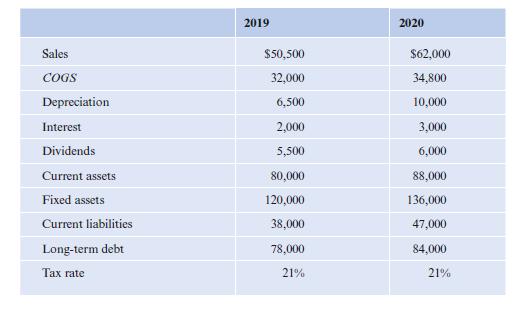
Cash flow Suppose you are given the following information for Stone’s Masonry Service:(a) Create the income statement for 2019 and 2020.(b) Create the balance sheet for both 2019 and 2020.(c) What is the operating cash flow for 2020?(d) What is the net capital spending for 2020?(e) What is the
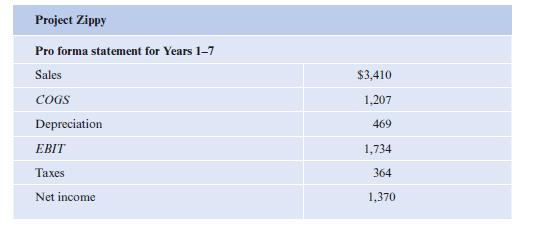
Project expected cash flows Suppose you are considering a seven-year project with the following annual pro forma statement:In addition, the project is going to require net capital spending of 10,000 and an increase in NWC of $2,400:(a) What is the project NINV?(b) What is the project operating cash
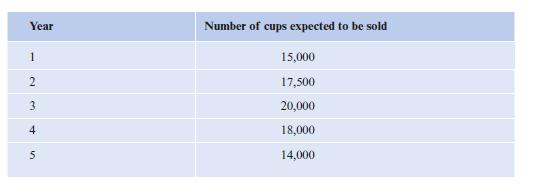
Project expected cash flows You are in charge of evaluating a project that is designed to produce coffee cups. The project requires the purchase of a new machine that costs $75,000 and will require an increase in NWC of $15,000 at initiation. The machine can be depreciated as a three-year property
Time value of money. Explain why this concept is so important in business.What are the potential pitfalls you may encounter if you fail to correctly account for the time value of money?
Simple versus compound interest. Briefly discuss the differences between simple and compound interest. How do these differences affect both the present and future values of cash flows?
Compounding versus discounting. What is the difference between compounding cash flows and discounting cash flows? Give an example of when you would use each.
Lump sums and interest rates. What is the relationship between interest rate changes and present values? What about future values? Why do these relationships exist?
Lump sums and time periods. What is the relationship between time periods and present values? What about future values? Why do these relationships exist?
Annual percentage rate. What is the APR? How is it calculated, and what is its influence on present and future values?
EAR and APR. Discuss the difference between the effective annual return(EAR) and the annual percentage rate (APR). Discuss the advantages and disadvantages of both rates and possible situations where each would be appropriate.
More frequent compounding. What is the relationship between the number of compounding periods per year and present values? What about future values?Why do these relationships exist?
Ordinary annuity. What are the four characteristics of an ordinary annuity?Give two real-life examples of an annuity.
Annuities, interest rates, and time periods. Discuss the relationships between the interest rate and the present and future value of annuities. What about the relationship between time periods and the present and future value of annuities?Be sure to explain why these relationships exist.
Interest rates. Suppose you have $1,000 to invest and are considering two alternative options. Option 1 has an APR of 10%, compounded quarterly, while option 2 has an APR of 12%, compounding annually. What is your thought process in deciding between the two? Why is it not as easy a question as it
Annuities and lump sums. What is the difference between investing $120 at the end of the year and investing $10 at the end of each month of that same year?
Loan types. What are the basic characteristics of the three loan types: pure discount, interest-only, and amortized loans. How do they differ? In what instances would you expect to see each of these?
Future value. Suppose you have $5,000 to invest. If you invest it in an account earning 5.5% annually over the next ten years, what will it be worth at the end of those ten years?
Present value. If you are to receive a lump sum payment of $1,430 in eight years, what is it worth today? Suppose the APR is 14%, compounded annually?
Present value. You are to receive $13,900. You will receive it at the end of 23 years from now. If the APR is 6%, compounding monthly, what is the present value of the lump sum?
Future value. Suppose you have $3,598 and want to invest it at 8%, compounded quarterly. How much money would you have at the end of 25 years?
Future value. You just found a wallet laying on the ground outside of the business school. Being a selfish and immoral person, you keep the $300 you find inside. However, being knowledgeable of the time value of money, you invest it with your bookie, who gives you 5% interest, compounded
Present value. Suppose you just received an inheritance of $25,000, but you can’t get it until you’re 21.Assume you are now only 13 years old. If the interest rate is 4.5% APR, compounded monthly, what is that inheritance worth to you today?
Future value. You recently won a drawing at work with a grand prize of$1,000. Being wise in the ways of finance, upon winning you immediately invest it in one of those online savings accounts that pays 3.8%, compounded monthly. Assuming you don’t put any more in or take any more out, what would
Present value. You have just bought an Andrew Luck rookie card. Assume you can jump in your time machine and see that he will turn out to be the greatest quarterback to ever play the game. As such, that card will be worth$5,000 in 50 years. Assuming the rate of interest is 6%, compounded annually,
Time period. You’re a boating enthusiast. You have recently found the vessel of your dreams, a 20-foot, 500-horsepower piece of nautical delight.However, it costs $55,000 and as of now you only have $5,000. On your way home, you see a sign on your local bank that guarantees a 5.5% APR, annually
Time period. On your tenth birthday, you received $100, which you invested at a 4.5% interest rate, compounded annually. That investment is now worth $3,000. How old are you now?
Interest rate. Your savings account has doubled in the past 13 years. You put one payment of $10,000 in at time 0.What annual interest rate have you earned?
Interest rate. You have identified your dream home. Unfortunately, it costs$350,000, and you currently have a grand total of $78,000. What interest rate must an account give you in order to have the total amount needed in ten years?
PV of unequal cash flows. You decide to become a professional gambler.You estimate that you can make $20,000 next year betting on sports. You then figure you will be better at it, so you estimate you will make $30,000 at the end of the second year and $35,000 at the end of the third year. What is
PV of unequal cash flows. Suppose you have an incentive deal worked out with your father. For every year you survive college with an acceptable GPA, you get compensated. Since the classes get harder, the compensation goes up each year. You have just finished your freshman year, so you have three
FV of unequal cash flows. You expect to receive cash flows of $12,000 at the end of year 1, $8,000 at the end of year 2, $4,500 at the end of year 3, and$7,800 at the end of year 4.What will this be worth at the end of 15 years from now, at an APR of 8%, compounded annually?
Annuities. You plan to invest $15,000 at the end of each of the next 12 years into an account earning 6.4% compounded annually. How much will it be worth at the end of those 12 years?
Present value. You and your husband (wife) just had a nasty divorce. You, being the breadwinner in the family, have to pay support to him (her) for the next 15 years. You haggle out a price of $3,000 to be paid at the end of every month. How much is this costing you in today’s dollars, if the
Annuities. You just signed a loan agreement on a boat. You will pay $867 each month for the next ten years. What was the purchase price of the boat if the APR is 8.5%, compounded monthly?
Annuities and time. You want to quit your day job and become a day trader.However, knowing the risk of doing so, you want to have a nest egg first.Your goal is to have $100,000 in an investment account before you can quit your job. If you put $600 a month into an account earning 9.5% APR,
Annuities and rates. Your grandpa is a great guy and is willing to give you$50,000 today to pay off some student loan. But he wants to be repaid $200 each month for the next 30 years. What APR is he charging you?
Interest-only loans. Suppose you buy a condo as an investment property.You buy it with a 30-year interest-only loan with a rate of 5%, compounded monthly. The condo costs $215,000, and you finance the entire amount.Exactly three years later, you sell the condo for $234,000. Including interest
Amortized loans. You want to buy a house with a price tag of $277,777.You pay 10% down and borrow the rest on an amortized loan at a rate of 6%, compounded monthly, for 30 years. After six months of payments, how much do you owe on the loan?
Loan types. Suppose you want to buy a $200,000 home on a hybrid loan.For the first five years, the loan will be an interest-only loan, and then it will turn into an amortized loan. If the applicable APR is 8.4%, compounded monthly, and the total time period is 30 years, how much would you pay in
Future value. Suppose you’ve just gotten a job that has an annual salary of$105,000. You are also promised a 3% raise in each of the following three years.However, you were fortunate to be born filthy rich so you don’t need to use the money. You instead invest it in an account that pays 12%,
Present value. Mary Lee Tucker has just turned 17.Her boyfriend, Scotty, decided to have a party for her. The party was thrown in Scotty’s parent’s basement with their full knowledge and consent. Although there were many minors involved, alcohol flowed freely. On her way home, Mary Lee ran a
Present value. Susie bets you $1,000 that she can run a mile in five minutes.You obviously don’t believe her, so you agree to take on the bet. However, at the last minute, she informs you that she doesn’t have the money right now but promises to pay you in six months, when her student loans
Future value. Following up on the previous question, suppose that you realize that you’re not exactly getting a fair deal. How much would you be willing to accept in six months in exchange for the bet? In other words, you agree to pay her $1,000 now if she wins, but if you win, she has to pay you
Annuity amount. Suppose your goal is to have $200,000 at the end of ten years in order to buy a home. If you invest in an account that earns an interest rate of 6.7%, compounded monthly, how much must you invest each month?
Annuity amount. You just bought a car that costs $19,000. You finance it over the next five years, at a rate of 5.5%, compounded monthly. How much is your monthly payment?
Present value. Suppose you were just hired at a prestigious sales company.You have two options for your salary. You can get paid either on a commission basis or on a straight salary basis. If you choose to get paid on a commission basis, you only get paid once a year, in a lump sum payment at the
Present value. You are an entrepreneur at heart and want to start your own business. However, in order to do so, you’re going to need funding.Fortunately, you have a wealthy aunt who is open to the possibility of lending you money to start your business. She is willing to provide you but wants
Future value. You have just started a side business making erasers for pencils.Your goal is to make enough to buy the house you desire on the lake.The house costs $200,000 and you want to buy it ten years from now. You think you can make a profit of $18,000 the first year. After that, you believe
Future value. You’ve always wanted to buy a mint condition 1965 K-code Mustang Coupe. Unfortunately, that is an expensive desire, as the current price tag on such a car is $60,000. Further, you only anticipate it will increase in value. Specifically, you anticipate it increasing by 3% a year. You
Loans. Suppose, by the time you have finished school, you will have accumulated$120,000 in debt, from two different sources. First, you have student loans of $85,000. These loans will carry a rate of 3.9% APR, compounded monthly, over the next 20 years. Second, you have $35,000 in credit card debt
Loans. You want to buy a farm that costs $650,000. You plan to finance it over the next 30 years. You are considering two options. Option A is that you use savings of $25,000 as a down payment on the loan. If you do so, you can obtain a fixed rate loan at a rate of 5.5%, compounded monthly.Option B
Public debt. Discuss the similarities and differences between private and public debts. What are the advantages of public debt relative to private debt?What are the disadvantages?
Bond investment. As an investor, what is the appeal of investing in bonds?What are the cash flows that you can look forward to in the future?
Bond underwriting. Compare and contrast the processes of going public in the equity markets and debt markets.
Bond markets. How are bonds traded, generally speaking? What are bid and ask prices?
Bond types. Structurally speaking, what is a coupon-paying bond? What type of loan? Answer by drawing comparisons between coupon bonds and personal loans.
Bond indenture. Discuss the following features that may be included in a bond contract: (1) call provision, (2) sinking fund provision, (3) security clause, and(4) restrictive covenants. For each, be sure to detail the potential benefit or cost to the borrower and/or the lender.
Bond ratings. What are the benefits of bond ratings? How do they affect both the issuing firm and the investor?
Bond ratings. What is the difference between an investment grade bond and a speculative grade bond? What makes a bond be defined as such and what does that mean for the investor from a risk-reward perspective?
YTM and YTC. What is the difference between the yield to maturity and the yield to call? What variables generally differ in calculating the two?
YTM and CR. Define both the yield to maturity and the coupon rate. What do each tell the investor and the issuing firm? How does the relationship between the two interact with the price of the bond?
Rates and prices. What is the relationship between rates and prices? Why is this, both in a mathematical and practical sense? Which variable is the driving force behind the other?
Government bonds. How do government bonds differ from corporate bonds.Why would an investor be interested?
STRIPS. What is STRIPS? How is it created and what purpose does it serve?
Bond price. What is the current price of a 25-year, 8% coupon bond that has a required return of 8.26%, 12 years left until maturity, and makes annual payments?
Bond price. Consider 30-year bonds that pay semiannual coupons and have seven years left until maturity. If you bought the bonds, you would receive a coupon payment of $49.43 each six months. The bonds have a YTM of 7.45% and face value of $1,000. What is the current price?
Bond price. What is the price of an 18-year coupon bond that has been outstanding for the past ten years, if the current YTM is 12.43% and the coupon rate is 10.4%, paid semiannually?
Bond costs. Judy’s Makeup Shop, Inc., just issued 20-year bonds that pay coupons of 5.89% on a face value of $1,000. How much is it going to cost Judy, in total throughout the life of the bond to pay for each bond, including all interest expenses?
Coupon rates. Suppose you have a 25-year semiannual coupon-paying bond selling for $895.68. The bond is currently selling at a yield of 8.5%and has 16 years left until maturity. What is the coupon rate?
Bond income. Your grandma is searching for some investments that will generate a stream of income in her elderly years. She needs $16,000 to cover her living expenses. Her advisor has just used her funds to invest in 200 corporate bonds that have face values of $1,000. 100 of these bonds have
Bond maturity. Suppose you have a bond with a current selling price of$1,123.26. It is a 30-year bond currently selling at 7.06%. If the coupon rate is 8.6% paid semiannually, how many years are left until maturity?
Bond yields. Consider a coupon bond that is currently selling for $897.07.If the bond pays a coupon rate of 7.1%, semiannually, and has 18 years left until maturity, what is the current YTM on these bonds?
Bond yields. Consider a 30-year bond that was issued 14 years ago. The bond is callable in five years at 104.Currently, it is selling at $976.39. The coupon rate is 8.10%, the face value is $1,000, and coupons are paid semiannually.What is the YTM on this bond?
Bond yields. In the above (#9), what is the YTC on the bond?
Zero-coupon bonds. You want to buy zero-coupon bonds with face value of $1,000 and 14 years left until maturity. The bonds have a YTM of 4.33%, compounded semiannually. What is the current price?
Zero-coupon bonds. You have just purchased a debt security that has no coupon payments and expires in eight years. The security has a face value of $800 and currently sells for $524.98. What is the annual yield?
Clean and dirty prices. Consider a bond that is currently quoted at 102.5.The bond pays a 6% coupon, semiannually. You bought this bond one-fourth of the way through a coupon cycle. How much would you pay for this bond? In other words, what is the “dirty” price?
STRIPS. What is the YTM on a coupon STRIPS that will mature in 15 years? The parent bond pays a semiannual coupon based upon a coupon rate of 8.6% and face value of $1,000. The 15-year coupon STRIP is currently selling for $28.73.
STRIPS. Consider an issuance of government bonds that have 20 years until maturity. The bond pays semiannual coupons based upon a CR of 5.2% and face value of $1,000. Suppose the bonds get “STRIPped” and you want to buy ten of the coupon strips that mature ten years from now and ten of the
Bond prices. You buy 30 zero coupon bonds that have 12 years left until maturity and a required return of 7.43%. In addition, you buy twelve 5%coupon bonds that have ten years left until maturity and yield 6.3%. Both have face value of $1,000 and are compounded semiannually. How much did this cost
Callable bond. Consider Bond XYZ, which is currently priced at $986.76 and is callable in two years at 102.It pays a coupon rate of 7.54% in semiannual coupons. It will expire in four years and has face value of $1,000.What is the bond’s current YTC?
Bond portfolios. Exactly three years ago, you started a portfolio. The portfolio was made up of 12 coupon bonds and 14 zero-coupon bonds:55 The coupon bonds have a coupon rate of 6.69%, paid semiannually.When you bought them, they had 15 years left until maturity and sold at YTM of 7.11%. The
Bond portfolio yield. Suppose you have just created a bond portfolio made up of three bond holdings. You bought 100 corporate bonds that have coupon rates of 7.4%, compounded semiannually, with 14 years left until maturity. You bought 50 government coupon bonds that have coupon rates of 4.1% and
Showing 2700 - 2800
of 5445
First
21
22
23
24
25
26
27
28
29
30
31
32
33
34
35
Last
Step by Step Answers

 Get 50% OFF
Claim Now
Get 50% OFF
Claim Now