New Semester
Started
Get
50% OFF
Study Help!
--h --m --s
Claim Now
Question Answers
Textbooks
Find textbooks, questions and answers
Oops, something went wrong!
Change your search query and then try again
S
Books
FREE
Study Help
Expert Questions
Accounting
General Management
Mathematics
Finance
Organizational Behaviour
Law
Physics
Operating System
Management Leadership
Sociology
Programming
Marketing
Database
Computer Network
Economics
Textbooks Solutions
Accounting
Managerial Accounting
Management Leadership
Cost Accounting
Statistics
Business Law
Corporate Finance
Finance
Economics
Auditing
Tutors
Online Tutors
Find a Tutor
Hire a Tutor
Become a Tutor
AI Tutor
AI Study Planner
NEW
Sell Books
Search
Search
Sign In
Register
study help
business
principles corporate finance
Applied Corporate Finance Making Value Enhancing Decisions In The Real World 2nd Edition Mark K. Pyles - Solutions
Equity. Define to someone who has never heard the notion exactly what equity is. Do so from both the firm and investor perspective.
Public equity. What distinguishes public equity from private equity? Why would a firm want either, or both?
Common stock. Your grandpa doesn’t understand why anyone would want to invest in the stock market instead of just putting their money in the bank.Explain to him the benefits of investing in common stock. Make sure to detail the characteristics of the cash flows associated with common stock.
Equity valuation. Why is equity valuation more difficult than bond valuation?Create an analogy to help explain to a beginner.
Dividends. What is the difference between current dividends and expected dividends?When would you use each, and why?
Dividends. Detail the four dates of concern dealing with dividend payments.From an investor’s perspective, when would you have to buy to receive the dividend?
Dividends. CEO Davidson knows the firm is falling into a financial black hole but refuses to reduce the dividend. Why is he being so stubborn? Is there any reason why he could be correct in his stubbornness?
Preferred stock. Your investing buddy says to you, “Why not buy preferred stock? It says right in the name that we should prefer them over common stock.”How do you respond?
Dividend growth model. What is the mathematical basis underlying the dividend growth model? If the required return increases, does this increase or decrease the stock price?
Dividend growth model. Show three ways the dividend growth model can be used, from either firm’s or investor’s perspective.
Required return. What are the two components to the required return on common stock? What do they mean for the firm? What about for the investor?
Required return. What is the relationship between required returns and growth rates in the dividend growth model?
Dividend growth models. What is the theoretical basis for the dividend growth model? Why does it not always work in the real world? Even if it mechanically works, can you think of reasons why the valuations it provides are sometimes far from accurate?
Valuation models. Name two other discounted cash flow-based models, and discuss how they different in general terms from the DGM.
Stock exchanges. Compare and contrast the NYSE and Nasdaq. How do they work, and what role do they play in the financial landscape?
Stock exchanges. Your best friend, Betty, just burst into your apartment with the following proclamation. “I just saw the movie ‘Wall Street,’ and I was so blown away by all the action on the trading floor. That is what I definitely want to do with my career. I would love to have all that
Dividend growth model. A firm just paid a dividend of $1.45. If the growth rate is a constant 5.42% and the required return is 6.4%, what is the current price of a share of stock, according to the DGM?
Dividend growth model. Suppose Scotty is expected to pay a dividend of$1.75 next year. If the required return is 5.47% and the expected growth rate is 3.64%, what is the expected price at time 6?
Dividend growth model. The current price of share of common stock is$25.80. If the company expects perpetual growth of 3.6% and has a required return of 8%, what dividend could be expected at time 4?
Common stock valuation. Suppose a firm is expected to pay a dividend of$1.25 in each of the next four years and then never pay a dividend again. If the firm’s required return is 5.4%, at what price would you estimate the current value of this stock?
Common stock valuation. Consider a share of stock that is expected to pay a dividend of $1.50. The firm expects the dividend to increase by 10% during the following year, then by 15% the year after, and by 20% the year after. Following that, growth of 2% forever thereafter is expected. If the
Required rate of return. Judy’s Fabric Emporium has a capital gains yield of 6.1%, is expected to pay dividends of $3.15, and has a current market price of $15.51. What is Judy’s required return?
Required rate of return. Suppose a firm has a current price of $43.53 and expects constant growth of 5% from this point forward. If the required rate of return on the equity is 8.75%, what is the current dividend?
Required rate of return. Henry’s Hammer Shop, Inc., has common stock that is currently selling for $28.06. They just paid a dividend of $1.78 and expect to increase this amount by $0.15 in each of the next three years.Following that, they plan growth of 3% forever thereafter. What is the firm’s
Multiple growth rates. A share of common stock paid a dividend exactly five years ago of $1.85 and have increased this by $0.18 each year until now.They are now planning on growth of 10% for the next three years before a constant growth rate of 5% is implemented for the rest of time. If the
Multiple growth rates. Greta’s Garden and Variety began issuing common stock 12 years ago. Eight years ago, Greta issued her first dividend at $0.10 per share. For each year since then, she had increased the value of the dividend by 5%. Today, after a meeting with her board of directors, she has
Multiple growth rates. Tyler’s Doggie Park, Inc., was founded exactly ten years ago. For the first seven years, they paid no dividend, as they sought to increase their market share first. However, at that time (exactly three years ago), they issued a dividend of $3.00 per share and have increased
Common stock valuation. Suppose you have a firm that plans to pay a constant dividend of $0.45 during each of the next six years and then never pay dividends again. At that time, the price will be $3.64. Given this, what is the current price of a share of stock if k = 8.5%?
Common stock valuation. Hattie’s Hat Emporium just went public at a price of $12.90 per share. They do not plan to pay a dividend for the next three years but then plan to pay a special one-time dividend of $2.50 to reward their existing shareholders’ loyalty at time four. They then plan,
Multiple growth rates. Consider Firm ABC. They just paid a dividend of$0.23 per share. They plan to increase this by 12% during each of the next three years. Following that, the firm plans to continue to increase their dividends by 4% per year forever after. As a further complication, an upcoming
Equity portfolios. Suppose you buy 180 shares of Stock A and 100 shares of Stock B. Stock A pays a constant dividend of $0.20 and will do so forever.They have a required rate of return of 7.42%. Stock B just paid a dividend of $0.80. They expect this dividend to grow at a rate of 6% for the rest of
Equity portfolios. Suppose you are creating an investment portfolio. You have decided upon two assets:55 Fifty shares of common stock in Firm A. The stock just paid a dividend of $1.25. However, they do not plan to pay another dividend until year four (as they expand their company). That dividend
Equity portfolios. Your best friend has an equity portfolio made up of three different common stocks: A, B, and C. The details are as follows:55 300 shares of Stock A, which pays a constant dividend of $1.85 forever and has a required return of 7%.55 100 shares of Stock B, which just paid a
Portfolio required return. Suppose you have a portfolio made up of 55%common stock A and 45% preferred stock B. The common stock is expected to pay a dividend of $4.54 and is currently selling for $67.23 per share.They expect a growth rate of 6% for the foreseeable future. The preferred stock pays
Risk and return What is the theoretical relationship between risk and return?
Risk and return Your best friend just said that she took a large risk last year and lost money. She is angry at you because she says you told her that higher risk equaled higher return. What is your response?
Returns Define both dollar returns and percentage returns. In what situations would you prefer one over the other?
Returns What are the two components of returns? Describe how each relates to the value of the asset. Also describe the two components from both the investor and firm perspective.
Returns Bob just calculated a return of 3.86% last year on Asset A. However, Asset A’s stock price decreased by $3 last year. So, what must have happened?
Returns Describe the differences between arithmetic and geometric returns. In what situation would you prefer to calculate one over the other?
Risk What is the difficulty in calculating risk? Describe the process through which one estimates the risk of an asset.
Confidence intervals What purpose does the confidence interval serve? How does it help extend the application of risk and reward?
Assets and risk You want a safe portfolio. Given that, should you invest primarily in equity or debt? Why? What makes the difference in relation to risk levels?
Assets and risk Are small assets riskier or safer than large, all else equal? Why?
Assets and risk Debt can be issued by corporations or governments. Which is riskier and why?
Expected returns What exactly is meant by expected return? What are the components to the expected return from a data-driven perspective and how are they used in the calculation?
Portfolios What is a portfolio? What are portfolio weights?
Portfolio risk What makes portfolio risk difficult to calculate? Why is it important to consider all correlation between pairs of assets?
Correlation and diversification You just started your retirement portfolio and went to your dad for advice. He said to simply, “diversify, diversify, diversify.”What did he mean by that? Why would he say it?
Unexpected risk What is the difference between systematic and unsystematic risk?
Diversification Your finance professor just stated that if you diversify correctly, you can eliminate, over time, losses from your investment mistakes. Is that correct?What are the conditions for this statement to be correct?
Beta You have three assets, A, B, and C. The beta of Asset A is 1.35, the beta of Asset B is −.13, and the beta of Asset C is .77. Describe what should happen to each if the market goes up by 2%. Which of the three is the riskiest? Which is safest?
Security market line What is the security market line? What is the slope? What is the y-intercept? Answer both in mathematical and definitional terms.
Cost of equity How does the CAPM help in estimating the cost of equity?Discuss the implications of the answer for both the firm and the investor.
Fama-French Model What is the difference between CAPM and the Fama-French model? What is the same?
Factors Describe what is meant by a “factor” as used in return analysis? Name some popular factors that have historically been identified and used for portfolio strategy?
Dollar return Suppose you bought 100 shares of Stock ABC at $105.65.Today, they are selling for $102.31. You received dividends of $.26 per quarter for each of the five years you have owned the stock. What is the dollar return on this investment?
Holding period return Suppose you bought 20 shares of Stock XYZ ten years ago for $5.31. For the first five years, Stock XYZ did not pay any dividends. For the remaining five years, they paid a dividend of $.30 per share each quarter. If you sell today for $10.31, what is the holding period return
Bond dollar return You just sold 300 bonds that pay an annual coupon of$76. When you bought them, exactly three years ago, they were selling at$956.28. Today they are selling at $854.24. How is your total dollar return on the investment?
Dollar return Exactly three and a half years ago, you began your portfolio using $10,000 given to you by your grandfather. You bought 40 shares of Stock A, which was selling at $83.00. You also bought 500 shares of Stock B, selling at $3.72. The rest of your portfolio was spent on Stock C, which
Holding period return If the HPR on a stock over an investment period is 18.26% and the beginning price is $11.50, what is the ending price? Assume that $2.10 in dividends was paid throughout the investment period.
Holding period return Suppose you entered into an investment eight years ago.You just sold your entire position of 8,000 shares and have calculated you received a total dollar return of $13,590. You sold the stock at $18.52. In addition, you received a $.13 dividend each quarter for the first five
Holding period returns Four years ago, you bought 100 shares of Stock A at$23.99 per share and 200 shares of Stock B at $12.90 per share. During the first year, Stock A paid a dividend of $.85 per share each quarter, and Stock B paid a dividend of $.34 per share each quarter. Stock A continued to
Geometric returns Suppose a company has had returns over the past four years of 6%, −8%, 7.5%, and −2.5%, respectively. What is the geometric average return for this stock?
Geometric cumulative returns Over the past four years, Stock CCC had returns of 5.04%, 16.14%, −1.85%, and 5.78%. If you invested $1,000 at the beginning of those five years and all returns can be automatically reinvested, how much do you have today?
Historical standard deviation The return on Stock A has been 3.45%,−5.33%, −6.43%, and 2.84% for the last four years, respectively. Given this, what is the historical standard deviation?
Confidence intervals Suppose a stock had returns of 10%, −1%, 8%, −3%, and 11% over the past five years. What is the 95% confidence interval?
Confidence intervals Suppose you have managed a mutual fund for the last five years, with returns of 15.4%, 13.5%, 18.4%, 9.87%, and 10.32% in each of them. There is approximately a 2.5% chance that you will have a return less than ______ over the next year.
Confidence intervals Suppose you have average returns over the last 25 years of 15.65%, while the variance of those returns is 17.98%. Given this, what is the probability your return next year will be less than 10%?
Expected returns Over the past 50 years, Stock AAA has an average return of 6.4% during normal economies. The return is half this during bad years.Contrarily, the return is double this during good years. You think there is a 40% chance of a normal economy and an equal chance of a bad and good year
Expected returns Over the past 25 years, the average return for Stock ABC has been 12.43% per year. However, during booming economies, this return is 5% higher. On the other hand, during recessionary economies, this return is 4% lower than the average. If you believe there is an equal 25% chance of
Portfolio returns Suppose you have an expected return on the portfolio of 15.6%. You are invested in only two stocks, A and B. The expected return on A is 18.55%, and the expected return on B is 8.96%. What percentage of your portfolio is invested in Stock A?
Portfolio risk Your portfolio is made up of 75% Stock A and 25% Stock B. Stock A has a variance of 31.36%, while Stock B has a standard deviation of 6.25%. The covariance between them is 6.8%. What is your portfolio standard deviation?
Portfolio risk Consider a two-asset portfolio. Stock A has a standard deviation of 15%, and Stock B has a standard deviation of 25%. You own 14,000 shares of Stock A, which is currently selling at $16.32. You own 8,000 shares of Stock B, which is currently selling at $31.08. If the correlation
Portfolio risk Consider the following historical returns for stocks R, S, and T.If you have weights of 45% R, 25% S, and 20% T, what is your portfolio standard deviation? Year Stock R Stock S Stock T 1 14.34% 15.46% 11.35% 2 11.35 13.35 10.99 3 8.42 6.45 -4.52 4 12.54 7.01 2.14
Beta A stock has a beta of 1.43. If the current stock price is $18.02, what would you expect the price to be if the market goes up by 1.4%?
Beta Suppose Firm VIP has a covariance of 84.87% with the market. The standard deviation of the market is 22.90% and the standard deviation of Firm VIP is 16.89%. What is the beta of Firm VIP?
Portfolio beta Suppose you want a portfolio such that when the market goes up by 2%, your portfolio goes up by 1.70%. In addition, you only have two assets in your portfolio. Asset A has a beta of 1.25, while Asset B has a beta of .62. What is the weight of Asset B in your portfolio?
Portfolio beta Suppose you have a portfolio made up of 36.8% Stock A, 25% Stock B, and 38.2% in a risk-free asset. The beta of Stock A is .60, while the beta of Stock B is 1.19. If the market goes down by 1.75%, what happens to your portfolio?
Portfolio beta Suppose that over a given month, the market has increased from an index value of 887.76 to 1,023.32. During the same time period, your portfolio has increased from $13,400 to $17,211. What does this infer regarding the beta of your portfolio?
Capital asset pricing model Consider Stock X, which is 50% riskier than the market. If the expected return on the market is 8.9% and the current riskfree rate is 3.2%, what is the expected return on Stock X?
Capital asset pricing model Portfolio ABC has an expected return of 15%and the market risk premium is 9%. The risk-free rate is 2%. Given this, what is the implied beta according to CAPM?
Holding period return Exactly six years ago, you started your own investment portfolio. To do so, you bought 1,000 shares of common stock A, each selling at $12.97 per share. Common stock A paid a dividend of $.12 per quarter for the first year, $.15/quarter for the next year, $.28/quarter for the
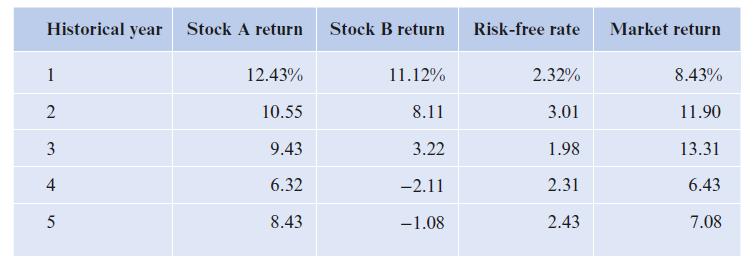
Portfolio beta You want to create a portfolio that is exactly 50% as risky as the market. You want to create this portfolio from three assets: Stock A, Stock B, and a risk-free asset. Historical returns for each are listed below, along with the historical returns from the market.Suppose you have
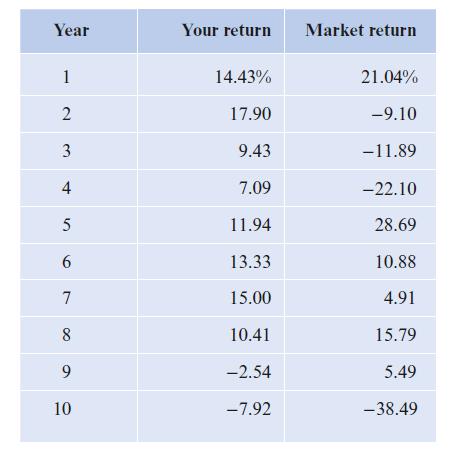
Portfolio returns You have had the following portfolio returns over the past ten years. Also included are the market returns for the same period of time.You may assume that a market return in excess of 15% is a good market. Any negative return is a bad market. Everything in between is a normal
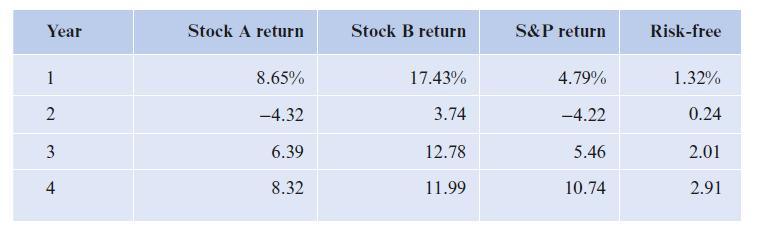
Portfolio beta Consider the following historical returns for Stocks A and B, along with the returns for the market and the risk-free asset at the end of the last four years.You have a total of $80,000 to invest. First, you will put $16,000 in the risk-free asset. You want a portfolio with a beta of
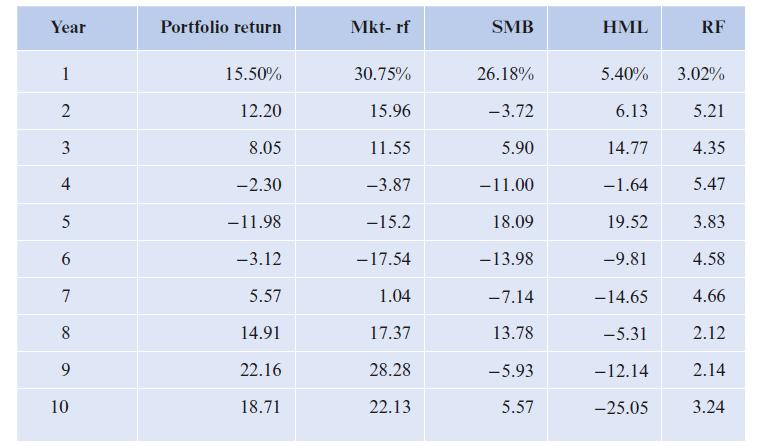
Fama-French Model You have run a portfolio for the past ten years, to the following returns. In addition, you have the Fama-French factors for that period of time.(a) You assume the expected return on the market is the average of the market return (from the table). Same with the risk-free rate.
Cost of capital. What is meant by the cost of capital? How does the concept apply to the financial operations of a firm, and why is it so important?
Required returns. Discuss the relationship between costs of capital and required returns. Who cares about which and how do they relate to each other, both qualitatively and quantitatively?
Equity. Your boss comes to you and says “why don’t we just use all our retained earnings to fund the project. That’s the company’s money, not the shareholders, so it won’t cost us anything.” What is the fallacy of this statement, and how does your boss indicate his misunderstanding of
Growth rates. Why is estimating the growth rate of a firm so important?Discuss from both the shareholder and firm perspectives.
Growth rates. Compare and contrast at least three different types of growth rate estimates.
Cost of equity. What are the strengths and weaknesses of using both the DGM and CAPM methods of estimating the cost of equity?
Debt sources. List at least two sources of debt capital. What are the characteristics of each?
WACC. Describe in a sentence what the WACC tells the firm.
WACC. Discuss both the qualitative and quantitative implications and design of WACC.
Cost of debt. How do taxes influence the cost of debt? Why? Can you create a personal financial analogy to extend the answer?
Capital structure theories. Briefly describe the primary findings of the capital structure theories discussed in the text. How do we incorporate those findings into capital structure policies?
Financial distress. Bob from accounting just barged into your office and screams “We’re about to go bankrupt! Do something!” Why is Bob so upset?Why is financial distress such a concern for a firm? What does Bob want you to “do” about it?
Source of funds. Evaluate the statement “the cost of funds depends upon the use of the funds.” What does that mean? Assume you are talking to your supervisor in relation to a project you are planning that has a very high level of risk.
Showing 2800 - 2900
of 5445
First
22
23
24
25
26
27
28
29
30
31
32
33
34
35
36
Last
Step by Step Answers

 Get 50% OFF
Claim Now
Get 50% OFF
Claim Now