New Semester Started
Get
50% OFF
Study Help!
--h --m --s
Claim Now
Question Answers
Textbooks
Find textbooks, questions and answers
Oops, something went wrong!
Change your search query and then try again
S
Books
FREE
Study Help
Expert Questions
Accounting
General Management
Mathematics
Finance
Organizational Behaviour
Law
Physics
Operating System
Management Leadership
Sociology
Programming
Marketing
Database
Computer Network
Economics
Textbooks Solutions
Accounting
Managerial Accounting
Management Leadership
Cost Accounting
Statistics
Business Law
Corporate Finance
Finance
Economics
Auditing
Tutors
Online Tutors
Find a Tutor
Hire a Tutor
Become a Tutor
AI Tutor
AI Study Planner
NEW
Sell Books
Search
Search
Sign In
Register
study help
business
probability statistics
Probability And Statistics For Engineers And Scientists 9th Edition Ronald E. Walpole, Raymond H. Myers, Sharon L. Myers, Keying E. Ye - Solutions
Problem 3.16 The number of cells (out of 100) that exhibit chromosome aberrations is a random variable X with pf given by P(X = i) = c(i + 1)2 2i+1 , (i = 0, 1, 2, 3, 4, 5). (a) Determine the value of the constantc. (b) Compute the mean and vari[1]ance of X.
Problem 3.15 The number of defects on printed circuit board is a random variable X with pf given by P(X = i) = c/(i + 1), i = 0, 1,... 4. (a) Compute the constantc. (b) Compute the mean and variance of X.
Problem 3.14 With reference to Example (3.24) compute the distribution function of the stock price after four periods.
Problem 3.13 The random variable Y has a geometric distribution P(Y = j) = pqj−1, j = 1,..., ; 0a) = qa. (b) Show that P(Y >a + b|Y >b) = P(Y >a). (c) Show that P(Y is odd )=1/(1 + q). (d) Compute the probability function of (−1)Y . Hint for (c): Use Equation 3.6 with a suitable choice for r.
Problem 3.12 The random variable X has the pf defined by f(x) = 1 x(x + 1) for x = 1, 2, . . . , n, . . . . (a) Show that 1≤x
Problem 3.11 Let X have the pf given by: f(x) = cx for x = 1, 2,...n; f(x)=0 elsewhere. (a) Show that c = 2 n(n+1) . (b) Show that F(x) = x(x+1) n(n+1) for x = 1, 2, . . . n. Hint: 1≤i≤x i = x(x + 1) 2 .
Problem 3.10 Let X have the pf given by: f(x) = cx for x = 1, 2, 3, 4, 5, 6; f(x)=0 elsewhere. Compute: (a) c (b) F(x) for x = 0, 1, 5, 7 (c) P(X is odd ) (d) P(X is even ) (e) P(X < 4) (f) P(2 ≤ X ≤ 4)
Problem 3.9 Suppose a lot of 50 items contains 4 defective ones, and a sample of 5 items is selected at random from the lot. Let X denote the number of defective items in the sample; compute the probability function of X.
Problem 3.8 Suppose a lot of 100 items contains 10 defective ones, and a sample of 5 items is selected at random from the lot. Let X denote the number of defective items in the sample; compute P(X = x) for x = 0, 1, 2, 3, 4, 5. Hint: This problem is similar to the computation of the probability
Problem 3.7 Consider a deck of 5 cards marked 1,2,3,4,5. Two of these cards are picked at random and without replacement; let W = sum of the numbers picked. Compute the pf of W.
Problem 3.6 The number of customers who make a reservation for a limousine service to an airport is a random variable X with probability function given by f(x) = 1 21(5 − |x − 3|), (x = 1, 2, 3, 4, 5, 6). The limousine has a 5 seat capacity and the cost is $10 per passenger. Consequently, the
Problem 3.5 Consider the experiment of selecting one coin at random from an urn con[1]taining 4 pennies, 3 nickels, 2 dimes, and 1 quarter. Let X denote the monetary value of the coin that is selected. Compute the probability function of X.
Problem 3.4 The df of a discrete random variable Y is given in the following table: F(y)=0,y < −1 F(y)=0.2, −1 ≤ y < 0 F(y)=0.5, 0 ≤ y < 1 F(y)=0.8, 1 ≤ y < 3 F(y)=1, y ≥ 3 (a) Draw the graph of F(y). (b) Compute the pf of Y . (c) Compute P(0 ≤ Y ≤ 2).
Problem 3.3 The random variable X has the pf defined by f(x) = c(6 − x) for x = −2, −1, 0, 1, 2; f(x)=0 elsewhere. Compute: (a) c (b) F(x) = P(X ≤ x) for x = −2.5, −0.5, 0, 1.5, 1.7, 3
Problem 3.2 With reference to the random variable defined in Problem 3.1 compute: (a) The probability function of X2 (b) The probability function of 2X (c) The probability function of 2X
Problem 3.1 The random variable X has the pf defined by f(x) = 5 − x2 15 ; x = −2, −1, 0, 1, 2; f(x)=0 elsewhere. Compute: (a) P(X ≤ 0) (b) P(X < 0) (c) P(X ≤ 1) (d) P(X ≤ 1.5) (e) P(|X| ≤ 1) (f) P(|X| < 1)
Problem 2.72 Suppose A, B, C are mutually independent events. Assume that P(B ∩ C) > 0—this hypothesis is just to ensure that the conditional probabilities below are defined. (a) Show that P(A|B ∩ C) = P(A). (b) Show that P(A|B ∪ C) = P(A).
Problem 2.71 Show that if A and B are independent then so are A and B.
Problem 2.70 Show that if P(A)=0 or P(A)=1 then A is independent of every event B.
Problem 2.69 Show that if A is independent of itself then P(A)=0 or P(A)=1.
Problem 2.68 Consider the sample space consisting of the 9 ordered triples: (a,a,a), (b,b. b), (c,c, c), (a,b, c), (a,c, b), (b,a, c), (b,c, a), (c,a, b), (c,b, a) equipped with equally likely probability measure. Let Ak denote the event that the kth coordinate is occupied bya. == Thus, A = {(a,a,
Problem 2.67(a) Show that S and A are independent for any A. (b) Show that the 0 and A are independent for any A.
Problem 2.66 Show that P(AUB|B) = 1.
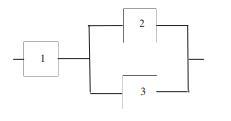
Problem 2.65 Consider the system consisting of three components linked together as indi[1]cated in the figure below. Let Wi be the event that component i is working and assume that P(Wi)=0.9 and the events Wi, i = 1, 2, 3 are independent. Let W denote the event that the system is working. Compute
Problem 2.64 Let Wi, i = 1, 2, 3 denote the event that component i is working. W i de[1]notes the event that the ith component is not working. Assume the events Wi, i = 1, 2, 3 are mutually independent and P(Wi)=0.9, i = 1, 2, 3. Compute the probabilities of the following events: Of the components
Problem 2.63 In the manufacture of a certain article, two types of defects are noted that occur with probabilities 0.02, 0.05, respectively. If these two defects occur independently of one another what is the probability that: (a) an article is free of both kinds of defects? (b) an article has at
Problem 2.62 A fair coin is tossed three times. (a) Let A denote the event that one head appeared in the first two tosses, and let B denote the event that one head occurred in the last two tosses. Are these events independent? (b) Let A denote the event that one head appeared in the first toss, and
Problem 2.61 A fair coin is tossed four times. (a) What is the probability that the number of heads is greater than or equal to three given that one of them is a head? (b) What is the probability that the number of heads is greater than or equal to three given that the first throw is a head?
Problem 2.60(Continuation of previous problem) Consider the following procedure to find and remove all defective transistors: A transistor is randomly selected and tested until all 3 defective transistors are found. What is the probability that the third defective transistor will be found on: (a)
Problem 2.59 A lot consists of 3 defective and 7 good transistors. Two transistors are selected at random. Given that the sample contains a defective transistor, what is the probability that both are defective?
Problem 2.58 In the case (re: State vs. Pedro Soto et al.) the New Jersey Public Defender’s office moved to suppress evidence against 17 black defendants (principally on charges of transporting illegal drugs) on grounds of selective enforcement, i.e., that blacks were more likely to be stopped by
Problem 2.57 Refer to Example 2.32. Suppose the results of the test were negative, i.e., the event T − occurred. Compute the posterior probabilities in this case.
Problem 2.56 An automobile insurance company classifies drivers into 3 classes: Class A (good risks), Class B (medium risks), Class C (poor risks). The percentage of drivers in each class is: Class A 20%; Class B 65%; Class C 15%. The probabilities that a driver in each of these classes will have
Problem 2.55 The CIA and FBI use polygraph machines—more popularly known as “lie detectors”—to screen job applicants and catch lawbreakers. A comprehensive review by a federal panel of distinguished scientists reported that “if polygraphs were administered to a group of 10,000 people that
Problem 2.54 In a bolt factory machines A, B, C manufacture, respectively, 20%,30%,and 50% of the total. Of their output 3%,2%,and 1% are defective. (a) A bolt is selected at random; find the probability that it is defective. (b) A bolt is selected at random and is found to be defective. What is
Problem 2.53 A new metal detector has been invented for detecting weapons in luggage. It is known that 1% of all luggage going through an airport contains a weapon. When a piece of luggage contains a weapon, an alarm (indicating a weapon is present) is activated 95% of the time. However, when the
Problem 2.52 Suppose the prevalence rate for a disease is 1/1,000. A diagnostic test has been developed which, when given to a person who has the disease, yields a positive result 99% of the time; while an individual without the disease shows a positive result only 2% of the time. (a) A person is
Problem 2.51 The student body of a college is composed of 70% men and 30% women. It is known that 40% of the men and 60% of the women are engineering majors. What is the probability that an engineering student selected at random is a man?
Problem 2.50 Three dice are thrown. If all three of them show different numbers, what is the probability that one of them is a six?
Problem 2.49 Two dice are thrown. If both of them show different numbers: (a) what is the probability that their sum is even? (b) what is the probability that one of them is a six?
Problem 2.48 A and B are independent events whose probabilities are given by P(A) = 0.7, P(B) = 0.4. Compute the following probabilities: (a) P(AUB) (b) P(A'B') (c) P(A'U B') (d) P(AB) (e) P(An B') (f) P(A' UB) (g) P(AU B')
Problem 2.47 Suppose A and B are events in a sample space S and P(A) = 0.4, P(B) = 0.3, P(A|B) = 0.3. Compute the following probabilities. (a) P(AB) (b) P(AUB) (c) P(An B') (d) P(BA)
Problem 2.46 A and B are events whose probabilities are given by P(A)=0.7, P(B)= 0.4, P(An B) = 0.2. Compute the following conditional probabilities: (a) P(A|B) (b) P(A'|B') (c) P(B'A') (d) P(A|B) (e) P(A|B') (f) P(BA')
Problem 2.45 Twelve jurors are to be selected from a pool of 30, consisting of 20 men and 10 women. (a) What is the probability that all members of the jury are men? (b) What is the probability all 10 women are on the jury? Section 2.4: Conditional probability, Bayes' theorem, and independence
Problem 2.44 A lot consists of 15 articles of which 8 are free of defects, 4 have minor defects, and 3 have major defects. Two articles are selected at random without replacement. Find the probability that: (a) both have major defects (b) both are good (c) neither is good (d) exactly one is good
Problem 2.43 A poker hand is a set of 5 cards drawn at random from a deck of 52 cards consisting of: (i) 4 suits (hearts, diamonds, spades and clubs) and (ii) each suit consists of 13 cards with face value (also called a denomination) denoted {ace, 2,3,. . . ,10, jack, queen, king}. Find the
Problem 2.42 An urn contains two nickels and three dimes. (a) List all elements of the sample space corresponding to the experiment “two coins are selected at random, and without replacement.” (b) Compute the probability that the value of the coins selected equals $0.10, $0.15, $0.20.
Problem 2.41 Consider a deck of four cards marked 1, 2, 3, 4. (a) List all the elements in the sample space S coming from the experiment “two cards are drawn in succession and without replacement” from the deck. If S is assigned the equally likely probability measure compute the probability
Project: Take 5 class periods to observe the shoe color of individuals in class. Assume the shoe color categories are red, white, black, brown, and other. Complete a frequency table for each color category.1. Estimate and interpret the meaning of the probability distribution.2. What is the
Consider a system of components in which there are 4 independent components, each of which possesses an operational probability of 0.9. The system does have a redundancy built in such that it does not fail if 3 out of the 4 components are operational. What is the probability that the total system
Another type of system that is employed in engineering work is a group of parallel components or a parallel system. In this more conservative approach, the probability that the system operates is larger than the probability that any component operates. The system fails only when all components
The behavior of series of components plays a huge role in scientific and engineering reliability problems. The reliability of the entire system is certainly no better than that of the weakest component in the series. In a series system, the components operate independently of each other. In a
Consider the random variables X and Y that represent the number of vehicles that arrive at two separate street corners during a certain 2-minute period. These street corners are fairly close together so it is important that traffic engineers deal with them jointly if necessary. The joint
Consider the situation of Review Exercise 3.75. But suppose the joint distribution of the two proportions is given by 1 2 12 1 2 X1 | X2 1 2 1. Give the marginal distribution f (x ) of the proportion X and verify that it is a valid density function.2. What is the probability that proportion X is
A chemical system that results from a chemical reaction has two important components among others in a blend. The joint distribution describing the proportions X and X of these two components is given by 1. Give the marginal distribution of X .2. Give the marginal distribution of X .3. What is the
The time Z in minutes between calls to an electrical supply system has the probability density function 1. What is the probability that there are no calls within a 20-minute time interval?2. What is the probability that the first call comes within 10 minutes of opening?
Impurities in a batch of final product of a chemical process often reflect a serious problem. From considerable plant data gathered, it is known that the proportion Y of impurities in a batch has a density function given by 1. Verify that the above is a valid density function.2. A batch is
Passenger congestion is a service problem in airports.Trains are installed within the airport to reduce the congestion.With the use of the train, the time X, in minutes, that it takes to travel from the main terminal to a particular concourse has density function 1. Show that the above is a valid
Pairs of pants are being produced by a particular outlet facility. The pants are checked by a group of 10 workers. The workers inspect pairs of pants taken randomly from the production line. Each inspector is assigned a number from 1 through 10. A buyer selects a pair of pants for purchase. Let the
The life span, in hours, of an electrical component is a random variable with cumulative distribution function 1. Determine its probability density function.2. Determine the probability that the life span of such a component will exceed 70 hours.
Consider the following joint probability density function of the random variables X and Y:1. Find the marginal density functions of X and Y.2. Are X and Y independent?3. Find P(X > 2).
An industrial process manufactures items that can be classified as either defective or not defective. The probability that an item is defective is 0.2. An experiment is conducted in which 6 items are drawn randomly from the process. Let the random variable X be the number of defectives in this
Consider the random variables X and Y with joint density function 1. Find the marginal distributions of X and Y.2. Find P(X > 0.25, Y > 0.5).
Let the number of phone calls received by a switchboard during a 5-minute interval be a random variable X with probability function 1. Determine the probability that X equals 0, 1, 2, 3, 4, 5, and 6.2. Graph the probability mass function for these values of x.3. Determine the cumulative
A service facility operates with two service lines. On a randomly selected day, let X be the proportion of time that the first line is in use whereas Y is the proportion of time that the second line is in use. Suppose that the joint probability density function for (X, Y) is 1. Compute the
Two electronic components of a missile system work in harmony for the success of the total system. Let X and Y denote the life in hours of the two components. The joint density of X and Y is 1. Give the marginal density functions for both random variables.2. What is the probability that the lives
An insurance company offers its policyholders a number of different premium payment options. For a randomly selected policyholder, let X be the number of months between successive payments. The cumulative distribution function of X is 1. What is the probability mass function of X?2. Compute P(4 < X
A tobacco company produces blends of tobacco, with each blend containing various proportions of Turkish, domestic, and other tobaccos. The proportions of Turkish and domestic in a blend are random variables with joint density function (X =Turkish and Y = domestic)1. Find the probability that in a
The joint probability density function of the random variables X, Y, and Z is Find 1. the joint marginal density function of X and Y;2. the marginal density of Z; 3. P
Let X, Y, and Z have the joint probability density function 1. Find k.2. Find .
The joint density function of the random variables X and Y is 1. Show that X and Y are not independent.2. Find P(X > 0.3 | Y = 0.5).
Given the joint density function find P(1 < Y < 3 | X = 1.5).
A coin is tossed twice. Let Z denote the number of heads on the first toss and W, the total number of heads on the 2 tosses. If the coin is unbalanced and a head has a 30% chance of occurring, find 1. the joint probability distribution of W and Z;2. the marginal distribution of W;3. the marginal
Three cards are drawn without replacement from the 12 face cards (jacks, queens, and kings) of an ordinary deck of 52 playing cards. Let X be the number of kings selected and Y the number of jacks. Find 1. the joint probability distribution of X and Y;2. P[(X, Y) ∈ A], where A is the region given
Suppose that X and Y have the following joint probability distribution:1. Find the marginal distribution of X.2. Find the marginal distribution of Y.
Let X denote the number of times a certain numerical control machine will malfunction: 1, 2, or 3 times on any given day. Let Y denote the number of times a technician is called on an emergency call. Their joint probability distribution is given as 1. Evaluate the marginal distribution of X.2.
Referring to Exercise 3.39, find 1. f(y|2) for all values of y;2. P(Y = 0 | X = 2).
The amount of kerosene, in thousands of liters, in a tank at the beginning of any day is a random amount Y from which a random amount X is sold during that day. Suppose that the tank is not resupplied during the day so that x ≤ y, and assume that the joint density function of these variables is
Referring to Exercise 3.38, find 1. the marginal distribution of X;2. the marginal distribution of Y.
Let X denote the diameter of an armored electric cable and Y denote the diameter of the ceramic mold that makes the cable. Both X and Y are scaled so that they range between 0 and 1. Suppose that X and Y have the joint density Find P(X + Y > 1).
Each rear tire on an experimental airplane is supposed to be filled to a pressure of 40 pounds per square inch (psi). Let X denote the actual air pressure for the right tire and Y denote the actual air pressure for the left tire. Suppose that X and Y are random variables with the joint density
Let X denote the reaction time, in seconds, to a certain stimulus and Y denote the temperature (°F) at which a certain reaction starts to take place. Suppose that two random variables X and Y have the joint density Find 1.2. P(X < Y).
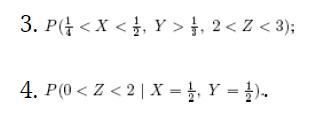
Let X and Y denote the lengths of life, in years, of two components in an electronic system. If the joint density function of these variables is find P(0 < X < 2 | Y = 2).
A candy company distributes boxes of chocolates with a mixture of creams, toffees, and cordials. Suppose that the weight of each box is 1 kilogram, but the individual weights of the creams, toffees, and cordials vary from box to box. For a randomly selected box, let X and Y represent the weights of
A fast-food restaurant operates both a drive-through facility and a walk-in facility. On a randomly selected day, let X and Y, respectively, be the proportions of the time that the drive-through and walk-in facilities are in use, and suppose that the joint density function of these random variables
From a sack of fruit containing 3 oranges, 2 apples, and 3 bananas, a random sample of 4 pieces of fruit is selected. If X is the number of oranges and Y is the number of apples in the sample, find 1. the joint probability distribution of X and Y;2. P[(X, Y) ∈ A], where A is the region that is
Determine the values of c so that the following functions represent joint probability distributions of the random variables X and Y:1. f(x, y) = cxy, for x = 1, 2, 3; y = 1, 2, 3;2. f(x, y) = c|x – y|, for x = –1, 0, 1; y = –3, 3.3.38 If the joint probability distribution of X and Y is given
On a laboratory assignment, if the equipment is working, the density function of the observed outcome, X, is 1. Calculate P(X < 0.5).2. What is the probability that X will exceed 0.4?3. Given that X ≥ 0.5, what is the probability that X will be less than 0.7?3.4 Joint Probability Distributions
Suppose it is known from large amounts of historical data that X, the number of cars that arrive at a specific intersection during a 20-second time period, is characterized by the following discrete probability function:1. Find the probability that in a specific 20-second time period, more than 8
Magnetron tubes are produced on an automated assembly line. A sampling plan is used periodically to assess quality of the lengths of the tubes. This measurement is subject to uncertainty. It is thought that the probability that a random tube meets length specification is 0.99. A sampling plan is
Suppose a certain type of small data processing firm is so specialized that some have difficulty making a profit in their first year of operation. The probability density function that characterizes the proportion Y that make a profit is given by 1. What is the value of k that renders the above a
The proportion of the budget for a certain type of industrial company that is allotted to environmental and pollution control is coming under scrutiny. A data collection project determines that the distribution of these proportions is given by 1. Verify that the above is a valid density function.2.
Based on extensive testing, it is determined by the manufacturer of a washing machine that the time Y (in years)before a major repair is required is characterized by the probability density function 1. Critics would certainly consider the product a bargain if it is unlikely to require a major
Measurements of scientific systems are always subject to variation, some more than others. There are many structures for measurement error, and statisticians spend a great deal of time modeling these errors. Suppose the measurement error X of a certain physical quantity is decided by the density
An important factor in solid missile fuel is the particle size distribution. Significant problems occur if the particle sizes are too large. From production data in the past, it has been determined that the particle size (in micrometers) distribution is characterized by 1. Verify that this is a
A cereal manufacturer is aware that the weight of the product in the box varies slightly from box to box. In fact, considerable historical data have allowed the determination of the density function that describes the probability structure for the weight (in ounces). Letting X be the random
The time to failure in hours of an important piece of electronic equipment used in a manufactured DVD player has the density function 1. Find F(x).2. Determine the probability that the component (and thus the DVD player) lasts more than 1000 hours before the component needs to be replaced.3.
From a box containing 3 black balls and 1 green balls, 3 balls are drawn in succession, each ball being replaced in the box before the next draw is made. Find the probability distribution for the number of green balls.
Find the probability distribution for the number of comic books when 4 books are selected at random from a collection consisting of 5 comic books, 2 art books, and 3 math books.Express your results by means of a formula.
Find the cumulative distribution function of the random variable W in Exercise 3.8. Using F(w), find 1. P(W > 0);2. P(–1 ≤ W < 3).
Showing 6900 - 7000
of 8686
First
63
64
65
66
67
68
69
70
71
72
73
74
75
76
77
Last
Step by Step Answers

 Get 50% OFF
Study Help!
Claim Now
Get 50% OFF
Study Help!
Claim Now