New Semester
Started
Get
50% OFF
Study Help!
--h --m --s
Claim Now
Question Answers
Textbooks
Find textbooks, questions and answers
Oops, something went wrong!
Change your search query and then try again
S
Books
FREE
Study Help
Expert Questions
Accounting
General Management
Mathematics
Finance
Organizational Behaviour
Law
Physics
Operating System
Management Leadership
Sociology
Programming
Marketing
Database
Computer Network
Economics
Textbooks Solutions
Accounting
Managerial Accounting
Management Leadership
Cost Accounting
Statistics
Business Law
Corporate Finance
Finance
Economics
Auditing
Tutors
Online Tutors
Find a Tutor
Hire a Tutor
Become a Tutor
AI Tutor
AI Study Planner
NEW
Sell Books
Search
Search
Sign In
Register
study help
business
production and operations management
Production And Operations Management 3rd Edition Panneerselvam - Solutions
9. Write down the different functional areas of industrial engineering.
10. What is the future scope of industrial engineering? Discuss the role and responsibilities of an industrial engineer.
11. A work sampling study is to be conducted to determine the idleness of the milling machines in the mill- ing section of the large engineering world. In a preliminary study, 100 observations were made and 25 observations showed the machine to be idle. What will be the number of random
12. A stop watch time study was made of an assembly task that involved four elements: (a) Calculate the normal task time. (b) Calculate the standard time. (c) What should be done with cycle2, element 3 in the study?Allowance are 15 percent of the normal time. Cycle Element 1 2 3 4 5 Rating 1 0.04
13. A work sampling study has yielded the following results. What is the standard time for the task? Units produced 320 Idle time 15% Performing rating 120% Allowances time 12%
14. Sample observations of an industrial job were obtained over a 40-hour week. During the week, the worker produced a total of 280 assemblies and was rated at 135% performance. Further, the sample showed that the worker was not working 20% of time. The allowances for this type of work total 10%.
1. A farm is engaged in breeding pigs. The pigs are fed on various products grown on the farm. In view of the need to ensure certain nutrient constituents, it is necessary to buy two products, say A and B, in addition. The contents of various products, per unit, in nutrient constituents are given
2. Given the following pay-off matrix, find out best strategy for each player. Player A Strategies == III 1311 -2 Player B || -4 3 + -7 7 ENTT III 2
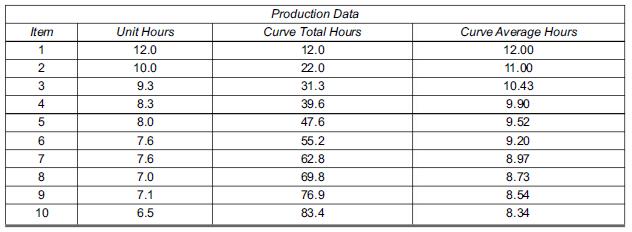
1. In the case of learning curve from single-unit data, plot the following three learning curves: Item Unit Hours Curve Total Hours Production Data Curve Average Hours 1 12.0 12.0 12.00 10 23456789 10.0 22.0 11.00 9.3 31.3 10.43 8.3 39.6 9.90 8.0 47.6 9.52 7.6 55.2 9.20 7.6 62.8 8.97 7.0 69.8 8.73
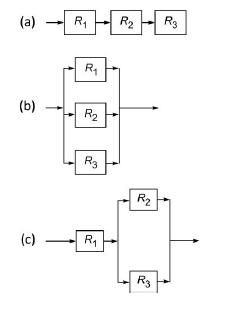
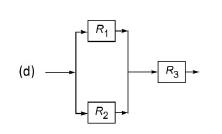
2. The pictorial form of series system of reliability is: (a) R R2 R3 (b) R R R3 R (c) - R R3
4. The formula for system availability is: 2 MTBF 2 MTTR (a) SA= (b) SA = MTBF + MTTR MTBF + MTTR (c) SA= MTTF MTTF + MTTR MTTR (d) SA = MTBF + MTTR
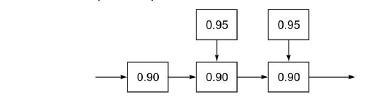
10. Determine the redundancy of the system.(a) 0.991 (b) 0.691 (c) 0.781 (d) 0.891. 0.95 0.95 0.90 0.90 0.90
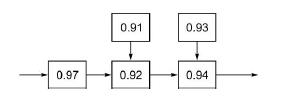
2. Determine the reliability of the system shown in the figure. 0.91 0.93 0.97 0.92 0.94
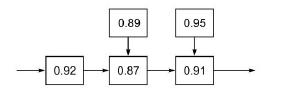
3. Determine the reliability of the system shown in the figure below. 0.89 0.95 0.92 0.87 0.91
1.1 Describe commercial and noncommercial foodservice segments.
1.2 Discuss the pros and cons of self-operated and contracted foodservices.
1.3 Apply systems theory to a foodservice organization.
1.4 Contrast types of foodservice operations.
1.5 Discuss foodservice trends.
1. Compare and contrast onsite foodservices that are commercial in nature from those that are noncommercial.
2. List two restaurants you have been to. Which segment of the restaurant industry does each one fall into? Was each restaurant independently owned or part of a chain?
3. How would a job in a commercial foodservice be different from working in an onsite foodservice, such as working for a hospital or school? Consider hours, benefits, responsibilities, menu, customers, and so on.
4. If you were to get a job in an onsite foodservice, which type would interest you and why? Would you rather work for a foodservice contract company or work directly for the foodservice? Explain why you choose your answer.
5. If you worked in a university foodservice, belonging to the National Association of College and University Food Services could bring you what types of benefits?
6. Find the name of a skilled nursing facility or continuing care retirement community in your area.
7. How is school (K–12) foodservice different from a restaurant?
8. Why do some onsite foodservices, such as a university foodservice, use a foodservice contract company such as Compass Group?
9. In one or two paragraphs, describe the foodservice systems model.
10. Make a table of the four types of foodservice operations including a basic description and advantages/disadvantages for each type.
11. Use the following two publications online to identify and briefly describe three trends in foodservice: FoodService Director (covers noncommercial) and Nation’s Restaurant News (covers restaurant industry). Include only one menu-related trend.
2.1 Discuss causes and prevention of foodborne illness.
2.2 Describe safe personal hygiene practices.
2.3 Apply food safety principles.
2.4 Manage food safety.
2.5 Explain how to have a successful sanitation inspection.
2.6 Maintain an accident-free workplace.
1. Describe which foods are most likely to cause foodborne illness and the different ways they can become contaminated.
2. What is the temperature danger zone? What are four ways to prevent foodborne illness?
3. Compare bacteria to viruses and seafood toxins in terms of how they cause foodborne illness.
4. Describe a situation when it would be best to use an instant read thermometer, a thermocouple thermometer with an immersion probe, an infrared thermometer, and a disposable temperature indicator.
5. Describe how FIFO works.
6. Describe three ways to defrost frozen foods safely and when each method is best used.
7. Describe how to cool hot foods and then reheat them.
8. Why are raw meat, poultry, and fish stored on the lowest rack in the refrigerator?
9. Why isn’t the steam table used to heat up cold foods? What is the required minimum temperature for hot foods that are being held hot?
10. What is the difference between a clean plate and a sanitized plate?
11. Discuss how pots and pans are sanitized in a three-compartment sink.
12. Find a recipe and determine where there are critical control points(CCP). Briefly describe each CCP you found.
13. Which are better to use to avoid cuts—a sharp or dull knife?Explain your answer.
14. How do you avoid steam burns and grease fires?
15. How do you lift properly to avoid back injury?
16. How do employees use a material safety data sheet?
17. Name the federal agency charged with keeping employees safe at work.
18. How does a manager ensure a safe workplace and safe food to eat?
List and explain different ERP products.AppendixLO1
List and explain the steps of ERP implementation.AppendixLO1
What are the components of ERP cost? Explain them AppendixLO1
What are the modules of ERP? Explain them.AppendixLO1
Explain the seller-buyer concept of ERP system.AppendixLO1
Discuss the benefits of ERP.AppendixLO1
What is ERP?AppendixLO1
Illustrate the application of QFD with a suitable example.AppendixLO1
Give the integrated view of House of Quality and explain its components.AppendixLO1
List and explain the phases of QFD.AppendixLO1
What is QFD?AppendixLO1
List and explain the components of Lean Manufacturing.AppendixLO1
Discuss the steps of Lean Manufacturing.AppendixLO1
What are the objectives of Lean Manufacturing?AppendixLO1
What is Lean Manufacturing?AppendixLO1
Give a framework of integrated business logistics system and explain its components.AppendixLO1
Give the framework of supply chain network and explain its components.AppendixLO1
What is Supply Chain Management?AppendixLO1
List and explain the steps of Business Process Reengineering.AppendixLO1
Define Business Process Reengineering.AppendixLO1
Discuss the benefits of Kaizen.AppendixLO1
What is Quick and Easy Kaizen system? Explain its steps.AppendixLO1
Discuss the guidelines for Kaizen team.AppendixLO1
Explain the steps of implementing Kaizen Blitz.AppendixLO1
Give the classification of Kaizen and explain different types of Kaizen.AppendixLO1
Explain Kaizen's 5 S framework for good housekeeping.AppendixLO1
What is Kaizen? Also, list and explain its key elements.AppendixLO1
Discuss the benefits and limitations of Poka Yoke.AppendixLO1
Discuss the steps of Poka Yoke.AppendixLO1
Give any 5 examples of Poka Yoke devices.AppendixLO1
Discuss the places where Poka Yoke works well.AppendixLO1
What are the types of Poka Yoke? Explain them.AppendixLO1
Discuss the characteristics of Poka Yoke.AppendixLO1
What are the bases on which Poka Yoke devices are designed?AppendixLO1
What is Poka Yoke?AppendixLO1
Explain the steps in obtaining ISO 9000 registration.AppendixLO1
Discuss the benefits of ISO 9000 series.AppendixLO1
Briefly explain the objectives/tasks of each of the five ISO 9000 standards.AppendixLO1
Explain the 9 fundamental factors affecting quality.AppendixLO1
What are the benefits of TQM?AppendixLO1
Briefly explain the scope of TQM.AppendixLO1
Discuss the aims of FMS.AppendixLO1
What are the equipments used in FMS?AppendixLO1
List the elements of the operational part of FMS.AppendixLO1
Briefly explain the steps which are followed in a Kanban system.AppendixLO1
Highlight the principle involved in PUSH/PULL system. Also, explain the application areas of each system.AppendixLO1
Showing 3400 - 3500
of 5227
First
28
29
30
31
32
33
34
35
36
37
38
39
40
41
42
Last
Step by Step Answers

 Get 50% OFF
Claim Now
Get 50% OFF
Claim Now