New Semester
Started
Get
50% OFF
Study Help!
--h --m --s
Claim Now
Question Answers
Textbooks
Find textbooks, questions and answers
Oops, something went wrong!
Change your search query and then try again
S
Books
FREE
Study Help
Expert Questions
Accounting
General Management
Mathematics
Finance
Organizational Behaviour
Law
Physics
Operating System
Management Leadership
Sociology
Programming
Marketing
Database
Computer Network
Economics
Textbooks Solutions
Accounting
Managerial Accounting
Management Leadership
Cost Accounting
Statistics
Business Law
Corporate Finance
Finance
Economics
Auditing
Tutors
Online Tutors
Find a Tutor
Hire a Tutor
Become a Tutor
AI Tutor
AI Study Planner
NEW
Sell Books
Search
Search
Sign In
Register
study help
business
production and operations management
Production And Operations Management 1st Edition McGraw-Hill Education India - Solutions
4. Which of the following are not considered in calculating inventory costs? (a) Holding costs (c) Ordering costs (b) Acquisition costs (d) Stock-out costs
3. The terms 'obsolescence' 'pilferage' and 'damage' come under the costs of: (a) Ordering (c) Holding (b) Set-up (d) None of the above
2. The inventory cost corresponding to ordering too much that cost is called (a) Carrying cost (c) Stocking cost (b) Ordering cost (d) Capacity cost
1. The main objective of inventory is: (a) Not to allow the production schedule flexibility (b) To take several disadvantages of economic purchase order size (c) To meet variations in demand (d) To maintain the dependence of operations
3. Ramesh Bhargav is considering several alternative strategies. The first would be to sell all of the com- ponents separately. The second strategy would be to modify the control box to allow other videotape systems to be used, as well as the video tape systems supplied by Ramesh. In general, what
2. If you were Ramesh Bhargav, which company would you choose to supply the videotape systems for your professional video system?
1. What are the reorder points for Kony and Toshiki?
As administrator, do you suggest any changes in the operational policy of the clinic?The best way of the most advancement in scheduling is either removing waiting or making waiting Hi-tech and entertaining. Adhering to time schedule is the key to create a win-win situation for both service pro-
List out the operating features of time management of the clinic.The best way of the most advancement in scheduling is either removing waiting or making waiting Hi-tech and entertaining. Adhering to time schedule is the key to create a win-win situation for both service pro- vider and service
If you are competitor of this clinic, how differently will you manage your clinic?The best way of the most advancement in scheduling is either removing waiting or making waiting Hi-tech and entertaining. Adhering to time schedule is the key to create a win-win situation for both service pro- vider
1. Operations scheduling is concerned with establishing _________ within a firm. (a) Timing (c) Both (a) & (b) (b) Use of resources (d) None of the above
3. The principle(s) of scheduling is/are: (a) Schedule jobs in continuation (b) After starting a job, finish it (c) Real time feedback, real time adjustments (d) All of the above
2. The main objective(s) of production scheduling is/are: (a) Consideration of due dates and avoiding delayed completion of jobs (b) Taking care of throughput times; to maximize the time a job spends in the system, from the open- ing of a shop order till it closed (c) Consideration and utilization
4. A scheduling that specifies the sequence in which individual jobs are to be processed is: (a) Order acceptance (b) Shop loading and job sequencing (c) Capacity planning (d) Due date specification
5. In the forward scheduling approach, which statement is true: (a) The scheduler begins with a planned receipt date and moves backward in time (b) Start with due date and work backward through operations reviewing lead times (c) Less WIP but must have accurate lead time (d) Jobs are given earliest
6. In the case of finite loading, which statement is true: (a) Work centre capacity is used to schedule orders(b) Assigns job to work centres without regard to capacity (c) Unless excessive capacity exists, long queues occur (d) Priority rules are appropriately used
7. The rule (s) of sequencing is/are: (a) First come/first served (b) Shortest processing time (c) Earliest due date (d) All of the above
8. The major limitation of EOQ is. (a) EOQ is based on annual "ballpark" estimates of demand and production rates, instead of most current estimates (b) It is a comprehensive scheduling technique (c) Multiple products usually doesn't share the same scarce production capacity (d) All of the above
9. In the basic EOQ model, if the cost of placing an order doubles and all other values remain constant, the EOQ will (a) Increase by about 41% (b) Increase by 100% (c) Increase by 200% (d) Either increase or decrease
10. Which of the following statements regarding the production order Quantity Model is true? (a) It applies only to items produced in the firm's own production departments (b) It relaxes the assumption that all the order quantity is received at one time (c) It relaxes the assumption that the demand
11. In which type the service is scheduled as per the actual demand on the service facility? (a) Peak demand strategy (b) Variable price strategy (c) Hire and fire strategy (d) Flexible capacity strategy
12. In which type of time fence in master production schedule, the following statement is true: "The man- power, machinery and jobs within the given capacity are allotted to various orders to produce the end products." (a) Frozen time fence (c) Full fence (b) Firm fence (d) Open fence
13. Select True or False (a) The main objective of MPS is to schedule and deliver the finished products as per the require- ments of the customers on the committed time. (b) The production and operations schedule cannot be derived from the production plan. (c) Loading is concerned with assigning
1. What is scheduling? Why is it required? What factors should be considered in scheduling?
2. What is Gantt chart? Discuss the applications of Gantt Chart in scheduling and workplace planning.
3. What is operations scheduling? What is the interface between production planning and operations scheduling?
4. What is process-focused manufacturing scheduling? Explain in detail.
5. Explain the different concepts and theories in product focused manufacturing scheduling.
6. What is loading? What are its different types?
7. Explain important considerations for scheduling decisions.
8. Describe the run out method for scheduling.
9. Explain Johnson rule for scheduling.
10. Describe the various types of strategies for service scheduling operations.
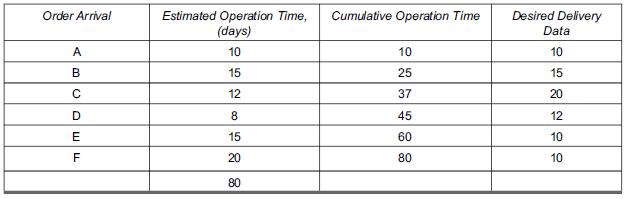
1. The FCFS rule places jobs or orders in time as they are received and selects the next order to be pro- cessed from the front of the line. The following table lists six jobs in order of their receipt along with other pertinent data. Using the selected criteria, we can evaluate the FCFS
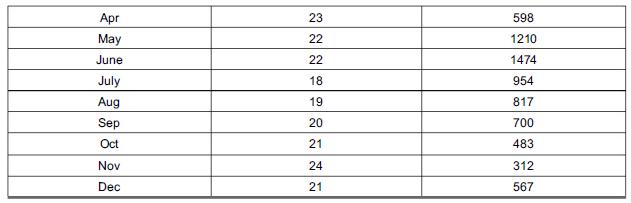
2. A company has forecasted the following monthly requirements of an item, influenced by seasonal fac- tors in unit. The likely production days/months are also given as below:(a) Prepare a chart showing the daily demand requirements. (b) Plot the demand as a histogram. (c) Determine the production
3. Mohan Bakery has orders for five specialty jobs (A, B, C, D and E) that must be processed sequentially through two workcentres (baking and decoration). The amount of time (in hours) required for the jobs is shown below.Determine the schedule sequence that minimizes the total elapsed time for the
4. In the same Mohan Bakery, as above, there is another order for five speciality jobs (A, B, C, D, E) that must be processed sequentially through three workcentres (preparation, baking and decoration). The amount of time (in hours) required for the job is shown below: Time Require (Hrs) for Jobs
9. "Dispatching is the real starting and implementation point of PPC." Explain the statement.
8. "PPC is a non-tangible function and is very difficult to measure its efficiency." Justify the statement.
7. Discuss the role of production control system in enhancing the efficiency of production function.
6. Differentiate between production planning and production control.
5. What do you mean by production control? Discuss its objectives.
4. Discuss the various factors which influence production planning.
3. "Effective production planning and control guarantees better utilization of resources." Comment on the statement with justification.
2. What is the major role played by production planning and control in manufacturing unit?
1. Explain the concept of production planning and control. Discuss its main functions.
13. Select True or False: (a) Production planning techniques are used to maximize production and profitability. (b) The main objective of production planning is to achieve optimum production with minimum ef- ficiency and maximum wastage. (c) Production control is intended to achieve production
12. The performance of a facility is measured by which standard(s)? (a) The average time taken by each job (b) The total processing time (c) The average waiting time of each job (d) All of the above
11. The main advantage of PPC in mass production is: (a) Training cost is comparatively high(b) Production time is less in assembly line productions (c) Assembly lines are rigid inflexible set-ups (d) The slowest machine, the production speed determines
10. The main advantage of PPC in batch production is: (a) Less investment is required in machines (b) More skilled workers are required (c) Material handling is costlier because of the longer flow (d) The maximum number of machines is required because of utilization in multiple lines for the same
9. Which document(s) is/are required in PPC functions? (a) Sales order (c) Route sheet with process planning (b) Order with job card (d) All of the above
8. The statement "it is concerned with the real implementation of the plan" represents which stage in production planning and control function: (a) Pre-planning stage (c) Action stage (b) Planning stage (d) Monitoring stage
7. _______ is concerned with establishing path and sequence of the operations. (a) Estimating (c) Routing (b) Loading (d) Sequencing
6. ___________ is formulated depending on the type of manufacturing process involved. (a) Master schedule (c) Scheduling of job order manufacturing (b) Manufacturing schedule (d) Production schedule
5. Which one represents the production control function? (a) Estimating (c) Dispatching (b) Routing (d) Scheduling
4. The statement "as production planning and control system coordinates all the involved departments", represent (a) Improved plant morale (c) More effective use of equipment (b) Better control of inventory (d) Good public image
3. The importance of production planning and control system is: (a) Increased idle time (c) Higher capital requirement (b) Fewer rush order (d) All of the above
2. Which factor(s) influence(s) the production planning which varies from one organization to another? (a) Nature of product (c) Nature of production process (b) Available technology to produce that product (d) All of the above
1. In the levels of production planning, the planning in terms of building, machines and equipment re- quired for manufacturing comes in _______ range planning. (a) Short (c) Long (b) Medium (d) Operational
2. What more benefits can the company derive in the given problem areas?India Food and Agro Ltd. is a major supplier to its retail and foodservice customers. It has an erroneous pro- duction and distribution situation with many challenges. As a vertically integrated producer and distributor with
1. If you are the consultant, can you suggest any other solution besides those suggested by the consulting company ABC Limited?India Food and Agro Ltd. is a major supplier to its retail and foodservice customers. It has an erroneous pro- duction and distribution situation with many challenges. As a
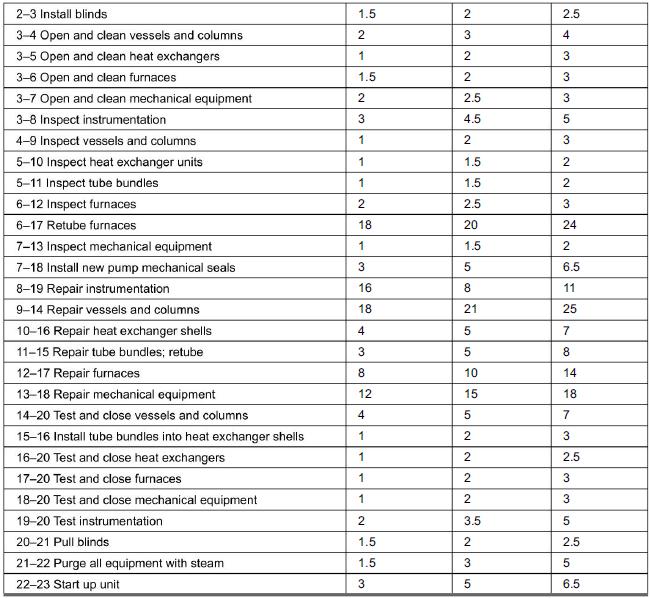
9. The Hindustan Oil Company contains several operating units that comprise its Moradabad and Karnal manufacturing complexes. These units process the crude oil that is pumped through, and transform it into a multitude of hydrocarbon products. The units run 24 hours a day, seven days a week and must
1. What is the competitive environment facing EDC?After some time, Mr. Rita came to know about a new company dealing in mountain bikes with unique fea- tures. Mountain bikes with front suspension were the latest trend. But such bikes were expensive. EDC, too, had an entry in this product category,
2. What are EDC's strengths in manufacturing?After some time, Mr. Rita came to know about a new company dealing in mountain bikes with unique fea- tures. Mountain bikes with front suspension were the latest trend. But such bikes were expensive. EDC, too, had an entry in this product category,
3. Should EDC establish a manufacturing division in Asia outside India?After some time, Mr. Rita came to know about a new company dealing in mountain bikes with unique fea- tures. Mountain bikes with front suspension were the latest trend. But such bikes were expensive. EDC, too, had an entry in
4. What plan of action would you recommend to Ms. Rita?After some time, Mr. Rita came to know about a new company dealing in mountain bikes with unique fea- tures. Mountain bikes with front suspension were the latest trend. But such bikes were expensive. EDC, too, had an entry in this product
1. The major factor(s) which influence(s) the facility location is/are: (a) Proximity to customers (c) Quality of labour (b) Business climate (d) All of the above
2. Which one is the evaluation technique of various locations? (a) Linear programming (c) Break-even analysis (b) Analytical hierarchy process (d) Centre of gravity method
3. In location planning, cost and availability of utilities, environmental regulations and taxes are: (a) Global factors (b) Regional/community factors (c) Country factors (d) Site-related factors
4. The centre of gravity method does not take into consideration: (a) The value of the goods shipped (b) The volume of the goods shipped to the market (c) The location of markets (d) The combination of volume and distance
5. Which of the following is most likely to affect the location decision of a service firm rather than a manu- facturing firm? (a) Labour costs (c) Energy and utility costs (b) Parking and access (d) Cost of shipping finished goods
6. Geographic information system can assist the location decision by: (a) Giving good Internet placement for virtual storefronts (b) Automatic centre of gravity problems (c) Computerizing factor rating analysis (d) Combining geography with demographic analysis
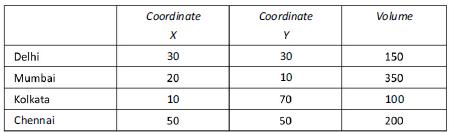
7. ABC limited is preparing to build one processing centre to serve its four sources of seasonings. The four source locations are at coordinates shown below. Also, the volume from each source is provided. What is the centre of gravity? Coordinate Coordinate Volume X Y Delhi 30 30 150 Mumbai 20 10
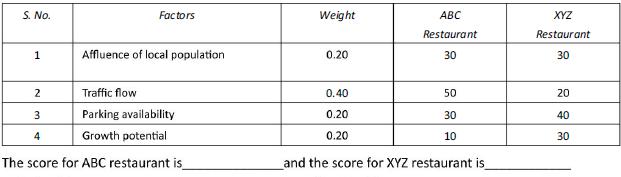
8. A South-Indian restaurant is considering opening a new facility in a specific city. The table below shows its ratings of four factors at each of two potential sites.(a) 34; 28 (b) 18; 120 (c) 120; 120 (d) 22; 24 S. No. Factors Weight ABC XYZ Restaurant Restaurant 1 Affluence of local population
9. A location decision for an appliance manufacturer would tend to have a (an): (a) Labour focus (c) Environmental focus (b) Cost focus (d) Revenue focus
11. Tangible costs include which of the following? (a) Zoning regulations (c) Availability of public transportation (b) Taxes (d) Quality of education
10. When making a location decision at the country level, which of these would be considered? (a) Zoning restrictions (c) Corporate desires (b) Land/construction (d) Location of market
12. Evaluation of location alternatives by comparing their composite (weighted-average) scores involves: (a) Centre of gravity method (b) Analytical hierarchy process (c) Factor-rating systems (d) Linear programming
13. Select True or False. (a) The right location is an essential requirement for the success of any business. (b) According to Alfred Weber, the primary factors are easy communication, cheap bank credits and insurance. (c) Agglomeration is the concept of clustering where a particular type of
1. What do you mean by facility location? Discuss the strategic role of facility location.
2. Explain the various methods to evaluate the location decision methods.
3. Define the location selection techniques.
4. What factors will you keep in mind while selecting the location?
5. Give in brief the various location evaluation retail considerations.
6. What are various company requirements in developing the location strategy?
7. Discuss at least ten important factors to locate a steel plant.
1. Using the data of the table, calculate the loss for Bright Petroleum stations during the last two years using regression analysis.Mr. Ramesh Gupta, a successful textbook author and Management professor, retired from his job in 1983 when he was 50 years old. During the job, he saved a very good
2. Was it worth to depend on costly approach (approx. Rs. 25,000) to perform the marketing research?Mr. Ramesh Gupta, a successful textbook author and Management professor, retired from his job in 1983 when he was 50 years old. During the job, he saved a very good amount. After seven years, he
3. Estimate the total loss in gross sales for Ramesh's Bright Petroleum stations over the two-year period. How accurate can the results claim to be?Mr. Ramesh Gupta, a successful textbook author and Management professor, retired from his job in 1983 when he was 50 years old. During the job, he
4. What other factors might be introduced into the lawsuit?Mr. Ramesh Gupta, a successful textbook author and Management professor, retired from his job in 1983 when he was 50 years old. During the job, he saved a very good amount. After seven years, he visited the Gulf and came across a very
1. Forecasts: (a) Are more accurate for individual items than for groups of items (b) Become more accurate with longer time horizons (c) Are rarely perfect (d) All of the above
2. Forecasts are usually classified by time horizon into three categories: (a) Departmental, organizational and industrial (b) Short-range, medium-range and long-range (c) Strategic, tactical and operational (d) Finance, marketing and operations
3. The three major types of forecasts used by business organizations are: (a) Economic, technological and demand (b) Strategic, tactical and operational (c) Causal, time series and seasonal (d) Exponential smoothening, delphi and regression analysis
4. The two general approaches to forecasting are: (a) Historical and associative (b) Mathematical and statistical (c) Judgemental and qualitative (d) Qualitative and quantitative
5. The medium-term objectives of demand forecasting are: (a) Strategic planning, product planning and capacity planning (b) Production and layout planning, aggregate planning and sales and marketing plans (c) Purchase planning, inventory plan and job scheduling (d) All of the above
6. Which of the following is not a type of qualitative forecasting? (a) Scenario writing (c) Weighted moving average method (b) Intuitive approaches (d) Delphi method
7. The forecasting model that pools the opinions of a group of experts or managers is known as the: (a) Intuitive approaches model (b) Expert judgment model (c) Scenario writing model (d) Delphi method
8. Which of the following statements about time series forecasting is true: (a) It makes extensive use of the data collected in the qualitative approach (b) It is based on the assumption that future demand will be the same as past demand (c) Because it accounts for trends, cycles and seasonal
9. In item series method of forecasting, which of the following cannot be predicted: (a) Technological trends (c) Random fluctuations (b) Large increases in demand (d) Seasonal fluctuations
10. The primary purpose of the mean absolute deviation in demand forecasting is to: (a) Seasonally adjust the forecast (c) Eliminate forecast errors (b) Measure the forecast accuracy (d) Estimate the trend line
Showing 3900 - 4000
of 5227
First
33
34
35
36
37
38
39
40
41
42
43
44
45
46
47
Last
Step by Step Answers

 Get 50% OFF
Claim Now
Get 50% OFF
Claim Now