New Semester
Started
Get
50% OFF
Study Help!
--h --m --s
Claim Now
Question Answers
Textbooks
Find textbooks, questions and answers
Oops, something went wrong!
Change your search query and then try again
S
Books
FREE
Study Help
Expert Questions
Accounting
General Management
Mathematics
Finance
Organizational Behaviour
Law
Physics
Operating System
Management Leadership
Sociology
Programming
Marketing
Database
Computer Network
Economics
Textbooks Solutions
Accounting
Managerial Accounting
Management Leadership
Cost Accounting
Statistics
Business Law
Corporate Finance
Finance
Economics
Auditing
Tutors
Online Tutors
Find a Tutor
Hire a Tutor
Become a Tutor
AI Tutor
AI Study Planner
NEW
Sell Books
Search
Search
Sign In
Register
study help
business
public accounting
Mastering Managerial Accounting Key Concepts Through Problem Sets 1st Edition Christine Denison - Solutions
8. Overhead is applied to production at a rate of 80% of direct labor costs. Half of overhead is variable and half fixed. Direct labor costs were $200,000 to produce 10,000 units.
7. Variable manufacturing overhead is applied at a rate of $5 per direct labor hour, and fixed manufacturing overhead is applied at a rate of $8 per direct labor hour. The firm actually used 14,000 direct labor hours to manufacture 1,000 units.
6. Direct labor costs of $600,000 were accrued this period for 80,000 hours used to manufacture 10,000 units.
5. The firm made 27,000 units, and paid direct labor $1,050,000 to work 108,000 hours. Direct labor is paid in cash.
4. The firm manufactured 300 units using 6,000 pounds of direct materials (cost = $15,000) and various indirect materials costing $2,000.
3. Forty thousand square feet of direct materials costing $85,000 and indirect materials costing$10,000 were put into production to make 8,000 units.
2. 20,000 gallons of direct materials costing $250,000 were purchased with cash, as well as indirect materials costing $100,000.
1. 110,000 pounds of direct materials costing $500,000 were purchased on account, as well as indirect materials costing $50,000.
Your firm has engaged in the following transactions. Make the appropriate journal entry, then post the entry to the corresponding t-accounts. Beginning balances are already entered in the t-accounts.Purchased materials on account for $300,000, including 14,200 pounds of direct materials and $16,000
Muldrow Corporation uses job costing, and applies manufacturing overhead costs to jobs at a rate of $15 per direct labor hour. Beginning inventories were $100,000 in raw materials, $250,000 in work-in-process, and $400,000 in finished goods. This period, the following transactions occurred:yyDirect
19. Juniper Corporation uses an activity-based costing system to account for its four types of products.The costing system divides manufacturing overhead into five activity pools, each with its own cost allocation base. The budget for fourth quarter was as follows:During the quarter, Juniper filled
17. Gersey, Inc., which allocates all manufacturing overhead on the basis of direct labor cost, budgeted the following for the first quarter:Job 418 used $20,000 in direct materials and $60,000 in direct labor. Of the 389 units manufactured, 39 units were spoiled as a normal part of the production
14. Massile Corp. uses a job costing system that assigns five costs to each job: direct labor, direct materials, overhead A (allocated based on direct labor hours), overhead B (allocated based on machine hours), and overhead C (allocated based on number of batches). This period, the following
3. Toroso Manufacturing uses a job costing system with manufacturing overhead calculated and allocated separately within each department. The Mixing department allocates overhead on the basis of direct labor hours. The Baking department allocates overhead on the basis of oven hours.The Packaging
2. Abka Company manufactures two basic kinds of products using an activity-based job costing system with manufacturing overhead divided into five activity pools as follows:Cost allocation base usage is as follows:Calculate the predetermined overhead rate for each pool of overhead. Stamping Budgeted
20. Mitsi Corporation has three production departments, which reported the followingFind the value of units completed and transferred out, ending work-in-process inventory, and the loss caused by abnormal spoilage for the each department in April, May, and June, first using the weighted average
19. Albutte, Inc., which uses the weighted average method of process costing, has two departments:Production and Finishing. In the Finishing department, direct materials are added at the beginning of the process, and conversion costs are incurred evenly throughout the process.The Finishing
18. Assuming that Mercury Manufacturing uses the FIFO method of process costing, find the value of units completed and transferred out, ending work-in-process inventory, and the loss caused by abnormal spoilage for the Finishing department.
17. The Finishing department at Mercury Manufacturing applies a high polish to all units and packages them. Thus, the only material added is the packaging, which is added at the very end of the process. Conversion costs are incurred evenly throughout the process. In August, the Finishing department
16. Assuming that Mercury Manufacturing uses the FIFO method of process costing, find the value of units completed and transferred out, ending work-in-process inventory, and the loss caused by abnormal spoilage for the Assembly department.
15. In July, the Assembly department of Mercury Manufacturing began the month with 1,200 units in work-in-process inventory (75% complete). During the month, 14,000 units were transferred in, with costs of $114,000 attached to them from the Molding department. During the month, 15,000 units were
14. Assuming that Mercury Manufacturing uses the FIFO method of process costing, find the value of units completed and transferred out, ending work-in-process inventory, and the loss caused by abnormal spoilage for the Molding department.
13. Mercury Manufacturing has three production departments that work on units in the following order: Molding, Assembly, and then Finishing. The Molding department began the month of June with 3,000 units in work-in-process inventory (20% complete), and began work on an additional 15,000 units
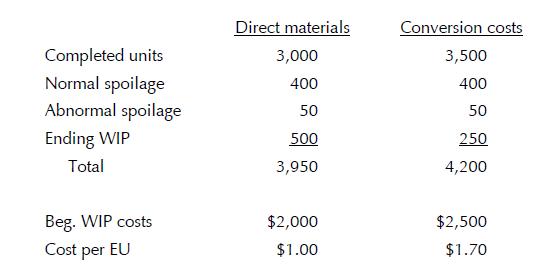
12. Equivalent units, beginning work-in-process inventory costs, and cost per EU were as follows for the Finishing department, which had no spoilage this period:Calculate the value of completed units, ending work-in-process inventory, and the loss caused by abnormal spoilage, using first the
11. Equivalent units, beginning work-in-process inventory costs, and cost per EU were as follows for the Cutting DepartmentCalculate the value of completed units, ending work-in-process inventory, and the loss caused by abnormal spoilage, using first the weighted average method, then the FIFO
10. Equivalent units, beginning work-in-process inventory costs, and cost per EU were as follows for the Assembly department:Calculate the value of completed units, ending work-in-process inventory, and the loss caused by abnormal spoilage, using first the weighted average method, then the FIFO
9. Production begins in the Mixing department at Josephson, Inc., which spent $5,000 on direct materials and $1,000 on conversion costs last period for goods it is finishing this period. During this period, the Mixing department incurred $20,000 in direct materials costs and $19,000 in conversion
8. In June, the Finishing department of Carbin Company had ending work-in-process inventory worth $400,000 ($100,000 in transferred-in costs, $180,000 in direct materials costs, and$120,000 in conversion costs). Goods costing $1,000,000 to previous departments were transferred to the department
7. The Assembly department of Moly Corporation had beginning work-in-process costs of $50,000($30,000 in direct materials, $10,000 in conversion costs, and $10,000 in transferred-in costs).During the period, $100,000 was spent on direct materials, and $300,000 was spent on conversion costs. Goods
6. Willow Company manufactures goods in three departments, Mixing, Baking, and Packaging.In the Baking department, 40% of direct materials are added at the beginning of the process, and the rest are added halfway through the process. Conversion costs are incurred evenly throughout the process.
5. Bobbly Corporation manufactures goods in two departments, Molding and Assembly. All materials are added in the Molding Department; the Assembly department just assembles the parts, with work done evenly throughout the production process. Beginning work-in-process for Assembly was 25% complete,
4. Sharma Corporation adds direct materials at the beginning of its single production process.Conversion costs are applied evenly throughout the production process. Beginning work-inprocess inventory was 40% complete, and ending work-in-process inventory was 70% complete.Units worked on were as
3. Jergis and Daughters produces goods in three departments: Cutting, Assembly, and Packaging.This period, 4,000 units were transferred from Cutting to Assembly, and 4,500 were transferred from Assembly to Packaging. The Assembly department worked on a total of 5,000 units, 200 of which ended up
2. Gentil Company normally experiences a spoilage rate of 5% in its Assembly department. This month, 1,000 of the 10,000 completed units were spoiled. Work on 1,200 of those units was begun in the prior period. This period, work was begun on 12,800 units.Calculate total units, how they started, and
1. Jovi Corporation began work on 2,000 units in August, and finished work on 2,500 units.Normal spoilage is 10% of good units. Altogether, 250 units were spoiled. Work-in process was as follows:Beginning work-in-process 700 units Ending work-in-process 200 units Calculate total units, how they
Assign costs to goods completed and transferred out, ending work-in-process inventory, and loss caused by abnormal spoilage for the Finishing department using the FIFO method.The Finishing department at Mass Manufacturing, Inc., began March with 400 units in WIP (40%completed), costing $20,000 in
Assign costs to goods completed and transferred out, ending work-in-process inventory, and loss caused by abnormal spoilage for the Finishing department using the weighted average method.The Finishing department at Mass Manufacturing, Inc., began March with 400 units in WIP (40%completed), costing
2. Assign costs to goods completed and transferred out, ending work-in-process inventory, and loss caused by abnormal spoilage for the Finishing department using the FIFO method.a. First, calculate total units, how they started, and how they ended up. Stop—Check!b. Next, calculate equivalent
1. Assign costs to goods completed and transferred out, ending work-in-process inventory, and loss caused by abnormal spoilage for the Finishing department using the weighted average method.a. First, calculate total units, how they started, and how they ended up. Stop—Check!b. Next, calculate
23. .Moriarity Enterprises produces two products, Duomite and Corbomite, in separate departments.The firm has two service departments, Human Resources and Facilities Management, which serve both production departments as well as each other. Moriarity outsources its tech support to a firm which
22. Corallis Corporation uses the step-down method of allocating service department costs to operating departments. Corallis has three service departments (Service 1, 2, and 3) and three operating departments (Operating 1, 2, and 3). This year’s service department costs were as follows: for
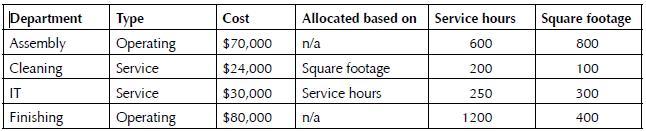
21. Allocate the service department costs to the operating departments using the reciprocal method.Smithson, Inc., has four departments with the following information before allocation: Department Cost Allocated based on Service hours Square footage Assembly Operating $70,000 n/a 600 800 Cleaning
34. Leroy Enterprises manufactures goods in two processes: Assembly and Finishing. The Famoso unit, which sells for $520, includes direct materials costing $260, has a demand of 300 per week, and requires 4 hours of assembly time and 2 hours of finishing time. The Ricco unit, which sells for $500,
20. Allocate the service department costs to the operating departments using the step-down method, with the Cleaning department allocated first.Smithson, Inc., has four departments with the following information before allocation: Department Cost Allocated based on Service hours Square footage
19. Allocate the service department costs to the operating departments using the direct method.Smithson, Inc., has four departments with the following information before allocation: Department Cost Allocated based on Service hours Square footage Assembly Operating $70,000 n/a 600 800 Cleaning
18. Allocate the service department costs to the operating departments using the reciprocal method Golber Manufacturing has two service departments, Administration and Maintenance, and two operating departments, Production 1 and Production 2. Administration costs of $180,000 are allocated based on
32. Hanson Company produces components in its Parts division, located in Belarus, that cost $100 per component in variable costs and sell on the market for $150 per component. Hanson incurs marketing costs of $10 per unit if they are sold on the market. Currently, Hanson transfers all 10,000
17. Allocate the service department costs to the operating departments using the step-down method, with the department with higher costs allocated first. Golber Manufacturing has two service departments, Administration and Maintenance, and two operating departments, Production 1 and Production 2.
31. The Bolt division of Murray industries manufactures bolts, which it transfers to the Machine division, which uses the bolts to make machines. It costs $0.04 per unit to make the bolts (plus fixed costs, which are $60,000 per year for the Bolt division), which sells for $0.20 per bolt on the
30. Saylor Manufacturing produces goods costing $25 per unit in variable costs and $18 per unit in fixed costs that sell for $60 each. Another firm has asked whether Saylor will make a special production run to manufacture 9,000 units for it in a one-time-only special order. Saylor has the
16. Allocate the service department costs to the operating departments using the direct method. Golber Manufacturing has two service departments, Administration and Maintenance, and two operating departments, Production 1 and Production 2. Administration costs of $180,000 are allocated based on
29. McLane wishes to liquidate its inventory of older items. The items cost $200 and sold for $340.McLane will incur costs of $20 per unit to store them until they are sold and to advertise that they are on sale.Calculate the minimum price per unit that the company should accept.
28. Southview Company is hoping to launch a new product that will cost $90 in direct materials and $100 in direct labor per unit. Startup and development costs should total $15,000,000, and fixed costs will be $300,000 per year. Variable manufacturing overhead is estimated at 60% of direct labor
27. Eastlake Manufacturing is trying to decide how much to charge for its new product, which has cost $8,400,000 for development and production setup. Fixed costs are not expected to increase as a result of the new product, but variable costs are expected to be $70 per unit. The product should sell
25. Clarke Company uses job costing, and applies manufacturing overhead costs to jobs at a rate of 120% of direct labor cost. Beginning inventories were $40,000 in raw materials, $120,000 in work-in-process, and $250,000 in finished goods. This period, the following transactions occurred:yyDirect
24. Hayes, Inc., uses a job costing system that divides manufacturing overhead into three categories:design (40% of overhead), production (25% of overhead), and labor support (35% of overhead).Design overhead is allocated on the basis of design hours, production overhead is allocated on the basis
15. Direct MethodStep-Down MethodReciprocal Method Service 1 Service 2 Initial cost $48,000 $80,000 Service 3 $49,500 Operating 1 Operating 2 Total $177,500 Service 1 40/100 60/100 (48,000) $19,200 $28,800 0 Service 2 120/200 80/200 (80,000) 48,000 32,000 0 Service 3 38/50 12/50 (49,500) 37,620
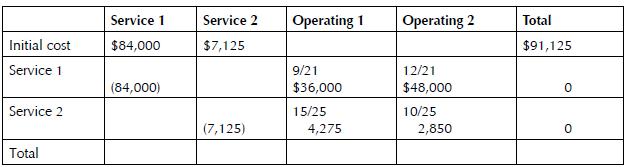
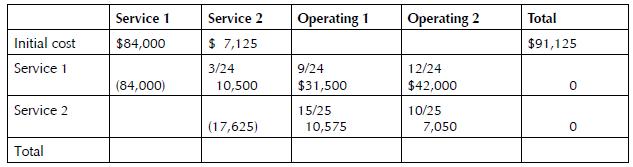
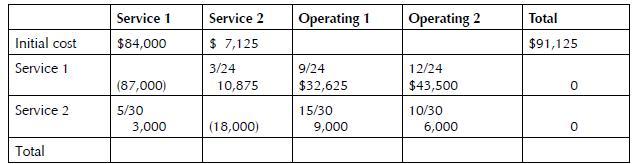
Find the total allocation to each operating department.14. Direct MethodStep-Down MethodReciprocal Method Service 1 Service 2 Operating 1 Operating 2 Total Initial cost $84,000 $7,125 $91,125 Service 1 (84,000) Service 2 9/21 $36,000 12/21 15/25 10/25 (7,125) 4,275 2,850 0 $48,000 0 Total
Find the total allocation to each operating department.13. Direct MethodStep-Down MethodReciprocal Method Service 1 Initial cost $20,000 Service 2 $50,400 Operating 1 Operating 2 Total $70,400 Service 1 (20,000) Service 2 14/20 $14,000 6/20 $ 6,000 3/12 (50,400) 12,600 0 9/12 37,800 0 Total
23. Quincy, Inc., uses a job costing system in which all manufacturing overhead costs (budgeted at $750,000) are allocated on the basis of direct labor costs (budgeted at $800,000). This period, Quincy completed a job for Mowrey Company that cost $15,000 in direct materials and$20,000 in direct
12. Direct MethodStep-Down MethodReciprocal Method Service 1 Service 2 Service 3 Operating 1 Operating 2 Total Initial cost $20,000 $14,000 $17,500 $51,500 Service 1 (20,000) Service 2 30/46 $13,043 16/46 $ 6,957 10/28 18/28 0 Service 3 18/41 23/41
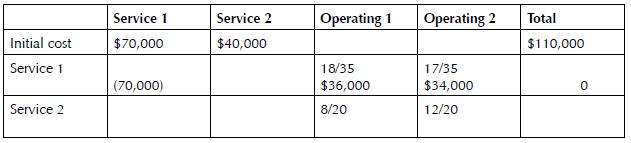
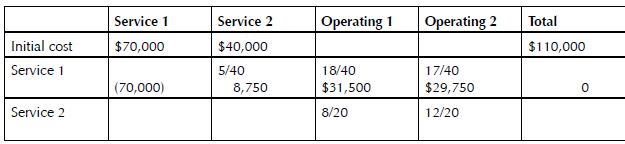
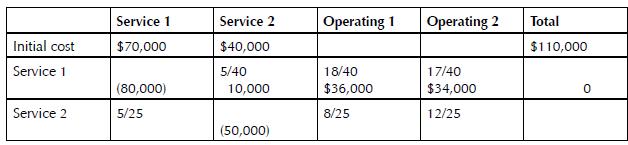
Allocate costs from subsequent service departments 11. Direct MethodStep-Down MethodReciprocal Method Service 1 Initial cost $70,000 Service 1 (70,000) Service 2 Service 2 $40,000 Operating 1 Operating 2 Total $110,000 18/35 $36,000 8/20 17/35 $34,000 12/20 0
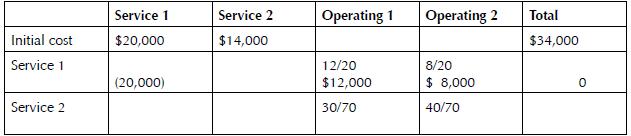
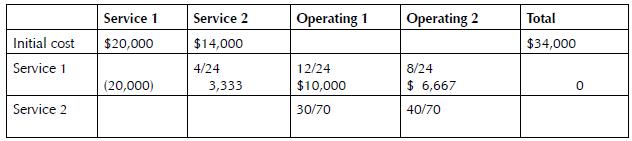
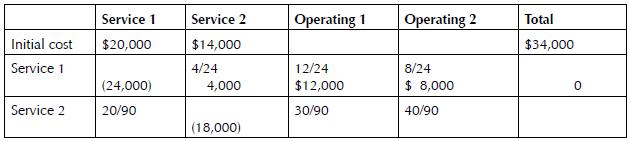
Allocate costs from subsequent service departments.10. Direct MethodStep-Down MethodReciprocal Method Service 1 Initial cost $20,000 Service 2 $14,000 Service 1 (20,000) Service 2 Operating 1 Operating 2 12/20 $12,000 8/20 $ 8,000 30/70 40/70 Total $34,000 0
Allocate costs from the first service department.9. Direct Method Step-Down MethodReciprocal Method Service 1 Service 2 Service 3 Operating 1 Operating 2 Total Initial cost $24,000 $16,000 $38,000 $78,000 Service 1 18/40 22/40
Allocate costs from the first service department.8. Direct MethodStep-Down MethodReciprocal Method Service 1 Initial cost Service 1 $100,000 Service 2 $200,000 Operating 1 Operating 2 Total $300,000 16/40 24/40
Allocate costs from the first service department.7. Direct MethodStep-Down MethodReciprocal Method Service 1 Service 2 Operating 1 Operating 2 Total Initial cost $40,000 $80,000 $120,000 Service 1 38/80 42/80
Determine the amount allocated out of each service department (reciprocal only). Service 1 Service 2 Service 3 Operating 1 Operating 2 Total Initial cost $50,000 $70,000 $30,000 $150,000 Service 1 5/64 12/64 27/64 20/64 Service 2 10/200 Service 3 12/60 6/60 20/200 60/200 110/200 22/60 20/60
Determine the amount allocated out of each service department (reciprocal only). Service 1 Service 2 Operating 1 Operating 2 Total Initial cost $50,000 Service 1 $84,000 16/60 $134,000 20/60 24/60 Service 2 10/100 60/100 30/100
22. In July, the Assembly department of Richmond Manufacturing began the month with 2,000 units in work-in-process inventory (60% complete). During the month, 25,000 units were transferred in, with costs of $121,500 attached to them from the previous department. During the month, 20,000 units were
Determine the amount allocated out of each service department (reciprocal only). Service 1 Service 2 Operating 1 Operating 2 Total Initial cost $400,000 Service 1 $544,000 20/100 $944,000 30/100 50/100 Service 2 5/40 20/40 15/40
21. Westwood Manufacturing has three production departments that work on units in the following order: Molding, Assembly, and then Finishing. The Molding department began the month of June with 4,000 units in work-in-process inventory (30% complete), and began work on an additional 20,000 units
3. Josephson Industries has two service departments and two operating departments:Janitorial costs were $200,000, and tech support costs were $250,000.Set up the chart, including initial costs and fractions, first for the direct method, then the stepdown method (with Janitorial allocated first),
19. Milner Manufacturing has two service departments, Administration and Maintenance, and two operating departments, Production 1 and Production 2. Administration costs of $233,090 are allocated based on number of employees, while Maintenance costs of $317,850 are allocated based on square footage.
2. Silvine, Inc., has two service departments, Maintenance and Human Resources, and two operating departments, Cutting and Assembly. Maintenance costs of $200,000 are allocated based on maintenance time, and Human Resources costs of $100,000 are allocated based on number of employees. The
18. Determine the profitability of each product after allocating joint costs using their net realizable value, if the byproduct is accounted for at the time of sale. KeotaChem produces two chemicals in a joint process that also results in a byproduct. The joint process costs $253,000, and results
1. Derbus, Inc., has three service departments (Cafeteria, Tech Support, and Maintenance) and three operating departments (Product A, Product B, and Product C). Cafeteria costs of $300,000 are allocated based on number of employees, tech support costs of $500,000 are allocated based on tech hours,
17. Determine the profitability of each product after allocating joint costs using their sales value at splitoff, if the byproduct is accounted for at the time of production. KeotaChem produces two chemicals in a joint process that also results in a byproduct. The joint process costs $253,000, and
16. Burns Company is considering developing a new operating system for MP3 players. Because of the pace of technology, the software will be obsolete in 3 years, but there is a 35% chance that it will become obsolete after only 1 year. The operating system will cost $700,000 to develop, and will
15. Wheaton Company, which requires a 12% return on its projects, is considering starting a new product line, which would require a $5,000,000 up-front investment, and would generate sales over 5 years. There is a 30% chance that the product could do poorly, in which case annual revenues would be
+ 14. Lopez Corporation has set the following standards for production:Direct materials: 10 gallons at $1.50 per gallon Direct labor: 2 hours at $4 per hour Lopez did the following:yy Budgeted fixed costs at $100,000 yy Applies variable overhead at a rate of $2 per direct labor hour yy Produced and
13. For Fianchetto, Inc., direct materials standards are 3 pounds at $9 per pound, direct labor standards are 2.5 hours at $20 per hour, and variable overhead is applied at a rate of $40 per hour. Fianchetto budgeted to manufacture and sell 200,000 units for $500 per unit, but actually manufactured
Allocate the service department costs to the operating departments using the reciprocal method.Chieftan Enterprises has two service departments, Tech Support and Cafeteria, and two operating departments, Production 1 and Production 2. Tech Support costs are allocated to each department on the basis
10. Cooper Corporation manufactures custom backyard play sets that sell for $4,000. Each play set contains raw materials costing $1,600, and requires 20 hours of labor to manufacture. Labor is paid $15 per hour. Variable manufacturing overhead is applied to products at a rate of $30 per hour. Fixed
9. Adams Enterprises manufactures many products, including wooden toy cars. Each car requires 2 feet of wood, costing $0.80 per foot. An assembly worker can supervise the machine carving and sanding process of 15 cars an hour. Assembly labor is paid $8 per hour. Variable overhead is applied at a
8. Walnut Corporation has an investment opportunity that would require an up-front investment of $10,000,000 in assets and would bring in additional revenues of $4,000,000 each year for 4 years. The assets could be sold at the end of 4 years for $350,000. Walnut has a tax rate of 30%, and a
7. Walton Company is considering replacing one of its machines with a new one that costs$3,000,000 and has a projected salvage value of $900,000. The old machine has a book value of $550,000, and could be sold for $300,000. Replacing the machine would allow Walton to save $700,000 a year over the
6. Bloomberry Corporation had revenues of $7,000,000, variable costs of $5,250,000, and fixed costs of $1,500,000 last year.Calculate the following:a. The revenues required to break evenb. The revenues required to earn before-tax profit of $750,000
5. Hedrick Company charges $650 per unit for its product, which costs $575 per unit in variable costs and $825,000 in total fixed costs.Calculate the following:a. The number of units required to break evenb. The number of units required to earn before-tax profit of $375,000c. The unit volume at
3. Ash Company is trying to decide whether to accept a special order for 12,000 units from Booth Corporation. Ash usually charges $100 per unit for its product, which includes $20 in direct materials, $30 in direct labor, $24 in variable overhead, and $16 in fixed overhead. The order from Booth
14. Minerva Manufacturing produces three products, Platinum, Silver and Gold, each of which must be processed in Department A, Department B, and Department C. Customers demand ten units of Platinum, eleven units of Silver, and nine units of Gold per day.Each of the three departments employs five
Allocate the service department costs to the operating departments using the step-down method, with Tech Support allocated first.Chieftan Enterprises has two service departments, Tech Support and Cafeteria, and two operating departments, Production 1 and Production 2. Tech Support costs are
11. Cumberland Enterprises manufactures goods in two processes: Assembly and Finishing. The Empire unit, which sells for $160, includes direct materials costing $30, and has a demand of 600 per week, requires 3 hours of assembly time and 1 hour of finishing time. The Monarch unit, which sells for
9. Swanni Company produces two products, Optimo (throughput margin = $6 per unit) and Ultimo(throughput margin = $5 per unit), in two departments, Assembly and Packaging. Assembly has 900 hours available each week, while Packaging has 800 hours available. Each unit of Optimo requires 1 hour in
6. Bob & Fred, Inc., has a bottleneck operation whose capacity is 100 units per day. Other operations have a capacity of 120 units per day. Each unit has a throughput margin of $80. The bottleneck operation employs 2 workers, each of whom could run 3 machines. The operation currently has 5
5. Marston Corporation has a bottleneck operation that processes 400 units per week using 4 identical machines that run 10 hours per day each. Other operations are capable of processing 450 units per week. Each unit has a throughput margin of $50. Marston could rent an additional machine for $3,000
4. Jumbler Enterprises has a bottleneck operation that processes 1,000 units per day. Its other operations are capable of processing 1,100 units per day. Each unit has a throughput margin of$200. Workers in the bottleneck operation are capable of processing 25 units per hour each, and are paid $12
3. Goldfinch, Inc., has two departments (A and B), each of which employs 10 workers. If the departments are fully staffed, each department can process 500 units per day. However, if a worker has to miss a day, a temp worker whose productivity is 60% of a regular worker must fill in. In an average
2. Millway Manufacturing has four production departments: Mixing, Molding, Assembly, and Packaging. Each unit of finished product requires 4 ounces of raw material. The Mixing department can process 2,500 ounces of material per hour. In the Molding department, each mold produces 12 units. The
1. Jenco manufactures goods in two processes—Assembly and Finishing. The Assembly process, which is highly automated, uses 2 machines, each of which can assemble 15 units per hour. The Finishing process, which is highly labor-intensive, employs 10 technicians, each of whom can process 4 units per
Allocate the service department costs to the operating departments using the direct method.Chieftan Enterprises has two service departments, Tech Support and Cafeteria, and two operating departments, Production 1 and Production 2. Tech Support costs are allocated to each department on the basis of
Showing 5300 - 5400
of 7256
First
47
48
49
50
51
52
53
54
55
56
57
58
59
60
61
Last
Step by Step Answers

 Get 50% OFF
Claim Now
Get 50% OFF
Claim Now