New Semester
Started
Get
50% OFF
Study Help!
--h --m --s
Claim Now
Question Answers
Textbooks
Find textbooks, questions and answers
Oops, something went wrong!
Change your search query and then try again
S
Books
FREE
Study Help
Expert Questions
Accounting
General Management
Mathematics
Finance
Organizational Behaviour
Law
Physics
Operating System
Management Leadership
Sociology
Programming
Marketing
Database
Computer Network
Economics
Textbooks Solutions
Accounting
Managerial Accounting
Management Leadership
Cost Accounting
Statistics
Business Law
Corporate Finance
Finance
Economics
Auditing
Tutors
Online Tutors
Find a Tutor
Hire a Tutor
Become a Tutor
AI Tutor
AI Study Planner
NEW
Sell Books
Search
Search
Sign In
Register
study help
business
public accounting
Mastering Managerial Accounting Key Concepts Through Problem Sets 1st Edition Christine Denison - Solutions
Sato Corporation assembles two products, Bleu and Verde, in Building A, which are then moved to Building B for sanding and painting. Building A has 30 employees, and Building B has 14 employees, each of whom works an 8-hour day. Each unit of Bleu takes 2 hours to assemble and 1 hour to sand and
34. McGhee Manufacturing has just made a product modification and wishes to liquidate its inventory of 2,000 units of the old version of the product, which will become obsolete as soon as the new product hits the market. McGhee markets all its products on the Internet. Advertising the sale on the
32. Montevallo Manufacturing operates a division in Brazil that manufactures goods for $30 in variable costs per unit. All 20,000 units manufactured each year are transferred to the Chicago division, where they are packaged for an additional $10 per unit and sold on the market for $75 each. There
31. Barry Manufacturing produces goods costing $25 per unit in variable costs and $40 per unit in fixed costs that sell for $100 each. Silman Enterprises has requested that Barry manufacture 5,000 units for Silman in a one-time-only special order. Barry has the manufacturing capacity to fill the
30. Chester Corporation is launching a new product that is expected to cost $75 in direct materials,$50 in direct labor, and $100 in variable overhead per unit. Fixed costs associated with the product are expected to be $500,000 each year the product is sold, and development and setup costs are
28. Bellway Company produces components in its Parts division, located in France, that cost $40 per component in variable costs and sell on the market for $60 per component. Market demand for the components is unlimited, but Bellway incurs marketing costs of $5 per unit if they are sold on the
27. The Papers division of Forsythe Industries manufactures cardboard, which it transfers to the Box division, which uses the cardboard to make boxes. It costs $0.02 per square foot to make the cardboard (plus fixed costs, which are $30,000 per year for the Papers division), which sells for$0.05
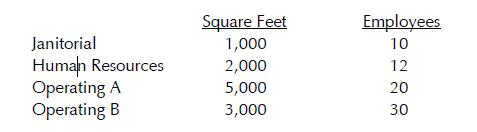
3. Allocate the service department costs to the operating departments using the reciprocal method.a. First, set up the chart, including initial costs and fractions. Stop—Check!b. Next, determine the amount allocated out of each service department. Stop—Check!c. Next, allocate costs from the
26. Fandango Enterprises produced 300 irregular units during its manufacturing process this month.The units cannot be sold through Fandango’s normal distribution channels. They each cost $45 in variable manufacturing costs to produce. Fandango could sell them through a deep discount retailer, but
25. Ellipsis Manufacturing produces goods costing $12 per unit in variable costs and $20 per unit in fixed costs that sell for $45 each. Another firm has asked if Ellipsis will make a special production run to manufacture 3,000 units for them in a one-time-only special order. Ellipsis has the
24. CellCo wishes to liquidate its inventory of older cell phones. The phones cost $50 and sold for$120. CellCo will incur costs of $10 per phone to store them until they are sold and to advertise that they are on sale.Calculate the minimum price per unit the company should accept.
23. Wilster Corporation is pricing a product that it estimates will cost $600 per unit in direct materials and $350 per unit in direct labor. Manufacturing overhead is applied to products at a rate of 120% of direct labor costs. Sixty percent of manufacturing overhead is variable. The company’s
22. Catoosa Company is hoping to launch a new product that will cost $70 in direct materials and$80 in direct labor per unit. Startup and development costs should total $18,000,000, and fixed costs will be $200,000 per year. Variable manufacturing overhead is estimated at 75% of direct labor costs.
21. Bedivere Manufacturing is trying to decide how much to charge for its new product, which has cost $5,000,000 for development and production setup. Annual fixed costs are not expected to increase as a result of the new product, but variable costs are expected to be $14 per unit. The product
20. Pillsur Corporation manufactures parts in its Australia division, which is subject to a 30% tax rate. The parts are transferred to the Egypt division for assembly and sale. The tax rate in Egypt is 20%.Determine whether the company would prefer a high or a low transfer price.
19. International Manufacturing has two divisions. Division A, which manufactures goods that are transferred to Division B, is located in Bulgaria, which has a corporate tax rate of 10%. Division B is located in the United States, where International falls into the 30% tax bracket.Determine whether
18. Doone, Inc., manufactures goods in its Sigma division that cost $40 per unit, plus fixed costs, to manufacture. The goods have a market price of $85 per unit. Sigma division has a manufacturing capacity of 10,000 units, all of which are currently transferred to the Epsilon division for use in
17. Simpatronics has two divisions. Division A manufactures goods for a variable cost of $100 that it could sell on the market for $150. Market demand is unlimited. Currently, Division A transfers its entire output to Division B, which saves Division A $15 per unit in marketing costs.In a
16. Passico has two divisions, Amber division and Crimson division. Amber division, which has an annual capacity of 20,000 units, manufactures parts at a variable cost of $35 per unit, which sell on the market for $50 per unit. Market demand is currently 10,000 units per year. Crimson division
15. Silvan Company has two divisions. Alpha division manufactures components for $3,000 per unit plus $1,000,000 in fixed costs, which are transferred to Omega division for use in manufacturing the firm’s finished product, which costs an additional $5,000 per unit, plus $3,000,000 in fixed costs.
14. Gover, Inc., transfers 100,000 units from Division A, which manufactures them at a cost of $20 per unit plus $1,000,000 in fixed costs, to Division B, which finishes them at a cost of $7 per unit, plus $200,000 in fixed costs, then sells the finished product for $50. Division A could sell the
13. Obladi, Inc., manufactures 50,000 parts per year in the Parts division, which are transferred to the Finishing division. The Parts division’s costs are $3 per unit, plus $200,000 in fixed costs. The Finishing division’s costs are $20 per unit, plus the cost of the transferred parts, plus
12. Rory Company manufactures goods in Division A that are transferred to Division B for use in its products. Division A’s costs are $25 per unit, plus $10,000,000 in fixed costs. Division B’s costs are $100 per unit, plus the cost of the transferred goods, plus $24,000,000 in fixed
11. Gruber Corporation manufactures the components of its products at its Parts Manufacturing division. Each component costs $15 in variable costs to produce. The components are transferred to the Assembly division, where they are assembled into the final product, which costs$30 per unit, plus the
10. Moona Company has two divisions. Division A produces a component that it transfers to Division B, who uses the component in its main product. Division A incurs $400 in variable costs to manufacture each component, as well as $100,000 in fixed costs. Division B incurs$1,000 in variable costs in
9. Annor Clothing wishes to place a stock of 100 holiday sweaters on clearance after the holiday season. The sweaters cost Annor $25, and sold for $50 during the holiday season. Annor will incur opportunity costs of $7 per sweater for rack space, and will spend $500 to advertise the clearance
8. Zolla Manufacturing has an excess capacity of 500 units in its manufacturing facility. Its product costs $1,000 per unit in variable costs, plus $450 in allocated fixed manufacturing overhead.Another firm wishes to purchase 400 units from Zolla that it will repackage and sell under a different
7. Jenkins Company recently discontinued sales of one of its products, but still has 2,000 units remaining in inventory. The units cost $40 each to make, and sold for $75. Jenkins could use the products for parts, which it estimates will generate $15 in savings per unit. Another firm has offered to
2. Allocate the service department costs to the operating departments using the step-down method, with Janitorial allocated first.a. First, set up the chart, including initial costs and fractions. Stop—Check!b. Next, allocate costs from the first service department. Stop—Check!c. Next, allocate
6. Alexander Corporation wants to market a product that will cost $510,000 over its life. Demand for the product is expected to total 5,000 units. Alexander believes that it can achieve a 30%profit margin on this product.Calculate the estimated selling price.
5. Mercury, Inc., is considering developing a product that will cost $20,000,000 over its life.Demand for the product is expected to total 400,000 units. Mercury sets prices to achieve a 10% profit.Calculate the estimated selling price.
4. Jiggins Company has developed a product that is estimated to sell 100,000 units and cost$5,240,000 over its life. Jiggins sets prices at 15% above full costs.Calculate the estimated selling price.
3. Chocco Toys has developed a toy that it believes will be the hot new toy for the holidays this year. Demand for the toy is expected to be 8,000,000 this year, but will drop to 500,000 next year, and go down to 10,000 the third year, after which Chocco believes that it will not be able to sell
2. Penji Corporation is considering starting research and development on a new product with a 15-year life. Development and manufacturing setup will cost $12,000,000. Once production starts, direct materials will cost $12 per unit, and each unit will use 0.5 hour of direct labor at $15 per hour.
1. Jellman Company is considering developing a product that will cost $50 per unit in direct materials and will require 4 hours of direct labor to manufacture, costing $10 per hour. Jellman applies variable manufacturing overhead at a rate of 75% of direct labor costs. Producing the product will
West Division is located in a state with a tax rate of 25%, and East Division is located in a state with a tax rate of 20%. Which of the above prices would the firm most prefer? Your firm has two divisions. West Division manufactures 100,000 bearings per year at a variable cost of $5 per unit,
If the two divisions were to negotiate the transfer price, what would be the minimum price acceptable to West? The maximum acceptable to East? Your firm has two divisions. West Division manufactures 100,000 bearings per year at a variable cost of $5 per unit, which it transfers to East Division,
Calculate the transfer price if it is based on market price. Then calculate the pre-tax income of each division and the firm as a whole with this transfer price. Your firm has two divisions. West Division manufactures 100,000 bearings per year at a variable cost of $5 per unit, which it transfers
Calculate the transfer price if it is based on full cost with a 20% markup. Then calculate the net income of each division and the firm as a whole with this transfer price. Your firm has two divisions. West Division manufactures 100,000 bearings per year at a variable cost of $5 per unit, which it
Calculate the transfer price if it is based on variable cost with a 20% markup. Then calculate the net income of each division and the firm as a whole with this transfer price. Your firm has two divisions. West Division manufactures 100,000 bearings per year at a variable cost of $5 per unit, which
Your firm is liquidating its inventory, which cost $20 per unit to purchase. Selling costs will be $5 per unit, and the opportunity cost of holding the inventory until it is sold will be $3 per unit. What minimum price should be set for the product?
Your firm is considering developing a new product. The product will cost $7,000,000 to develop.Product-related costs will be $250,000 per year, plus $15 per unit. Your firm plans to manufacture an average of 40,000 units per year over the product’s 8-year life. What price should be set for the
5. What range would the transfer price fall into if it were negotiated between the two divisions?Stop—Check!Kitine Wagon Company has two divisions: the Wheel division is located in the United States, where the tax rate is 20%, and the Assembly division is located in Finland, where the tax rate is
4. Which of the prices calculated above would the company as a whole most prefer? Stop—Check!Kitine Wagon Company has two divisions: the Wheel division is located in the United States, where the tax rate is 20%, and the Assembly division is located in Finland, where the tax rate is 40%. The Wheel
3. Calculate the transfer price and the pre-tax income for each division and the company as a whole if the transfer price is based ona. Variable cost with a 10% markup. Stop—Check!b. Full cost with a 10% markup. Stop—Check!c. Market price. Stop—Check!Kitine Wagon Company has two divisions:
William’s Emporium is overstocked on merchandise that ordinarily sells for $100 each. William’s paid $60 per unit for the merchandise. At this point, it will cost William’s $10 per unit to stock and sell the merchandise.2. What minimum price should William’s Emporium charge for each unit?
Wiode Company is considering launching a new product. The firm has estimated that the product will have a 10-year life once sales begin, and that demand will be 5,000 units the first year regardless of the price set. Demand is expected to increase 75% the first year, then drop by 10% each following
18. Janavee Construction applies all overhead to jobs on the basis of direct labor hours. This period, manufacturing overhead is budgeted to be $1,800,000, and direct labor hours are budgeted to be 90,000. Janavee pays direct labor $12 per hour.Janavee bid on a job that it estimated would require
16. Cambrie, Inc., uses a job costing system that divides manufacturing overhead into three categories:design (25% of overhead), production (60% of overhead), and labor support (15% of overhead). Design overhead is allocated on the basis of design hours, production overhead is allocated on the
15. The law firm of Corbin and Wilkins uses a job costing system to account for its client costs. The cost of attorney and paralegal time (Professional Labor) is traced to each client, as are the costs of court fees and copying. All other costs (Support) are allocated to clients using Professional
13. Coleman, Inc., uses a job costing system in which all manufacturing overhead costs (budgeted at $500,000) are allocated on the basis of direct labor costs (budgeted at $625,000). This period, Coleman completed a job for O’Reilly Company that cost $10,000 in direct materials and$15,000 in
12. The Delta job cost $60,000 before accounting for spoilage and rework, and resulted in $1,200 in normal spoilage caused by the production process, $10,000 in abnormal spoilage, and $5,000 in normal rework caused by customer request.Calculate the cost of the job after accounting for spoilage and
11. Job 24A cost $550,000 before accounting for spoilage and rework, and resulted in $40,000 in abnormal spoilage, $10,000 in normal spoilage caused by customer rejection, and $30,000 in normal rework caused by the production process.Calculate the cost of the job after accounting for spoilage and
10. Job 1480 cost $1,000,000 before accounting for spoilage and rework, and resulted in $10,000 in normal spoilage caused by the production process, $40,000 in normal spoilage caused by customer rejection, and $100,000 in abnormal rework.Calculate the cost of the job after accounting for spoilage
9. An order for Corbis Company cost $550,000 before accounting for spoilage and rework. Five percent of the units produced were spoiled as a normal part of the production process. Two percent of the units produced did not meet the customer’s requirements, and were deemed irreparable. Several
8. Job 13A cost $8,000,000 before accounting for spoilage and rework. Of the 1,600 units produced, 20 had to be repaired because the customer was not satisfied with their quality. These repairs cost a total of $50,000. In addition, 15 units were spoiled as a normal result of the production process,
7. Job 1840, which cost $100,000 for 1,000 units before accounting for spoilage and rework, resulted in 30 units that were spoiled as a result of the normal production process and 10 that were spoiled because of a lightning strike, which also damaged 12 units that could be repaired at a cost of $45
6. Mackenzie Company uses a job costing system with four activity-based overhead pools: Cutting, allocated at $4.50 per cut; Molding, allocated at $25 per machine hour; Assembly, allocated at 30% of direct labor cost; and Packing, allocated at $1,000 per order. A recent order from Rose, Inc., used
5. Rook, Inc., uses a job costing system with a single overhead pool allocated at a rate of $60 per direct labor hour. Rook pays its direct labor $25 per hour. On Job 390, Rook spent $150,000 on direct materials costs, and direct labor worked 1,000 hours.Calculate the cost of Job 390 before
4. Gemini Production uses a job costing system with two overhead pools: Overhead A, allocated at a rate of $45 per direct labor hour; and Overhead B, allocated at a rate of $100 per machine hour. Gemini just completed Job A45, which used $500,000 in direct materials costs, $80,000 in direct labor
1. Tembe, Inc., uses a job costing system with a single pool of overhead budgeted to be $5,568,000 for the upcoming period and allocated on the basis of direct labor hours. Tembe plans to manufacture 3,000 units of Type A, which uses 40 direct labor hours per unit; 5,000 units of Type B, which uses
Calculate the cost of the job after accounting for spoilage and rework.Your firm uses a job costing system that uses direct labor cost as a cost allocation base for manufacturing overhead. Manufacturing overhead was budgeted at $1,200,000 for the period, and direct labor was budgeted at $3,000,000.
Account for the costs of spoilage and rework.Your firm uses a job costing system that uses direct labor cost as a cost allocation base for manufacturing overhead. Manufacturing overhead was budgeted at $1,200,000 for the period, and direct labor was budgeted at $3,000,000. One of the jobs your firm
Calculate the cost of the job before accounting for spoilage and rework.Your firm uses a job costing system that uses direct labor cost as a cost allocation base for manufacturing overhead. Manufacturing overhead was budgeted at $1,200,000 for the period, and direct labor was budgeted at
1. Allocate the service department costs to the operating departments using the direct method.a. First, set up the chart, including initial costs and fractions. Stop—Check!b. Next, allocate costs from the first service department. Stop—Check!c. Next, allocate costs from subsequent service
Calculate the predetermined overhead rate for manufacturing overhead.Your firm uses a job costing system that uses direct labor cost as a cost allocation base for manufacturing overhead. Manufacturing overhead was budgeted at $1,200,000 for the period, and direct labor was budgeted at $3,000,000.
Schrades, Inc., uses a job-costing system with three overhead pools: Cutting, Grinding, and Assembly.Cutting overhead (40% of total overhead cost) is applied on the basis of number of cuts made.Grinding overhead (25% of total overhead cost) is applied on the basis of grinding time. Assembly
13. Dodger Company is performing real options analysis on a project under consideration. There is a 20% chance that the present value of future cash flows will be $3,700,000 and an 80%chance that the present value of future cash flows will be $12,000,000. The investment will cost$8,000,000 up
8. Joint costs of $500,000 are allocated to two products on the basis of net realizable value. Total net realizable value was $600,000 for Product A and $650,000 for Product B.Allocate the joint costs to the joint products.
20. Xylon Industries manufactures chemicals in a three-step procedure. After processing in the Mixing Department, 20% of the total weight of materials is split off to be processed into Xylite.The remainder of the materials are transferred to the Heating Department. The heating process results in a
6. Prosea Company manufactures two chemicals, tudine and lodine, in a joint process. The process yields 4,000 pounds of tudine that could be sold for $150,000 at splitoff, and 2,000 pounds of lodine that could be sold for $600,000 at splitoff. Tudine is processed further at a cost of $30,000 into
5. McClennan Company grows cucumbers, some of which it processes further into pickles. After the cucumbers are picked, they are separated into those suitable for sale, which are worth$0.70 per pound at splitoff, and those suitable for pickling, which are worth $0.40 per pound at splitoff. This
4. Damon Corporation manufactures three products in a joint process. Product A could sell at splitoff for $15 per pound, Product B for $7 per pound, and Product C for $9 per pound. However, all three products are processed further, costing $5 per pound for Product A, $6 per pound for Product B, and
3. Codor, Inc., manufactures three products in a joint process that also results in 2,000 pounds of a byproduct, which is accounted for at the time of production. Joint costs are $50,000. The byproduct sells for $2 per pound at splitoff.Calculate the joint costs to be allocated to joint products.
2. Wooten Corporation uses a joint process that costs $700,000 up to the splitoff point. This process results in four main products and a byproduct that is sold at splitoff for $15,000. The byproduct is accounted for at the time of sale.Calculate joint costs to be allocated to joint products.
1. Mavin Company produces two joint products and a byproduct in a joint process that costs$250,000 up to the splitoff point. The byproduct is accounted for at the time of production. The byproduct could sell at splitoff for $5,000, but it is processed further at a total cost of $2,000 and sold
Assume that the flidgets are accounted for at the time of production. Allocate the joint costs using pounds at splitoff as a cost allocation base. Jibblejabble uses a production process that results in two joint products, widgets and pidgets, and one byproduct, flidgets. Jibblejabble begins with
Assume that the flidgets are accounted for at the time of production. Allocate the joint costs using the net realizable value as a cost allocation base. Jibblejabble uses a production process that results in two joint products, widgets and pidgets, and one byproduct, flidgets. Jibblejabble begins
Assume that the flidgets are accounted for at the time of sale. Allocate the joint costs using the sales value at splitoff as a cost allocation base. Jibblejabble uses a production process that results in two joint products, widgets and pidgets, and one byproduct, flidgets. Jibblejabble begins with
7. Joint costs of $100,000 are allocated to three products on the basis of sales value at splitoff.Product A’s total sales value at splitoff is $250,000, Product B’s is $300,000, and Product C’s is$450,000.Allocate the joint costs to the joint products.
9. Joint costs of $1,800,000 are allocated to three products on the basis of their weight. Twelve thousand pounds of Product A, 14,000 pounds of Product B, and 10,000 pounds of Product C were produced.Allocate the joint costs to the joint products.
10. Applard, Inc., grows apples that are either sold as-is or processed into applesauce or apple juice. Joint costs, allocated on the basis of NRV, were $112,500 for apples (NRV of $150,000),$150,000 for applesauce (NRV of $200,000), and $52,500 for apple juice (NRV of $70,000).A byproduct
19. Determine the profitability of each product after allocating joint costs. Kingline Company produces three products in a joint process costing $1,000,000. Product 1 sells for $0.35 per ounce after further processing, which costs $0.10 per ounce. Product 2 sells for $1 per ounce at splitoff.
18. Determine the profitability of each product after allocating joint costs using sales value at splitoff, with the byproduct accounted for at the time of production. Parkle Corporation runs a mining operation that costs $300,000 per year. The mining yields precious stones that sell for $500 each,
17. Determine the profitability of each product after allocating joint costs using volume, with the byproduct accounted for at the time of sale. Parkle Corporation runs a mining operation that costs $300,000 per year. The mining yields precious stones that sell for $500 each, semi-precious stones
Determine the profitability of each product after allocating joint costs using their net realizable value. Bonanno, Inc., produces a cleaning chemical that is diluted to three different strengths and infused with different scents. The cleaning chemical costs $40,500 to process. This produces enough
15. Determine the profitability of each product after allocating joint costs using their net realizable value, if the byproduct is accounted for at the time of sale.Engelbert Pharmaceuticals produces two drugs in a joint process that also results in a byproduct.The joint process costs $108,000, and
14. Determine the profitability of each product after allocating joint costs using their sales value at splitoff, if the byproduct is accounted for at the time of production.Engelbert Pharmaceuticals produces two drugs in a joint process that also results in a byproduct.The joint process costs
13. Berman Technology produces electronic components in a process that is highly unstable.Precise conditions are necessary to produce Grade A components, which sell for $100 per unit. If manufacturing conditions are less than perfect, the result is Grade B components, which sell for $50 per unit,
12. Mosaic produces two kinds of tiles in a joint process that yields 5,000 pounds of blue tiles and 2,000 pounds of black tiles. Joint costs are allocated on the basis of weight, resulting in$150,000 in joint costs allocated to blue tiles and $60,000 allocated to black tiles. Blue tiles sell for
11. Coleman Company manufactures three products in a joint process. Joint products are allocated on the basis of sales value at splitoff, resulting in $350,000 in joint costs allocated to Product A,$320,000 to Product B, and $120,000 to Product C. Product A is processed further at a cost of$100,000
3. Assume that the animal feed is accounted for at the time of sale. Allocate the joint costs using pounds at splitoff as a cost allocation base.a. First, calculate the amount of the cost allocation base to be used to allocate the joint costs for each joint product. Stop—Check!b. Next, allocate
2. Assume that the animal feed is accounted for at the time of production. Allocate the joint costs using the net realizable value as a cost allocation base.a. First, subtract the net realizable value of the byproduct from joint costs. Stop—Check!b. Next, calculate the amount of the cost
1. Assume that the animal feed is accounted for at the time of sale. Allocate the joint costs using the sales value at splitoff as a cost allocation base.a. First, calculate the amount of the cost allocation base to be used to allocate the joint costs for each joint product. Stop—Check!b. Next,
9. Miama Company, which requires a 12% return on all its new products, is considering launching a new product. There is a 70% chance that the product will generate income of $200,000 per year for the next 10 years, and a 30% chance that it will generate income of only $17,500 per year for the next
8. Wabash Industries, which has a 10% required rate of return, is considering hiring a productivity specialist at an annual salary of $100,000 per year. The specialist demands a 10-year employment contract, claiming that she can save the company $800,000 per year in operating costs.After a 1-year
7. Crete Beverages, which requires an 8% rate of return on its investments, is considering changing the flavor of its most popular drink to one that its taste testers have determined tastes better. The reformulated drink would cost the same to produce as the current drink, but Crete would incur
6. Bullfrog Games is considering the development of a new kind of computer game. If the game catches on, Bullfrog sees the potential for creating similar games based on the same premise.Identify the possible outcomes and the firm’s available choices.
5. Yahamba Technology is considering whether to invest in research and development for a new product. Yahamba knows that a competitor is developing a similar product, and Yahamba could probably only make significant income from the product if it beats the competitor to market.However, there is a
4. Ruggers Productions is considering launching a new television series. If the series is popular enough, Ruggers could license elements of the show for merchandising, which would bring in extra revenue. If the series is not popular, Ruggers could cancel the show at any time.Identify the possible
Showing 5400 - 5500
of 7256
First
48
49
50
51
52
53
54
55
56
57
58
59
60
61
62
Last
Step by Step Answers

 Get 50% OFF
Claim Now
Get 50% OFF
Claim Now