New Semester
Started
Get
50% OFF
Study Help!
--h --m --s
Claim Now
Question Answers
Textbooks
Find textbooks, questions and answers
Oops, something went wrong!
Change your search query and then try again
S
Books
FREE
Study Help
Expert Questions
Accounting
General Management
Mathematics
Finance
Organizational Behaviour
Law
Physics
Operating System
Management Leadership
Sociology
Programming
Marketing
Database
Computer Network
Economics
Textbooks Solutions
Accounting
Managerial Accounting
Management Leadership
Cost Accounting
Statistics
Business Law
Corporate Finance
Finance
Economics
Auditing
Tutors
Online Tutors
Find a Tutor
Hire a Tutor
Become a Tutor
AI Tutor
AI Study Planner
NEW
Sell Books
Search
Search
Sign In
Register
study help
business
systems analysis and design
Heating Ventilating And Air Conditioning Analysis And Design 6th Edition Faye C. McQuiston, Jerald D. Parker, Jeffrey D. Spitler - Solutions
What is the purpose of a Management Guide?
Develop a proforma JAD outline for a project of 20 users in 3 business locations.
Name and explain what is meant by user categories.
How do user levels assist the analyst when preparing for user interviews?
You have been assigned by your boss to interview Mr. Smith. Mr. Smith runs a department within Human Resources that essentially provides two tasks: (1)assigning employee identification numbers to new employees, and (2) sending applications for individual insurance to the firm’s insurance
Prepare 15 questions that you would ask Mr. Smith during the interview.
Describe the concept of the logical equivalent as it relates to defining the requirements of a system.
What is the purpose of functional decomposition? How is the leveling of a DFD consistent with this concept?
How does Long Division depict the procedures of decomposition ?Explain.
Processes and data represent the two components of any software application.Explain the alternative approaches to obtaining process and data information from a legacy system.
What is reverse engineering? How can it be used to build a new system?
Why is analysis version control important?
Explain the procedures for developing a DFD from an existing program.
What is the purpose of a process specification? Explain.
Outline the differences between a business specification and a programming specification. What is their relationship, if any?
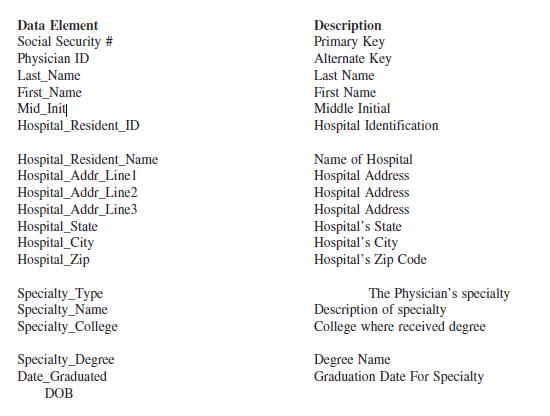
The Physician Master File from a DFD contains the following data elements:Assumptions 1. A physician can be associated with many hospitals, but must be associated with at least one.2. A physician can have many specialties, or have no specialty.Assignment Normalize to 3rd normal form Data Element
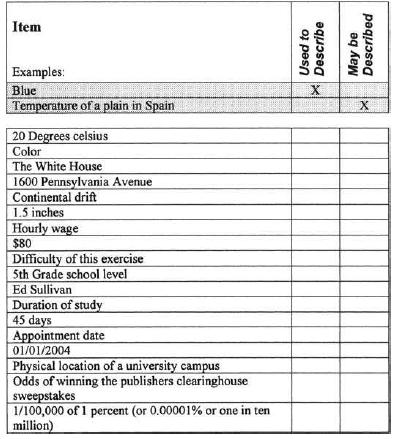
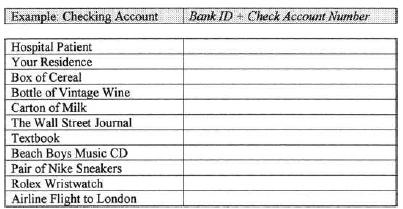
Mini-Project #2 1. Check the appropriate column that best identifies the use of each named item as to whether it describes an element or whether it is an element.2. For the following list of named entity types, provide a natural and unique identifier that provides significant information. Where no
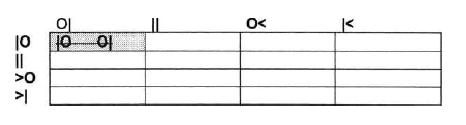
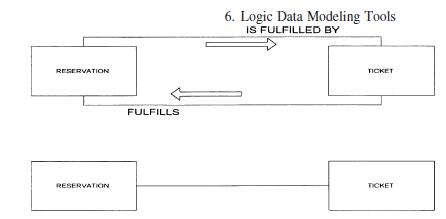
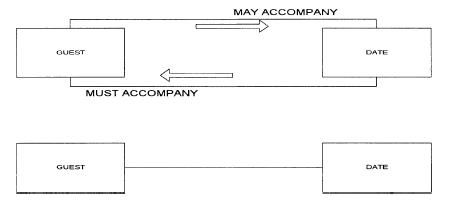
Mini-Project #3 Crow’s-Foot Exercise 1. (a) What is the total number of possible pairings of crow’s-foot indicators? _____ How many mirror image pairs exist in these possible combinations(like matching bookends)? _____(b) How many unique pairs exist? _____ And if you didn’t count the reversed
=+1-1. Convert the following quantities from English to SI units:(a) 98 Bru/(hr-ft-F)(d) 1050 Btu/lbm(b) 0.24 Btu/(Ibm-F)(e) 1.0 ton (cooling)(c) 0.04 lbm/(ft-hr)(f) 14.7 Ibf/in.2
=+1-2. Convert the following quantities from SI to English units:(a) 120 kPa(d) 10* (N-s)/m2(b) 100 W/(m-C)(e) 1200 kW(c) 0.8 W/(m2-C)(f) 1000 KJ/kg
=+1-3.A pump develops a total head of 50 ft of water under a given operating condition. What pres-sure is the pump developing in SI units and terminology?
=+1-4.A fan is observed to operate with a pressure difference of 4 in. of water. What is the pressure difference in SI units and terminology?
=+1-5 The electric utility rate for a facility during the months of May through October is 4.5 cents per kilowatt-hour for energy, $11.50 per kilowatt peak demand, and a $68.00 per month meter charge. During the August billing period the facility used 96,000 kw-hrs and set a peak demand of 624 kw
=+1-6.For the business whose monthly electrical energy use is described in Problem 1-5, estimate the average rate of energy use in kw, assuming it uses energy only from 7:00 A.M. to 6:00 P.M ., Monday through Friday in a 31-day month. Assume that the month starts on a Monday to give 22 working days
=+1-7.Determine the interest rate at which the project in Example 1-2 would become feasible. Do higher interest rates make this project more feasible or less feasible? Would a longer life for the equipment make this project more feasible or less feasible? What would a price escalatice in energy do
=+1-8.How much could a company afford to spend on an HVAC system that would bring monthly savings of $1000 over the entire 12-year life of the equipment? The company uses an annual interest rate of 12 percent in making investment projections.
=+1-9.Make the following volume and mass flow rate calculations in SI units. (a) Water flowing at an average velocity of 2 m/s in nominal 21/2-in ., type L copper tubing. (b) Standard air flowing at an average velocity of 4 m/s in a 0.3 m inside diameter duct.
=+1-10.A room with dimensions of 3 × 10 × 20 m is estimated to have outdoor air brought in at an infiltration rate of 1/4 volume change per hour. Determine the infiltration rate in m'/s.
=+1-11.Compute the heat transferred from water as it flows through a heat exchanger at a steady rate of 1 m3/s. The decrease in temperature of the water is 5 C, and the mean bulk temperature is 60 C. Use SI units.
=+1-12.Air enters a heat exchanger at a rate of 5000 cubic feet per minute at a temperature of 50 F and pressure of 14.7 psia. The air is heated by hot water flowing in the same exchanger at a rate of 11,200 pounds per hour with a decrease in temperature of 10 F. At what temperature does the air
=+1-13.Water flowing at a rate of 1.5 kg/s through a heat exchanger heats air from 20 ℃ to 30 C flow-ing at a rate 2.4 m3/s. The water enters at a temperature of 90 C. and the air is at 0.1 MPa. At
=+what temperature does the water leave the exchanger?
=+1-14.Air at a mean temperature of 50 F flows over a thin-wall I-in. O.D. tube, 10 feet in length.which has condensing water vapor flowing inside at a pressure of 14.7 psia. Compute the heat transfer rate if the average heat transfer coefficient between the air and tube surface is 10
=+1-15.Repeat Problem 1-10 for air at 10 C, a tube with diameter 25 mm, a stream pressure of 101 kPa, and a tube length of 4 m, and find the heat transfer coefficient in SI units if the heat trans-fer rate is 1250 W.
=+1-16.Air at 1 atm and 76 F is flowing at the rate of 5000 cfm. At what rate must energy be removed, in Btu/hr, to change the temperature to 58 F. assuming that no dehumidification occurs?
=+1-17.Air flowing at the rate of 1000 cfm and with a temperature of 80 F is mixed with 600 cfm of air at 50 F. Use Eq. 1-2 to estimate the final temperature of the mixed air. Assumec. = 0.24 Btu/(Ibm-F) for both streams.
=+1-18.A chiller is providing 5 tons of cooling to an air handler by cooling water transfer between the two devices. The chiller is drawing 3.5 kw of electrical power during this operation. At what rate must the chiller dump energy to the environment (say to a cooling tower) in Btu/hr to sat-isfy
=+1-19. Air is delivered to a room at 58 F and the same amount of air is removed from the room at 76 F in order to provide sensible cooling. The room requires 0.5 tons of cooling to remain at a steady 76 F. What must the airflow rate be in cfm? Assume an air density of 13.5 cubic feet per pound
=+1-20.A chiller is to provide 12 tons of cooling to a chilled water stream. What must the flow rate through the chiller be, in gpm, if the temperature of the supply water from the chiller is 46 F and the temperature of the water returning to the chiller is 60 F?
=+1-21.Air is being furnished to a 30-ft by 40-ft by 12-ft room at the rate of 600 efm and mixes thor-oughly with the existing air in the room before it is continuously removed at the same rate.
=+How many times does the air change completely each hour (air changes per hour)?
=+1-22. If cold outside air at 20 F is leaking into a 20-ft by 30-ft by 10-ft room where the heating sys-tem is trying to maintain a comfortable temperature of 72 F, then the same amount of air might be assumed to be leaking out of the room. If one were to estimate that this rate of leakage
=+1-23.A Btu-meter is a device that measures water flow rate and the temperature difference between the water entering and leaving the property of an energy customer. Over time the device meas-ures and reads out the amount of energy used. Water enters the property at 140 F and leaves at 120 F and
=+1-24.A heat pump uses a 100,000-gallon swimming pool as a heat sink in the summer. When the heat pump is running at full capacity it is dumping 6 tons of energy into the pool. Assuming no heat loss by conduction or evaporation from the pool, what would be the temperature rise of the pool per day
=+1-25.A heat pump uses a 100,000-gallon swimming pool as a heat source in the winter. When the heat pump is running at full capacity it is drawing 3.5 tons of energy from the pool. Assuming no heat gain to the pool from sunlight or ground conduction, how long would it take the heat pump, running
=+2-1. Consider the small single-story office building in Fig. 2-21. Lay out an all-air central system using an air handler with two zones. There is space between the ceiling and roof for ducts. The air handler is equipped with a direct expansion cooling coil and a hot water heating coil. Show all
=+2-2.Suppose the building in Problem 2-1 is to use a combination air-water system where fan-coil units in each room are used for heating. Schematically lay out this part of the system with related equipment. Discuss the general method of control for (a) the supplied air and (b) the fan-coil units.
=+2-3.Lay out a year-round all-water system for the building of Problem 2-1, Show all equipment schematically. Discuss the control and operation of the system in the summer, in the winter, and between seasons.
=+2-4. Apply single-package year-round rooftop type unit(s) to the single-story building in Fig. 2-21.
=+2.5.Suppose a VAV all-air system is to be used to condition the space shown in Fig. 2-22. Assume that the space is the ground floor of a multistory office building. Describe the system using a schematic diagram. The lighting and occupant load are variable. Discuss the general operation of the
=+2-6.Devise a central equipment arrangement for the system of Problem 2-5 that will save energy during the winter months, Sketch the system schematically.
=+2-7.Suppose an air-to-water heat pump is used to condition each space of Fig. 2-22, where the water side of each heat pump is connected to a common water circuit. Sketch this system schemati-cally, showing all necessary additional equipment. Discuss the operation of this system during the (a)
=+2-8. A building such as that shown in Fig. 2-22 requires some outdoor air. Explain and show schematically how this may be done with the system of Problem 2-5. Incorporate some sort of heat recovery device in the system. What controls would be necessary?
=+2.9.How can an economizer be used to advantage during (a) winter months, (b) summer months, and (c) intermediate seasons?
=+2-10.The system proposed in Problem 2-7 requires the distribution of outdoor ventilation air to each space, Sketch a central air-handler system for this purpose that has energy recovery equipment and an economizer. Do not sketch the air distribution system. Discuss the control of this sys-tem,
=+2-11.Make a single-line block diagram of an all-water cooling system. The system has unit ventila-tors in each room with a packaged water chiller, and pumps. Explain how the system will be controlled.
=+2-12.Sketch a diagram of an air-water system that uses fan-coils around the perimeter and an over-head air distribution system from a central air handler. Show a hot water boiler, chiller, and water distribution pumps. Explain the operation of the system in the summer and in the win-ter. What
=+2-13.Make a sketch of a variable-volume system with a secondary perimeter heating system for a perimeter zone. Discuss the operation and control of the system for the different seasons of the year.
=+2-14.Diagram a combination air-to-air heat recovery and economizer system. Describe the operation and control of the system for various times of the year.
=+2-15.A large manufacturing facility requires hot and chilled water and electricity in its operation.Describe how internal combustion engines operating on natural gas could provide part or all of these needs, using heat recovery and generating electricity. The objective would be to save energy.
=+2-16 Thermal storage is often used to smooth the demand for cooling in large buildings. Imagine that the chiller can also make ice during the nighttime hours for use later when the peak cool-ing demand is high. Make a sketch of such a central plant, and describe its operation for a typ-ical daily
=+2-17.Make a sketch of a single-zone system for a small building that uses a ground-coupled heat pump. Show all the major parts of the system, including the ground heat exchanger. Discuss operation of the system in summer and winter.
=+2-18.Sketch a variable-air-volume reheat system that has four zones. Discuss the operation of a typ-ical zone.
=+2-19.Sketch a dual-duct VAV system. Show the fans and a typical zone. Describe a way to control the speed of the fans as the terminal devices reduce the air flow to the various zones.
=+2-20 It is desirable for the water leaving a cooling coil to be at a fixed temperature for return to the chiller. Sketch a coil, control valve, and so on to accomplish this action, and describe the oper-ation of the system.
=+3.1. A space is at a temperature of 75 F (24 C), and the relative humidity is 45 percent. Find (a) the partial pressures of the air and water vapor, (b) the vapor density, and (c) the humidity ratio of the mixture. Assume standard sea-level pressure.
=+3-2.Determine the humidity ratio, enthalpy, and specific volume for saturated air at one standard atmosphere using perfect gas relations for temperatures of (a) 80 F (27 C) and (b) 32 F (0 C).
=+3-3.Suppose the air of Problem 3-2 is at a pressure corresponding to an elevation of (a) 5000 ft and(b) 1500 m.
=+3-4.What is the enthalpy of moist air at 70 F (20 C) and 75 percent relative humidity for an eleva-tion of (a) sea level and (b) 5000 ft (1525 m).
=+3-5.The inside surface temperature of a window in a room is 40 F (4 C) where the air has a tem-perature of 72 F (22 C) db, 50 percent relative humidity, and a pressure of 14.696 psia (100 kPa)pressure. Will moisture condense on the window glass?
=+3-6.What is the mass flow rate of dry air flowing at a rate of 5000 ft /min (2.36 m3/s) where the dry bulb temperature is 55 F (13 C), the relative humidity is 80 percent, and the pressure inside the duct corresponds to (a) sea level and (b) 6000 ft (1500 m)?
=+3-7. Determine the dew point of moist air at 80 F (27 C) and 60 percent relative humidity for pres-sures corresponding to (a) sea level and (b) 5000 ft (1225 m).
=+3-8.A room is to be maintained at 72 F (22 C) db. It is estimated that the inside wall surface tem-perature could be as low as 48 F (9 C). What maximum relative and specific humidities can be maintained without condensation on the walls?
=+3-9.Air with a dry bulb temperature of 75 F and a wet bulb temperature of 65 F is at a barometric pressure of 14.2 psia. Using the program PSYCH. find (a) the relative humidity of the air,(b) enthalpy. (c) dew point, (d) humidity ratio, and (e) the mass density of the dry air.
=+3-10.One thousand cfm of air with a temperature of 100 F db and 10 percent relative humidity (RH)at a barometric pressure of 14.7 psia is humidified under adiabatic steady-flow conditions to 40 percent relative humidity with saturated vapor at 14.7 psia. Use the program PSYCH to find:(a) the
=+3-11. Air is cooled from 80 F db and 67 F wb until it is saturated at 55 F. Using Chart la. find (a) the moisture removed per pound of dry air. (b) the heat removed to condense the moisture, (e) the sensible heat removed, and (d) the total amount of heat removed.
=+3-12.Conditions in a room are measured to be 80 F db and 65 F wh, respectively. Compute the humidity ratio and relative humidity for the air at (a) sea level and (b) 5000 ft.
=+3-13.Complete Table 3-3 using the program PSYCH for (a) sea level, (b) 5000 ft elevation; (c) com-pare parts (a) and (b).
=+3-14.The environmental conditions in a room are to be regulated so that the dry bulb temperature will be greater than or equal to 72 F (22 C) and the dew point will be less than or equal to 52 F(11 C). What maximum relative humidity can occur for standard barometric pressure?
=+3-15.Air enters a cooling coil at the rate of 5000 cfm (2.4 m3/s) at 80 F (27 C) db. 68 F (20 ℃) wb and sea-level pressure. The air leaves the coil at 55 F (13 C) db. 54 F (12 C) wb. (a) Determine the SHF and the apparatus dew point. (b) Compute the total and sensible heat transfer rates from
=+3-16.Air flowing in a duct has dry and wet bulb temperatures of 78 F (24 C) and 65 F (18 C), respec-tively. Use psychrometric Charts la and 1b to find the enthalpy, specific volume, humidity ratio, and relative humidity in (a) English units and (b) SI units.
=+3-17.The air in Problem 3-16 is cooled to a temperature of 54 F db and 52 F wb. Use the program PSYCH to compute the heat transfer rate if 4000 ft /min is flowing at state 1.
=+3-18.The air in Problem 3-16 is heated to 120 F. Use the program PSYCH to compute the heat trans-fer rate if 4000 ft /min is flowing at state 1.
=+3-19.Using the program PSYCH, investigate the effect of elevation on the relative humidity, enthalpy, specific humidity, and density, assuming constant values of 85 F db and 68 F wb tem-peratures at sea level and 6000 ft elevation. If 5000 efm of air is flowing in a duct, how does the mass flow
=+3-20 Determine the heat transfer rate for a process where 5000 cfm of air is cooled from 85 F db and 70 F wb to 60 F db and 57 F wb using the program PSYCH. (a) For 1000 ft elevation and(b) for 6000 ft elevation. (c) Compute the percent difference relative to the heat transfer rate at 1000 ft
=+3-21.Air at 100 F (38 C) db, 65 F (18 C) wb, and sea-level pressure is humidified adiabatically with steam. The steam supplied contains 20 percent moisture (quality of 0.80) at 14.7 psia(101.3 kPa). The air is humidified to 60 percent relative humidity. Find the dry bulb tempera-ture of the
=+3-22.Air is humidified with the dry bulb temperature remaining constant. Wet steam is supplied for humidification at 20 psia (138 kPa). If the air is at 80 F (32 C) db, 60 F (16 C) wb, und set-level pressure, what quality must the steam have (a) to provide saturated air and (b) to provide air at
=+3-23.Air at 38 C db and 20 C wh is humidified adiabatically with liquid water supplied at 60 C in such proportions that a relative humidity of 80 percent results, Find the final dry bulb temperature,
=+3-24. Two thousand cfm (1.0 m3/s) of air at an initial state of 60 F (16 C) db and relative humidity of 30 percent is to be heated and humidified to a final state of 110 F (43 C) db and 30 percent relative humidity. Assume sea-level pressure throughout. The air will first be heated followed by
=+3-25.Air at 40 F (5 C) db and 35 F (2 C) wb is mixed with warm air at 100 F (38 ℃) db and 77 F(25 C) wb in the ratio of 2000 cfm cool air to 1000 cfm warm air. Find the resulting humidity ratio and enthalpy using psychrometric Chart la on the basis of volume flow rates.
=+3-26. Rework Problem 3-25, using Chart la, with the mixture condition computed on the basis of the mass flow rates rather than volume flow rates. What is the percent error in the mixture enthalpy and humidity ratios?
=+3-27. The design cooling load for a zone in a building is 250,000 Btu/hr (73 kW), of which 200,000 Bru/hr (59 kW) is sensible cooling load. The space is to be maintained at 75 F (24 ℃) dry bulb temperature and 50 percent relative humidity. Locate the space condition line on Charts la and Ib and
=+3-28.Assume that the air in Problem 3-27 is supplied to the space at 53 F (12 C). Compute the vol-ume flow rate of the air required in (a) English units and (b) SI units.
=+3-29 Reconsider Problems 3-27 and 3-28 using the program PSYCH for (a) sea level and (b) 2000 ft elevation, respectively. Assume a supply air temperature of 56 F.
=+3-30.Rework Problem 3-29 using the program PSYCH for 5000 ft elevation.
=+3-31.The sensible heat loss from a space is 500,000 Btu/hr (146 KW) and the latent heat loss due to infiltration is 50,000 Btu/hr (14.6 kW). The space is to be maintained at 72 F (22 C) and 30 percent relative humidity. Construct the condition line on (a) Charts la and 1b. (b) If air is sup-plied
=+3.32 Air enters a refrigeration coil at 90 F db and 75 F wb at a rate of 1400 cfm. The apparatus dew point temperature of the coil is 55 F. If 5 tons of refrigeration are produced, what is the dry bulb temperature of the air leaving the coil. Assume sea-level pressure.
=+3-33, Air at 80 F db and 50 percent relative humidity is recirculated from a room and mixed with outdoor air at 97 F db and 83 F wb at a pressure corresponding to 2000 ft elevation. Use the program PSYCH to determine the mixture dry bulb and wet bulb temperatures if the volume of recirculated air
=+3-34.A building has a calculated cooling load of 20 tons, of which 5 tons is latent load. The space is to be maintained at 72 F db and 50 percent relative humidity. Ten percent by volume of the air supplied to the space is outdoor air at 100 F db and 50 percent relative humidity. The air supplied
=+(b) the amounts of return air and outdoor air in cfm, (c) the conditions and volume flow rate of the air entering the cooling coil, and (d) the capacity and SHE for the cooling coil. (HINT:Estimate the amount of outdoor air and supply relative humidity and iterate.)
Showing 6100 - 6200
of 7343
First
55
56
57
58
59
60
61
62
63
64
65
66
67
68
69
Last
Step by Step Answers

 Get 50% OFF
Claim Now
Get 50% OFF
Claim Now